Boeing Wins Landmark Deals, Highlights Broad Portfolio at Dubai Airshow
DUBAI, United Arab Emirates, Nov. 15, 2017 – Boeing [NYSE:BA] won large commitments across its twin- and single-aisle commercial airplane families, debuted key capabilities including the CST-100 Starliner docking and KC-46 refueling simulators, and announced services agreements at the 2017 Dubai Airshow.
“This has been a very successful show for Boeing. Our regional customers have maintained their trust in our products and technology, and our partnerships in the Middle East region continue to grow,” said Bernard Dunn, President, Boeing Middle East, North Africa and Turkey. “We signed agreements with key airline partners including Emirates, flydubai, Azerbaijan Airlines, ALAFCO and Ethiopian Airlines. In addition, Egyptair became a new customer for the 787. Finally, the airshow was a great opportunity to introduce our newest business unit, Boeing Global Services, to the Middle East market and reiterate the region’s importance to Boeing.”
The continued growth of the Middle East aviation market was underscored by customers in the region announcing orders and commitments for 296 airplanes – including 50 options – with a value of about $50 billion at list prices.
Boeing also celebrated the opening of Emirates Flight Training Academy (EFTA), where Boeing was selected to provide a customized, integrated software system for managing cadet learning and training using software.
Boeing Defense, Space & Security also saw great interest in the CST-100 Starliner docking simulator spacecraft which debut in Dubai for the first time, highlighting the region’s high interest for space travel and exploration. Other defense products on display included the MV-22 Osprey tiltrotor, AH-64 Apache and the CH-47 Chinook helicopters, as well as the F-15 multi-role fighter.
Boeing Global Services successfully wrapped up their inaugural airshow with four service agreements:
Custom services from the Boeing Global Fleet Care portfolio to Oman Air
A five-year strategic agreement to provide Royal Jordanian with a comprehensive training solution, including pilot type-rating and recurrent training at its London Gatwick training campus
Support to Cathay Pacific Airways’ 747-8 freighter fleet through the Boeing Landing Gear Overhaul and Exchange Program.
Parts sales and distribution agreement with Rolls-Royce – through Boeing subsidiary Aviall – in support of their global fleet of AE defense engines.
For more information about Boeing at the Dubai Airshow 2017, please visit: http://www.boeing.com/specialty/dubai-airshow-2017/index.page.
Boeing Forecasts $730 Billion Market for New Airplanes in Middle East
DUBAI, United Arab Emirates, Nov. 13, 2017 — Boeing [NYSE: BA] forecasts that airlines in the Middle East will need 3,350 new airplanes over the next 20 years, valued at an estimated $730 billion. Boeing presented its 2017 Current Market Outlook (CMO) for the region during the Dubai Airshow.
“Traffic growth in the Middle East is expected to grow at 5.6 percent annually during the next 20 years,” said Randy Tinseth, vice president of Marketing, Boeing Commercial Airplanes. “The fact that 85 percent of the world’s population lives within an eight-hour flight of the Arabian Gulf, coupled with robust business models and investment in infrastructure, allows carriers in the Middle East to channel traffic through their hubs and offer one-stop service between many cities.”
Twin-aisle airplanes are expected to make up nearly 50 percent of the new airplanes in the Middle East, and more than 70 percent of the value at $520 billion. Both percentages are significantly higher than the global average. The strong long-term demand for widebody airplanes was reinforced at the show as Emirates Airline announced a commitment to purchase 40 Boeing 787-10 Dreamliners in a deal valued at $15.1 billion at current list prices.
More than half of the total deliveries in the Middle East will be single-aisle airplanes such as the 737 MAX. Operators in the region will need 1,770 single-aisle airplanes valued at $190 billion, driven by the growth of low-cost carriers.
Boeing’s presence and support for the Middle East also includes Global Services, the company’s third and newest business unit that is expanding its service capability offerings to better support the region’s airlines and aircraft.
Global Services is focused on bringing innovative solutions to market quickly within four capability focus areas: supply chain, engineering, modifications and maintenance, digital aviation and analytics, and training and professional services. Boeing’s services expertise, global reach, and strong customer in-country partnerships, position the company to compete and win.
“From training the next generation of pilots to creating tailored solutions and everything in between, the combined commercial and defense services market is estimated at $2.6 trillion over the next 10 years and includes strong opportunities in the Middle East,” said Tinseth.
Around the world, Boeing has forecasted long-term demand for 41,030 new airplanes, valued at $6.1 trillion. These new airplanes will replace older, less efficient airplanes, benefiting airlines and passengers and stimulating growth in emerging markets and innovation in airline business models.
For more information on Boeing’s Current Market Outlook please visit:
http://www.boeing.com/cmo
Boeing, Ethiopian Airlines Celebrate Delivery of First 787-9 Dreamliner
ADDIS ABABA, Ethiopia, — Boeing [NYSE: BA] and Ethiopian Airlines celebrated the delivery of the carrier’s first Boeing 787-9. Ethiopian is leasing the Dreamliner through an agreement with AerCap.
Ethiopian’s newest 787 touched down in Addis Ababa following a non-stop 8,354 mile (13,444 km) delivery flight from Boeing’s Everett, Wash., facility. Ethiopian becomes the first carrier in Africa to operate the 787-9 and extends a tradition of setting aviation milestones. Ethiopian became Africa’s first carrier to fly the 787-8 in 2012, and similarly introduced the 777-200LR (Longer Range), 777-300ER (Extended Range) and 777 Freighter.
“We are proud to celebrate yet another first with the introduction of the cutting-edge 787-9 into our young and fast growing fleet,” said Mr. Tewolde GebreMariam, Group CEO of Ethiopian Airlines. “Today, the 787 is the core of our fleet with 20 aircraft in service. Our investment in the latest technology airplanes is part of our Vision 2025 strategy and our commitment to our esteemed customers to offer complete on-board comfort. We will continue to invest in the most advanced aircraft to give our customers the best possible travel experience.”
The 787 Dreamliner is the most innovative and efficient airplane family flying today. Since 2011, more than 600 Dreamliners have entered commercial services, flying almost 200 million people on more than 560 unique routes around the world, saving an estimated 19 billion pounds of fuel.
“AerCap is very proud to deliver to Ethiopian Airlines their first 787-9 aircraft, as the airline continues to lead the way in African aviation,” said AerCap President and Chief Commercial Officer Philip Scruggs. “The 787-9 will complement Ethiopian’s existing fleet of 787-8 aircraft, bringing further operational efficiencies and scope to enhance their existing network. We thank our friends and partners at Ethiopian Airlines for their continued confidence in AerCap and wish them every success as they continue to optimize their fleet.”
“We are pleased to see the 787-9 enter into Ethiopian’s growing Boeing fleet,” said Marty Bentrott, senior vice president sales for Middle East, Turkey, Africa, Russia & Central Asia Boeing Commercial Airplanes. “The 787-9 will further enhance the Ethiopian network with its incredible range and capacity.”
Ethiopian Airlines conducted its 32nd Humanitarian Delivery Flight as part of the 787-9 delivery. In conjunction with the non-profit Seattle Alliance Outreach, Ethiopian transported goods donated by medical organizations in the U.S. to Black Lion Hospital and St. Paul Hospital in Ethiopia.
“We are very happy to continue our longstanding partnership with Boeing to deliver medical equipment and supplies to public hospitals in Ethiopia, which benefit the society at-large,” said GebreMariam. “This is our 32nd humanitarian flight over the course of the last few years. No airline has provided such sustained support to the delivery of humanitarian supplies to the African continent. It is a testament to our commitment to serve the community as a responsible corporate organization.”
Ethiopian Airlines operates a Boeing fleet of 737, 767, 777, and 787 airplanes in passenger service and six 777 and two 757-200 airplanes in cargo operations.
EasyJet Signs Agreement To Acquire Air Berlin
EasyJet today signed an agreement with Air Berlin to acquire part of its operations at Berlin Tegel Airport for a purchase consideration of €40 million. This excludes potential start-up and transitional operating costs. The acquisition is subject to regulatory approvals and is expected to close in December 2017.
The acquisition will result in easyJet entering into leases for up to 25 A320 aircraft, offering employment to Air Berlin flying crews and taking over other assets including slots. easyJet has launched a recruitment campaign to attract around 1000 of Air Berlin’s pilots and cabin crew who will be recruited over the coming months and will then be trained on easyJet’s safety and operating procedures. In line with easyJet’s business model they will be employed on local, German contracts under collective labour agreements negotiated with ver.di.
This agreement is consistent with easyJet’s strategy of purposeful investment in strong number one positions in Europe’s leading airports (or number two to a legacy incumbent). This will enable easyJet to operate the leading short haul network at Tegel connecting passengers to and from destinations across Germany and the rest of Europe. This is in addition to easyJet’s existing base at Berlin Schönefeld and would mean that easyJet would be the leading airline in Berlin.
EasyJet will make announcements on the new routes and services to be flown to and from Tegel in due course. easyJet will operate a reduced timetable at Tegel during the winter season but plans to operate a full schedule from the summer season 2018.
EasyJet looks forward to building on the strong, customer focussed platform it already has in Berlin to fly more passengers, employ more people and support more economic growth in both Berlin and Brandenburg.
Boeing, Singapore Airlines Announce Order for 39 Airplanes
WASHINGTON, — Boeing [NYSE: BA] and Singapore Airlines (SIA) today formally announced a deal for 20 777-9s and 19 787-10s, during a ceremony at the White House.
The order, previously attributed to an unidentified customer, is worth $13.8 billion at current list prices. The value of this sales transaction will sustain thousands of U.S. suppliers and more than 70,000 direct and indirect U.S. jobs during the delivery period of this contract. The airline also has options for 12 additional aircraft, six of each aircraft type.
The signing ceremony, witnessed by US President Donald Trump and Prime Minister of Singapore Lee Hsien Loong, included Singapore Airlines’ CEO Goh Choon Phong and Boeing Commercial Airplanes’ President & CEO Kevin McAllister. Peter Seah, Singapore Airlines’ Chairman, and Dinesh Keskar, senior vice president, Asia Pacific & India Sales, Boeing Commercial Airplanes and other members of the airline and Boeing also were in attendance.
“SIA has been a Boeing customer for many decades and we are pleased to have finalised this major order for widebody aircraft, which will enable us to continue operating a modern and fuel-efficient fleet,” said Goh. “These new aircraft will also provide the SIA Group with new growth opportunities, allowing us to expand our network and offer even more travel options for our customers.”
Singapore Airlines has more than 50 777s in service and is the launch customer of the 787-10, which is set to deliver in the first half of 2018. With a prior order for 30 787-10s, the airline now has 49 on order, making it the largest customer for this type. A long-range airplane that’s efficient at any stage length, the 787-10 will serve the airline’s medium-range operations while partnering with the 777-9 for the carrier’s long-haul routes. Its subsidiaries SilkAir, Scoot and SIA Cargo also operate Boeing airplanes with the 737 MAX 8 and 737-800, 787-8 and 787-9 Dreamliners and 747-400 Freighter types in service, respectively.
“Boeing and Singapore Airlines have been strong partners since the airline’s first operations 70 years ago and we are thrilled to finalise their purchase of 20 777Xs and 19 additional 787-10 Dreamliners,” said McAllister. “Singapore Airlines’ order is a testament to the market-leading capabilities of Boeing’s widebody airplanes and we look forward to delivering the very first 787-10 to them next year.”
With more than 1,280 orders from 70 customers worldwide, the 787 Dreamliner family offers three modern and efficient airplanes that are optimized for markets ranging from 200 seats to over 350 seats. To date, more than 600 787s have entered commercial service. They have flown nearly 200 million people on more than 560 unique routes – including 156 new nonstop routes – while saving an estimated 19 billion pounds of fuel.
The 787-10, the largest family member, adds seats and cargo capacity while offering 25 percent better fuel efficiency per seat and lower emissions than the airplanes it will replace. The combination of capability, reliability and efficiency has attracted carriers from around the world, including Asia where the 787-10 will be able to connect all points within Asia at lower seat costs than any other twin-aisle airplane, with the flexibility to also link to Europe, Africa and Oceania.
The 777X, builds on the passenger-preferred and market-leading 777, and will be the largest and most-efficient twin-engine jet in the world, with the latest innovative technologies, including the most advanced, fuel-efficient commercial engine ever. Opening new growth opportunities for airlines, the 777-9 will have the lowest operating cost per seat of any commercial airplane. The 777-9 seats 400-425 passengers with a range of 7,600 nautical miles (14,075 km) and is the only twin-engine available of its size.
New Commercial Hot-Air Balloon Safety Program
October 13–After a July 2016 balloon accident in Lockhart, TX that caused 16 fatalities, the Federal Aviation Administration (FAA) took proactive steps to increase the safety of hot-air balloon tourism.
As the result of a year-long FAA “Call to Action” with the commercial hot-air balloon industry, the Balloon Federation of America (BFA) has developed an “Envelope of Safety” accreditation program for balloon ride operations.
Consumers can use the program to select a ride company or pilot that strives to reach a higher safety standard – a move the agency applauds.
To meet the BFA’s program requirements, company pilots of balloons that are capable of carrying more than 4-6 passengers must be commercially certificated for 18 months, have a specified amount of flight experience, and hold an FAA second-class medical certificate. Pilots also must pass a drug and alcohol background check, have attended a BFA-sanctioned safety seminar within the last 12 months, and be enrolled in the FAA WINGS program. The BFA will verify this information annually, and will check the safety background of pilot applicants by researching FAA accident and incident data.
A second part of the program provides balloon ride operators with a choice of three levels of safety accreditation: Silver, Gold, or Platinum. While any size company can achieve the highest level, the tiered structure is designed with different size companies in mind. Each level has increasingly stringent safety requirements including:
Meeting the pilot requirements
Holding valid aircraft and commercial vehicle insurance
Not exceeding a minimum specified number of accidents or incidents within a recent time period
Verifying annual aircraft inspections
Hosting a forum for passengers to rate the company
Notifying local FAA offices of the location of their base of operations
Executing and storing passenger liability waivers
Conducting random pilot drug screening
Developing written policies for crew safety.
The FAA believes the BFA program will enhance safety and professionalism, and will allow consumers to be better informed before they choose a commercial balloon ride operator.
AerData STREAM and Transition Services Chosen by Monarch for Transition of Leased Aircraft
AMSTERDAM, – Boeing [NYSE: BA], through its subsidiary AerData, today announced that Monarch has chosen AerData Secure Technical Records for Electronic Asset Management (STREAM) and transition services for its fleet of 36 Airbus A320s in readiness for lease transition.
“We are pleased to have signed up to STREAM,” said Nils Christy, Monarch Chief Operating Officer. “As we look ahead to our first Boeing 737 MAX 8 arriving next year it is very important to have a seamless transition. This service will be a great asset in the countdown to delivery and the move to the new Boeing fleet.”
STREAM allows for smooth and efficient transition of aircraft and easy remarketing by airlines, lessors and MROs. A secure and web-enabled system, STREAM allows for the management of records relating to the entire history of aircraft and associated assets, and it is proven to save cost over the life of an aircraft and during redelivery.
“AerData is thrilled to expand our partnership with Monarch, supporting their end-of-lease program through STREAM and the expertise of our technical services team,” said Matt Bull, AerData Chief Executive Officer. “The combination of the professional Monarch team, innovative AerData software and our talented services team will ensure smooth and efficient fleet transition.”
About AerData
AerData, a Boeing Company, provides lease management, records management, engine fleet planning and audit and inspection software as well as technical and back office services for aircraft and engine operators, lessors and MROs. AerData is part of the Digital Aviation and Analytics business unit within Boeing Global Services.
Boeing, Japan Investment Adviser Finalize Order For 10 737 MAX 8 Airplanes
SEATTLE, — Boeing [NYSE: BA] and Tokyo-based Japan Investment Adviser Co., Ltd., (JIA) [TSE: 7172] today finalized an order for Boeing 737 MAX 8 airplanes, valued at $1.12 billion at current list prices.
The order was previously announced as a commitment at the 2017 Paris Air Show in June.
The new 737 MAX 8s are the first directly purchased airplanes for JIA and will help bolster the lessor’s growing fleet of next-generation aircraft.
“We are excited to introduce the new 737 MAX 8 airplane into our single-aisle fleet and we are confident that this airplane will diversify our operating lease portfolio in the years ahead,” said Naoto Shiraiwa, president and CEO of JIA. “The 737 MAX will provide us with a stronger competitive advantage in providing our future airline clients with reliable airplanes that make sense economically.”
JIA is an innovative Financial Solutions Provider and is listed on the Tokyo Stock Exchange. Its activities include operating a lease business that manages a fleet of around 60 aircraft worldwide through its operating lease arm, JP Lease Products & Services (JLPS). The current managed fleet includes Next Generation Boeing 737s as well as Boeing 777s.
“We are truly honored to play an important role in the growth of JIA as a key player in the commercial leasing business within Asia,” said Rick Anderson, vice president of Northeast Asia Sales, Boeing Commercial Airplanes. “JIA has made the perfect selection for their new fleet strategy, as the 737 MAX provides operators with market-leading economics and reliability. We are proud to share this milestone with JIA as we continue to strengthen our partnership going forward.”
The 737 MAX family has been designed to offer customers exceptional performance, flexibility and efficiency, with lower per-seat costs and an extended range that will open up new destinations in the single-aisle market.
The 737 MAX incorporates the latest technology CFM International LEAP-1B engines, Advanced Technology winglets, Boeing Sky Interior, large flight deck displays, and other improvements to deliver the highest efficiency, reliability and passenger comfort in the single-aisle market.
About JIA
Japan Investment Adviser Co., Ltd. (JIA) is an emerging financial services provider with a diverse business scope that ranges from operating leases to renewable energy and investment banking services, such as IPO and M&A advisory. JIA’s mainstay is the origination and management of investment funds focused on operating leases and renewable energy through its wholly owned subsidiary, JP Lease Products & Services Co., Ltd. JIA is listed on the Mothers section of the Tokyo Stock Exchange.
United Airlines to Offer More Options for Seattle-Area Customers with Daily Service Between Paine Field and its Denver and San Francisco Hubs
EVERETT, Wash., — Nearly 80 years after operating the first commercial flight from Paine Field, United Airlines (UAL) today announced it is returning to the airport and will offer customers six daily flights to its hubs in Denver and San Francisco beginning in the fall of 2018.
“Bringing new service to Paine Field offers customers more ways to conveniently connect to the country’s largest business and leisure destinations,” said Dave Hilfman, United’s senior vice president of Worldwide Sales. “We know our customers value time and convenience when traveling, and North Seattle and Northwest Washington area travelers will now have easy access to our hubs in Denver and San Francisco and to opportunities to connect to business centers around the world with just one stop.”
Originally constructed by the Works Progress Administration (WPA) in 1936 to create jobs and economic growth in the region, the Snohomish County Airport quickly grew and served as an alternate-day landing field and in 1939 United Airlines operated the first commercial flight from the airport. Paine Field has since become the center of Boeing’s production facilities producing many United aircraft including the 747, 767, 777, and the 787 airplanes and employing tens of thousands of employees.
“We look forward to welcoming United Airlines to Snohomish County and Paine Field Airport,” said Snohomish County Executive Dave Somers. “We are excited by the opportunities that daily connections to United’s hubs with international service will bring to our community.”
Located just 23 miles north of Seattle, Paine Field is the newest option for the fast growing number of business and leisure travelers from the Northern Seattle, Snohomish and Northern King County areas.
United currently operates 36 flights between Seattle-Tacoma International Airport and its U.S. hubs. North Seattle and Northwest Washington are among the fastest growing areas in the nation and Paine Field will provide an essential and convenient choice for air travel moving forward.
“United and Paine will give Northwest Washington travelers much needed options,” said Brett Smith, CEO of Propeller Airports. “Offering service at Paine Field continues United’s decades-long economic partnership with Snohomish County, deepening their commitment to creating jobs locally and generating revenue for our communities.”
United in Denver
With more than 58 million passengers traveling through the airport each year, Denver International Airport is the 18th-busiest airport in the world and the sixth-busiest airport in the United States. The airport is the primary economic engine for the state of Colorado, generating more than $26 billion for the region annually.
United in San Francisco
United flies nonstop to more destinations in Asia than any other U.S. carrier from San Francisco International Airport, United’s gateway to the Asia Pacific. The airline provides U.S. travelers with convenient access to some of the most dynamic cities throughout Asia and gives travelers access via San Francisco for onward convenient connections to destinations throughout the United States, Canada and Latin America.
About United
United Airlines and United Express operate approximately 4,500 flights a day to 338 airports across five continents. In 2016, United and United Express operated more than 1.6 million flights carrying more than 143 million customers. United is proud to have the world’s most comprehensive route network, including U.S. mainland hubs in Chicago, Denver, Houston, Los Angeles, Newark/New York, San Francisco and Washington, D.C. United operates 748 mainline aircraft and the airline’s United Express carriers operate 475 regional aircraft. The airline is a founding member of Star Alliance, which provides service to more than 190 countries via 28 member airlines. For more information, visit united.com, follow @United on Twitter or connect on Facebook. The common stock of United’s parent, United Continental Holdings, Inc., is traded on the NYSE under the symbol “UAL”.
Boeing Delivers First 737 MAX 8 to flydubai
SEATTLE, July 31, 2017 — Boeing [NYSE:BA] and flydubai today celebrated the delivery of the airline’s first 737 MAX 8, making the Middle East carrier the first in the region to operate Boeing’s newest single-aisle airplane.
Today’s delivery is the first of 76 737 MAX airplanes the airline will be adding to their all-Boeing fleet of Next-Generation 737s.
“We are delighted to receive our first Boeing 737 MAX 8 aircraft from our order made at the Dubai Airshow in 2013,” said Ghaith Al Ghaith, Chief Executive Officer, flydubai. “This marked the largest single-aisle Boeing aircraft order placed in the Middle East. With this new chapter, we are looking forward to continuing our work with Boeing as we benefit from increased efficiency and are able to offer an enhanced customer experience.”
flydubai currently operates a fleet of 58 Next-Generation 737-800s and has built a network of more than 95 destinations in 44 countries, from Russia in the north, Czech Republic in the west, Thailand in the east and Tanzania in the south.
“flydubai’s growth in just nine years has been remarkable and Boeing is honored to have been part of this journey,” said Boeing Commercial Airplanes President and CEO Kevin McAllister. “This delivery marks another significant milestone in our partnership. We are confident that the market-leading efficiency and reliability of the 737 MAX will play a key role in flydubai’s continued success and complement its current Boeing fleet.”
The 737 MAX family has been designed to offer customers exceptional performance, flexibility and efficiency, with lower per-seat costs and an extended range that will open up new destinations in the single-aisle market.
“As the first MAX customer in the region, we look forward to the further fuel and operating efficiencies that this aircraft will bring to our young modern fleet,” said Ken Gile, Chief Operating Officer, flydubai. “Our flight crew share our excitement in operating one of the most highly anticipated commercial aircraft to enter service on our network.”
The 737 MAX incorporates the latest technology CFM International LEAP-1B engines, Advanced Technology winglets, Boeing Sky Interior, large flight deck displays, and other improvements to deliver the highest efficiency, reliability and passenger comfort in the single-aisle market.
The 737 MAX is the fastest-selling airplane in Boeing history, accumulating more than 3,800 orders to date from 89 customers worldwide.
Mile High City Receives Royal Treatment for United’s 80th Birthday in Denver: Nonstop Service Between Denver and London
DENVER, — In celebration of United’s 80 years of service in Denver, the airline today announced the launch of daily nonstop seasonal service between Denver International Airport (DEN) and London’s Heathrow Airport (LHR) beginning March 24, 2018 through October 26, 2018, subject to government approval. The new Denver flight will conveniently connect customers from nearly 80 domestic destinations to London.
“For the last 80 years, United has played an integral role in serving the Denver region and helping Denver International become an essential hub connecting business and leisure travelers to destinations around the globe,” said Steve Jaquith, vice president of its Denver hub. “Our new service to London will provide more customers with convenient one-stop opportunities from markets that are served only through Denver, and we’re excited to bring this new service to the Mile High City.”
Jaquith was previously the managing director of the company’s Denver hub, and was recently promoted to vice president.
United Airlines has served the Denver community since 1937 and is the only airline to continuously operate in the Mile High City – operating 6.5 million flights serving more than 580 million customers during this time.
“We are so appreciative of our partnership with United Airlines and beyond excited that they continue to grow in Denver with this new service to London Heathrow beginning next March,” said DEN CEO Kim Day. “These new flights will complement United’s successful nonstop service to Tokyo Narita, making United the only carrier to provide both transatlantic and transpacific flights from Denver.”
Onboard products and services
Throughout the summer season, United’s flight between Denver and London will be operated with Boeing 787-8 Dreamliner aircraft with a total of 219 seats – 36 flat-bed seats in United Polaris business class, 70 Economy Plus seats and 113 seats in United Economy.
United Polaris business class features a reimagined, sleep-enhancing experience for intercontinental travelers, including elevated inflight food and beverages, tranquil custom bedding from Saks Fifth Avenue and exclusive amenity kits with products from Soho House & Co’s Cowshed Spa.
United Economy Plus offers additional legroom and increased personal space. Located near the front of the economy cabin, the seats give the added benefit of allowing a swifter exit from the plane on arrival.
United Economy offers complimentary food, soft drinks, juices, beer and wine, tea, coffee and inflight entertainment. Additionally, the seats feature an adjustable headrest and a personal on-demand entertainment system.
United in Denver
With more than 58 million passengers traveling through the airport each year, Denver International Airport is the 18th-busiest airport in the world and the sixth-busiest airport in the United States. The airport is the primary economic engine for the state of Colorado, generating more than $26 billion for the region annually.
About United
United Airlines and United Express operate approximately 4,500 flights a day to 338 airports across five continents. In 2016, United and United Express operated more than 1.6 million flights carrying more than 143 million customers. United is proud to have the world’s most comprehensive route network, including U.S. mainland hubs in Chicago, Denver, Houston, Los Angeles, Newark/New York, San Francisco and Washington, D.C. United operates 748 mainline aircraft and the airline’s United Express carriers operate 475 regional aircraft. The airline is a founding member of Star Alliance, which provides service to more than 190 countries via 28 member airlines. For more information, visit united.com, follow @United on Twitter or connect on Facebook. The common stock of United’s parent, United Continental Holdings, Inc., is traded on the NYSE under the symbol “UAL”.
Boeing Partners with China Airlines to Enhance Maintenance, Engineering, Training Capabilities
Boeing [NYSE: BA] and China Airlines have signed a Memorandum of Understanding (MOU) to explore the development of the airline’s capabilities to serve the growing maintenance, repair and overhaul market in Asia.
Boeing anticipates providing technical support and maintenance training to China Airlines to enhance its ability to service Boeing products.
In addition, Boeing intends to work closely with China Airlines to qualify it as an approved Boeing supplier, which will enable the airline to bid for work on Boeing’s wide-ranging products and services.
“We are pleased to further extend our partnership with The Boeing Company,” said Ho Nuan-Hsuan, Chairman, China Airlines. “This MOU with Boeing provides a platform that will allow us to enhance the world-class capabilities of China Airlines Group. We look forward to contributing to the steady growth of commercial aviation in Taiwan, as well as the rest of Asia.”
With a growing number of airlines in the Asia-Pacific region selecting Boeing airplanes, China Airlines will have the opportunity to become a qualified Boeing Global Fleet Care service provider in Asia. In addition, Boeing aims to aid China Airlines’ qualification as a potential Boeing Converted Freighter (BCF) conversion site, as well as explore training opportunities to develop the airline’s capability as an airframe modification supplier for Boeing’s airplanes.
“China Airlines has been a very important partner to Boeing for more than five decades and this mutually beneficial collaboration will further enhance their capabilities in maintenance and engineering,” said Ihssane Mounir, senior vice president, Sales and Marketing, Boeing Commercial Airplanes. “This relationship will allow China Airlines to develop and deliver world-class maintenance service to global airline customers, while also adding value to Boeing’s network of global supplier partners.”
With nearly 40 percent of the future market demand for commercial airplanes coming from the Asia-Pacific region, the collaboration with China Airlines in Boeing’s largest market will provide flexibility for global airline customers, while also contributing to Taiwan’s growing commercial aviation industry.
“We are proud to have the support of customers like China Airlines as we enter into this new chapter of services excellence under Boeing Global Services,” said Mike Fleming, vice president Commercial Services for Boeing Global Services. “By working together, we can provide tailored and cost-effective solutions within the commercial aviation industry.”
Federal Aviation Authority Evaluates Drone Detection Systems at DFW
This week, the Federal Aviation Administration (FAA) and its partners are conducting detection research on unmanned aircraft (UAS) – popularly called drones – at Dallas/Fort Worth International (DFW) Airport.
The DFW evaluation is the latest in a series of detection system evaluations that began in February 2016. Previous evaluations took place at Atlantic City International Airport; John F. Kennedy International Airport; Eglin Air Force Base; Helsinki, Finland Airport; and Denver International Airport.
Drones that enter the airspace around airports can pose serious safety threats. The FAA is coordinating with government and industry partners to evaluate technologies that could be used to detect drones in and around airports. This effort complies with congressional language directing the FAA to evaluate UAS detection systems at airports and other critical infrastructure sites.
At DFW, the Texas A&M University-Corpus Christi UAS test site is performing the flight operations using multiple drones. Gryphon Sensors is the participating industry partner. The company’s drone detection technologies include radar, radio frequency and electro-optical systems.
The FAA’s federal partners in the overall drone detection evaluation effort include the Department of Homeland Security; the Department of Defense; the Federal Bureau of Investigation; the Federal Communications Commission; Customs and Border Protection; the Department of the Interior; the Department of Energy; NASA; the Department of Justice; the Bureau of Prisons; the U.S. Secret Service; the U.S. Capitol Police; and the Department of Transportation. The work is part of the FAA’s Pathfinder Program for UAS detection at airports.
The FAA intends to use the information gathered during this assessment and other previous evaluations to develop minimum performance standards for any UAS detection technology that may be deployed in or around U.S. airports. These standards are expected to facilitate a consistent and safe approach to UAS detection at U.S. airports.
U.S. Transportation Secretary Elaine L. Chao Announces $527.8 Million in Infrastructure Grants to Airports
WASHINGTON – U.S. Department of Transportation Secretary Elaine L. Chao today announced the Federal Aviation Administration will award $527.8 million in airport infrastructure grants to 584 airports across the United States as part of the FAA’s Airport Improvement Program (AIP).
“The Airport Improvement Program helps to maintain our aviation infrastructure and supports safety, capacity, security and environmental improvements,” said Secretary Chao.
The airport grant program funds various types of airport infrastructure projects, including runways, taxiways, and airport signage, lighting, and marking which helps to create thousands of jobs.
“Investing in our airport infrastructure ensures the safe and efficient operation of our air transportation system,” said FAA Administrator Michael P. Huerta. “This funding program helps us maintain, renovate, and build airport infrastructure at airports.”
Airports are entitled to a certain amount of AIP funding each year, based on passenger volume. If their capital project needs exceed their available entitlement funds, then the FAA can supplement their entitlements with discretionary funding. At this time, FAA is providing discretionary funding to 38 airports based on their high-priority project needs.
Those receiving discretionary grants are listed here, while the entitlement grant recipients can be found at the link below:
Ainsworth Regional Airport in Ainsworth, NE, $683,000 – this grant will fund two runway projects. The first project will repair and apply a protective coating to Runway 17/35 at this general aviation airport, to extend its useful life. The second project will repair Runway 13/31. The projects will be completed in phases so that only one runway is closed at a time. The projects will begin when the airport receives grant funds and will take approximately 50 days to complete.
Asheville Regional Airport in Asheville, NC, $18.2 million – this is the seventh phase of a nine-phase project at this small hub airport. A temporary runway will be built while Runway 17/35 is rebuilt and relocated 75 feet to the west to meet FAA design standards. The lighting and navigational aids also will be relocated. The entire project will take 13 months to complete.
Bay Minette Municipal Airport in Bay Minette AL, $1.2 million – the grant will fund the rehabilitation to Runway 8/26 to maintain the structural integrity of the pavement and to minimize debris on the runway.
Boise Air Terminal/Gowen Field in Boise, ID – $350,000 – to install six noise monitoring systems, eight portable noise monitors, computer equipment and reporting software to conform with the Part 150 Noise Compatibility Program.
Bozeman Yellowstone International in Bozeman, MT, $1.9 million – to rehabilitate the primary taxiway, general aviation taxiway, associated connector taxiways, and adjoining hangar taxilanes needed to maintain the structural integrity of the pavement.
Brookings Regional Airport in Brookings, SC, $1.2 million – to rehabilitate a portion of runway 17/35 to maintain the structural integrity of the pavement and to keep debris off the runway.
Chicago O’Hare International in Chicago, IL, $60 million – the first grant for this large hub airport will allow the construction phase of Runway 9C/27C to begin, which includes siting utilities, grading, and pavement work. The runway is expected to be commissioned in 2020. The second grant will reimburse the airport for projects associated with the construction of Runway 10C/28C, including taxiway systems, navigational aids, site utilities, and existing facility relocations. The runway was commissioned in October of 2013.
Chippewa Valley Regional Airport in Eau Claire, WI, $491,511 – this grant will fund the design and construction of taxi lanes M and N to provide access to aircraft hangars.
Columbia Metropolitan Airport in Columbia, SC, $8 million – this grant will fund the second and final construction phase for concrete overlay of 12,000 feet of the existing Taxiway A needed to maintain the structural integrity of the pavement.
Dallas Love Field in Dallas, Texas, $7.9 million – to rehabilitate the existing passenger terminal apron pavement that had reached the end of its useful life.
Dane County Regional-Truax Field in Madison, WI, $4 million – this project is phase one of a three-phase project. The project will build Taxiway M of this small hub airport to connect Runways 14/32 and 18/36. The construction is expected to begin in the summer of 2017 and be completed by the fall of 2019. The runway will be closed for three weeks in September 2017. The work will be accomplished while the Wisconsin National Guard is deployed.
Denver International in Denver, CO, $12.4 million – is a large hub airport that is receiving grant funding to renovate several airfield projects including Runway 8/26, runway lighting for Runway 8/26, a taxiway and the associated lighting, and a vehicle service road on the airport.
Devils Lake Regional in Devils Lake, ND, $2.5 million – to rehabilitate taxiways A1 and A2 and to purchase aircraft rescue and firefighting safety equipment, and rehabilitate Runway 13/31.
Dillingham Airport in Dillingham, AK, $14 million – the funds will be used to rebuild Runway 1/19 at this small hub airport to ensure the structural integrity of the runway pavement. The project is expected to begin in the summer of 2017 and be completed before the winter of 2018. During construction, only half of the 6,400-foot runway will be used and there will be no operations between 8 p.m. and 6:30 a.m. The airport sponsor has developed a plan with the airline servicing the airport to manage operations during the construction.
Fairfield County in Winnsboro, SC, $709,586 – rehabilitate the taxiway and runway lighting for Runway 4/22 that has reached the end of its useful life and requires rehabilitation to enhance safe airfield operations during low visibility conditions.
Flagstaff Pulliam Airport in Flagstaff, AZ, $7.8 million – the funds will be used to restore the structural integrity of 8,800-foot Runway 3/21 at this small hub airport. The project will begin in the fall and will be completed by early 2018. The runway will be closed nightly for 30 days and all day for seven days prior to completion of the project. The airline and the public have been notified of the planned project impacts. The airline has made the necessary preparations in anticipation of the runway construction and related closures.
Fort Lauderdale/Hollywood International Airport in Fort Lauderdale FL, $20 million – will receive a grant to fund a runway extension project completed in 2014 that the FAA agreed to pay for through a Letter of Intent. The airport extended Runway 10L/28R to enhance airfield capacity.
Gary/Chicago International in Gary, IN, $4.9 million – this grant will fund the last payment from a Letter of Intent for the Runway 12/30 extension project at Gary/Chicago International Airport. This phase of the project includes airfield paving, grading, and site utilities.
Gulfport-Biloxi International Airport in Gulfport, MS, $3.4 million – the grant is for noise mitigation measures for 347 residences near the airport. The soundproofing projects include residential sound insulation and easement acquisition to comply with the airport’s approved noise compatibility program.
Haines Airport in Haines, AK, $11.4 million – the funds will be used for three projects at this commercial service airport. The first project will repair 45,000 square yards in the area where the aircraft park on the airfield, known as the apron. The second project will fund a 1,370-foot perimeter fence installation to prevent unauthorized people and vehicles from entering the airfield. The final project will reconstruct Taxiway A. All three projects will begin in the spring of 2017 and be completed by the fall of 2017. During construction, a temporary apron will be available for some aircraft and other aircraft will be temporarily relocated to another airport.
Huntsville International-Carl T. Jones Field in Huntsville, AL, $5.5 million – this grant will fund the construction of a new parallel Taxiway C to enhance safety by reducing mid-field runway crossings by cargo aircraft.
Indianapolis International in Indianapolis, IN, $2.8 million – the grant will fund the renovation of Taxiway C at this medium hub airport including rehabilitation of the overlay work for the shoulders of the existing taxiway.
Key West International in Key West, FL, $4.1 million – the grant will fund soundproof 175 residents near the airport.
Metropolitan Oakland International in Oakland, CA, $7 million – the grant award will rehabilitate Runway 12/30 to maintain the structural integrity of the pavement and to minimize debris on the runway.
Michigan State Block Grants program, in Lansing, MI, $2 million – the grant is for Saginaw County H.W. Browne Airport for a project to rehabilitate a portion of Runway 09/27.
Millard Airport in Omaha, NE, $450,000 – the project will replace the edge lighting system for Taxiway Z at this reliever airport because it has reached the end of its useful life. The new lighting system will enable airfield operations during low-visibility conditions. Portions of the taxiway will be shut down to complete the installation. The project will begin when the airport sponsor receives grant funds and will take approximately 90 days to complete.
Mobile Regional Airport in Mobile, AL, $3.4 million – to reconstruct the runway lighting for Runway 15/33, and to rehabilitate Runway 15/33. In addition, the grant will fund the purchase of an aircraft rescue and firefighting vehicle.
Ocala International-Jim Taylor Field in Ocala, FL, $999,081 – to install a 26,000 wildlife fence around the airport and replacement aircraft rescue and firefighting vehicle.
Ohio State University in Columbus, OH, $730,508 – the grant will be used to update the existing airport master plan study to show current and future needs of the airport.
Palmer Municipal in Palmer, AK, $9.1 million – the grant will remove obstructions, rehabilitate Runway 16/34, expand the apron, improve the runway safety area, and rehabilitate Taxiway B.
Pellston Regional Airport of Emmet in Pellston, MI, $3.7 million – to rehabilitate Runway 14/32. This project will fund the construction phase of rehabilitation of 6,513 feet of Runway 14/32 to maintain the structural integrity of the pavement and to minimize debris on the runway.
Pryor Field Regional Airport in Decatur, AL, $783,644 – to reconstruct the runway edge lighting for Runway 18/36.
Pullman/Moscow Regional Airport in Pullman/Moscow, WA, $16 million – this project is phase four of an eight-phase project to realign Runway 6/24 to meet FAA design standards. This small hub airport project includes additional runway grading, drainage, and the construction of an electrical building. The project is expected to begin in late May and be completed in the fall of 2020.
Reno/Stead Airport in Reno, NV, $2.6 million – to reconstruct a portion of the existing apron pavement to accommodate larger aircraft.
Salt Lake City International in Salt Lake City, UT, $7.3 million – the grant funds will allow the airport to renovate Runway 14/32 and the runway lighting associated with that runway.
Theodore Francis Green State in Providence, RI, $5.1 million – the grant will fund noise soundproofing projects for 336 residences near the airport. The soundproofing projects include sound insulation and mitigation to residences adversely impacted by aircraft noise to comply with the airport’s approved noise compatibility plan.
Weedon Field in Eufaula, Al, $1 million – this project will fund the rehabilitation of a portion of Runway 18/36 to maintain the structural integrity of the pavement and to minimize debris on the runway.
Westfield-Barnes Regional Airport in Westfield-Springfield, MA, $2.4 million – to purchase land and acquire home adversely impacted by aircraft noise. This project will include the relocation of approximately 25 residents.
For a list of airports receiving entitlement grants please click on http://www.faa.gov/airports/aip/grantapportion_data/.
The FAA will issue AIP grants to the airports over the next several weeks in time to take advantage of the spring and summer construction season. The grants will ensure the projects at these airports are either under construction or completed prior to the onset of the winter season, which comes early in late fall in some parts of the country.
Boeing, DARPA to Design, Build, Test New Experimental Spaceplane
ARLINGTON, Va., – Boeing [NYSE: BA] and the U.S. Defense Advanced Research Projects Agency (DARPA) are collaborating to design, build and test a technology demonstration vehicle for the Experimental Spaceplane (XS-1) program.
Boeing will develop an autonomous, reusable spaceplane capable of carrying and deploying a small expendable upper stage to launch small (3,000 pound/1,361 kg) satellites into low Earth orbit. Boeing and DARPA will jointly invest in the development.
Once the spaceplane – called Phantom Express – reaches the edge of space, it would deploy the second stage and return to Earth. It would then land on a runway to be prepared for its next flight by applying operation and maintenance principles similar to modern aircraft.
“Phantom Express is designed to disrupt and transform the satellite launch process as we know it today, creating a new, on-demand space-launch capability that can be achieved more affordably and with less risk,” said Darryl Davis, president, Boeing Phantom Works.
The Aerojet Rocketdyne AR-22 engine, a version of the legacy Space Shuttle main engine, would power the spaceplane. It is designed to be reusable and operates using liquid oxygen and liquid hydrogen fuel.
Phantom Express would offer an advanced airframe design as well as third-generation thermal protection to create a vehicle capable of flying at high flight velocity, while carrying a smaller, more affordable expendable upper stage to achieve the mission objectives.
In the test phase of the program, Boeing and DARPA plan to conduct a demonstration of 10 flights over 10 days.
For more information on Defense, Space & Security, visit www.boeing.com. Follow us on Twitter: @BoeingDefense.
Boeing Demonstrates Airborne Networking System
ARLINGTON, Va., – Boeing [NYSE: BA] and the U.S. Air Force recently demonstrated that multiple aircraft and ground stations can efficiently and securely communicate using the Boeing-developed Talon HATE airborne networking system.
During flight testing at Nellis Air Force Base, Nev., Talon HATE pods on two F-15C aircraft enabled test pilots to share information through the military’s Link 16, Common Data Link and Wideband Global SATCOM satellites.
The tests also validated intra-flight datalink network capabilities used by F-22 aircraft.
Pilots using the system can transmit information quickly between the F-15C and other Air Force aircraft and weapon systems, enabling efficient information sharing in real time.
“We’ve completed developmental flight test,” said Lt. Col. Christopher Bradley, Air Force Talon HATE manager. “We look forward to fielding this system, not only to immediately provide aircrews with actionable information faster and at a higher quality, but also to help the Air Force learn important lessons for the employment of tactical gateway systems in the future.”
“This aerial network is a giant leap forward in tactical fighter capability with real-time connectivity and expanded information sharing,” said Paul Geery, vice president, Phantom Works Mission Solutions and Boeing’s Talon HATE program manager. “We are now demonstrating secure datalink connections between F-15Cs and F-22s in a way that integrates information for the pilot into a common operating picture.”
Boeing will conduct additional tests later this year with advanced sensors, which will offer improved aircraft targeting capabilities.
United Airlines Resolves with Flight Incident Victim Dr. David Dao And Announces Changes To Improve Customer Experience
We are pleased to report that United and Dr. Dao have reached an amicable resolution of the unfortunate incident that occurred aboard flight 3411. We look forward to implementing the improvements we have announced, which will put our customers at the center of everything we do.
United Airlines (UAL) today announced 10 substantial changes to how it flies, serves and respects its customers. The changes are the result of United’s thorough examination of its policies and procedures, and commitment to take action, in the wake of the forced removal of a customer aboard United Express Flight 3411 on April 9.
United commits to:
Limit use of law enforcement to safety and security issues only.
Not require customers seated on the plane to give up their seat involuntarily unless safety or security is at risk.
Increase customer compensation incentives for voluntary denied boarding up to $10,000.
Establish a customer solutions team to provide agents with creative solutions such as using nearby airports, other airlines or ground transportations to get customers to their final destination.
Ensure crews are booked onto a flight at least 60 minutes prior to departure.
Provide employees with additional annual training.
Create an automated system for soliciting volunteers to change travel plans.
Reduce the amount of overbooking.
Empower employees to resolve customer service issues in the moment.
Eliminate the red tape on permanently lost bags by adopting a “no questions asked” policy on lost luggage.
While several of these policies are effective immediately, others will be rolled out through the remainder of the year. The facts of what happened aboard Flight 3411 and a full review of United’s changes can be found at hub.united.com.
Oscar Munoz, chief executive officer of United Airlines, said, “Every customer deserves to be treated with the highest levels of service and the deepest sense of dignity and respect. Two weeks ago, we failed to meet that standard and we profoundly apologize. However, actions speak louder than words. Today, we are taking concrete, meaningful action to make things right and ensure nothing like this ever happens again.”
“Our review shows that many things went wrong that day, but the headline is clear: our policies got in the way of our values and procedures interfered in doing what’s right. This is a turning point for all of us at United and it signals a culture shift toward becoming a better, more customer-focused airline. Our customers should be at the center of everything we do and these changes are just the beginning of how we will earn back their trust,” he added.
About United
United Airlines and United Express operate approximately 4,500 flights a day to 337 airports across five continents. In 2016, United and United Express operated more than 1.6 million flights carrying more than 143 million customers. United is proud to have the world’s most comprehensive route network, including U.S. mainland hubs in Chicago, Denver, Houston, Los Angeles, New York/Newark, San Francisco and Washington, D.C. United operates 743 mainline aircraft and the airline’s United Express partners operate 478 regional aircraft. The airline is a founding member of Star Alliance, which provides service to 190 countries via 28 member airlines. For more information, visit united.com, follow @United on Twitter or connect on Facebook. The common stock of United’s parent, United Continental Holdings, Inc., is traded on the NYSE under the symbol “UAL”.
AITA: Urgent Call for Alternatives to Large Electronic Restrictions
Montreal – The International Air Transport Association (IATA) called on governments to urgently find alternatives to recently announced measures by the United States and the United Kingdom to restrict the carry-on of large electronic items on certain flights departing the Middle East and North Africa.
The Case for Alternative Measures
“The current measures are not an acceptable long-term solution to whatever threat they are trying to mitigate. Even in the short term it is difficult to understand their effectiveness. And the commercial distortions they create are severe. We call on governments to work with the industry to find a way to keep flying secure without separating passengers from their personal electronics,” said Alexandre de Juniac, IATA’s Director General and CEO
De Juniac made this demand in a speech to the Montreal Council on Foreign Relations in which he highlighted the need to maintain public confidence in the security of the global aviation industry which safely and security operates an average 100,000 flights a day.
“With the measures now in place, our passengers and member airlines are asking valid questions. Why don’t the US and the UK have a common list of airports? How can laptops be secure in the cabin on some flights and not others, including flights departing from the same airport? And surely there must be a way to screen electronic equipment effectively? The current situation is not acceptable and will not maintain the all-important confidence of the industry or of travelers. We must find a better way. And Governments must act quickly,” said de Juniac.
IATA Calls for Better Coordination and Information Sharing
IATA also expressed frustration at the process used by governments to put in place the security measures which was woefully lacking. “The industry came together quickly to implement the new requirements. That was a challenge because there was no prior consultation and little coordination by governments,” said de Juniac.
IATA has long called for better information sharing and coordination on security measures among governments and with the industry.
“While governments have the primary responsibility for security, we share the priority of keeping passengers, crew and aircraft secure. To do that effectively intelligence is king. And it needs to be shared amongst governments and with the industry. It’s the only way to stop terrorists before they get near an airport, let alone aircraft,” de Juniac.
Moreover, cooperation between industry and governments yields a better result. “Airlines don’t want access to state secrets. But if airlines understand the outcome governments want, they can help with the operational experience to deliver that result effectively and efficiently,” said de Juniac.
International Cooperation
UN Security Council Resolution 2309 recognized the need for coordinated international efforts to fortify aviation security and supported the development by the International Civil Aviation Organization (ICAO) of a Global Aviation Security Plan (GASeP). At the 39th ICAO Assembly states asked ICAO to fast track the development of GASeP. “The need for such a plan has been made very clear by wide gaps in the measures taken by governments in recent days. States need to lend their full support to ICAO in developing GASeP quickly. And even before that can be achieved, there is an early opportunity to make a real improvement to international cooperation on security. In May ICAO member states will consider amendments to Annex 17 of the Chicago convention that would require information sharing. The security experience of recent years should compel States to support this,” said de Juniac.
First and foremost, IATA promotes safe, efficient, economical and sustainable global connectivity by air. To achieve that, we seek borders that are open to people and to trade. Without that, the positive impact of connecting people, goods, markets and ideas through air transport cannot be realized.
I believe that aviation is the business of freedom. It liberates people to live better lives. So we are deeply concerned with political developments pointing to a future of more restricted borders and protectionism. These deny the benefits of globalization to which aviation has made an enabling contribution.
Some argue that the tide of globalization has not lifted all boats equally. While acknowledging that view, it is undeniable that the world has become more prosperous with growing trade and travel. Aviation is proud of the role it plays in making this happen by safely transporting over 50 million tonnes of cargo and nearly four billion passengers annually.
Second IATA has a unique global view. With our 265 members we set global industry standards and facilitate their implementation. It’s critical for a global industry that simply could not function with different systems and standards for each airport or destination. Because the rules are basically the same the world over, the 100,000 flights operating today will do so safely and efficiently.
We share this duty with the International Civil Aviation Organization (ICAO), which is also headquartered here in Montreal. The work that we have done in partnership with ICAO over more than seven decades is the foundation of the globally-connected world in which we live.
Third, IATA is involved in the global air transport business. Like all trade associations, we advocate for our industry. But we do much more.
On behalf of the industry we operate services that are critical for a global business. That includes our financial settlement systems, which annually process well over $350 billion, and the IATA Operational Safety Audit, which is the global standard for airlines in this most important area.
And to support the industry we provide products and services such as consulting, business intelligence and training.
Aviation in Montreal
With our headquarters here, IATA is a proud member of the Montreal aviation community.
The community is a strategic economic asset for Montreal. Along with IATA and ICAO, Montreal is also home to international organizations representing airports, pilots and air traffic controllers. Two of IATA’s four Canadian members are based here–Air Canada and Air Transat. Calin Rovinescu, President and CEO of Air Canada, is a past Chairman and current member of IATA’s Board of Governors. Bombardier and CAE are among the six IATA Strategic Partners located here. Aéroports de Montreal operates great airports served by some 30 airlines, most of which are IATA members.
Air connectivity is the key to success for any modern economy. Montreal’s diverse community and business interests are well-connected to world markets. And work that is done in this city is shaping aviation globally.
Aviation also plays a critical role in Canada’s economy—supporting nearly 600,000 Canadian jobs. Canada relies on an efficient air transport industry to link its vast geography and connect it to the world. Railways were a key to Canada’s nation-building 150 years ago. Today aviation—the business of freedom—is existential for Canada’s success and growth.
A transformative 15 years
Aviation in Canada and around the world has been through a transformative decade-and-a-half.
The way we travel is being changed by technology
Airlines’ financial performance is improving
And the air transport industry has emerged as a leader in managing its climate change impact
Let’s take those one at a time, starting by thinking about how you travel today. You use an e-ticket, probably check-in on-line and you may use a mobile boarding pass to navigate through the airport. All of that technology was introduced in the last decade. And it is built on innovative thinking and IATA’s global standards.
Now we are modernizing how airlines sell their products through travel agents with global standards built for the internet age. It is a project called New Distribution Capability, or NDC. The name may sound bland, but it will progressively enable a richer and more transparent shopping experience. I am confident that it will unleash product innovations and options for travelers that will once again profoundly change how people travel.
These innovations are not only making life better for travelers, they are also contributing to a great turnaround story in airline financial performance.
Between 2011 and 2014 airlines were profitable even as the price of crude oil hovered around US$100/barrel. And in 2015 there was a great breakthrough. For the first time in history, airlines earned a profit in excess of the industry’s average cost of capital. In 2016 airlines collectively made a record profit of $35.6 billion.
It is still, however, an incredibly tough business. Total industry revenues were some $701 billion. So the global net profit margin was just 5.1%. Put another way, on average airlines made about $9.43 per passenger. That is a lot less than what most governments—including Canada—take from passengers in taxes!
We expect this year to be another strong year—although a little down on 2016 as a result of higher oil prices.
Aviation continues to grow to meet the world’s thirst for travel. This year we expect passenger numbers to reach 4 billion and over 55 million tonnes of cargo will be delivered to markets around the world by air. By value, that accounts for just over a third of goods traded internationally.
By 2035 passenger numbers are forecast to reach 7.2 billion. The air transport industry has stepped up to the challenge of doing that sustainably. Aviation’s goal is to stabilize net emissions from 2020 with carbon neutral growth. And by 2050 we will cut our net emissions to half the levels of 2005.
We will achieve these goals with a combination of technology improvements, better operations and more efficient infrastructure. These measures, however will not come in time to realize carbon neutral growth from 2020.
So the industry united to ask governments to impose a global Carbon Offset and Reduction Scheme for International Aviation (also known as CORSIA) from 2020. Under the leadership of ICAO, governments agreed. And that historic achievement was reached a few blocks from here in the ICAO building in October last year.
Pause and think about this. I am not aware of any other industry that has asked to be regulated in a similar way and with real costs. It is quite remarkable. This gives aviation a strong platform to make demands on governments—to replace environmental taxes and charges with CORSIA, to remove inefficiency from air traffic management and to incentivize the use of sustainable alternative fuels.
In the Canadian context, that means:
Removing the patchwork of provincial environment measures so that there is alignment with CORSIA.
Creating more projects like the partnership at Montreal-Trudeau for the production of 400,000 litres of sustainable aviation fuels annually.
And continuing to be a recognized leader on air traffic management with the success of Nav Canada. In fact we are promoting it as the model for much-needed corporatization of US air traffic management.
Challenges
I am optimistic about the future of aviation. But it would be naïve not to acknowledge that there are challenges. I will spend a few minutes about one of our biggest global challenges—security—before addressing specific policy issues in Canada.
Security
For everybody in the aviation industry, safety and security are paramount. Government regulators and the industry have worked hand-in-hand to build an industry that last year performed 40.4 million safe flights. There were ten fatal accidents. Each is a tragedy and we strive to do ever better. You can, however, be assured that flying is the safest way to travel long distances.
Flying is also secure. But it’s a real challenge to keep it that way as some tragedies demonstrate. Airport attacks in Brussels and Istanbul, an aircraft shot down over a conflict zone and an aircraft nearly destroyed by an explosive smuggled on board are all in recent memory.
Recognizing this, last September the UN Security Council challenged ICAO to deliver a Global Aviation Security Plan. It’s needed and the industry is aligned to support a coordinated approach to security, including a measure requiring states to share information. ICAO, however, can only fulfil that vital need with the active support of its member states.
While governments have the primary responsibility for security, keeping passengers, crew and aircraft secure is a common priority with industry. To do that effectively information, or intelligence, is king. And it needs to be shared among governments and with the industry. It’s the only way to stop terrorists before they get anywhere near an airport or aircraft.
And I should emphasize, airlines don’t want access to state secrets. But if airlines understand the outcome governments want, they can help with their real world operational experience to deliver the result effectively and efficiently.
Last week’s ban on large electronics for flights to the US and the UK from some airports is worth reflecting on. The industry came together quickly to implement the new requirements. That was a challenge because there was no consultation and little coordination by governments.
Now, along with our customers we are asking some questions that underpin confidence in our security measures:
Why don’t the US and the UK have a common list of airports?
How can laptops be secure in the cabin on some flights and not others…..especially on flights originating at a common airport?
And surely there must be a way to screen electronic equipment effectively at airport checkpoints?
The current measures are not an acceptable long-term solution to whatever threat they are trying to mitigate. Even in the short term it is difficult to understand their effectiveness. And the commercial distortions they create are severe. We call on governments to work with the industry to find a way to keep flying secure without separating passengers from their personal electronics.
Aviation in Canada
Turning to Canada, the biggest aviation challenge can be summed up in one word—competitiveness. Canada’s airlines compete vigorously domestically and internationally. Unfortunately they do so in a regulatory framework that in some cases seems more focused on generating direct revenues for the government than on enabling aviation’s social and economic benefits.
We had some good news in the Federal Budget last week. Over-collection of security charges has been addressed. The provision of security services should not be a profit center for governments. And all travelers will certainly appreciate the additional investment to reduce security queues.
It would be good if that same thinking could be applied to address the issue of Crown Rents charged on airports. The Canadian government has already pocketed about C$5 billion as the historical landlord of airport property. That’s a C$5 billion disincentive to travel, to visit this wonderful country or to plan a business trip. We recently estimated the positive economic impact of eliminating Crown Rents as boosting GDP by over C$300 million annually, creating more than 4,000 jobs and generating an additional C$111 million in tax receipts.
Unfortunately, current government considerations on airport privatization could make things worse.
Let me be completely unambiguous. Canada will regret it if the crown jewels are sold.
Airports should focus on enabling economic vibrancy in the communities they serve. That means providing sufficient capacity, with high service levels at affordable costs so that airlines can develop connectivity. Community owned airports—as is the case in Canada today—have every incentive to do so. Private companies, however, have a different goal which is to maximize profits for their shareholders.
We have not seen a regulatory framework anywhere in the world that has been able to successfully balance profit and public interest over the long-term. But we have seen airport privatization dent a country’s competitiveness by increasing the costs of mobility and compromising service levels.
You don’t have to take my word for it. Just look at the top airports and most dynamic air transport markets—Singapore, Hong Kong, Doha, Seoul, or Dubai. Not one is in private hands.
Fortunately, airport privatization did not appear in last week’s Federal Budget. And we all hope that Transport Minister Marc Garneau’s motivation to defend the interests of travelers will keep the idea on the back-burner permanently.
I am impressed by the government’s openness to dialogue. That was clear in the review of the Canada Transport Act. So I am also hopeful for policy outcomes that aim to strengthen Canada’s competitiveness in air transport. That aligns with our industry’s call for Smarter Regulation. Essentially Smarter Regulation describes policy measures that create value by efficiently solving real problems with minimal compliance costs. And that enhances competitiveness.
The first step, and possibly most important one, in building Smarter Regulation is dialogue. Being an optimist, I hope that the Government’s openness to dialogue will point it towards Smarter Regulation principles on issues as diverse as passenger rights, tax levels, and infrastructure development.
The Business of Freedom is Important
It’s important that Canada gets its aviation policy right. As I said earlier, aviation is the business of freedom. It matters to real people—linking them with loved ones and helping them to expand beyond their local horizons. Aviation has the power to transform economies by connecting global markets. Aviation can preserve the enormous benefits of globalization in a skeptical world. And aviation can make Canada an even more prosperous and competitive nation.
These are certainties even in times of great change. I am confident that the Montreal aviation community will continue to be the driving force for the safe, secure, sustainable and profitable development of global aviation. We all have a stake in the business of freedom.
Thank you. Merci.
American Airlines Introduces New Basic Economy Fare
American Airlines (Nasdaq:AAL) today announced it will begin selling Basic Economy fares in addition to the wide range of Main Cabin fares currently offered. These no-frills tickets provide a simple and affordable way to experience American’s network, and provide customers the option to pay for the services they want.
Basic Economy fares will go on sale in February in 10 select markets, with the first flights occurring shortly thereafter and expansion to additional markets expected later this year. Not every American Airlines flight will offer Basic Economy fares.
“American Airlines now has something to offer every customer, from those who want simple, low-price travel to those who want an ultra-premium experience via First Class,” said American Airlines President Robert Isom. “Importantly, this new fare product also gives American the ability to compete more effectively with the growing number of ultra low-cost carriers.”
Here’s a look at what Basic Economy customers can expect:
In-flight experience – The same in-flight experience that all Main Cabin customers receive today, including free entertainment options, soft drinks, and snacks, and the same seats.
Seat assignments – Made automatically and only when customers check in. Paid seat assignments can be purchased 48 hours before the flight.
Upgrades – Not permitted, regardless of elite status level.
Bags – One personal carry-on item that fits under the seat (such as a purse or small backpack) is allowed. No overhead bin luggage may be brought on board. Larger carry-ons such as a rollerboard bag must be checked at the ticket counter for the applicable checked-baggage charge. Basic Economy customers who bring more than an under-seat personal item to the gate will incur regular checked baggage charges plus a $25 gate service charge per bag.
Elite customers and eligible AAdvantage® credit cardmembers will be allowed to bring one personal item, one rollerboard, and they maintain their current free checked bag allowance.
Boarding – Basic Economy customers will comprise the last boarding group and will be seated in the Main Cabin. Elite customers and eligible AAdvantage® credit cardmembers will continue to receive Priority or preferred boarding even when purchasing this fare.
Tickets – Non-refundable, non-changeable. Use it or lose it. No same-day flight change or same-day standby.
AAdvantage – Full AAdvantage miles and Elite Qualifying Dollars may be earned when purchasing these fares; however, only one-half Elite Qualifying Mile will be earned per mile flown, and one-half Elite Qualifying Segment per segment flown.
American is committed to helping every customer find the ticket price and service that’s best for his or her travel needs. Multiple disclosures will spell out the attributes of a Basic Economy ticket at the time of purchase on aa.com, and when utilizing the airline’s reservations phone centers or when booking through a travel agent or online travel site. In addition to clear disclosures at the time of purchase, Basic Economy customers will also receive reminders as their travel day gets closer, including at check-in kiosks at the airport.
“Our goal is to make sure that all customers have the opportunity to purchase a ticket on American that works for their specific needs,” continued Isom. “We will work hard to ensure transparency, provide clear explanations of these fares, and we look forward to continuing to offer a wide variety of services to our customers.”
CIO: ‘Time to transform tech into a competitive advantage for Delta’
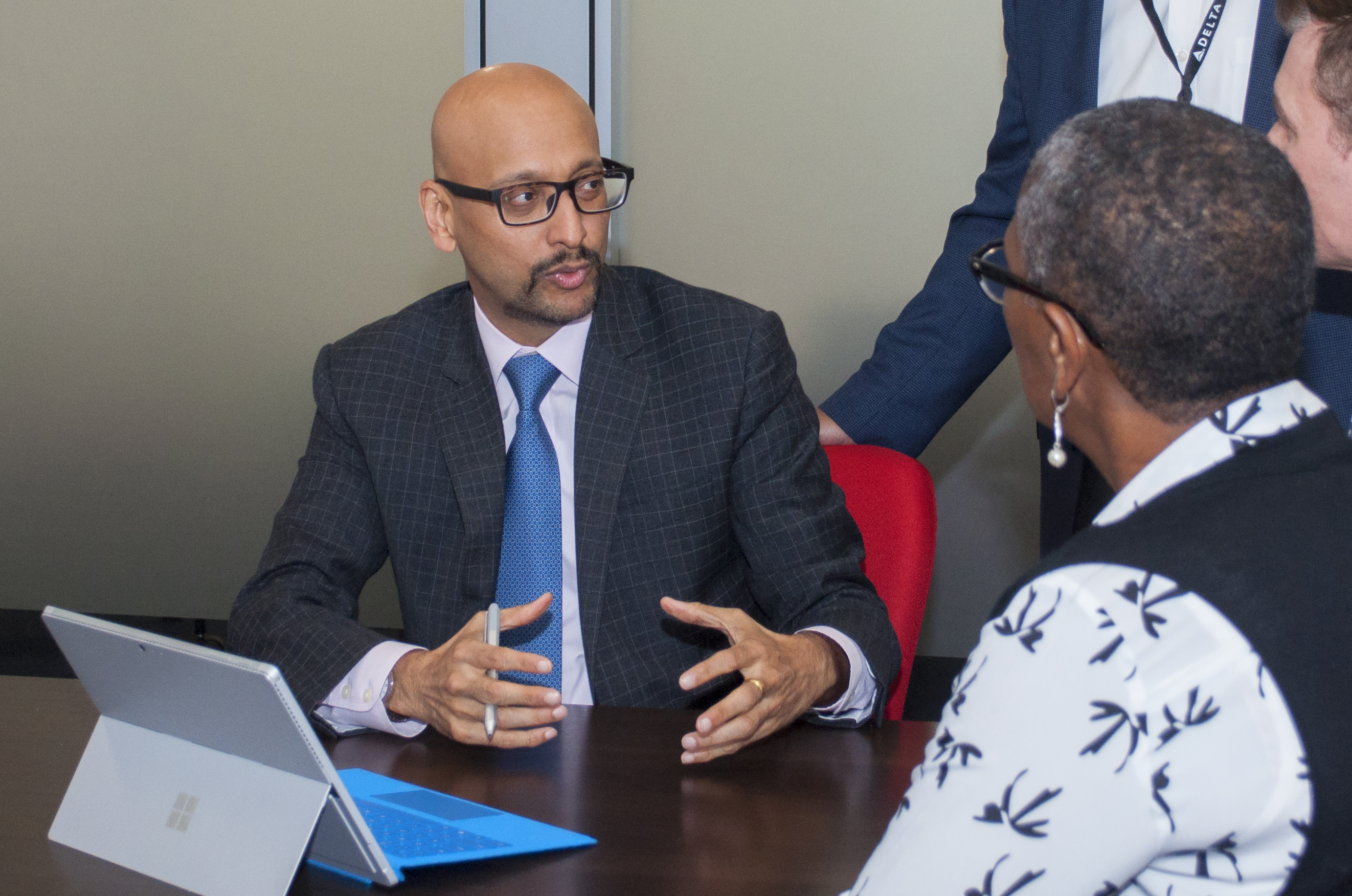
Growing up in Mumbai, India, Rahul Samant learned the value of hard work and humility early on.
“I grew up in a middle class household, living in 380 square feet with my parents and older brother. We certainly were a close family,” he joked. “But what we lacked in material possessions, we made up for in love and humor.”
After earning a degree in electronics engineering from the University of Mumbai, Samant left India to begin a job as a software programmer in London. It was the first time he was ever away from home… and the first time he was ever on a plane.
“It was total culture shock, and I really had to grow up fast,” said Samant.
As he began his climb up the corporate ladder, the virtues his family instilled in him became his guiding force – constantly reminding him of how far he’d come and the future he dreamed of building.
“I always knew I wanted to be the CIO of a major company and managed my career to that overall trajectory,” he recalled.
Following 23 years in financial services at American International Group and Bank of America, Samant joined Delta in February, a path he never imagined, but one he says he’s fortunate to have found.
At AIG, Samant was Chief Digital Officer, responsible for company-wide digital strategy, which included developing programs for client engagement, new business models and digitized operational processes. Prior to AIG, he held various positions at Bank of America, including a two-year stint as CIO of the company’s wealth management division and another three years as the CIO for consumer channels.
Just six months into his new role at Delta, Samant got the call every CIO dreads: IT systems were down, impacting operations systemwide. Over the next 72 hours, he led Delta’s IT team through the recovery effort and committed to ensuring such an outage would never happen again.
Before that call, Samant had already begun the early stages of a multi-year IT transformation of infrastructure, applications, cyber security and data – all vital parts of nearly every aspect of the customer and employee experience.
In a recent interview with Delta News Hub, the airline industry newbie and proud father of two shared insights into his ambitious new role, what other tech leaders inspire him and how one of his pet projects turned into a real job.
Delta News Hub: What role does technology play in an airline like Delta?
Samant: Delta is the world’s most reliable airline, and IT has a foundational part to play in keeping aircraft flying safely and on time. Those are the table stakes.
The outage and resulting operational disruption we recently experienced shows just how important a solid, reinforced IT foundation is to our business. The entire leadership team is committed to ensuring that kind of event doesn’t happen at Delta again.
Having a strong IT infrastructure is essential for IT to achieve our higher purpose to power our customers’ experience from beginning to end in a seamless and engaging way. Therefore, we continue to deliver more and more functionality directly to our customers via our mobile and web channels, while at the same time, we equip and enrich our frontline employees with the tools they need to deliver the best customer service in the industry.
I never miss an opportunity to chat up a flight attendant about the functionality of their SkyPro tablet or shadow a below-wing ramp agent to see firsthand how the new RFID baggage tracking is being implemented. I’m always finding new ways to immerse myself in the inner-workings of our business. And as technology changes, we will listen, learn and deliver to our customers’ and employees’ needs.
DNH: What’s the most important thing you’re working on/focused on right now?
Samant: Here at Delta, we have embarked on a multi-year, multi-phase journey to transform IT and provide a more reliable experience for both our customers and employees.
Our mission is two-fold. We want to make technology a source of competitive advantage for Delta, not just be a support function, as well as be a partner of choice, not just be utilized out of necessity. We’re also laser-focused on hiring new talent and retaining a highly-skilled workforce. Ultimately, our aim is to blend those with expertise in the airline domain with those who have backgrounds in contemporary technologies, like Cloud, API’s and mobile.
In May, Delta launched Comfort+, a seating class with extra legroom and additional amenities such as free craft beer and wine. Rolling out this fare type for purchase required Delta to change mobile and web applications, as well as modify reservations, customer service and other back end systems.
In April, we launched our new and improved employee intranet, Deltanet, which over time will serve as a single point of entry into a wide variety of resources.
And Delta has a number of exciting IT-enabled projects in the pipeline for the remainder of the year, including the “Flight Family” project focused on improving communication during the boarding process and the launch of our new routes to Cuba.
The Flight Family Communications project aims to improve communication efficiency through peer-to-peer messaging across the teams who work together to get a flight out on time. This pilot project will include select flight attendants, gate agents, FlightOps and Operations and Customer Center participants on select flights.
Launching service to Cuba is another important project on IT’s to-do list. People often don’t realize the choreography it takes to launch a new route, from the hardware and software applications to the connectivity to the setting up the various airport workstations. It really takes a village, and IT has a hand in it all.
DNH: What do you think makes a successful leader? How would you describe your leadership style?
Samant: Leadership is about driving change, especially in our uber dynamic world. To lead well, one must instill commitment and inspire a following.
I have three basic tenets for my own style. First, I prize humility and candor.
Second, I live by the three “Ts” – trust, transparency and teamwork.
Third, I lead people AND manage work. When you do the opposite, you risk becoming a micro-manager. What’s most important in a transformational journey, like the one we are embarking on, is creating a realistic vision of our airline powered by reliable, thoughtful and innovative technology, aligning the team with this vision and then making all of them a part of the journey to success.
DNH: What’s been your greatest challenge or career setback and how did you overcome it?
Samant: In 2008, I was the CIO for the wealth management division at Bank of America and was in charge of the integration of an acquisition. Despite rigorous testing, the account conversion went horribly wrong. There were many reasons for it, but as the leader, I took full accountability.
I led the recovery efforts, rallying both our business colleagues and my own IT and operations teams, to remedy the issues account by account. At the time, I was based in Boston but relocated to New York City for two months until we had the situation under control.
DNH: What’s your greatest achievement and how has it shaped you?
Samant: In 1998, as part of a capstone project for my MBA at Wake Forest University, I researched and wrote a paper recommending my employer at the time, Bank of America, globalize their IT operations. I spent the next 24 months circulating the paper to executives several levels higher than me.
Finally, I found a willing sponsor who took me under his wing and asked me to turn my pet project into a full time job. By the time I was done rolling out this new program, we had a global network of centers on three different continents.
More or less, it was like I was an entrepreneur and catalyst for change inside of a major Fortune 500 company. I got broad exposure to disciplines across the company, from cross-border funding to human resources hiring to real estate transactions… and I was a 30-something IT guy!
DNH: What words of wisdom or career advice would you pass on to others?
Samant: Never be on autopilot with your career. If you don’t have clear goals in mind, you’ll never know which path you’re supposed to take and may never feel that fulfillment we all crave from the work we do.
And when it comes to networking, quality trumps quantity. Invest in those relationships and you will earn those connections over time. Remember, networking is nourishing relationships when you don’t need them, not when you do.
Bonus questions…
DNH: What do you enjoy doing when you have the opportunity to step away from the job?
Samant: I treasure time with my wife and my two daughters, one is 22 and the other is 19, especially if we are traveling together since we all enjoy going to new places. I also love reading history and a good spy novel. Before joining Delta, I was very active with an organization representing the Indian diaspora in Charlotte and would like to find another organization or activity that’s close to my heart here in Atlanta when I have a bit more time on hand.
DNH: What’s your favorite travel destination?
Samant: I have a special fondness for London, since it’s the first destination I flew to in my life. But I have enjoyed some very diverse places around the globe, like Istanbul, Dubrovnik, Machu Picchu and Hong Kong.
My favorite spot in the world is to stand on the Kowloon side of Victoria Harbor looking at the Hong Kong skyline. It is a spectacular view! My travel tip: Get there at twilight and watch the lights come on, then catch the ferry across.
DNH: Where do you most want to travel but never have been?
Samant: My family and I have a long bucket list. In total, I have traveled to 46 countries – three new ones since joining Delta. Russia, Iceland and Australia all top my list of places I want to go, and of course we fly to all three!
DNH: What’s one thing you would never travel without?
Samant: I am a really light sleeper, so my eye mask and ear plugs go with me everywhere just in case the shades in the room don’t close all the way or there is too much ambient noise.
DNH: Which TV shows are on your must-see list?
Samant: I recently finished Season 4 of “House of Cards.” I also love “Elementary” because Sherlock Holmes was my childhood idol.
DNH: What’s on your music playlist?
Samant: I enjoy a lot of different music, but I mainly carry a large collection of Indian music in two languages on my iPod. It ranges from the 60s to the 2000s. I love it for the nostalgic value.
DNH: What’s the last book you read?
Samant: I recently read this really interesting tech book called “Exponential Organizations” and met the author who grew up less than a mile away from where I lived in Mumbai.
Since joining Delta, I made a point to read “Glory Lost and Found.” It was quite educational for me as a newcomer and filled me in on the ups and downs the airline has gone through. I am amazed at the resilience of Delta’s employees and the strength of its culture through the tough times.
DNH: What is your favorite or most notable item in your office?
Samant: My growing collection of model planes, thanks to Delta President Glen Hauenstein. He seeded the collection with three really awesome ones.
DNH: Who’s your personal hero?
Samant: I am the product of my varied experiences and the many mentors who have guided me along the way. When I think back to what my parents did for me and the values they instilled in my brother and I, they are the people I admire most on this planet.
DNH: Who are your social media influencers/who do you follow on Twitter?
Samant: I follow a lot of different tech publications for my own continuing education, like Engadget, TechCrunch, Mashable and CNET.
I also follow some of the most notable leaders in the industry like Microsoft CEO Satya Nadella, Apple CEO Tim Cook and Google CEO Sundar Pichai.
I also keep tabs on my favorite cricket players, the Prime Minister of India, plus close friends and ex-bosses!