Russia’s S7 Airlines joins the E-Jets operators’ family
Shannon Ireland, – Just weeks after receiving the Type Certificates from the Russian authorities for the E170 and E175 jets, S7 Airlines will be the first operator of the E170 in the country. The airline signed an agreement with GE Capital Aviation Services (GECAS) to lease 17 E170 pre-owned jets, therefore not impacting Embraer’s order backlog. The airline will start to receive the aircraft in the first quarter of 2017.
“Once again, GECAS joins Embraer to provide aircraft to the Russian market,” said Arjan Meijer, Vice President, Europe & Middle East, Embraer Commercial Aviation. “We welcome S7 Airlines to the growing E-Jets operators’ family. We are delighted to see the E170 in operation with one of the largest Russian Airlines, supporting the airline as it spreads its wings around Russia. S7 is now the carrier with the largest network outside Moscow serving regional and intra-regional markets.”
“New E170s will allow us to gain momentum in the development of regional air transportation. We see this segment as having high potential. Today, air transportation is concentrated in Moscow, and passengers from Ural cities often have to fly to the Far East through a connecting flight in Moscow. The first Embraers will be based at the Novosibirsk Tolmachevo airport which is located well enough to serve as an efficient hub for other regions. The new type of airliners will allow us to launch flights from small and hard to reach cities, where the use of medium-haul aircrafts is impossible,” said Vladimir Obyedkov, CEO of S7 Airlines.
“The introduction of the E170 into the S7 fleet is the result of thorough analysis of the airline’s growing needs,” said Alec Burger, GECAS President & CEO, “The E170 offers strong economics and is well-suited to help S7 serve the Russian markets.”
The E-Jets are already well established in several countries in the region– Poland, Finland, and Bulgaria – and in CIS (Commonwealth of Independent States) countries where Embraer customers operate E-Jets in Kazakhstan, Azerbaijan, Belarus, Ukraine and the Republic of Moldova. The E190 and the E195 were certified by Russia in 2012, and Saratov Airlines has been flying the E195 since 2013.
Embraer is the world’s leading manufacturer of commercial jets with up to 130+ seats. The Company has over 100 customers all over the world operating the ERJ and E-Jet families of aircraft. For the E-Jets program alone, Embraer has logged more than 1,700 orders and over 1,300 deliveries, redefining the traditional concept of regional aircraft by operating across a range of business applications.
About S7 Airlines
S7 Airlines (www.s7.ru ) is a member of the oneworld® global aviation alliance. The airline has a nationwide route network, created on the basis of air transport hubs in Moscow (Domodedovo) and Novosibirsk (Tolmachevo). S7 Airlines also performs regular flights to countries of the Commonwealth of Independent States (CIS), Europe, the Middle East, Southeast Asia and countries of the Asia-Pacific region. In 2007 the company received an official IATA certificate as an IOSA (IATA Operational Safety Audit) operator, becoming the second air carrier in Russia to have successfully passed the full international audit procedure for compliance with operational safety standards. The airline is a member of the S7 Group of companies. In 2015 Group member airlines carried 10.6 million passengers.
About Embraer
Embraer is a global company headquartered in Brazil with businesses in commercial and executive aviation, defense & security. The company designs, develops, manufactures and markets aircraft and systems, providing customer support and services. Since it was founded in 1969, Embraer has delivered more than 8,000 aircraft. About every 10 seconds an aircraft manufactured by Embraer takes off somewhere in the world, transporting over 145 million passengers a year. Embraer is the leading manufacturer of commercial jets up to 130 seats. The company maintains industrial units, offices, service and parts distribution centers, among other activities, across the Americas, Africa, Asia and Europe.
About GE Capital Aviation Services (GECAS)
GE Capital Aviation Services (GECAS) is a world leader in aviation leasing and financing. With over 45 years of experience, GECAS offers a wide range of aircraft types including narrowbodies, widebodies, regional jets, turboprops, freighters and helicopters, plus multiple financing products and services including operating leases, purchase/leasebacks, secured debt financing, capital markets, engine leasing, airframe parts management and airport/airline consulting. GECAS owns or services a fleet of over 1,950 aircraft (~1,700 fixed wing/ ~250 rotary wing) in operation or on order, plus provides loans collateralized on an additional ~400 aircraft. GECAS serves ~ 270 customers in over 75 countries from a network of 25 offices. www.gecas.com
Boeing Tax Break Ruled Unlawful by World Trade Organization
On 19 December 2014, the European Union requested consultations with the United States with respect to conditional tax incentives established by the State of Washington in relation to the development, manufacture, and sale of large civil aircraft.
The European Union alleges that the measures constitute specific subsidies within the meaning of Articles 1 and 2 of the SCM Agreement. The European Union also considers that the measures are prohibited subsidies that are inconsistent with Articles 3.1(b) and 3.2 of the SCM Agreement.
On 12 February 2015, the European Union requested the establishment of a panel.
Panel and Appellate Body proceedings
At its meeting on 23 February 2015, the DSB established a panel. Brazil, China, India, Japan, Korea and the Russian Federation reserved their third-party rights. Subsequently, Australia and Canada reserved their third-party rights.
On 13 April 2015, the European Union requested the Director-General to compose the panel. On 22 April 2015, the Director-General composed the panel. On 29 September 2015, the Chairperson of the Panel informed the DSB that it estimated to issue its report within 12 months. On 23 September 2016, the Chairperson of the Panel informed the DSB that the final report was to be circulated to all Members by the end of November 2016.
On 28 November 2016, the panel report was circulated to Members.
Summary of key findings
This dispute concerns legislation enacted in the state of Washington in the United States in November 2013 through Engrossed Substitute Senate Bill 5952 (ESSB 5952), which amended and extended various tax incentives for the aerospace industry. The European Union identified seven separate tax incentives, including a reduced business and occupation tax rate, credits against business taxation, and exemptions from various other taxes in the state of Washington.
The European Union claimed that those tax incentives are prohibited under Articles 3.1(b) and 3.2 of the SCM Agreement as subsidies that are contingent on the use of domestic over imported goods. According to the European Union, the contingency results from two siting provisions contained in ESSB 5952, namely a First Siting Provision and a Second Siting Provision. In the European Union’s view, the challenged aerospace tax measures are de jure contingent upon the use of domestic over imported goods inasmuch as the text of the relevant legislation sets out the prohibited contingency. The European Union also made a secondary claim that the aerospace tax measures are de facto contingent upon the use of domestic over imported goods.
The Panel found that, under each of the aerospace tax measures at issue, there is a financial contribution by the Washington State government and a benefit is thereby conferred. The Panel concluded therefore that each of the aerospace tax measures at issue constitutes a subsidy within the meaning of Article 1 of the SCM Agreement.
With respect to the European Union’s de jure claim against the aerospace tax measures at issue, the Panel looked separately at the First Siting Provision and the Second Siting Provision contained in ESSB 5952, to assess whether the European Union had successfully demonstrated the existence of the prohibited contingency in either of the provisions. In this regard, the Panel concluded that the European Union had not demonstrated that, on their own, and based on their express terms, the First Siting Provision or the Second Siting Provision make the challenged aerospace tax measures de jure contingent upon the use of domestic over imported goods.
The Panel subsequently considered the two siting provisions acting jointly and concluded that the European Union had not demonstrated that, acting together, the First Siting Provision and the Second Siting Provision make the challenged aerospace tax measures de jure contingent upon the use of domestic over imported goods.
With respect to the European Union’s de facto claim against the aerospace tax measures at issue, the Panel considered the joint operation of the First Siting Provision and the Second Siting Provision contained in ESSB 5952, to assess whether the European Union had successfully demonstrated the existence of the prohibited contingency. The Panel concluded that the siting provisions in ESSB 5952, and in particular the prospective modalities of operation of Washington State Department of Revenue’s discretion under the Second Siting Provision, make one of the challenged aerospace tax measures (namely, the reduced business and occupation tax rate for the manufacturing or sale of commercial airplanes under the 777X programme) de facto contingent upon the use of domestic over imported goods within the meaning of Article 3.1(b) of the SCM Agreement.
Having found that the reduced business and occupation tax rate for the manufacturing or sale of commercial airplanes under the 777X programme is inconsistent with Article 3.1(b) of the SCM Agreement, the Panel also found that the United States has acted inconsistently with Article 3.2 of the SCM Agreement.
FAA Awards Infrastructure And Environmental Grants to Airports
WASHINGTON – U.S. Transportation Secretary Anthony Foxx today announced more than$90 million in Federal Aviation Administration (FAA) grants to six airports in Alabama, Missouri, North Dakota, Oregon, Tennessee, and Wyoming for airport runway, taxiway, and apron projects.
“A safe and efficient air transportation system for the traveling public requires building and maintaining the airport infrastructure at our nation’s airports,” said U.S. Transportation Secretary Anthony Foxx. “When we fund critical projects like these, we’re making an important investment in our future while also creating jobs and supporting local economies across the country.”
The following airports recently received Airport Improvement Program (AIP) grants:
Huntsville International Airport (Alabama) – The Huntsville-Madison County Airport Authority received $9.6 million for Huntsville International Airport-Carl T. Jones Field. The funds will be used for the second phase of a five-phase project to construct a new parallel Taxiway C. This phase of the project will include site preparation and drainage improvements for the 0.6 mile-long segment of Taxiway “C” that connects the cargo aircraft parking area to the north end of Runway 18L/36R. The new taxiway will enhance safety at the airport by reducing mid-field runway crossings by cargo aircraft. The project will begin in early spring 2017 and is expected to be completed in August 2017.
Kansas City International Airport (Missouri)– This airport received $19 million to fund the reconstruction of approximately 9,000 feet of Taxiway B, which has reached the end of its useful life. In addition to returning the pavement’s structural integrity, the project will correct taxiway design geometry and improve airfield lighting, signs, circuits, and markings. Taxiway B is important to airport operations because it is parallel to Runway 1L/19R, which provides primary access to the terminal apron area, commercial aprons, and the general aviation apron. The project design is nearly complete and will begin construction in the spring of 2017 with anticipated completion in November 2017.
Bismarck Municipal Airport (North Dakota)– The airport will use $13.5 million to fund the first phase of a three-phase project to reconstruct a portion of Runway 13/31. This portion of the runway has reached the end of its useful life and can no longer be repaired. This project will ensure the Runway Safety Area grading will meet current standards. The project design is currently underway, with construction set to begin in early spring of 2017.
Portland International Airport (Oregon) – This $11.6 million project will fund the reconstruction of approximately 3,300 feet of Taxiway B Center, including exits B3-B5 and B8 holding bay areas and intersection at Taxiway B and M, which has reached the end of its useful life. This project is critical to airport operations because it will keep aircraft taxi times from increasing to and from the terminal area. Two other elements to the project include widening the taxiway shoulders from 15 feet to 30 feet to meet airport design standards and replacing and installing drains under the taxiway to meet requirements. The taxiway project will begin in April 2017 and is expected to be completed in October 2017.
McGhee Tyson Airport (Tennessee) – The Metropolitan Knoxville Airport Authority received $27.9 million for the third phase of a five-phase project to reconstruct Runway 5L-23R. This phase of the project includes site preparation, earthwork and drainage improvements. The reconstructed Runway 5L-23R will enhance safety by meeting design standards to correct the pilot’s line of sight and remove vertical curves along the runway centerline. McGhee Tyson is a small hub airport that provides service to commercial aviation, general aviation, air cargo, and the Tennessee Air National Guard. The third phase of the project will begin in late October 2016 and is expected to be completed by September 2017.
Jackson Hole Airport (Wyoming)– $8.6 million in funding will repair approximately 33,000 square yards of the existing commercial service apron, specifically aircraft parking areas eight and nine, which have reached the end of their useful life. This project is the fourth phase of a six-phase plan. The project is scheduled to begin construction in early spring 2017 with an expected completion by October 2017.
“Ensuring the infrastructure needs of our commercial, general aviation, and civilian-military use airports is critically important to the FAA,” said FAA Administrator Michael P. Huerta. “We will continue to provide funding to maintain airport infrastructure across the country.”
In fiscal year 2016, the FAA issued 1,768 new grants to airports. AIP provides more than $3 billion in annual funding for projects that are vital to maintaining the safety, security, capacity, efficiency, and environmental stewardship of the nation’s airports. More than 3,300 airports are eligible for AIP grants benefiting commercial passengers, cargo operations, and general aviation activities throughout the nation.
$33.7 Million in Environmental Grants to Airports
U.S. Transportation Secretary Anthony Foxx today announced the recent award of $33.7 million in Federal Aviation Administration (FAA) grants to nine airports around the country to reduce emissions and improve air quality through the FAA’s Voluntary Airport Low Emission (VALE) and Zero Emissions Airport Vehicle (ZEV) programs.
“These grants represent the U.S. Department of Transportation’s continued commitment to reduce greenhouse emissions and work with airports and communities to provide healthier air quality for all Americans,” said U.S. Transportation Secretary Anthony Foxx.
The VALE program supports the objectives of President Obama’s Climate Action Plan. That plan builds on efforts to address climate change and support clean energy innovation. The Climate Action Plan also builds upon historic investments in advanced vehicle and fuel technologies, public transit, and rail under the Recovery Act. In addition, the investments include ambitious new fuel economy standards for cars and trucks, which the Administration has worked to develop since 2009 in collaboration with industry.
VALE is designed to reduce all sources of airport ground emissions in areas that do not meet air quality standards. The FAA established the program in 2005 to help airport sponsors meet their air quality responsibilities under the Clean Air Act. Through these programs, airport sponsors can use Airport Improvement Program (AIP) funds and Passenger Facility Charges (PFCs) to help acquire refueling and recharging stations, electrified gates, low-emission vehicles, and other airport-related air quality improvements.
The ZEV program, created through the FAA Modernization and Reform Act of 2012, allows airport sponsors to use AIP funds to purchase vehicles that produce zero exhaust emissions. AIP funds can cover up to 50 percent of these total project costs. Airport sponsors also can use federal funds to pay for any needed infrastructure construction or modification of infrastructure needed to facilitate the delivery of the fuel and services for these vehicles.
“We applaud these airports for working to reduce ground emissions and being responsible stewards of the environment and good neighbors to surrounding communities,” said FAA Administrator Michael P. Huerta.
The FAA is awarding $31.1 million in VALE grants to following airports:
– Chicago O’Hare International, $3.6 million – to purchase and install 124 electrical charging stations. These stations will allow airlines to use electric-powered ground service equipment, including belt loaders, aircraft tractors, and baggage and cargo tugs. Many of these charging stations are multi-port stations that can potentially support up to a total of 326 pieces of electrical equipment.
– Memphis International, $2.4 million – to purchase and install 11 ground-power units (GPUs) and 11 preconditioned air units (PCAs) for passenger gates.
– George Bush Intercontinental Airport Houston, $1.5 million– to purchase and install five PCAs for passenger gates and 68 electrical ground support recharging ports.
– Dallas Fort Worth International Airport, $3.1 million– to purchase and install 23 GPUs, five PCAs and two air chilling units for passenger gates.
– Los Angeles International Airport, $4 million– to purchase and install 9 GPUs and associated electrical infrastructure for remote parking sites.
– Portland International Airport, $5.7 million – to purchase and install 27 PCAs at passenger gates.
– San Francisco International Airport, $10.6 million– to purchase and install 5 GPUs and five PCAs and associated infrastructure at five remote maintenance stations.
– Boise Airport, $200,000 –to purchase and install a solar-powered system to heat water for the terminal.
The remaining funds of $2.6 million were awarded in a ZEV grant to:
– Indianapolis International – to purchase six electric shuttle buses for passenger service from terminal to terminal and three charging stations and required infrastructure needed to charge the vehicles.
Through VALE, airports are reducing ozone emissions by approximately 840 tons per year, which is equivalent to removing about 46,912 cars and trucks from the road annually. In fiscal year 2015, the FAA issued $23.4 million in VALE grants for 13 projects at 12 airports. Since 2005, the FAA has funded 92 VALE projects at 46 airports, which represents a total investment of $251 million in clean airport technology. That amount includes $196 million in federal grants and $55 million in local airport matching funds. This marks the second year the FAA has awarded ZEV grants that provide funding to replace hydrocarbon burning buses with electric buses.
The Airport Improvement Program (AIP) provides more than $3 billion in annual funding for projects that are vital to maintaining the safety, security, capacity, efficiency, and environmental stewardship of the nation’s airports. More than 3,300 airports are eligible for AIP grants benefiting commercial passengers, cargo operations, and general aviation activities throughout the nation.
United Airlines and Houston Airport System Break Ground on New Technical Operations Center at Bush Intercontinental Airport
HOUSTON, – United Airlines, in partnership with the City of Houston and the Houston Airport System, will break ground today on the airline’s new United Technical Operations Center (UTOC) at George Bush Intercontinental Airport.
The project, which is the next phase of United’s ongoing expansion of facilities at its Houston hub, will add approximately 200,000 square feet of additional hangar capacity for maintaining widebody aircraft, in addition to a new warehouse distribution center, technical services building and administrative offices.
Once completed, the $162 million facility will accommodate widebody aircraft, including Boeing 767s, 777s, 787s and Airbus A350s, and provide an improved work environment with better ergonomics, safety and efficiency for United’s maintenance technicians and support personnel.
“With flights from Houston to destinations around the globe, this new facility and the employees who work here will provide critical support to our worldwide operations,” said Greg Hart, United’s, executive vice president and chief operations officer. “This significant investment in our Houston facilities will enable us to support more aircraft than ever before in Houston and allow us to return them to serving our customers more quickly, while providing a workplace that our people can take pride in.”
The new UTOC, which is expected to be completed in late 2018, will consolidate United’s Houston maintenance facilities, placing engineers in the hangars adjacent to technicians and aircraft for optimal efficiency. In addition, the expanded facilities will generate approximately 200 new jobs.
“Once again, our strong partnership with United Airlines brings us to the beginning of another important project here at George Bush Intercontinental Airport. From work to build not one, but two new terminals, to now this new facility, United and the City of Houston prove that public-private partnerships benefit everyone involved,” said Houston Mayor Sylvester Turner. “United recognizes the fact that Houston is a tremendous place to do business and they understand that this community embraces them and wants to see them succeed.”
United In Houston
From Houston, United and United Express offer nearly 500 daily flights to more than 175 destinations around the world, including top business and leisure travel markets in Asia, Europe and the Americas. The Houston hub is United’s premier gateway to Latin America, serving 51 nonstop destinations across Latin America and the Caribbean.
United is one of the city’s largest employers, with more than 14,000 Houston-based employees.
About Houston Airport System
Houston Airports served more than 55 million passengers in 2015. Houston’s three airports — George Bush Intercontinental Airport (IAH), William P. Hobby (HOU) and Ellington Airport (EFD) — contribute more than $27.5 billion to the regional economy. IAH and HOU collectively provide nonstop flights to nearly 200 destinations worldwide. For more information, visit fly2houston.com. Get social with Houston Airports by following us on Twitter @IAH and @HobbyAirport.
About United
United Airlines and United Express operate more than 4,500 flights a day to 339 airports across five continents. In 2015, United and United Express operated more than 1.5 million flights carrying more than 140 million customers. United is proud to have the world’s most comprehensive route network, including U.S. mainland hubs in Chicago, Denver, Houston, Los Angeles, New York/Newark, San Francisco and Washington, D.C. United operates more than 720 mainline aircraft, and this year, the airline anticipates taking delivery of 21 new Boeing aircraft, including 737NGs, 787s and 777s, as well as six used Airbus A319 aircraft. The airline is a founding member of Star Alliance, which provides service to 192 countries via 28 member airlines. For more information, visit united.com, follow @United on Twitter or connect on Facebook. The common stock of United’s parent, United Continental Holdings, Inc., is traded on the NYSE under the symbol UAL.
Trust Together: Air France-KLM Regains The Offensive With A New Strategic Project
Jean-Marc Janaillac, Chairman and Chief Executive Officer of Air France-KLM, today unveils Trust Together, Air France-KLM’s new strategic project.
“With Trust Together, Air France-KLM regains the offensive with a project which is both ambitious and realistic. It will enable us to capture our share of air transport industry growth by improving the competitiveness of our businesses. With our nine strategic priorities, we shall be fighting back on every front. Our strength lies in the fact that we are challengers. The status quo is not an option. We must launch a new dynamic to return to a leadership position in our markets.” said Jean-Marc Janaillac.
The Air France-KLM Group’s ambition is to regain the offensive to return to a leadership position in the global air transport industry:
Built around major airlines – Air France and KLM – coordinating two European hubs,
mainly focused on:
Its long-haul network, at the heart of a network of alliances,
Its medium-haul network which feeds the dual hubs.
A major point-to-point player within Europe, to/from its French and Dutch home markets
thanks, notably, to Transavia, the Group’s low-cost vehicle.
An industry reference for its customers in terms of operational efficiency, product quality
and customer intimacy thanks, notably, to digital.
A world leader in the airline MRO business
Defending its Cargo business in support of the Passenger business.
Trust Together must enable Air France-KLM to rise to three major challenges: capture its share within worldwide air transport growth, reinforce the Group’s competitiveness and operational efficiency and further enhance the customer experience.
The Air France-KLM Group’s strategic project is based on nine strategic priorities:
1. Regain the offensive in long haul Air France-KLM is targeting profitable growth for the long-haul operations of between 2% and 3% per year through to 2020, based on several levers:
At revenue level: alliances and commercial integration with partners, together with investment in the existing tools.
At cost level: ongoing measures to improve the competitiveness of Air France and KLM.
Concerning Air France, the development of an additional tool – a new company – adapted to ultra-competitive markets and positioned on structurally loss-making routes, or those that have been closed in the past few years.
. Deepen alliances modelled on the partnership with Delta
Air France-KLM will reinforce its commercial integration with its principal partners to benefit from an expanded market position, leverage joint distribution networks and be able to offer customers a global proposition in each market.
. Creation of a new company alongside Air France, which is competitive and innovative and will drive growth for the Paris-Charles de Gaulle hub
This new company will constitute the Group’s response to the Gulf State airlines which are developing at low production costs on key markets where Air France-KLM is pursuing its growth ambition. This initiative to regain market share has been dubbed Boost.
It will be focused on ultra-competitive markets and will enable the Group to go on the offensive by opening new routes, re-opening routes closed due to their lack of profitability and maintaining routes under threat. This new company will propose a simple, modern and innovative offer, whose positioning will not be low cost. It will offer its customers business and leisure destinations with standards comparable to those of Air France in terms of product quality and the professionalism of the crews.
The new company will also serve as a laboratory for the Group’s innovative ability in terms of products, digital and technology, catering, cabin design, services and the customer experience, as well as for working methods.
It will number 10 long-haul aircraft by 2020 with some 30% of operations focused on newly-created routes. It will operate with Air France pilots on a volunteer basis at work conditions adapted to its competitive positioning. For cabin crews, an independent career path will be created to enable this new company to be operated at the level of market costs. The ground operations, handled by Air France, will also be optimized by benefiting to the maximum from digitalization. The HR framework for this new company will be negotiated with the unions in the coming weeks.
2. Improve the efficiency and connectivity of the hubs The Paris-Charles de Gaulle and Amsterdam-Schiphol hubs play a central role in the strategy of Air France-KLM and its partners. The Group is going to strengthen the measures aimed at improving their operational efficiency and supporting the economic performance of the long and medium-haul operations to/from the hubs.
The Paris-Charles de Gaulle hub will also gain renewed dynamism, within the framework of the Boost initiative, through the launch of the new company on the medium-haul network with a simple, modern and innovative offer.
The Amsterdam-Schiphol hub will be reinforced by closer coordination between Transavia and KLM, particularly in terms of investment in the fleet and the development of the network and new joint commercial approaches.
3. Develop the point-to-point markets on departure from the French and Dutch home markets The point-to-point operations, i.e. the short- and medium-haul flights without connections in a Group
hub, are currently operated by Transavia, HOP! Air France, Air France and KLM.
The priority for Transavia, the Group’s low-cost airline, will be growth in its French and Dutch home markets. In France, Transavia will reinforce its position on some routes to compete with the TGV and the low cost carriers, and will develop its European routes on departure from Orly and the provinces.
Commercial coordination between Transavia and the Group’s other airlines (HOP! Air France, Air France and KLM) will be stepped up to expand the offer to customers.
The Group will rationalize its brands and optimize its networks in the French market. Starting from 2017, HOP! Air France and Transavia will be the only two brands in point-to-point.
Concerning the ground operations at Paris-Orly and the French stations, Air France will redefine an operational model on a station-by-station basis, to reconcile changes in the professions and activity.
4. Strengthen the growth of the maintenance business
Air France-KLM will continue its investment in this high-growth market to reinforce its global number two position and improve the efficiency of its production tools. From this perspective, the Group will launch a review of this business’ industrial model, examining its potential corporatization, knowing that Air France-KLM wishes to retain exclusive control.
5. Defend the Cargo business in support of the Passenger activities
To seize opportunities in the air freight market, Air France-KLM will continue to rescale its activity focused on the utilization of long and medium-haul aircraft bellies. The Group will put the emphasis on digitalization and the steamlining of processes, and on a high level of service quality.
6. Reinforce competitiveness and the utilization of aircraft
To improve its competitiveness, the Group plans to act on all levels by pursuing and amplifying the initiatives already under way in terms of unit cost reduction.
Air France-KLM will focus its efforts on reducing fleet costs by optimizing the utilization of its aircraft.
7. Further develop the customer relationship to create more value
Air France-KLM is looking to differentiate itself via investment in digital tools, a more personalized service for customers and a move up market.
The Group will thus amplify its customer-focused action plans:
Personalization of the customer experience and relationship thanks to Big Data,
An ongoing move up market for products and services – with, for example, a new uniform for Air France and Hop! Air France by 2018-2019,
Improvement in the operational efficiency of its airlines.
8. Optimize organizational structures and gain agility to facilitate the initiatives and accelerate innovation
The work in progress on organizational optimization and functioning modes will be pursued and intensified. Air France plans to launch a new HR ambition for employees, in the form of a commitment to greater recognition, career development, empowerment, innovation and internal cohesion, across all staff categories, accompanied by concrete action plans. The implementation of digital tools for Air France-KLM employees and the digitalization of processes will be accelerated to facilitate collaborative working across the Group and gain agility.
9. Pursue lobbying initiatives in Europe and France directed at more equitable competition
The Group will pursue its lobbying initiatives at European level to establish equitable competition with the Gulf State and low-cost carriers and, at French level, reduce the structural lag in competitiveness due to higher taxes and fees.
The implementation of Trust Together must guarantee Air France-KLM’s financial flexibility
Air France-KLM must pursue efforts to improve its competitiveness, by confirming the Perform 2020 competitiveness objectives and by improving the cost of fleet utilization and financing. The unit cost reduction target for the 2017-2020 period is in excess of 1.5% per annum.
The Group will also maintain strict capex discipline, by targeting annual positive free cash-flow before disposals and by limiting its investment. For 2017 and 2018, the capex forecast is between €1.7bn and €2.2bn per year.
Deleveraging will remain the priority, with a mid-cycle adjusted net debt/EBITDAR1 ratio target of below 2.5x at the end of 2020.
With this ambitious project, by 2020 the Air France-KLM Group aims to reach:
Revenues of around €28 billion (depending on the trend in RASK);
For 100 million passengers carried;
With a fleet reaching 435 aircraft (excluding regional aircraft).
PSA Airlines Announces Industry-Leading Pay for New-Hire Pilots
DAYTON, Ohio, — PSA Airlines, a wholly owned subsidiary of American Airlines Group (Nasdaq:AAL), today announced significant changes to its pilot pay program, including industry-leading wages for new-hire pilots, an increased sign-on bonus for new recruits and retention bonuses for First Officers and Captains to create a top-tier compensation structure – marking a monumental milestone for the airline. These valuable enhancements, which are effective immediately, elevate PSA to the top of the regional industry in first-year compensation for new-hire pilots. This is an important milestone for the company’s recruiting mission to hire the best and brightest future aviators in the industry to carry out its future plans as a vital part of the American Airlines regional network.
“PSA’s new pilot compensation program is a true game-changer for our airline and we are proud to offer the highest first-year compensation in the regional industry,” said Dion Flannery, President of PSA Airlines. “This package complements the unrivaled stability and growth opportunity at our carrier and with a true seniority-based flow to American Airlines, PSA is well-positioned to offer prospective pilots the highest paying and most stable career path in commercial aviation.”
Details of the new compensation package include a 56 percent increase to the starting pay for new-hire First Officers, increasing wages from $24.62 per hour to $38.50 per hour. The airline will continue offering all new-hire pilots a $15,000 sign-on bonus, with an additional $5,000 for new-hire pilots with CRJ-type experience. PSA is also implementing a $20,000 retention bonus for First Officers hired under this new program to be paid out in installments after their one-year anniversary with the company. PSA is also instituting a $7,500 retention bonus for all Captains currently employed with the company.
With these changes, first-year pay for new-hire pilots now tops the regional industry at $58,500, plus an additional $3,000 with a commuter hotel allowance program implemented earlier this year. A pilot starting their commercial aviation career with PSA can reasonably expect to reach Captain and earn between $165,000 and $175,000 in compensation for their first three years of service with the company.
As a stable carrier owned by the largest airline in the world, PSA has a defined and committed fleet and growth plan. Since 2014, PSA has doubled its size from 49 aircraft to 115 aircraft and will continue to grow to operate 150 Bombardier CRJ aircraft.
Today’s announcement builds on the success of PSA’s sustained recruitment platform which includes the recent introduction and continued development of the airline’s Cadet Program. The program is the first of its kind and helps the most promising future pilots make a smooth transition from the classroom at top colleges, universities and flight schools to the cockpit and offers various levels of support as the Cadet’s certifications, training and experience evolves.
For more information about the benefits offered to PSA’s pilots, please visit: http://www.psaairlines.com/careers/pilots.
About PSA Airlines
PSA Airlines operates an all-jet fleet consisting of exclusively Bombardier regional jet aircraft. The company’s 2,500 employees operate nearly 700 daily flights to nearly 90 destinations. Headquartered in Dayton, Ohio, PSA also has flight crew bases located in Dayton, Cincinnati, Ohio, Knoxville, Tennessee, and Charlotte, North Carolina. PSA has maintenance facilities in Dayton and Canton, Ohio and Cincinnati/Northern Kentucky Airport and Charlotte, North Carolina. PSA operates 35 Bombardier CRJ200 aircraft, 26 Bombardier CRJ700 aircraft and 54 Bombardier CRJ900 aircraft. The airline expects to add additional Bombardier CRJ700 aircraft and Bombardier CRJ900 aircraft to its fleet in the next two years, bringing its fleet count to 150.
Qatar Airways And British Airways Announce Joint Business Agreement Offering Passengers More Choice
DOHA, Qatar – Qatar Airways and British Airways’ parent company, International Airlines Group (IAG), today announced a joint business agreement that will come into effect on 30 October 2016.
The joint business will benefit customers by offering a wider choice of flights, an enhanced network, greater choice of fares and superior benefits for members of their frequent flyer programmes.
Crucially, the partnership between Qatar Airways and British Airways will allow the carriers to provide passengers with better links and an even more seamless travel experience between the UK, Asia, Middle East and Africa. The joint business will see the two airlines code-sharing on all non-stop flights between the UK and Doha, to offer customers a combined route network that will serve more than 70 destinations. Between the airlines’ hubs of London and Doha the new partnership will offer seven daily non-stop services in both directions.
Qatar Airways Group Chief Executive, His Excellency Mr. Akbar Al Baker, commented: “British Airways is an airline steeped in history and prestige and we are proud to be partnering with them to offer our passengers an even greater choice of global destinations. This partnership brings together two world-class airlines to provide an enhanced operation for our passengers with increased daily flights between London and Doha, greater choice of flight schedules, wider range of fares and improved members benefits.
“Today’s announcement reinforces our already established relationship with IAG and we look forward to welcoming British Airways’ direct flights to our hub, Hamad International Airport, where we can provide passengers with seamless access to our global network of more than 150 destinations.”
IAG Chief Executive, Mr. Willie Walsh, said: “We are delighted to announce this joint business with Qatar Airways which is one of the world’s premier airlines. This agreement will benefit customers by giving them access to more destinations through Qatar Airways’ extensive network. It will also allow us to provide easier journeys with better aligned schedules, more frequencies and improved flight transfers. This partnership follows the commercial agreement with IAG Cargo signed two years ago and enhances our relationship with Qatar Airways further.”
This agreement will also strengthen the oneworld alliance and enable it to compete more effectively on the included routes creating greater competition and increased options for consumers.
About Qatar Airways:
Qatar Airways, the national carrier of the State of Qatar, is one of the fastest growing airlines operating one of the youngest fleets in the world. Now in its 19th year of operations, Qatar Airways has a modern fleet of 190 aircraft flying to more than 150 key business and leisure destinations across six continents.
A multiple award-winning airline, Qatar Airways was awarded World’s Best Business Class; Best Business Class Airline Lounge and Best Airline Staff Service in the Middle East at the prestigious 2016 World Airline Awards managed by international air transport rating organisation Skytrax.
Qatar Airways is a member of the oneworld global alliance. The award-winning alliance was named the World’s Best Airline Alliance 2015 by Skytrax for the third year running. Qatar Airways was the first Gulf carrier to join global airline alliance, oneworld, enabling its passengers to benefit from more than 1,000 airports in more than 150 countries, with 14,250 daily departures.
Oryx One, Qatar Airways’ inflight entertainment system offers passengers up to 3,000 entertainment options from the latest blockbuster movies, TV box sets, music, games and much more. Passengers flying on Qatar Airways flights served by its B787, A350, A380, A319 as well as select A320 and A330 aircraft can also stay in touch with their friends and family around the world by using the award-winning airline’s on-board Wi-Fi and GSM service.
Qatar Airways is one of the world’s leaders in sponsoring global sporting events, including the strategic team sponsorships of FC Barcelona and Al-Ahli Saudi Arabia FC. Qatar Airways’ strategy reflects the values of sports as a means of bringing people together, something at the core of the airline’s own brand message – Going Places Together.
Qatar Airways Cargo, the world’s third largest cargo carrier, serves more than 50 exclusive freighter destinations worldwide via its Doha hub and also delivers freight to more than 150 key business and leisure destinations globally on 190 aircraft. The Qatar Airways Cargo fleet now includes eight Airbus 330Fs, 10 Boeing 777 freighters and two Boeing 747 freighters.
About IAG:
International Airlines Group is one of the world’s largest airline groups with 541 aircraft flying to 274 destinations and carrying almost 95 million passengers each year. It is the third largest group in Europe and the sixth largest in the world, based on revenue.
Formed in January 2011, IAG is the parent company of Aer Lingus, British Airways, Iberia and Vueling. It is a Spanish registered company with shares traded on the London Stock Exchange and Spanish Stock Exchanges. The corporate head office for IAG is in London, UK.
IAG combines leading airlines in Ireland, the UK and Spain, enabling them to enhance their presence in the aviation market while retaining their individual brands and current operations. The airlines’ customers benefit from a larger combined network for both passengers and cargo and a greater ability to invest in new products and services through improved financial robustness.
The airline industry is moving gradually towards consolidation though some regulatory restrictions still prevail. IAG’s mission is to play its full role in future industry consolidation both on a regional and global scale.
The FAA’s New Drone Rules Are Effective For Commercial Applications
The Federal Aviation Administration’s (FAA) new comprehensive regulations go into effect today for routine non-recreational use of small unmanned aircraft systems (UAS) – more popularly known as “drones.”
The provisions of the new rule – formally known as Part 107 – are designed to minimize risks to other aircraft and people and property on the ground.
The FAA has put several processes in place to help you take advantage of the rule.
Waivers: If your proposed operation doesn’t quite comply with Part 107 regulations, you’ll need to apply for a waiver of some restrictions. You’ll have to prove the proposed flight will be conducted safely under a waiver. Users must apply for these waivers at the online portal located at www.faa.gov/UAS
Airspace Authorization: You can fly your drone in Class G (uncontrolled) airspace without air traffic control authorization, but operations in any other airspace need air traffic approval. You must request access to controlled airspace via the electronic portal at www.faa.gov/UAS, not from individual air traffic facilities.
You may submit your requests starting today, but air traffic facilities will receive approved authorizations according to the following tentative schedule:
Class D & E Surface Area October 3, 2016
Class C October 31, 2016
Class B December 5, 2016
We will try to approve requests as soon as possible, but the actual time will vary depending on the complexity of an individual request and the volume of applications we receive. You should submit a request at least 90 days before you intend to fly in controlled airspace.
Aeronautical Knowledge Test. Testing centers nationwide can now administer the Aeronautical Knowledge Test required under Part 107. After you pass the test, you must complete an FAA Airman Certificate and/or Rating Application to receive your remote pilot certificate at: https://iacra.faa.gov/IACRA/Default.aspx
It may take up to 48 hours for the website to record you passed the test. We expect to validate applications within 10 days. You will then receive instructions for printing a temporary airman certificate, which is good for 120 days. We will mail you a permanent Remote Pilot Certificate within 120 days.
The new regulations don’t apply to model aircraft operations that meet all the criteria specified in Section 336 of Public Law 112-95 (which is now codified in part 101), including the stipulation they be operated only for hobby or recreational purposes.
Boeing Vancouver Labs to Focus on Rapid Development of Data Analytics-Driven Software Solutions
VANCOUVER, B.C., – Boeing Vancouver today announced that it will open a new downtown laboratory focused on data analytics-driven software solutions. The Vancouver Labs will be focused on rapidly conceiving of, building and scaling solutions that help airlines and other aircraft operators increase efficiencies and drive costs out of their businesses. The Vancouver Labs complement the company’s facilities in Richmond, B.C., which today employ more than 200 highly skilled software engineers and data scientists.
“The expansion represents a natural extension of Boeing Vancouver’s analytics, software development and professional consulting work,” said Boeing Vancouver president Bob Cantwell. “As one of the largest analytics groups within Boeing, we are well suited to house the new Vancouver Labs, which will focus on delivering data-driven solutions at a rapidly increased pace over traditional development.”
By leveraging data science insights, reducing traditional enterprise development cycles and working with customers in a consultative manner as products are developed, the Vancouver Labs will work to deliver innovative solutions to Boeing’s global customer base at an accelerated pace. Boeing Vancouver’s new labs will create new jobs, while facilitating local knowledge transfer and enhancing partnerships between Boeing, other technology companies and academic institutions across Canada.
“We’re delighted another tech giant is expanding its work in B.C.,” said Amrik Virk, B.C. Minister of Technology, Innovation and Citizens’ Services. “Boeing Vancouver is tapping into an amazing talent pool with a long history of delivering great innovations that have made the world a better place. Bringing new ideas to reality and driving the future of tech in B.C. is exactly what we aim to foster as part of our #BCTECH Strategy.”
“Boeing’s new labs office will be a significant addition to the province’s growing technology sector and demonstrates B.C.’s reputation as a leading hub for technological innovation,” said Teresa Wat, B.C Minister of International Trade and Minister Responsible for Asia Pacific Strategy and Multiculturalism. “B.C. has a highly skilled knowledge-based workforce, and this is a great example of how they are being recruited to support the needs of a global leader in the aviation sector.”
The Vancouver Labs are designed as an open concept space to maximize collaboration and creativity among multi-disciplined teams with skills in UI/UX design, data science, consulting, and Agile software-development. Boeing Vancouver, formerly known as AeroInfo, will move into the new facility in September 2016.
Delta Offers Compensation for Customers Affected by Systemwide Outage
In a video, Delta CEO Ed Bastian apologizes to customers for disruption to airline’s operations today, assures that airline employees are working “all hands on deck” to bring flight schedule back to normal. (Transcript of video below.)
ED BASTIAN VIDEO TRANSCRIPT
I’m Ed Bastian. I’m speaking to you today from our operations and customer center where we’ve got Delta teams working around the clock to restore our system capability. As I’m sure you can appreciate, it’s a all hands on deck effort. We lost power about 2:30 this morning, which caused us to implement the ground stop that we put in place at five.
I apologize for the challenges this has created for you with your travel experience. The Delta team is working very, very hard to restore and get these systems back as quickly as possible.
For those of you who have been inconvenienced and need to access and make changes to your travel plans, we have instituted system-wide waivers and you can access those either through delta.com or by talking to any of our reservation agents.
I appreciate the hard work the Delta team and the Delta people are doing to bring our system back up as quickly and safely as possible. And once again I apologize for any inconvenience this has caused to you our customer.
Delta will provide $200 in travel vouchers to all customers who experienced a delay of greater than three hours or a cancelled flight as a result of today’s systemwide outage. The vouchers are available for travel on all Delta and Delta Connection-operated flights.
“We know that travelers value our commitment to excellent operational performance, and today we did not deliver on that commitment,” said Gil West, Delta’s Senior Executive Vice President and Chief Operating Officer. “We want our customers to know we are thoroughly investigating the matter and that we are truly sorry.”
Delta cancelled hundreds of flights and hundreds more were delayed as it worked to reset its operation following a loss of power in Atlanta that affected Delta computer systems and operations worldwide. Systems are fully operational and flights resumed hours ago but delays and cancellations remain as recovery efforts continue.
Customers affected by the outage and who have provided their email address will be contacted today and will receive their voucher in seven to 10 business days. Customers who have not been contacted can complete a Customer Care form on www.delta.com/wecare to receive their voucher. All travel must be booked by Aug. 8, 2017.
A travel waiver is in effect: http://www.delta.com/content/www/en_US/traveling-with-us/advisories/system-outage.html.
FAA Administrator Talks Safety and Innovation at AirVenture
Speaking before a diverse general aviation audience at the EAA AirVenture air show in Oshkosh, Wisconsin, FAA Administrator Michael Huerta underscored the importance of government and industry collaboration and highlighted a number of initiatives that are making general aviation safer and more efficient.
“The passion that drives pilots to fly here, year after year, is the same passion that fuels so much of the work we do every day at the FAA, said Administrator Huerta. “We’re committed to making general aviation safer and more efficient and we’re making a lot of progress. Collaboration between the FAA and industry is allowing the GA community to benefit from upgraded technology, lower costs, and higher levels of safety.”
By working together, the FAA and industry are transforming general aviation in a number of ways:
The FAA is offering a one-time $500 rebate to general aviation owners to help offset the cost of purchasing ADS-B Out equipment, or an integrated system that also includes ADS-B In. The agency will issue 20,000 rebates on a first-come, first-served basis beginning this fall to owners of U.S. registered, fixed-wing, and single-engine piston aircraft. The January 1, 2020 deadline will not change, so the time to buy your ADS-B equipment is now. It’s a smart move.
TheGot Data? External Data Access Initiative aims to increase and improve the public’s access to FAA data. The initiative will spur innovation, provide better opportunities for the development of new applications and services, and ultimately, advance the safety and efficiency of the aviation industry.
The FAA is working to meet a recent Congressional mandate to draft a rule within 180 days that will generally allow pilots to fly without a medical certificate if they have a driver’s license, held a medical certificate within the past 10 years, completed a medical education course, and have been physically examined by a state-licensed physician.
The Part 23 proposed rule and Non-Required Safety Enhancing Equipment (NORSEE) policy are aimed at streamlining aircraft certification. The Part 23 rewrite would overhaul the airworthiness standards for small general aviation aircraft, which would speed the time it takes to move safety-enhancing technologies for small airplanes into the marketplace. The recent NORSEE policy will encourage general aviation aircraft owners to voluntarily install safety enhancing equipment on airplanes and helicopters that is not required by the agency’s regulations. It will reduce costs and streamline the installation of equipment, such as traffic advisory systems, terrain awareness and warning systems; attitude indicators; fire extinguishing systems; and autopilot or stability augmentation systems.
New Airman Certification Standards provide pilots, instructors and evaluators with a single-source set of clear, logical standards that tell them what they need to know, consider and do to qualify and pass both the knowledge and practical tests for airman certification and ratings.
The GA Joint Steering Committee promotes safety technologies and best practices within the general aviation community and is working to reduce risk in general aviation. The FAA partners with stakeholders to raise awareness about safety issues such as Loss of Control – the number one cause of fatal general aviation accidents – through the Fly Safe education campaign.
The FAA encourages the general aviation community to spread a positive safety culture to the newest members of the community who operate unmanned aircraft systems (UAS). Pilots and aircraft owners can share important UAS information with their friends and family on flying unmanned aircraft for fun or work.
The United States has the largest and most diverse GA community in the world, with more than 220,000 aircraft – including amateur-built aircraft, rotorcraft, balloons, and highly sophisticated turbojets. The FAA and GA community areworking together to put the right technologies, regulations, and education initiatives in place to improve safety.
Delta Breaks Its Record For Passengers Carried In A Day
More people flew Delta last Friday than any previous day in the airline’s history, as 624,000 revenue customers departed on flights to destinations around the globe aboard 5,903 Delta and Delta Connection flights. That was like carrying the entire population of Baltimore in a single day.
The record enplanements beat the previous No. 1 day—June 30 this year—by about 6,500 customers. Delta first eclipsed the 600,000 customer mark on July 31, 2015.
“Summer is our World Series,” said Dave Holtz, Delta’s Senior Vice President—Operations and Customer Center. “Our employees are knocking it out of the park. We’re getting our customers to their vacation spots, connecting people with their families and providing very reliable business travel. We are busier, yet more reliable this summer than we ever have, delivering upon our promise to be the most reliable airline in industry.”
The airline record comes in the busiest operational month of the year, with near-daily enplanements above a half-million and about 17 million customers expected to fly in July. In fact, of the top 10 planned busiest operational days of the year, eight of them fall in July, debunking the oft-reported story that the days leading up to and following Thanksgiving are the busiest of the year.
Speaking of Thanksgiving, Delta anticipates flying roughly 5,800 flights on the Sunday after Turkey Day, so it won’t even make the top 10 busiest days of the year by flight count.
DOT and FAA Finalize Rules for Small Unmanned Aircraft Systems
WASHINGTON – Today, the Department of Transportation’s Federal Aviation Administration has finalized the first operational rules (PDF) for routine commercial use of small unmanned aircraft systems (UAS or “drones”), opening pathways towards fully integrating UAS into the nation’s airspace. These new regulations work to harness new innovations safely, to spur job growth, advance critical scientific research and save lives.
“We are part of a new era in aviation, and the potential for unmanned aircraft will make it safer and easier to do certain jobs, gather information, and deploy disaster relief,” said U.S. Transportation Secretary Anthony Foxx. “We look forward to working with the aviation community to support innovation, while maintaining our standards as the safest and most complex airspace in the world.”
According to industry estimates, the rule could generate more than $82 billion for the U.S. economy and create more than 100,000 new jobs over the next 10 years.
The new rule, which takes effect in late August, offers safety regulations for unmanned aircraft drones weighing less than 55 pounds that are conducting non-hobbyist operations.
The rule’s provisions are designed to minimize risks to other aircraft and people and property on the ground. The regulations require pilots to keep an unmanned aircraft within visual line of sight. Operations are allowed during daylight and during twilight if the drone has anti-collision lights. The new regulations also address height and speed restrictions and other operational limits, such as prohibiting flights over unprotected people on the ground who aren’t directly participating in the UAS operation.
The FAA is offering a process to waive some restrictions if an operator proves the proposed flight will be conducted safely under a waiver. The FAA will make an online portal available to apply for these waivers in the months ahead.
“With this new rule, we are taking a careful and deliberate approach that balances the need to deploy this new technology with the FAA’s mission to protect public safety,” said FAA Administrator Michael Huerta. “But this is just our first step. We’re already working on additional rules that will expand the range of operations.”
Under the final rule, the person actually flying a drone must be at least 16 years old and have a remote pilot certificate with a small UAS rating, or be directly supervised by someone with such a certificate. To qualify for a remote pilot certificate, an individual must either pass an initial aeronautical knowledge test at an FAA-approved knowledge testing center or have an existing non-student Part 61 pilot certificate. If qualifying under the latter provision, a pilot must have completed a flight review in the previous 24 months and must take a UAS online training course provided by the FAA. The TSA will conduct a security background check of all remote pilot applications prior to issuance of a certificate.
Operators are responsible for ensuring a drone is safe before flying, but the FAA is not requiring small UAS to comply with current agency airworthiness standards or aircraft certification. Instead, the remote pilot will simply have to perform a preflight visual and operational check of the small UAS to ensure that safety-pertinent systems are functioning property. This includes checking the communications link between the control station and the UAS.
Although the new rule does not specifically deal with privacy issues in the use of drones, and the FAA does not regulate how UAS gather data on people or property, the FAA is acting to address privacy considerations in this area. The FAA strongly encourages all UAS pilots to check local and state laws before gathering information through remote sensing technology or photography.
As part of a privacy education campaign, the agency will provide all drone users with recommended privacy guidelines as part of the UAS registration process and through the FAA’s B4UFly mobile app. The FAA also will educate all commercial drone pilots on privacy during their pilot certification process; and will issue new guidance to local and state governments on drone privacy issues. The FAA’s effort builds on the privacy “best practices” (PDF) the National Telecommunications and Information Administration published last month as the result of a year-long outreach initiative with privacy advocates and industry.
Part 107 will not apply to model aircraft. Model aircraft operators must continue to satisfy all the criteria specified in Section 336 of Public Law 112-95 (PDF) (which will now be codified in Part 101), including the stipulation they be operated only for hobby or recreational purposes.
Boeing Announces Expansion Plans for Training Capabilities in Shanghai
SHANGHAI, – Boeing (NYSE: BA) announced today it has expanded its training capabilities at its Flight Services campus in Shanghai to support customers in the region. Included in the new offerings are a Next-Generation 737 full-flight simulator and a state-of-the-art 737 maintenance training classroom.
“We are pleased to help our customers be more efficient and provide programs to ensure pilots and technicians are trained to the highest standard,” said Stan Deal, senior vice president, Boeing Commercial Aviation Services.
The Boeing Shanghai Flight Services campus also includes one 747 full-flight simulator, one 757/767 full-flight simulator and one 787 full-flight simulator.
“With the growth of new low cost carriers in China, the need for additional training capabilities to support all our customers in the country is crucial,” said Sherry Carbary, vice president, Boeing Flight Services.
According to the 2015 Boeing Pilot & Technician Outlook, 100,000 pilots and 106,000 technicians will be needed in China through 2034.
China leads the Asia-Pacific region for demand of new commercial airplane deliveries over the next 20 years. By 2034, 6,330 new airplanes worth $950 billion will be needed for China, according to Boeing’s 2015 Current Market Outlook.
Boeing Flight Services provides flight, maintenance and cabin safety training to more than 400 customers through its network of 16 campuses on six continents. Flight Services also offers a range of services to support training centers, including simulator data packages and hardware, software modeling, and training operations and schedule management, as well as pilot provisioning services such as ferry flight support and flight crew line assist.
From Airmail to Biofuel – United Airlines Builds on 90 Years of Aviation Firsts
CHICAGO, – When a Swallow aircraft took off from Pasco, Washington, on an airmail route bound for Boise, Idaho, on April 6, 1926, it marked the beginning of 90 years of aviation firsts for United Airlines. Since then, United has connected more than 4 billion people to important business meetings, family events, new experiences and cultures, and, most importantly, each other.
“On our 90th birthday, I couldn’t be more proud of our rich heritage and the exciting future ahead of United. I want to thank our customers for your loyalty over the years, and we look forward to serving you for many more as we continue to elevate our customer experience today and into the future,” said Oscar Munoz, president and CEO of United Airlines. “I also want to express my deep gratitude to United’s more than 84,000 aviation professionals for your unsurpassed teamwork, passion and dedication. You’ve helped make the world a smaller place by safely and comfortably uniting billions of people around the globe.”
United and the family of airlines that it represents has been at the forefront of innovation in the airline industry for the last 90 years. Some of these innovative firsts include:
Creating commercial aviation’s first flight kitchen in 1936. The first meal served was a choice of fried chicken or scrambled eggs. Today, United serves more than 50 million meals per year.
Instituting the industry’s first progressive maintenance program that dramatically improved efficiency. Today, United has 12,500 technical operations employees located at more than 60 stations around the world.
Introducing live television to the airline industry in the 1960s. In the Boeing 707’s inflight lounge, passengers could sit together and briefly watch live TV while flying over major metropolitan areas. Now, United has 216 aircraft with live television, offers the largest selection of free streaming content among U.S. carriers and operates nearly 700 aircraft with satellite Wi-Fi, making it the world’s largest satellite Wi-Fi fleet.
The first U.S. airline to order jetliners, introduced the Boeing 777, and was the North American launch customer for the Boeing 787 Dreamliner.
The first airline to fly to all 50 U.S. states, launched first-ever nonstop service between the United States and Chengdu, China, and was the first U.S. airline to serve Israel from the West Coast with service between San Francisco and Tel Aviv.
United recently made history by becoming the first U.S. airline to begin use of commercial-scale volumes of sustainable aviation biofuel for regularly scheduled flights.
Varney Air Lines operated its first flight exactly 90 years ago. Varney Air Lines, founded by Walter T. Varney, would become one of the founding carriers of United Airlines. In 1934, Varney also founded Varney Speed Lines, which would eventually become Continental Airlines. Visit United Hub for more stories, photos and videos highlighting the company’s proud history.
About United
United Airlines and United Express operate an average of nearly 5,000 flights a day to 342 airports across six continents. In 2015, United and United Express operated nearly two million flights carrying 140 million customers. United is proud to have the world’s most comprehensive route network, including U.S. mainland hubs in Chicago, Denver, Houston, Los Angeles, New York/Newark, San Francisco and Washington, D.C. United operates more than 700 mainline aircraft, and this year, the airline anticipates taking delivery of 20 new Boeing aircraft, including 737 NGs, 787s and 777s. The airline is a founding member of Star Alliance, which provides service to 192 countries via 28 member airlines. Approximately 84,000 United employees reside in every U.S. state and in countries around the world. For more information, visit united.com, follow @United on Twitter or connect on Facebook. The common stock of United’s parent, United Continental Holdings, Inc., is traded on the NYSE under the symbol UAL.
Alaska Air Group to Acquire Virgin America, Creating West Coast’s Premier Carrier
SEATTLE and SAN FRANCISCO, April 4, 2016 Highlights:
Deal combines two leading airlines known for outstanding customer service and low fares.
Alaska Airlines expands its California presence, while creating new opportunities for growth and competition.
Expanded route network benefits customers, with 1,200 daily departures.
Transaction is expected to be accretive to adjusted earnings per share in first full year, increases annual revenues 27 percent to more than $7 billion and offers $225 million total net synergies annually at full integration.
Alaska Airlines Mileage Plan™ to welcome Virgin America Elevate® members.
Company headquarters to remain in Seattle.
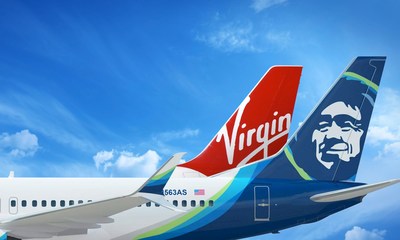
Alaska Air Group, Inc. (NYSE: ALK), parent company of Alaska Airlines, and Virgin America, Inc. (NASDAQ: VA) today announced that their boards of directors have unanimously approved a definitive merger agreement, under which Alaska Air Group will acquire Virgin America for $57.00 per share in cash. Including existing Virgin America indebtedness and capitalized aircraft operating leases, the aggregate transaction value is approximately $4.0 billion. With an expanded West Coast presence, a larger customer base, and an enhanced platform for growth, Alaska Airlines will be positioned to provide more choices for customers, increase competition and deliver attractive returns to investors.
The combination expands Alaska Airlines’ existing footprint in California, bolsters its platform for growth and strengthens the company as a competitor to the four largest U.S. airlines. Combining Alaska Airlines’ well-established core markets in the Pacific Northwest and the state of Alaska with Virgin America’s strong foundation in California will make Alaska Airlines the go-to airline for the more than 175,000 daily fliers in and out of Golden State airports, including San Francisco and Los Angeles.
For Virgin America customers, service will expand in the thriving technology markets in Silicon Valley and Seattle. The combined airline will also offer more frequent connections to international airline partners departing Seattle, San Francisco and Los Angeles. In addition, this transaction will open up growth opportunities in important East Coast business markets by increasing Alaska Airlines’ access to slot-controlled airports like Ronald Reagan Washington National Airport and the two primary New York City-area airports, John F. Kennedy International Airport and LaGuardia Airport.
“Our employees have worked hard to earn the deep loyalty of customers in the Pacific Northwest and Alaska, while the Virgin America team has done the same in California. Together we will continue to deliver what customers tell us they want: low fares, unmatched reliability and outstanding customer service,” said Brad Tilden, chairman and CEO of Alaska Air Group. “With our expanded network and strong presence in California, we’ll offer customers more attractive flight options for nonstop travel. We look forward to bringing together two incredible groups of employees to build on the successes they have achieved as standalone companies to make us an even stronger competitor nationally.”
David Cush, Virgin America president and CEO said, “Our mission has always been to create an airline that people love – and we accomplished that while changing the industry for the better. Joining forces with Alaska Airlines will ensure that our mission lives on, and that the stronger, combined company will continue to be a great place to work and an airline that focuses on an outstanding travel experience.”
“Today’s merger announcement of two great airlines coming together provides both pilot groups with an outstanding opportunity to benefit from the growth of the expanded Alaska Airlines’ route network,” said Captain Chris Notaro, chairman of the Alaska Airlines MEC of the Air Line Pilots Association. “We would like to welcome the professional pilots of Virgin America to the Alaska family and we look forward to a common goal of building a new joint pilot group that will benefit from a stronger and more prosperous airline that we have helped build.”
“Alaska Airlines and Virgin America are both known for providing an exceptional in-flight experience, thanks in large part to the dedication of our respective flight attendants,” said Jeffrey Peterson, president of the Association of Flight Attendants-CWA Master Executive Council at Alaska Airlines. “The combination of these two award-winning airlines provides an exciting opportunity for our members and for the Virgin America flight attendants, or Inflight Team Members. We look forward to joining together and building on our legacies of customer satisfaction to the benefit of both companies’ passengers.”
A Larger Network, More Choices and an Enhanced Mileage Plan
The transaction brings together two airlines that consistently earn customer admiration and the highest industry accolades:
Alaska Airlines has been ranked #1 among the nine largest carriers in the United States by The Wall Street Journal for overall operational performance for three years in a row, while Virgin America has placed #2 in the same study for the past two years.
Virgin America has been voted “Best Domestic Airline” in both Travel + Leisure’s Annual World’s Best Awards and Conde Nast Traveler’s Readers’ Choice Awards for the past eight consecutive years.
Alaska Airlines has been ranked “Highest in Customer Satisfaction Among Traditional Carriers” by J.D. Power for eight years running, and has been ranked #1 for on-time performance six years in a row by FlightStats.
Virgin America has been rated #1 for the past three years in the annual Airline Quality Rating report, an annual study of U.S. domestic airline performance based on public data submitted to the Department of Transportation and conducted by professors at Wichita State University and Embry-Riddle Aeronautical University.
Alaska Airlines has been named the most fuel-efficient airline by the International Council on Clean Technology for the last six years.
The combined airline will retain its safety-centric, employee-focused culture:
Alaska Airlines and Virgin America both have been named among America’s ‘best employers’ by Forbes, which annually ranks 500 U.S. companies based on responses to a survey of American workers.
Both Alaska Airlines and Virgin America are listed on the International Air Transport Association’s Operational Safety Audit (IOSA) registry, the globally recognized benchmark for the airline industry. Alaska Airlines has been on the registry for 10 years and Virgin America has qualified for six years.
Alaska Airlines expects that Virgin America’s Pilots, Inflight Teammates, Guest Services Teammates and maintenance technicians will be protected in the combination.
Together, the combined airline will have:
1,200 daily departures, with hubs in Seattle, San Francisco, Los Angeles, Anchorage, Alaska, and Portland, Oregon.
Approximately 280 aircraft, which include regional planes, with an average age of 8.5 years.
Virgin America’s fleet of 60 Airbus A319 and A320 aircraft boast three classes of service, in-flight WiFi and power outlets on every flight, as well as personal, touch-screen seatback entertainment.
Following closing, Alaska Airlines will welcome Virgin America Elevate loyalty program members into its Mileage Plan, ranked #1 by U.S. News and World Report. With Alaska Airlines Mileage Plan, members are able to redeem award miles for travel to more than 900 destinations worldwide, rivaling global alliances. Until the transaction closes, both loyalty programs will remain distinct – with no short-term impact on members. Upon closing, the programs will be merged. Alaska Airlines is committed to ensuring that loyalty members of both airlines maintain the same high-value rewards they’ve come to enjoy in both programs – with access to an even larger network.
Attractive Returns for Shareholders
Under the terms of the agreement, Alaska Air Group will acquire Virgin America for $57.00 per share in cash, representing a total equity value of $2.6 billion. The combined company expects to achieve $225 million annually in total net synergies at full integration. One-time integration costs are expected to be between $300-350 million. The combined airline is projected to have annual revenues of more than $7 billion. Alaska Air Group expects the transaction to be accretive to adjusted earnings per share in the first full year, excluding integration costs.
The transaction builds on both companies’ strong financial performance. In 2015, Alaska Air Group achieved a record full-year adjusted net income of $842 million, which increased 47 percent over 2014. Alaska Airlines also grew passenger revenues by 5 percent year-over-year, and has increased dividend payments 175 percent since initiation in 2013. In 2015, Alaska Airlines added 20 new markets and 10 new cities to its growing network and 11 new aircraft. As of March 31, 2016, Alaska Airlines had $1.6 billion in unrestricted cash and short-term investments.
Since its successful IPO in 2014, Virgin America has reached a number of milestones, most recently reporting a record annual year-over-year net income of $201 million, an increase of 139 percent in FY 2015, the highest in company history. In 2015, Virgin America also outperformed the industry in domestic unit revenue growth and began growing the airline with 10 new aircraft deliveries.
Preparing for Takeoff
The combined organization will be based in Seattle under the leadership of Tilden and his senior leadership team, who collectively have nearly 15 decades of combined airline industry experience. Until receiving regulatory approval to close, Tilden and Cush will co-lead a transition team, which will develop a specific integration plan.
Alaska Airlines and Virgin America are two of the most respected aviation brands in the United States (and globally in the case of Virgin). While the companies apply for a single operating certificate, Alaska will maintain its new, refreshed brand and will work closely with Virgin America to learn more about the award-winning Virgin America brand and customer experience. And over the next few months Alaska will explore with the Virgin Group how the Virgin America brand could continue to serve a role in driving customer acquisition and loyalty to get the best from both brands.
The merger, which has been approved unanimously by the boards of directors of both companies, is conditioned on receipt of regulatory clearance, approval by Virgin America shareholders and satisfaction of other customary closing conditions. The companies expect to complete the transaction with regulators’ approval no later than Jan. 1, 2017.
Advisors
BofA Merrill Lynch and UBS Investment Bank acted as lead financial advisors to Alaska Airlines on the transaction. Cowen & Company also acted as a financial advisor to the company. Evercore Group LLC acted as financial advisors to Virgin America. O’Melveny & Myers LLP acted as legal advisors to Alaska Airlines, and Latham & Watkins LLP acted as legal advisors to Virgin America.
Microsite and multimedia assets
Additional details about the transaction, including multimedia assets, are posted at www.FlyingBetterTogether.com and include:
A video featuring Alaska Airlines CEO Brad Tilden discussing the announcement;
A blog post with Tilden’s take on merging the two West Coast airlines;
Customer and investor FAQs; and
High-resolution, broadcast quality b-roll footage and images.
Investor and Media Conference Call and Webcast
Executives from Alaska Airlines and Virgin America will host a call for the investment community and media today at 5:30 a.m. Pacific time/8:30 a.m. Eastern time to discuss the transaction. To access the conference call, please dial 1-800-300-0356 FREE, referencing conference ID # 82998792. A slide presentation and the live audio webcast will be available and archived on the investor relations section of the Alaska Air Group website approximately one hour after the call concludes.
About Alaska Airlines
Alaska Airlines, a subsidiary of Alaska Air Group (NYSE: ALK), together with its partner regional airlines, serves more than 100 cities through an expansive network in Alaska, the Lower 48, Hawaii, Canada, Costa Rica and Mexico. Alaska Airlines ranked “Highest in Customer Satisfaction Among Traditional Carriers” in the J.D. Power North American Airline Satisfaction Study for eight consecutive years from 2008 to 2015. Alaska Airlines’ Mileage Plan also ranked “Highest in Customer Satisfaction among Airline Loyalty/Rewards Programs” for the second year in a row in the J.D. Power 2015 Airline Loyalty/Rewards Program Satisfaction Report. For reservations, visit www.alaskaair.com. For more news and information, visit the Alaska Airlines Newsroom at www.alaskaair.com/newsroom.
About Virgin America
Known for its mood-lit cabins, three beautifully designed classes of service and innovative fleetwide amenities — like touch-screen personal entertainment, WiFi and power outlets at every seat, Virgin America has earned a host of awards since launching in 2007 — including being named the “Best U.S. Airline” in Condé Nast Traveler’s Readers’ Choice Awards years and “Best Domestic Airline” in Travel + Leisure’s World’s Best Awards for the past eight consecutive years. For information, visit www.virginamerica.com.
Air New Zealand and Virgin Australia launch search for aviation biofuel opportunities
Air New Zealand and Virgin Australia today announced a partnership to investigate options for locally produced aviation biofuel.
The trans-Tasman alliance partners are issuing a Request for Information (RFI) to the market to explore the opportunity to procure locally-produced aviation biofuel.
Air New Zealand Chief Flight Operations and Safety Officer Captain David Morgan says the airline recognises the impact aviation has on the environment and this RFI is a key initiative under its carbon management programme.
“By working in partnership with our alliance partner Virgin Australia we hope we can stimulate the local market, drive innovation and investment and potentially uncover a sustainable biofuel supply suitable for our respective operations,” says Captain Morgan.
Virgin Australia Head of Sustainability Robert Wood says the airline is committed to stimulating the development of a sustainable aviation biofuel industry in the region.
“Aviation biofuel offers a significant opportunity for the aviation industry to reduce emissions whilst also building long-term fuel security for the sector,” says Mr Wood.
“We are seeing the development of the aviation biofuel industry accelerate internationally but that is not yet the case for our region. We are confident that our collaboration with Air New Zealand to procure a large volume of aviation biofuel will de-risk investment in the sector, creating high-tech, high-skilled jobs in the region.”
Both airlines are committed to ensuring that aviation biofuel delivers environmental, social and economic benefits, and respondents to the RFI are encouraged to address these principles.
Interested parties have until 30 May 2016 to express their interest.
Boeing Announces European Leadership Structure to Streamline & Drive Growth
London, – Boeing today announced a regionalized leadership structure in Europe, to streamline its corporate presence and drive business growth. The new structure aligns Boeing corporate leaders across the Continent into a unified team and integrates the company’s strategy development and government affairs initiatives at a regional level.
“These changes sharpen Boeing’s strategic focus on Europe, make us more efficient in how we operate and emphasize localized decision making on a pan-European basis,” said Marc Allen, president of Boeing International. “Boeing has long benefited from Europe’s tradition of innovation and excellence, with ties dating back 80 years. Building on this legacy, Boeing Europe will press forward in developing new, local business and partnership platforms to increase our global competitiveness.”
Effectively immediately, the positions of the following executives are expanded accordingly:
Sir Michael Arthur, president of Boeing United Kingdom and Ireland, will have an expanded leadership role as president of Boeing Europe.Arthur will continue to head Boeing in the U.K. and Ireland from London, but in the regional leadership role will also lead the company’s European strategy and operations, strengthening regional alignment and improving operating efficiencies.
Brian Moran is named vice president of Boeing Europe for government affairs and will report to Arthur. Already focused on EU and NATO relations in Brussels, Moran will have expanded regional responsibilities. He will work closely with Boeing’s national offices across the Continent to build and manage an integrated government affairs strategy at the pan-European level.
Antonio de Palmas is named managing director of Southern Europe and will report to Arthur. He will continue to lead Boeing Italy, while also taking responsibility for enterprise growth and productivity initiatives in Spain, Portugal and Greece and for Boeing Defense Space & Security marketing and business developments efforts in those countries.
Additionally, effective June 1, Mark Nieuwendijk becomes director of strategy and market development for Boeing Europe. He will help to design and implement the company’s pan-European growth, productivity and partnerships strategy across Europe. Currently, he is the co-managing director of AerData, a Boeing subsidiary, which Nieuwendijk co-founded, that sells software platforms and data services to aviation lessors and airlines.
Under the regional structure, the leaders of Boeing France and Boeing Germany & Northern Europe will report through Arthur.
Lower Noise Emissions, Up To Four Percent in Fuel Saving Thanks To Wingtip Extensions
Even before introducing the A350 long-haul aeroplane with an up to 50 percent smaller noise footprint, in future Lufthansa medium-haul planes will also be flying more quietly. This is because the Airbus A320 fleet is being fitted with ‘sharklets’, which are 2.40-metre-tall wingtip extensions. Depending on the length of the route, they bring about fuel savings of up to four percent and correspondingly low CO2 emissions. Thanks to the sharklets, the plane’s climbing performance improves, reducing noise emissions during take-off. “We are in a good position regarding sustainability in Munich. The fact that our fleet is getting quieter and quieter is good news for people who live near the airport in particular”, says Thomas Winkelmann, CEO Lufthansa Hub Munich.
Nature is the model for the sharklets. Large birds, such as the crane or the condor, bend their outer feathers upwards and thus fly in a much more energy-efficient way. The sharklets reduce the lift-dependent resistance and improve the aerodynamics at the wingtips. According to Airbus, the kerosene savings achieved, and thus reduced CO2 emissions, are around 1,000 tonnes per plane per year, which roughly corresponds to the CO2 emissions of 200 cars with average use.
The first Airbus A320 with sharklets has already been delivered to Munich, the second is to follow in the next few days. In total, 12 planes of this type will be stationed in the southern Lufthansa hub by the middle of next year, and there will be 20 planes in Frankfurt. They will all replace older medium-haul planes. Currently, Lufthansa deploys 50 planes of the types A319, A320 and A321 in Munich.
The FAA Reminds You to Register Your Drone
The Federal Aviation Administration (FAA) is reminding drone owners about this week’s registration deadline.
If you own a drone weighing more than 0.55 lbs. but less than 55 lbs., and you’ve been flying it outdoors or plan to fly it outdoors for hobby or recreation, federal law requires you to register by today Friday, February 19, 2016.
Registration is simple. You can register online at FAA.gov– it costs only $5 and is valid for three years. Once you complete the registration process, you will receive a certificate and an FAA registration number which must be marked on all unmanned aircraft that meet the registration weight requirement. You must have your certificate with you when you fly. You can print your certificate or save it to your personal electronic device, like your smartphone, or do both.
“Besides being required by law, registration provides an excellent opportunity to educate yourself if you are new to aviation, and it will help you become part of the safety culture that has been the hallmark of traditional aviation for more than a century,” said FAA Administrator Michael Huerta.
More than 342,000 people have already registered. Failure to register with the FAA could result in one or a combination of the following: a civil penalty of up to $27,500; a criminal fine of up to $250,000; imprisonment for up to three years.