IBM Signs Agreement to Acquire Aperto to Meet Growing Client Need for Digital Transformation
ARMONK, N.Y.- 02 Feb 2016: IBM (NYSE: IBM) today announced it has signed a definitive agreement to acquire Aperto – a digital agency with headquarters in Berlin. Upon completion of this transaction, Aperto will join the IBM Interactive Experience (IBM iX) team, supporting IBM’s growth in the largest economy in Europe.
Aperto’s 300-plus employees will continue to serve its roster of clients, which currently includes companies such as Airbus Group, Volkswagen and Siemens.
IBM iX is the largest global digital agency Ad Age Agency Report –2014 & 2015, providing clients a unique fusion of services spanning strategy, analytics and systems integration for scalable digital, commerce, mobile and wearable platforms –including consumer apps for the Apple Watch. Its consultants co-create solutions for clients, including Nationwide, Jaguar’s Landrover, Citi and Wimbledon, in its 25 global IBM Studios.
“IBM iX is a global market leader in experience design, which is emerging as an essential element in all business strategy,” said Paul Papas, Global Leader, IBM Interactive Experience. “We’re honored to be joining forces with Aperto and look forward to reshaping the future of business and digital innovation with our clients in Germany and beyond.”
“We pride ourselves on remaining at the forefront of the digital revolution. After 20 years in the industry, we’re proud to join forces with IBM iX, the largest global digital agency, to continue doing just that,” said Dirk Buddensiek, CEO, Aperto. “Between the talent sitting within the iX team, and IBM’s transformative work in the cognitive space, as well as leadership in cloud, mobile and analytics, this opportunity will open many doors for both our team and clients.”
IBM has identified a critical and growing need for digital, strategy and design skills at the leading edge of business strategy. Demand for experience design is expected to accelerate as clients in all industries seek to deliver more consumer-like experiences to their customers and employees, and integrate the power of cognitive computing and analytics platforms.
This is IBM’s second creative and digital agency acquisition in a matter of days. It follows Thursday’s announcement of IBM’s intent to acquire US-based agency Resource/Ammirati, and demonstrates continued investment in Germany. In December 2015 IBM launched its global headquarters for the Watson Internet of Things (IoT) unit in Munich.
The transaction is expected to close in the first quarter of 2016 and is subject to applicable regulatory review and customary closing conditions. Financial details were not disclosed.
The Fourth Industrial Revolution: What It Means, How to Respond – Klaus Schwab
We stand on the brink of a technological revolution that will fundamentally alter the way we live, work, and relate to one another. In its scale, scope, and complexity, the transformation will be unlike anything humankind has experienced before. We do not yet know just how it will unfold, but one thing is clear: the response to it must be integrated and comprehensive, involving all stakeholders of the global polity, from the public and private sectors to academia and civil society.
The First Industrial Revolution used water and steam power to mechanize production. The Second used electric power to create mass production. The Third used electronics and information technology to automate production. Now a Fourth Industrial Revolution is building on the Third, the digital revolution that has been occurring since the middle of the last century. It is characterized by a fusion of technologies that is blurring the lines between the physical, digital, and biological spheres.

4th-industrial-revolution
There are three reasons why today’s transformations represent not merely a prolongation of the Third Industrial Revolution but rather the arrival of a Fourth and distinct one: velocity, scope, and systems impact. The speed of current breakthroughs has no historical precedent. When compared with previous industrial revolutions, the Fourth is evolving at an exponential rather than a linear pace. Moreover, it is disrupting almost every industry in every country. And the breadth and depth of these changes herald the transformation of entire systems of production, management, and governance.
The possibilities of billions of people connected by mobile devices, with unprecedented processing power, storage capacity, and access to knowledge, are unlimited. And these possibilities will be multiplied by emerging technology breakthroughs in fields such as artificial intelligence, robotics, the Internet of Things, autonomous vehicles, 3-D printing, nanotechnology, biotechnology, materials science, energy storage, and quantum computing.
Already, artificial intelligence is all around us, from self-driving cars and drones to virtual assistants and software that translate or invest. Impressive progress has been made in AI in recent years, driven by exponential increases in computing power and by the availability of vast amounts of data, from software used to discover new drugs to algorithms used to predict our cultural interests. Digital fabrication technologies, meanwhile, are interacting with the biological world on a daily basis. Engineers, designers, and architects are combining computational design, additive manufacturing, materials engineering, and synthetic biology to pioneer a symbiosis between microorganisms, our bodies, the products we consume, and even the buildings we inhabit.
Challenges and opportunities
Like the revolutions that preceded it, the Fourth Industrial Revolution has the potential to raise global income levels and improve the quality of life for populations around the world. To date, those who have gained the most from it have been consumers able to afford and access the digital world; technology has made possible new products and services that increase the efficiency and pleasure of our personal lives. Ordering a cab, booking a flight, buying a product, making a payment, listening to music, watching a film, or playing a game—any of these can now be done remotely.
In the future, technological innovation will also lead to a supply-side miracle, with long-term gains in efficiency and productivity. Transportation and communication costs will drop, logistics and global supply chains will become more effective, and the cost of trade will diminish, all of which will open new markets and drive economic growth.
At the same time, as the economists Erik Brynjolfsson and Andrew McAfee have pointed out, the revolution could yield greater inequality, particularly in its potential to disrupt labor markets. As automation substitutes for labor across the entire economy, the net displacement of workers by machines might exacerbate the gap between returns to capital and returns to labor. On the other hand, it is also possible that the displacement of workers by technology will, in aggregate, result in a net increase in safe and rewarding jobs.
We cannot foresee at this point which scenario is likely to emerge, and history suggests that the outcome is likely to be some combination of the two. However, I am convinced of one thing—that in the future, talent, more than capital, will represent the critical factor of production. This will give rise to a job market increasingly segregated into “low-skill/low-pay” and “high-skill/high-pay” segments, which in turn will lead to an increase in social tensions.
In addition to being a key economic concern, inequality represents the greatest societal concern associated with the Fourth Industrial Revolution. The largest beneficiaries of innovation tend to be the providers of intellectual and physical capital—the innovators, shareholders, and investors—which explains the rising gap in wealth between those dependent on capital versus labor. Technology is therefore one of the main reasons why incomes have stagnated, or even decreased, for a majority of the population in high-income countries: the demand for highly skilled workers has increased while the demand for workers with less education and lower skills has decreased. The result is a job market with a strong demand at the high and low ends, but a hollowing out of the middle.
This helps explain why so many workers are disillusioned and fearful that their own real incomes and those of their children will continue to stagnate. It also helps explain why middle classes around the world are increasingly experiencing a pervasive sense of dissatisfaction and unfairness. A winner-takes-all economy that offers only limited access to the middle class is a recipe for democratic malaise and dereliction.
Discontent can also be fueled by the pervasiveness of digital technologies and the dynamics of information sharing typified by social media. More than 30 percent of the global population now uses social media platforms to connect, learn, and share information. In an ideal world, these interactions would provide an opportunity for cross-cultural understanding and cohesion. However, they can also create and propagate unrealistic expectations as to what constitutes success for an individual or a group, as well as offer opportunities for extreme ideas and ideologies to spread.
The impact on business
An underlying theme in my conversations with global CEOs and senior business executives is that the acceleration of innovation and the velocity of disruption are hard to comprehend or anticipate and that these drivers constitute a source of constant surprise, even for the best connected and most well informed. Indeed, across all industries, there is clear evidence that the technologies that underpin the Fourth Industrial Revolution are having a major impact on businesses.
On the supply side, many industries are seeing the introduction of new technologies that create entirely new ways of serving existing needs and significantly disrupt existing industry value chains. Disruption is also flowing from agile, innovative competitors who, thanks to access to global digital platforms for research, development, marketing, sales, and distribution, can oust well-established incumbents faster than ever by improving the quality, speed, or price at which value is delivered.
Major shifts on the demand side are also occurring, as growing transparency, consumer engagement, and new patterns of consumer behavior (increasingly built upon access to mobile networks and data) force companies to adapt the way they design, market, and deliver products and services.
A key trend is the development of technology-enabled platforms that combine both demand and supply to disrupt existing industry structures, such as those we see within the “sharing” or “on demand” economy. These technology platforms, rendered easy to use by the smartphone, convene people, assets, and data—thus creating entirely new ways of consuming goods and services in the process. In addition, they lower the barriers for businesses and individuals to create wealth, altering the personal and professional environments of workers. These new platform businesses are rapidly multiplying into many new services, ranging from laundry to shopping, from chores to parking, from massages to travel.
On the whole, there are four main effects that the Fourth Industrial Revolution has on business—on customer expectations, on product enhancement, on collaborative innovation, and on organizational forms. Whether consumers or businesses, customers are increasingly at the epicenter of the economy, which is all about improving how customers are served. Physical products and services, moreover, can now be enhanced with digital capabilities that increase their value. New technologies make assets more durable and resilient, while data and analytics are transforming how they are maintained. A world of customer experiences, data-based services, and asset performance through analytics, meanwhile, requires new forms of collaboration, particularly given the speed at which innovation and disruption are taking place. And the emergence of global platforms and other new business models, finally, means that talent, culture, and organizational forms will have to be rethought.
Overall, the inexorable shift from simple digitization (the Third Industrial Revolution) to innovation based on combinations of technologies (the Fourth Industrial Revolution) is forcing companies to reexamine the way they do business. The bottom line, however, is the same: business leaders and senior executives need to understand their changing environment, challenge the assumptions of their operating teams, and relentlessly and continuously innovate.
The impact on government
As the physical, digital, and biological worlds continue to converge, new technologies and platforms will increasingly enable citizens to engage with governments, voice their opinions, coordinate their efforts, and even circumvent the supervision of public authorities. Simultaneously, governments will gain new technological powers to increase their control over populations, based on pervasive surveillance systems and the ability to control digital infrastructure. On the whole, however, governments will increasingly face pressure to change their current approach to public engagement and policymaking, as their central role of conducting policy diminishes owing to new sources of competition and the redistribution and decentralization of power that new technologies make possible.
Ultimately, the ability of government systems and public authorities to adapt will determine their survival. If they prove capable of embracing a world of disruptive change, subjecting their structures to the levels of transparency and efficiency that will enable them to maintain their competitive edge, they will endure. If they cannot evolve, they will face increasing trouble.
This will be particularly true in the realm of regulation. Current systems of public policy and decision-making evolved alongside the Second Industrial Revolution, when decision-makers had time to study a specific issue and develop the necessary response or appropriate regulatory framework. The whole process was designed to be linear and mechanistic, following a strict “top down” approach.
But such an approach is no longer feasible. Given the Fourth Industrial Revolution’s rapid pace of change and broad impacts, legislators and regulators are being challenged to an unprecedented degree and for the most part are proving unable to cope.
How, then, can they preserve the interest of the consumers and the public at large while continuing to support innovation and technological development? By embracing “agile” governance, just as the private sector has increasingly adopted agile responses to software development and business operations more generally. This means regulators must continuously adapt to a new, fast-changing environment, reinventing themselves so they can truly understand what it is they are regulating. To do so, governments and regulatory agencies will need to collaborate closely with business and civil society.
The Fourth Industrial Revolution will also profoundly impact the nature of national and international security, affecting both the probability and the nature of conflict. The history of warfare and international security is the history of technological innovation, and today is no exception. Modern conflicts involving states are increasingly “hybrid” in nature, combining traditional battlefield techniques with elements previously associated with nonstate actors. The distinction between war and peace, combatant and noncombatant, and even violence and nonviolence (think cyberwarfare) is becoming uncomfortably blurry.
As this process takes place and new technologies such as autonomous or biological weapons become easier to use, individuals and small groups will increasingly join states in being capable of causing mass harm. This new vulnerability will lead to new fears. But at the same time, advances in technology will create the potential to reduce the scale or impact of violence, through the development of new modes of protection, for example, or greater precision in targeting.
The impact on people
The Fourth Industrial Revolution, finally, will change not only what we do but also who we are. It will affect our identity and all the issues associated with it: our sense of privacy, our notions of ownership, our consumption patterns, the time we devote to work and leisure, and how we develop our careers, cultivate our skills, meet people, and nurture relationships. It is already changing our health and leading to a “quantified” self, and sooner than we think it may lead to human augmentation. The list is endless because it is bound only by our imagination.
I am a great enthusiast and early adopter of technology, but sometimes I wonder whether the inexorable integration of technology in our lives could diminish some of our quintessential human capacities, such as compassion and cooperation. Our relationship with our smartphones is a case in point. Constant connection may deprive us of one of life’s most important assets: the time to pause, reflect, and engage in meaningful conversation.
One of the greatest individual challenges posed by new information technologies is privacy. We instinctively understand why it is so essential, yet the tracking and sharing of information about us is a crucial part of the new connectivity. Debates about fundamental issues such as the impact on our inner lives of the loss of control over our data will only intensify in the years ahead. Similarly, the revolutions occurring in biotechnology and AI, which are redefining what it means to be human by pushing back the current thresholds of life span, health, cognition, and capabilities, will compel us to redefine our moral and ethical boundaries.
Shaping the future
Neither technology nor the disruption that comes with it is an exogenous force over which humans have no control. All of us are responsible for guiding its evolution, in the decisions we make on a daily basis as citizens, consumers, and investors. We should thus grasp the opportunity and power we have to shape the Fourth Industrial Revolution and direct it toward a future that reflects our common objectives and values.
To do this, however, we must develop a comprehensive and globally shared view of how technology is affecting our lives and reshaping our economic, social, cultural, and human environments. There has never been a time of greater promise, or one of greater potential peril. Today’s decision-makers, however, are too often trapped in traditional, linear thinking, or too absorbed by the multiple crises demanding their attention, to think strategically about the forces of disruption and innovation shaping our future.
In the end, it all comes down to people and values. We need to shape a future that works for all of us by putting people first and empowering them. In its most pessimistic, dehumanized form, the Fourth Industrial Revolution may indeed have the potential to “robotize” humanity and thus to deprive us of our heart and soul. But as a complement to the best parts of human nature—creativity, empathy, stewardship—it can also lift humanity into a new collective and moral consciousness based on a shared sense of destiny. It is incumbent on us all to make sure the latter prevails.
Author: Klaus Schwab, Founder and Executive Chairman, World Economic Forum. Klaus Schwab was born in Germany in 1938. He holds two doctoral degrees, one in mechanical engineering and another in economics and social sciences, and started his professional life as the youngest professor at the University of Geneva. He is the recipient of numerous awards and holds honorary professorships and doctorates from universities around the world. Schwab founded the Forum in 1971. In 1998, he and his wife Hilde created the Schwab Foundation for Social Entrepreneurship, which supports social initiatives that significantly improve people’s lives and can be reproduced on a global scale. In 2014, hoping to integrate more young people into global decision-making processes, Schwab established the Forum of Young Global Leaders for leaders under the age of 40. Seven years later, he created the Global Shapers Community, for potential leaders between the ages of 20 and 30.
Microsoft and Red Hat to Deliver New Standard for Enterprise Cloud Experiences
REDMOND, Wash., and RALEIGH, N.C. — Microsoft Corp. (Nasdaq “MSFT”) and Red Hat Inc. (NYSE: RHT) on Wednesday announced a partnership that will help customers embrace hybrid cloud computing by providing greater choice and flexibility deploying Red Hat solutions on Microsoft Azure. As a key component of today’s announcement, Microsoft is offering Red Hat Enterprise Linux as the preferred choice for enterprise Linux workloads on Microsoft Azure. In addition, Microsoft and Red Hat are also working together to address common enterprise, ISV and developer needs for building, deploying and managing applications on Red Hat software across private and public clouds.
Key elements of the partnership include the following:
Red Hat solutions available natively to Microsoft Azure customers. In the coming weeks, Microsoft Azure will become a Red Hat Certified Cloud and Service Provider, enabling customers to run their Red Hat Enterprise Linux applications and workloads on Microsoft Azure. Red Hat Cloud Access subscribers will be able to bring their own virtual machine images to run in Microsoft Azure. Microsoft Azure customers can also take advantage of the full value of Red Hat’s application platform, including Red Hat JBoss Enterprise Application Platform, Red Hat JBoss Web Server, Red Hat Gluster Storage and OpenShift, Red Hat’s platform-as-a-service offering. In the coming months, Microsoft and Red Hat plan to provide Red Hat On-Demand — “pay-as-you-go” Red Hat Enterprise Linux images available in the Azure Marketplace, supported by Red Hat.
Integrated enterprise-grade support spanning hybrid environments. Customers will be offered cross-platform, cross-company support spanning the Microsoft and Red Hat offerings in an integrated way, unlike any previous partnership in the public cloud. By co-locating support teams on the same premises, the experience will be simple and seamless, at cloud speed.
Unified workload management across hybrid cloud deployments. Red Hat CloudForms will interoperate with Microsoft Azure and Microsoft System Center Virtual Machine Manager, offering Red Hat CloudForms customers the ability to manage Red Hat Enterprise Linux on both Hyper-V and Microsoft Azure. Support for managing Azure workloads from Red Hat CloudForms is expected to be added in the next few months, extending the existing System Center capabilities for managing Red Hat Enterprise Linux.
Collaboration on .NET for a new generation of application development capabilities. Expanding on the preview of .NET on Linux announced by Microsoft in April, developers will have access to .NET technologies across Red Hat offerings, including Red Hat OpenShift and Red Hat Enterprise Linux, jointly backed by Microsoft and Red Hat. Red Hat Enterprise Linux will be the primary development and reference operating system for .NET Core on Linux.
“This partnership is a powerful win for enterprises, ISVs and developers,” said Scott Guthrie, executive vice president for Microsoft’s Cloud and Enterprise division. “With this partnership, we are expanding our commitment to offering unmatched choice and flexibility in the cloud today, meeting customers where they are so they can do more with their hybrid cloud deployments — all while fulfilling the rigorous security and scalability requirements that enterprises demand.”
“The datacenter is heterogeneous, and the cloud is hybrid,” said Paul Cormier, president, Products and Technologies, Red Hat. “With Red Hat and the leader in enterprise cloud workloads joining forces, our customers are the winners today, as we unite on common solutions to help them solve challenges in this hybrid cloud. Together, we’re offering the most comprehensive support agreement for our mixed technologies to support customers.”
Additional information on the partnership is available on The Official Microsoft Blog and the Red Hat Blog. A live webcast with executives from both companies will begin at 11 a.m. EST/8 a.m. PST Wednesday and can be accessed by the general public at https://vts.inxpo.com/Launch/QReg.htm?ShowKey=28455. Following executive remarks, there will be a question and answer session. A replay of the webcast will be available shortly after the live event has ended.
About Red Hat Inc.
Red Hat is the world’s leading provider of open source software solutions, using a community-powered approach to reliable and high-performing cloud, Linux, middleware, storage and virtualization technologies. Red Hat also offers award-winning support, training, and consulting services. As the connective hub in a global network of enterprises, partners, and open source communities, Red Hat helps create relevant, innovative technologies that liberate resources for growth and prepare customers for the future of IT. Learn more at http://www.redhat.com.
About Microsoft
Microsoft (Nasdaq “MSFT” @microsoft) is the leading platform and productivity company for the mobile-first, cloud-first world, and its mission is to empower every person and every organization on the planet to achieve more.
Red Hat, Red Hat Enterprise Linux, JBoss, Gluster, OpenShift, CloudForms and the Shadowman logo are trademarks of Red Hat, Inc., registered in the U.S. and other countries. Linux® is the registered trademark of Linus Torvalds in the U.S. and other countries. The use of the word “partnership” does not imply a legal partnership between Red Hat and any other company.
Softbank Deploys Cisco Evolved Services Platform Technologies to Increase Customer Experience and Flexibility
DUSSELDORF, GERMANY — (Marketwired) – Cisco (NASDAQ: CSCO) — At SDN & OpenFlow World Congress, Softbank Corp. announced that it will deploy an upgraded architecture of Softbank’s White Cloud SmartVPN, utilizing Cisco Evolved Services Platform (ESP) Orchestration, software defined networking (SDN) and network function virtualization (NFV) technologies. The enhanced architecture reduces the time to deployment for new enterprise services from weeks to minutes, while allowing for greater elasticity of customer demand by utilizing service chaining of new virtual network functions.
The Softbank White Cloud SmartVPN offers enterprise customers a differentiated network service with a selection of multi-vendor networking equipment offerings. Traditionally, network operators have built service chains of L4-L7 security functions by wiring cables between physical network devices. This service chaining infrastructure is expensive, difficult to manage, and inflexible for differentiated service offerings to diverse customer segments. In contrast, service chaining using SDN creates software-controlled service chains in which traffic is steered through the appropriate security functions for a given flow, based on customer profile, service type or other characteristics.
Softbank is using Cisco’s Network Services Orchestrator (NSO) enabled by Tail-f for the provisioning of both its physical and virtual elements. Cisco NSO is an extremely flexible standards-based DevOps product that enables rapid development and modification of network services. Using strict, standardized YANG models for both services and devices, NSO automates all of the multi-vendor devices, making it easy to change and reconfigure services on-demand, without time-consuming and error-prone manual effort.
Softbank has also deployed Cisco’s Virtual Topology System to stitch the dynamic service chains within the data center. The Cisco Virtual Topology System is a standards-based, open software-overlay management and provisioning system. It automates data center network fabric provisioning for virtual and physical infrastructure.
The White Cloud SmartVPN uses a self-service online portal to give customers a simple way to select security policies and scalable network services associated with changes of business requirements.
Supporting Quotes:
“Our new Cisco architecture has enabled us to dramatically increase our ability to provide highly responsive customer experience,” said Sadahiro Sato senior vice president of ICT innovation, Softbank. “The flexibility and open nature of the Cisco Evolved Services Platform will equip us with the tools to innovate new services at a rapid pace and keep ahead of our competition. Automation and elasticity on demand will also help us dramatically reduce both our operating and capital costs as we grow the offering.”
“We are delighted to partner with Softbank to unlock network innovation and accelerate service creation and deployment,” said Gee Rittenhouse, senior vice president of cloud and virtualization, Cisco. “Softbank was able to enable an open, modular multi-vendor architecture that suits its specific needs by utilizing Orchestration, NFV and SDN products from Cisco’s Evolved Services Platform. This new business solution is an exciting opportunity for Cisco to work with such an innovative and customer-centric service provider.”
About Cisco
Cisco (NASDAQ: CSCO) is the worldwide leader in IT that helps companies seize the opportunities of tomorrow by proving that amazing things can happen when you connect the previously unconnected. For ongoing news, please go to http://thenetwork.cisco.com.
About Softbank
SoftBank Corp., a subsidiary of SoftBank Group Corp. (TOKYO: 9984), provides mobile communication, fixed-line communication and Internet connection services to customers in Japan. Leveraging synergies with other companies in the SoftBank Group, SoftBank Corp. aims to transform lifestyles through ICT and expand into other business areas including IoT, robotics and energy. To learn more, please visit www.softbank.jp/en/corp/group/sbm/
Cisco and the Cisco logo are trademarks or registered trademarks of Cisco and/or its affiliates in the U.S. and other countries. A listing of Cisco’s trademarks can be found at www.cisco.com/go/trademarks. Third-party trademarks mentioned are the property of their respective owners. The use of the word partner does not imply a partnership relationship between Cisco and any other company.
Facebook is Testing New Video Experiences According to Will Cathcart, VP of Product Management

Since our update last year, video has continued to grow on Facebook. It has become an integral part of how people around the world discover, watch and share videos they care about every day. Today, we want to provide another update on some of the things we’ve been working on over the past year, along with some of the new features you may see in the coming months.
New Immersive Video Formats
In August, we announced that public figures can share live video with their fans via Mentions, and we’ve seen thousands of authentic and candid live videos, from Vin Diesel to Serena Williams and many more. We rolled out 360 video on Facebook in September, enabling people to view a video from all angles right in News Feed. Star Wars and Discovery were among the first publishers to share these stunning videos on Facebook.
New Video Tests
We know people enjoy these more immersive video experiences, but we’re also learning that people want to watch videos in different ways at different times. We have been testing a number of new features that give people more flexibility when watching videos, whether you’re watching a video in News Feed on-the-go or sitting down to enjoy multiple videos back-to-back.
Suggested videos
Suggested videos is one of the features we’ve been testing on iPhone, making it easy to discover multiple related videos in a row after you tap on a video from News Feed. While we’re still in the early days of testing, we’re pleased with initial results, which show that people who have suggested videos are discovering and watching more new videos. We’ve now rolled out suggested videos to most people on iPhone globally, and are starting to test ads within the experience. We are also starting to test this on the web, and plan to test on Android phones in the coming months.
In addition to helping people find more videos they may be interested in, we know people sometimes want to multitask while they watch videos. To make this possible, we’re testing a way for people to watch a video in a floating screen while simultaneously multitasking on Facebook.
We also know that sometimes people want to watch a video, but they don’t have time or aren’t in a place where they can turn on sound. To make it easy to return to the videos you’re interested in, we’ve been testing a button that allows you to save a video to watch later, which can be accessed in your “Saved” bookmark.
Videos section
Lastly, we’ll be testing a dedicated place on Facebook for people to go when they exclusively want to watch video—whether that’s videos they’ve saved for later, or videos from friends, Pages they follow, and other video publishers on Facebook. This new videos section helps people discover, watch and share videos on Facebook that are relevant to them. It can be accessed by tapping a “Videos” icon at the bottom of the Facebook app on iPhone or in the “Favorites” section on the left-hand side of News Feed on the web. We’ll be testing this with a small number of people now, so this isn’t something most people will see on Facebook right away. We look forward to seeing how people use it to discover, watch and share videos with their friends.
Tools for Publishers
We’ve also been working on a number of features for publishers to help them better manage and control their videos on Facebook. We recently began testing new video matching technology with a set of partners, with the long-term goal of providing a comprehensive video management system for creators. We’ve also rolled out new video tools for Pages — like updates to Page Insights and video upload improvements — to help video publishers grow their businesses on Facebook.
The last few years have been exciting for video, and we look forward to seeing more people discover the videos that matter to them on Facebook.
Dell Signs Definitive Agreement to Acquire EMC Corporation and Create Premier End-to-End Technology Company
Dell Inc. and EMC Corporation today announced they have signed a definitive agreement under which Dell, together with its owners, Michael S. Dell, founder, chairman and chief executive officer of Dell, MSD Partners and Silver Lake, the global leader in technology investing, will acquire EMC Corporation, while maintaining VMware as a publicly-traded company.
Under the terms of the agreement, EMC shareholders will receive $24.05 per share in cash in addition to tracking stock linked to a portion of EMC’s economic interest in the VMware business. Based on the estimated number of EMC shares outstanding at the close of the transaction, EMC shareholders are expected to receive approximately 0.111 shares of new tracking stock for each EMC share. Assuming, for illustrative purposes, a valuation for each share of tracking stock of $81.78, the intraday volume-weighted average price for VMware on Wednesday, October 7, 2015, EMC shareholders would receive a total combined consideration of $33.15 per EMC share and the total transaction would be valued at approximately $67 billion. The value of the tracking stock may vary from the market price of VMware given the different characteristics and rights of the two stocks.
The EMC Board of Directors approved the merger agreement and intends to recommend that stockholders of EMC approve the agreement.
DELIVERING FUTURE-READY TECHNOLOGIES TO CUSTOMERS
The combination of Dell and EMC will create the world’s largest privately-controlled, integrated technology company. The company will be a leader in the extremely attractive high-growth areas of the $2 trillion information technology market with complementary product portfolios, sales teams and R&D investment strategies. The transaction combines two of the world’s greatest technology franchises with leadership positions in servers, storage, virtualization and PCs and it brings together strong capabilities in the fastest growing areas of the industry, including digital transformation, software-defined data center, hybrid cloud, converged infrastructure, mobile and security.
Since becoming a private company, Dell has had the flexibility and agility to focus completely on customers and invest for long-term results. The transaction will unite Dell’s strength with small business and mid-market customers with EMC’s strength with large enterprises to fuel profitable growth and generate significant cash flows. The combined company will consist of strategically-aligned businesses and incubated high-growth assets, fostering innovation, enabling customer choice and attracting and retaining world-class talent .
“The combination of Dell and EMC creates an enterprise solutions powerhouse bringing our customers industry leading innovation across their entire technology environment. Our new company will be exceptionally well-positioned for growth in the most strategic areas of next generation IT including digital transformation, software-defined data center, converged infrastructure, hybrid cloud, mobile and security,” said Mr. Dell. “Our investments in R&D and innovation along with our privately-controlled structure will give us unmatched scale, strength and flexibility, deepening our relationships with customers of all sizes. I am incredibly excited to partner with the EMC, VMware, Pivotal, VCE, RSA and Virtustream teams and am personally committed to the success of our new company, our customers and partners.”
“I’m tremendously proud of everything we’ve built at EMC – from humble beginnings as a Boston-based startup to a global, world-class technology company with an unyielding dedication to our customers,” said Joe Tucci, chairman and chief executive officer of EMC. “But the waves of change we now see in our industry are unprecedented and, to navigate this change, we must create a new company for a new era. I truly believe that the combination of EMC and Dell will prove to be a winning combination for our customers, employees, partners and shareholders.”
“We are excited and honored to invest in the outstanding businesses built by Joe Tucci and his world-class management team. This is an extraordinary opportunity to continue and expand our partnership with the iconic technology entrepreneur Michael Dell and his talented team,” said Egon Durban, managing partner of Silver Lake. “We believe the strategic integration of EMC and Dell will generate unparalleled depth and breadth across servers, storage, virtualization and the next era of converged infrastructure, creating a global technology platform poised for sustained long term growth and innovation in the years to come. We are doubling down and increasing our investment in this differentiated market leader for the next paradigm of enterprise computing.”
VMware will remain a publicly-traded company and continue to provide customers value through leading software- defined data center technology, together with its cloud, mobile and desktop offerings. This transaction is expected to accelerate VMware’s growth across all of its businesses through significant synergies with Dell’s solutions and go-to-market channels. VMware remains committed to investing in and partnering with its strong, industry ecosystem.
TRANSACTION TERMS
The transaction is expected to be financed through a combination of new common equity from Michael S. Dell, MSD Partners, Silver Lake and Temasek, the issuance of tracking stock, as well as new debt financing and cash on hand. There are no financing conditions to the closing of the transaction.
Mr. Dell and related stockholders will own approximately 70 percent of the company’s common equity, excluding the tracking stock, similar to their pre-transaction ownership.
Following completion of the transaction, Mr. Dell will lead the combined company as chairman and chief executive officer. Mr. Tucci will continue as chairman and chief executive officer of EMC until the transaction closes. Dell’s headquarters will remain in Round Rock, Texas, and the headquarters of the combined enterprise systems business will be located in Hopkinton, Mass.
Historically, Dell and EMC have maintained conservative financial policies, and have strong track records of cash flow generation and debt reduction. The transaction is expected to have a neutral to positive impact on Dell’s current corporate credit ratings. The combined company will focus on rapidly de-levering in the first 18 to 24 months following the closing of the transaction, and on achieving and maintaining investment grade debt ratings.
In connection with the financing of the transaction and prior to or at the time of its closing, Dell expects to redeem any outstanding 5.625% Senior First Lien Notes due 2020.
The transaction is subject to customary conditions, including receipt of required regulatory and EMC stockholder approvals. The transaction is expected to close in the second or third quarter of Dell’s fiscal year ending February 3, 2017 (within the months of May to October 2016).
For further information regarding all terms and conditions contained in the definitive merger agreement, please see EMC’s Current Report on Form 8-K, which will be filed in connection with this transaction.
Morgan Stanley & CO LLC is acting as lead financial advisor to EMC and provided a fairness opinion to EMC’s Board of Directors. Evercore Partners also provided a fairness opinion to EMC’s Board of Directors, and Needham and Company provided financial assistance to EMC. Skadden, Arps, Slate, Meagher & Flom LLP is acting as legal advisor to EMC. J.P. Morgan is acting as lead financial advisor to Dell and Silver Lake. Credit Suisse and J.P. Morgan (in alphabetical order) are acting as global financing coordinators. Barclays, BofA Merrill Lynch, Citi, Credit Suisse, Deutsche Bank Securities Inc., affiliates of Goldman, Sachs & Co., J.P. Morgan, and RBC Capital Markets (in alphabetical order) are acting as financial advisors and are providing debt financing to Dell. Simpson Thacher & Bartlett LLP is acting as legal advisor to Dell and Silver Lake. Wachtell, Lipton, Rosen & Katz is acting as legal advisor to Michael Dell and MSD Partners.
About Dell
Dell Inc. listens to customers and delivers innovative technology and services that give them the power to do more. For more information, visit www.dell.com.
Dell World
Join us Oct. 20-22 at Dell World 2015, Dell’s flagship event bringing together technology and business professionals to network, share ideas and help co-create a better future. Learn more at www.dellworld.com and follow #DellWorld on Twitter.
About EMC
EMC Corporation is a global leader in enabling businesses and service providers to transform their operations and deliver IT as a service. Fundamental to this transformation is cloud computing. Through innovative products and services, EMC accelerates the journey to cloud computing, helping IT departments to store, manage, protect and analyze their most valuable asset – information – in a more agile, trusted and cost-efficient way. Additional information about EMC can be found at www.EMC.com.
About VMware
VMware is a leader in cloud infrastructure and business mobility. Built on VMware’s industry-leading virtualization technology, our solutions deliver a brave new model of IT that is fluid, instant and more secure. Customers can innovate faster by rapidly developing, automatically delivering and more safely consuming any application. With 2014 revenues of $6 billion, VMware has more than 500,000 customers and 75,000 partners. The company is headquartered in Silicon Valley with offices throughout the world and can be found online at www.VMware.com.
About Silver Lake
Silver Lake is the global leader in technology investing, with over $26 billion in combined assets under management and committed capital. The firm’s portfolio of investments collectively generates more than $85 billion of revenue annually and employs more than 170,000 people globally. Silver Lake has a team of approximately 100 investment and value creation professionals located in New York, Menlo Park, San Mateo, London, Hong Kong and Tokyo. The firm’s current portfolio includes leading technology and technology-enabled businesses such as Alibaba Group, Avago, Avaya, Dell, Global Blue, Go Daddy, Hillstone Networks, Intelsat, Interactive Data Corporation, Qunar, Quorum Business Solutions, Red Ventures, Sabre, SMART Modular, SunGard, Vantage Data Centers, Virtu Financial and WME/IMG. For more information about Silver Lake and its entire portfolio, please visit www.silverlake.com.
About MSD Partners
MSD Partners, L.P., an SEC-registered investment adviser, was formed in 2009 by the principals of MSD Capital, L.P. to enable a select group of investors to invest in strategies that were developed by MSD Capital. MSD Capital was established in 1998 to exclusively manage the capital of Michael Dell and his family. MSD Partners utilizes a multi-disciplinary investment strategy focused on maximizing long-term capital appreciation by making investments across the globe in the equities of public and private companies, credit, real estate and other asset classes and securities. MSD Partners’ team operates from the firm’s offices in New York and London.
About Temasek
Incorporated in 1974, Temasek is an investment company based in Singapore, with a US$177 billion portfolio as at March 31, 2015. Temasek’s portfolio covers a broad spectrum of sectors, including financial services; telecommunications, media & technology; consumer; energy & resources; life sciences, among others. For more information on Temasek, please visit www.temasek.com.sg.
Microsoft Redefines the Laptop with Surface Book, Ushers in New Era of Windows 10 Devices
NEW YORK — Microsoft Corp. on Tuesday unveiled new Surface, Lumia and Microsoft Band devices, taking advantage of powerful and versatile hardware to unlock new Windows 10 experiences, including fast and secured login with Windows Hello1; new Cortana2 experiences that turn Windows 10 devices into a personal assistant; improved touch and pen experiences on Surface; and Continuum for phones, which enables the new Lumia 950 and 950 XL phones to work like PCs3. Showcasing the innovation possible with Windows 10, Microsoft also shared new gaming experiences from Xbox and new details on Microsoft HoloLens, the first fully untethered holographic computer.
Now running on 110 million devices around the world, Windows 10 is off to the fastest start in history — seeing upgrades at three times the rate of Windows 7 in the same time period. With more than 1.25 billion visits to the Windows Store, Microsoft announced all-new universal apps for Windows 10, including Box, Facebook, Instagram, Candy Crush Soda Saga, Flipagram, Uber, and others. These apps add to the existing Windows 10 experiences that will be available on the new Microsoft devices.
“With Windows 10 and these new Microsoft devices, you are at the center of magical new experiences,” said Satya Nadella, chief executive officer of Microsoft. “We’re moving people from needing to choosing to loving Windows, and these devices promise to fuel even more enthusiasm and opportunity for the entire Windows ecosystem.”
Surface redefines the laptop
Building on its track record of pioneering new categories, Microsoft is redefining the laptop with the new Surface Book — a powerful, high-performance laptop with stunning craftsmanship and incredibly accurate and responsive pen and touch support. Ultrathin, Surface Book combines the impressive power of 6th Generation Intel® Core™ i5 and Core™ i7 processors with up to 12 hours of battery life4. The 13.5-inch optically bonded PixelSense Display delivers a high-contrast 267 dpi display with improved latency and parallax, making it not just beautiful to look at but natural and fluid to write on. The screen also detaches, so it can be used like a clipboard to sketch, take notes and benefit from Windows programs like Microsoft Edge. An optional discrete GPU allows Surface Book to harness the full power of hardware-accelerated graphics for seamless video editing, fast rendering or immersive gaming. Surface Book starts at $1,4995.
The tablet that can replace your laptop just got thinner, lighter, faster
Microsoft also introduced Surface Pro 4, the thinnest, lightest and most powerful tablet that can replace your laptop. At only 8.4 mm thin, it features a stunning 12.3-inch PixelSense Display and 6th Generation Intel® Core™ m, Core™ i5, and Core™ i7 processors, enabling everyone from students to professionals to get more done on the go. Starting at $8995, Surface Pro 4 is not only 30 percent more powerful than Surface Pro 3 but also quieter, runs cooler, and is even more efficient with up to nine hours of battery life4. The new Surface Pro 4 Type Cover6 takes Surface Pro 4 from tablet to laptop in an instant and features a redesigned mechanical keyboard with optimal key spacing for fast and fluid typing. Backwards compatible with Surface Pro 3, the new Surface Pro 4 Type Cover comes with an optional fingerprint reader, bringing the convenience and enterprise-grade security of Windows Hello to existing customers. The redesigned Surface Pen packs 1,024 levels of pressure sensitivity, letting you write, draw and mark documents with precision ink on one end and an eraser on the other.
Surface Book, Surface Pro 4 and new accessories are available for preorder in select markets Oct. 7, then for purchase in Canada and the United States on Oct. 26, with additional markets to follow. Full device and accessory specs are available here, here and here.
Lumia phones showcase the power of Windows 10
The company also reinforced its commitment to mobile with the introduction of Lumia 950 and Lumia 950 XL, the first Windows 10 Lumia phones and newest premium phones from Microsoft. With more people using multiple devices throughout their day, Windows 10 provides a familiar and consistent experience that enables a seamless and productive transition from one device to another, whether PCs, tablets or the new phones. With Continuum capability for phones enhanced by the new Microsoft Display Dock accessory, connect the phone to a monitor and transform it for larger-screen entertainment, or add a keyboard and mouse to work like a PC with Windows 10 apps like Microsoft Office, while simultaneously taking calls or performing other tasks6. With the latest-generation PureView cameras with 20-megapixel sensors, triple LED natural flash and 4K video capture, the Lumia 950 and Lumia 950 XL enable faster focus and crisper images and videos even in challenging conditions. Lumia 950 and Lumia 950 XL will become available in select markets in November; local retailers or operators can give pricing and availability. Full device specs are available here and here.
Lumia 550, Microsoft’s most affordable 4G LTE smartphone running Windows 10, also joins the Lumia family7. For people who value affordability, uncompromised quality and signature Microsoft services, Lumia 550 combines superfast Internet, the latest Qualcomm® Snapdragon™ quad-core processor with ultrafast LTE speeds, and the best of Microsoft services for just $1395. Lumia 550 will begin rolling out in select European markets in December, with additional markets to follow. Full device specs are available here.
Achieve your fitness goals with Microsoft Band 2
Microsoft also announced Microsoft Band 2, the latest fitness wearable designed to help you live healthier and achieve more. The new Microsoft Band features a new curved display, making it even more comfortable to wear, and Cortana8 enables you to reply to texts or set reminders with the touch of a button. Alongside a continuous optical heart rate monitor and onboard GPS, the smart band still tracks calories burned, deep exercise and sleep quality — and now records floors climbed — all while maintaining up to two-day battery life. Microsoft Health is available as a universal Windows app, a dedicated app for iOS and Android devices, and via a Web Dashboard, all enabling people to set wellness goals and receive actionable insights. Starting at $2495, Microsoft Band 2 is available for preorder in select markets Oct. 6, then for purchase in the United States on Oct. 30, with additional markets to follow. Full device specs are available here.
Microsoft HoloLens arrives for developers
Microsoft HoloLens is the world’s first fully untethered holographic computer, powered by Windows 10. Whether for education, design, healthcare or entertainment, HoloLens creates innovative experiences that are impossible on any other device — or any other platform. Starting today, we are inviting applications for the Microsoft HoloLens Development Edition and will start shipping in Q1 2016 for $3,0005. Developers can visit http://hololens.com to apply for the Microsoft HoloLens Development Edition.
Xbox brings new gaming experiences
Powered by Windows 10, the new Xbox One experience will launch around the world in November. This free update is a complete redesign built on the cornerstone of Windows 10 and provides the fastest and most social Xbox experience ever. Also launching in November, Xbox One Backward Compatibility9 lets you play your Xbox 360 games on Xbox One for free with 100 games at launch and hundreds more in the months ahead. Backward-compatible Xbox 360 games will also be playable on Windows 10 through game streaming from Xbox One to Windows 1010. Games like “Halo 5: Guardians, Rise of the Tomb Raider,” “Forza Motorsport 6,” and “Gears of War: Ultimate Edition” cement this holiday as the greatest lineup in Xbox history. What’s more, Microsoft is offering gamers unmatched value and choice this holiday with its most extensive bundle lineup ever, starting at $3495. Whether it’s the Xbox One “Halo 5: Guardians” Limited Edition Bundle, the Xbox One 1TB “Fallout 4” Bundle that includes both the critically acclaimed “Fallout 4” and a full-game download of “Fallout 3” for Xbox 360, the Xbox One Elite Bundle, or the Xbox One 1TB Holiday Bundle, there’s a console for every gamer. Full details on Xbox One and the new Xbox One experience can be found here.
In the United States, Surface Book, Surface Pro 4, Lumia 950, Lumia 950 XL, Microsoft Band 2 and Xbox One will be available through microsoftstore.com, more than 110 Microsoft stores, authorized resellers and select partner retailers. More information on Windows 10 and Microsoft devices can be found at http://blogs.windows.com/launch.
Microsoft (Nasdaq “MSFT” @microsoft) is the leading platform and productivity company for the mobile-first, cloud-first world, and its mission is to empower every person and every organization on the planet to achieve more.
Altice Acquires Cablevision and Creates the #4 Cable Operator in the US Market
Altice N.V. (Euronext: ATC, ATCB) and Cablevision Systems Corporation (NYSE: CVC) today announced that they have entered into a definitive agreement for Altice to acquire Cablevision. Under the agreement, Altice will deliver $34.90 in cash for each Cablevision share.
The acquisition of Cablevision represents Altice’s next step in the US market following the announced acquisition of Suddenlink earlier this year. Together both operators represent the 4th largest cable operation in the US market.
Cablevision is the leading operator in the New York metropolitan area (New York, New Jersey, Connecticut) which represents the most attractive US cable market characterized by affluence and population density. With a network passing more than 5 million premises Cablevision serves more than 3.1 million residential and business customers. With approximately 65% of its cable customers subscribing to triple-play services, Cablevision generates industry-leading ARPU and benefits from high
customer loyalty.
Cablevision’s focus on service, innovation and investment provides a strong basis for extending its market leadership and growth momentum. Its first-in-class broadband network positions Cablevision well to provide next generation services to its
customers while competing effectively in the marketplace.
The acquisition also includes:
– Lightpath, the company’s business services unit
– News 12 Networks “as local as local news gets” is the first, largest, and most watched 24-hour local television news network in the US, delivering local news to more than 3.7 million homes in the New York tri-state area
– Newsday Media Group with Newsday, the Pulitzer Prize-winning newspaper distributing to over 1.8 million weeklies on Long Island, and amNewYork, the prominent free daily newspaper in the US with a circulation of approximately 300,000
– Cablevision Media Sales, the company’s advertising sales division.
Cablevision generated $6,525 million in revenue and $1,858 million in AOCF1 on a consolidated basis for the 12 months period ended June 30, 2015. Cablevision’s cable and Lightpath businesses generated $6,206 million and $2,005 million in AOCF
over the same period with a balanced mix between video, broadband, telephony and business services.
The acquisition of Cablevision by Altice represents an enterprise value of $17.7 billion and values Cablevision’s cable and Lightpath business at 6.1x synergyadjusted AOCF2.
As part of Altice, Cablevision will benefit from additional international operational expertise, enhanced scale and further investment support that are at the core of the Altice business model and strategy. While operating with independent capital
structures, Cablevision and Suddenlink will draw upon management from both companies creating a leading communications services and technology group in the US market with 4.6 million customers in 20 states. Both companies will benefit from this national platform and from operating efficiencies and economies of scale.
Altice’s commitment to innovation, best-in-class services, long-term network investments and customer service creates significant benefits and long-term value for customers, employees and shareholders.
Patrick Drahi, Founder and President of Altice: “As a family business we are proud to be entrusted by the Dolan family with the ownership of Cablevision and look forward to continuing the pioneering path they have paved for us. The strategy of Altice in the large and highly strategic US market is reinforced with the acquisition of Cablevision. We will be in a stronger position, as in all other markets in which we operate, to deliver the best services, invest in the most advanced technology, and
develop innovative products for the benefit of our customers.”
Dexter Goei, CEO of Altice: “We are very excited about our acquisition of Cablevision, which has developed into a pre-eminent cable operator under the steady, long-term ownership of the Dolan Family. This acquisition, our second in the cable sector in the US, is the next step in Altice’s long-term oriented strategy in the US, one of the largest and fastest growing communications markets in the world.”
Transaction details
Holders of shares representing a majority of the outstanding of voting power of Cablevision delivered written consents approving the transaction. The announced transaction is not subject to further shareholder approval.
The transaction is to be financed with $14.5 billion of new and existing debt at Cablevision, cash on hand at Cablevision and $3.3 billion of cash from Altice. BC Partners and CPP Investment Board have an option to participate for up to 30% of
the equity of Cablevision. Altice intends to raise equity by issuing Class A shares in connection with funding its portion of the acquisition. Altice has received full financing commitments from JP Morgan, BNP Paribas and Barclays.
The announced transaction is expected to close in the first half of 2016 once applicable regulatory approvals have been obtained.
JP Morgan, BNP Paribas and Barclays acted as financial advisors to Altice. Shearman & Sterling, Covington & Burling, Mayer Brown, Ropes & Gray, De Brauw Blackstone Westbroek and Morris Nichols Arsht & Tunnell acted as legal advisors to Altice.
About Altice
Founded by telecom entrepreneur, Patrick Drahi, Altice is a multinational cable, fiber, telecommunications, contents and media company with presence in three regions – Western Europe (comprising France, Belgium, Luxembourg, Portugal and Switzerland), Israel and the Overseas Territories (currently comprising the French Caribbean and the Indian Ocean regions and the Dominican Republic). We provide very high speed based services (high quality pay television, fast broadband Internet and fixed line telephony) and, in certain countries, mobile telephony services to residential and corporate customers.
Amazon Introduces Fire—Setting an Entirely New Standard for a Tablet under $50
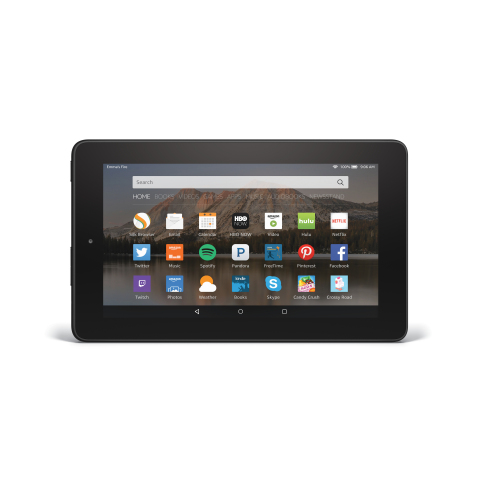
SEATTLE- (NASDAQ: AMZN)—Amazon today introduced a groundbreaking new tablet for under $50. The new Fire tablet includes a quad-core processor, 7” IPS display, front- and rear-facing cameras, up to 128GB of expandable storage, exclusive Amazon features and services, and access to the world’s best content ecosystem—all for just $49.99. Customers can also choose to buy Fire as a six-pack for less than $250.
“Today, we’re taking another step in our mission to deliver premium products at non-premium prices,” said Jeff Bezos, Amazon.com Founder and CEO. “The all-new Fire features a quad-core processor, is incredibly durable, and is backed by the Amazon content ecosystem, the new Amazon Underground, and Amazon customer service with Mayday Screen Sharing. Fire sets a new bar for what customers should expect from a low cost tablet.”
Fire delivers a world-class entertainment experience. With access to over 38 million movies, TV shows, songs, books, apps, and games, as well as exclusive features like X-Ray, ASAP, and Second Screen, Fire is great for watching movies, playing games, reading books, listening to music, and more. With expandable storage via microSD card and features like On Deck you’ll never worry about running out of entertainment, whether jumping on a plane or heading out on a family road trip.
Fire—High Quality Tablet, Affordable Price For just $49.99, the new Fire tablet includes:
Best display of any tablet in its price class—Unlike other low-cost tablets that use TN displays, Fire’s 7” IPS display offers a great viewing experience with vivid and accurate color reproduction that can be seen at all angles.
Quad-core 1.3 GHz processor—2x more processing power than Samsung Galaxy Tab 3 Lite at less than half the price; quickly and easily switch between apps, stream movies, and browse the web without waiting for your tablet to catch up.
Durability—As measured in tumble tests, Fire is almost 2x more durable than the latest generation iPad Air.
Front- and rear-facing cameras—Video chat with friends and family with the front-facing camera; take and share photos, and save them for later with free, unlimited cloud storage for all photos taken on Fire devices.
Up to 128GB of expandable storage via microSD—Enjoy even more videos, music, games, and photos while offline.
All-day battery life—Delivers up to 7 hours of reading, browsing the web, listening to music, and watching video.
Fire OS 5 “Bellini”—Includes an updated user interface that replicates the look and feel of a magazine, making browsing and searching for your content easier than ever—what you want is just one tap away; plus, Fire OS 5 includes hundreds of new and upgraded features and platform updates, plus Amazon-exclusive services.
Amazon Underground—A one-of-a-kind app store experience where over $10,000 in apps, games and even in-app items are actually free—including extra lives, unlocked levels, unlimited add-on packs, and more.
Have you ever forgotten to download a movie ahead of a flight? For Prime members, On Deck automatically keeps your Fire tablet current with popular Prime movies and TV shows, as well as Amazon Original Series, so you always have something good to watch. Importantly, On Deck only uses the available storage on your tablet, opportunistically in a special shadow mode. When you download something, On Deck automatically makes room for your selected content—there’s no hassle of needing to clear out space yourself. This feature will be available via a free, over-the-air Fire OS update in the coming months.
Activity Center—For parents whose kids have outgrown Amazon FreeTime, Activity Center provides an easy way for them to see how their kids are spending time on their Fire tablet—from how much time they spend playing games, to which websites they visit. Activity Center will be available via a free, over-the-air Fire OS update in the coming months.
World-class customer service and tech support—Mayday Screen Sharing lets an Amazon expert guide you remotely through any feature on your screen, available 24×7, 365 days a year—for free.
Amazon-exclusive features—ASAP, X-Ray, Second Screen, Amazon FreeTime, Family Library, Word Runner, and more.
World’s best content ecosystem—Access to over 38 million movies, TV shows, songs, books, magazines, apps, and games—with free, unlimited cloud storage for all Amazon content.
Also available for Fire are new accessories, including a protective cover available in five colors—black, blue, orange, green, and purple—that can stand in both landscape and portrait orientations, for $24.99.
The Fire Family
Fire is $49.99, and will start shipping on September 30—order at www.amazon.com/fire. Fire is also available as a buy five, get one free six-pack for $249.95.
In addition to Fire, Amazon also today introduced the new Fire HD 8 and Fire HD 10 tablets, Fire Kids Edition tablet, and the all-new Amazon Fire TV. To read the press release about the new Fire HD tablets, visit www.amazon.com/fire-hd-pr. To read about the new Fire Kids Edition, visit www.amazon.com/kids-edition-pr. To read about the new Fire TV, visit www.amazon.com/fire-tv-pr.
About Amazon
Amazon.com opened on the World Wide Web in July 1995. The company is guided by four principles: customer obsession rather than competitor focus, passion for invention, commitment to operational excellence, and long-term thinking. Customer reviews, 1-Click shopping, personalized recommendations, Prime, Fulfillment by Amazon, AWS, Kindle Direct Publishing, Kindle, Fire tablets, Fire TV, Amazon Echo, and Alexa are some of the products and services pioneered by Amazon.
Microsoft and Dell Partner to Deliver Windows 10 Devices and Unmatched Sales, Services and Support to the Enterprise
ROUND ROCK, TX and REDMOND, WA – Microsoft and Dell today announced an expanded partnership to deliver premium Windows 10 devices and world-class services and support to enterprise customers. This partnership kicks off Microsoft’s new Surface Enterprise Initiative, focused on bringing greater mobility and productivity to organizations to help them transform their businesses with Windows 10. Built for the enterprise with unmatched security and management options, Windows 10 will roll out new enterprise capabilities this month following a strong first month of availability with 75 million devices already running Windows 10.
Starting in early October in the United States and Canada, for the first time, Dell will sell Microsoft Surface Pro tablets and Surface accessories through its North America commercial sales organization and later in the year on Dell.com/Work. This will be rolled out to the remaining 28 markets of Microsoft’s Surface commercial channel starting in early 2016. Additionally, Surface Pro devices sold through Dell will include the option of Dell Services, including Dell Hardware Warranty (up to 4 years), ProSupport with Accidental Damage Service, and Configuration and Deployment Services. The Surface Pro will be sold alongside Dell’s existing Windows tablet portfolio including the Venue Pro and Latitude 2-in-1 devices, meeting a wide range of customer needs with Windows devices from mobile productivity for knowledge workers to application-driven tablets that are purpose-built to meet specific customer use cases like in the hospitality, healthcare, retail or education sectors.
“We want to move people from needing, to choosing, to loving Windows and so do our partners,” said Satya Nadella, chief executive officer, Microsoft. “Our global enterprise customers have asked us to match the Surface Pro 3 and Windows 10 experience with enterprise-grade support and services – and our partnerships like this one with Dell will do just that.”
“Windows 10 is off to a great start, and we’re ready to help make the transition to Windows 10 as easy as possible for all of our customers,” said Michael Dell, chairman and chief executive officer, Dell. “Together with Microsoft, we are giving our customers great products, including Surface, with the best sales, service and support in the world.”
Many businesses are choosing Surface and Windows 10 to improve productivity, and this partnership will make it easier for large enterprises to deploy Surface at scale – providing a way to purchase Surface Pro devices and world-class enterprise support and services, in one transaction and have devices deployed all over the world. Organizations will also be able to take advantage of improved enterprise grade security and management features with Windows 10.
New Enterprise Features Coming to Windows 10
Built for the enterprise, feedback from millions of IT Pros helped shape Windows 10. Ready for corporate deployments today, Windows 10 will introduce new key enterprise features to Windows Insiders this month, with broader availability later this year. For the first time, enterprises will be able to experience features like Enterprise Data Protection (EDP), which provides personal and corporate data protection wherever data flows; Microsoft Passport for enterprise, which helps business workers securely login to applications, websites and networks without the need for a password; and Windows Store For Business, which delivers business customers a unified Windows app store experience including a choice of Windows store apps alongside company-owned apps, and allow IT administers to acquire apps in bulk. As part of delivering Windows 10 as a service, enterprise customers can expect ongoing feature innovations that will keep them up-to-date with the latest technology and ongoing security updates for a secure experience they can trust.
More information regarding today’s announcement, including videos from Satya Nadella and Michael Dell, can be found on the Windows blog.
About Dell
Dell Inc. listens to customers and delivers innovative technology and services that give them the power to do more. For more information, visit www.dell.com.
Dell World
Join us Oct. 20-22 at Dell World 2015, Dell’s flagship event bringing together technology and business professionals to network, share ideas and help co-create a better future. Learn more at www.dellworld.com and follow #DellWorld on Twitter.
About Microsoft
Microsoft (Nasdaq “MSFT” @microsoft) is the leading platform and productivity company for the mobile-first, cloud-first world, and its mission is to empower every person and every organization on the planet to achieve more.
Apple Introduces watchOS 2 with Native Apps and New Gold & Rose Gold Aluminum Apple Watch Sport Models

SAN FRANCISCO — Apple® today introduced beautiful new Apple Watch® cases and bands, available starting today, including new gold and rose gold aluminum Apple Watch Sport models. Since its release, Apple Watch has helped users receive and respond to notifications, interact by simply speaking to Siri®, conveniently use Apple Pay™ and track their health and fitness activity. watchOS™ 2 arrives as a free update on September 16 and further enhances this groundbreaking experience with new features and native third-party apps.
watchOS 2 makes apps faster and more fluid by running natively on Apple Watch, and introduces new watch faces, the ability for third-party apps to display information on the watch face as complications, and an innovative way to see future events, past headlines and more with Time Travel. watchOS 2 also includes new communication features such as the ability to respond quickly to Mail with dictation, Smart Replies or emoji, and Digital Touch enables more creativity with multiple sketch colors.
“Our customers love Apple Watch and tell us its incredible health and fitness features are having a huge impact on their lives,” said Jeff Williams, Apple’s senior vice president of Operations. “We’re excited to expand Apple Watch’s functionality with watchOS 2 and offer even more personal choice with beautiful new styles and colors.”
Expanded Assortment of Apple Watch Styles
Apple Watch collections are expanding with new case colors and fresh new bands. With new standalone Sport Bands that range from rich vibrant colors to more neutral tones, Apple Watch is now more customizable than ever:
Apple Watch Sport’s lightweight anodized aluminum case now comes in two new beautiful colors, gold aluminum and rose gold aluminum paired with high-performance fluoroelastomer Sport Bands in lavender, antique white, stone and midnight blue.
Apple Watch Sport silver aluminum is now available with new orange or blue Sport Bands.
The stainless steel Apple Watch collection offers a variety of new bands including a two-toned Classic Buckle in black or saddle brown.
The Apple Watch space black stainless steel case is now available with a black Sport Band.
Apple Watch Edition now includes an 18-karat rose gold case with a midnight blue Classic Buckle.
Apple Watch joins Apple’s commitment to (PRODUCT)RED with a stainless steel case and a (PRODUCT)RED Sport Band with a portion of the proceeds going to the Global Fund to fight AIDS.
Apple Watch bands for the entire Apple Watch Sport and Apple Watch collections are available to purchase separately, along with four new Sport Band colors in fog, turquoise, vintage rose and walnut.
View the full line-up in the Apple Watch gallery.
watchOS 2 & Native Third-Party Apps
watchOS 2, the first major software update for Apple Watch, available September 16, provides even more ways to customize with new watch faces including Photo, Photo Album and Time-Lapse. Watch faces are even richer with third-party app complications that let users see news headlines, upcoming flight times and more. Time Travel allows users to conveniently explore events in the future by scrolling the Digital Crown™.
Apple Watch app developers can now take advantage of key hardware and APIs to create fast, fluid, native third-party apps such as playing back video in the CNN app, using the speaker and microphone in iTranslate or measuring heart rate while cycling with Strava.
Pricing & Availability
Shipping today, Apple Watch is available on Apple.com and will be available in Apple’s retail stores and select Apple Authorized Resellers, specialty stores and department stores over the next few days. For local availability, visit locate.apple.com.
Apple Watch is available in two different sizes, 38 mm and 42 mm, in three collections, Apple Watch Sport, starting at $349 (US); Apple Watch, starting at $549 (US); and Apple Watch Edition, crafted from custom rose or yellow 18-karat gold alloys, with prices starting at $10,000 (US).
Apple Watch requires iPhone® 5, iPhone 5c, iPhone 5s, iPhone 6 or iPhone 6 Plus, iPhone 6s and iPhone 6s Plus running iOS 8.2 or later.* watchOS 2 and iOS 9 will be available beginning Wednesday, September 16 as a free software update.
*To use all watchOS 2 features, download iOS 9.
Apple revolutionized personal technology with the introduction of the Macintosh in 1984. Today, Apple leads the world in innovation with iPhone, iPad, the Mac and Apple Watch. Apple’s three software platforms — iOS, OS X and watchOS — provide seamless experiences across all Apple devices and empower people with breakthrough services including the App Store, Apple Music, Apple Pay and iCloud. Apple’s 100,000 employees are dedicated to making the best products on earth, and to leaving the world better than we found it.
Apple Brings Innovation Back to Television with The All-New Apple TV

SAN FRANCISCO — Apple® today announced the all-new Apple TV®, bringing a revolutionary experience to the living room based on apps built for the television. Apps on Apple TV let you choose what to watch and when you watch it.The new Apple TV’s remote features Siri®, so you can search with your voice for TV shows and movies across multiple content providers simultaneously.
The all-new Apple TV is built from the ground up with a new generation of high-performance hardware and introduces an intuitive and fun user interface using the Siri Remote™. Apple TV runs the all-new tvOS™ operating system, based on Apple’s iOS, enabling millions of iOS developers to create innovative new apps and games specifically for Apple TV and deliver them directly to users through the new Apple TV App Store™.
“There has been so much innovation in entertainment and programming through iOS apps, we want to bring that same excitement to the television,” said Eddy Cue, Apple’s senior vice president of Internet Software and Services. “Apps make the TV experience even more compelling for viewers and we think apps represent the future of TV.”
The new Siri Remote dramatically simplifies how you select, scroll and navigate through your favorite content while bringing unique interactivity to the new Apple TV by using a glass touch surface that handles both small, accurate movements as well as big, sweeping ones. Adding touch to Apple TV creates a natural, connected experience, even if the TV screen is on the other side of the room. Developers can take advantage of the built-in accelerometer and gyroscope, and the touch surface on the Siri Remote to create games and other app experiences that have never been seen on TV before.
With Siri, you can use your voice to search TV shows and movies by title, genre, cast, crew, rating or popularity, making it easy to say things like “Show me New Girl,” “Find the best funny movies from the ‘80s,” “Find movies with Jason Bateman” and “Find popular TV shows for kids.” Apple TV will search iTunes® and popular apps from Netflix, Hulu, HBO and Showtime, displaying all the ways the resulting TV shows and movies can be played. Siri also offers playback control and on-screen navigation, as well as quick access to sports, stock and weather information.*
tvOS is the new operating system for Apple TV, and the tvOS SDK provides tools and APIs for developers to create amazing experiences for the living room the same way they created a global app phenomenon for iPhone® and iPad®. The new, more powerful Apple TV features the Apple-designed A8 chip for even better performance so developers can build engaging games and custom content apps for the TV. tvOS supports key iOS technologies including Metal™, for detailed graphics, complex visual effects and Game Center, to play and share games with friends.
Pricing & Availability
The new Apple TV will be available at the end of October starting at $149 (US) for a 32GB model and $199 (US) for a 64GB model from Apple.com, Apple’s retail stores and select Apple Authorized Resellers. A new Xcode® beta is available for developers today that includes the tvOS SDK at developer.apple.com/xcode/downloads. Developers can request an Apple TV developer kit at developer.apple.com/tvos/.
*Siri availability and functionality varies by country. Subscription required for some content.
Apple revolutionized personal technology with the introduction of the Macintosh in 1984. Today, Apple leads the world in innovation with iPhone, iPad, the Mac and Apple Watch. Apple’s three software platforms — iOS, OS X and watchOS — provide seamless experiences across all Apple devices and empower people with breakthrough services including the App Store, Apple Music, Apple Pay and iCloud. Apple’s 100,000 employees are dedicated to making the best products on earth, and to leaving the world better than we found it.
Apple Introduces iPhone 6s & iPhone 6s Plus – Next Generation of Multi-Touch Arrives

SAN FRANCISCO — Apple® today announced iPhone® 6s and iPhone 6s Plus, the most advanced iPhones ever, adding a powerful new dimension to iPhone’s revolutionary Multi-Touch™ interface. The new iPhones introduce 3D Touch, which senses force to enable intuitive new ways to access features and interact with content. iPhone 6s and iPhone 6s Plus feature Retina® HD displays made from the strongest glass on any smartphone and 7000 series aluminum, the same alloy used in the aerospace industry, in gorgeous metallic finishes that now include rose gold.
iPhone 6s and iPhone 6s Plus also introduce a transformative new approach to photography called Live Photos, bringing still images to life by capturing a moment in motion. Live Photos, 3D Touch and other advancements in the new iPhones are powered by the Apple-designed A9 chip, the most advanced chip ever in a smartphone, delivering faster performance and great battery life.
“The only thing that has changed with iPhone 6s and iPhone 6s Plus is everything — 3D Touch lets users interact with iPhone in entirely new and fun ways, and the innovative Live Photos brings your pictures to life,” said Philip Schiller, Apple’s senior vice president of Worldwide Marketing. “These are the most advanced iPhones ever, with 7000 series aluminum, ion-strengthened glass, the new 64-bit A9 chip, 12-megapixel iSight and 5-megapixel FaceTime HD cameras, faster Touch ID, LTE and Wi-Fi. Customers are going to love them.”
3D Touch
iPhone 6s and iPhone 6s Plus introduce new ways to navigate and experience iPhone by sensing pressure to enable new gestures — Peek and Pop™ — so you can dip in and out of content without losing your place. Press lightly to Peek at a photo, email, web page or other content, and press a little deeper to Pop into the content itself. With Quick Actions, 3D Touch provides shortcuts to the things you do most, so you can send a message or take a selfie with just a simple press from the Home screen.
Camera Innovations
The world’s most popular camera is even better in the new iPhones with new ways to capture and relive unforgettable moments. iPhone 6s and iPhone 6s Plus introduce Live Photos, which go beyond snapshots to capture moments in motion. Live Photos are beautiful 12-megapixel photos that, with just a press, reveal the moments immediately before and after the shot was taken, so you can enjoy a living memory rather than an instant frozen in time.
High-definition video improves with support for 4K — with a resolution of 3840 x 2160, delivering over 8 million pixels — and the expansion of optical image stabilization to video on iPhone 6s Plus, for taking beautiful videos in lower light. After capturing 4K video, you can edit on your Mac®, PC, iPad® and with the latest version of iMovie® on iPhone, you can even edit two simultaneous streams.
Additional camera advancements include:
a new state-of-the-art 12-megapixel sensor with advanced pixel technology and Apple-designed image signal processor, for truer colors and sharper, more detailed photos; and
a new 5-megapixel FaceTime® HD camera and Retina Flash, which momentarily makes the display three times brighter with True Tone® lighting, for wonderfully bright selfies in low light.
Advanced Technology
A9, Apple’s third-generation 64-bit chip powers these innovations with 70 percent faster CPU and 90 percent faster GPU performance than the A8, all with gains in energy efficiency for great battery life. The A9 chip and iOS 9 are architected together for optimal performance where it matters most, in real world usage. M9, Apple’s next-generation motion coprocessor, is embedded into A9, allowing more features to run all the time at lower power, including “Hey Siri,” without iPhone needing to be plugged in.
With advanced wireless technologies including faster Wi-Fi and LTE Advanced, iPhone 6s and iPhone 6s Plus users can browse, download and stream content even faster.¹ The new iPhones also support up to 23 LTE bands — the most in any smartphone — for better worldwide roaming.
iOS 9, the world’s most advanced mobile operating system, brings more intelligence to iPhone with proactive assistance, powerful search and improved Siri® features, all while protecting users’ privacy. Built-in apps become more powerful with a redesigned Notes app, detailed transit information in Maps, and an all-new News app for the best news reading experience on any mobile device.² The foundation of iOS is even stronger with software updates that require less space to install and advanced security features
to further protect your devices.
Pricing & Availability
iPhone 6s and iPhone 6s Plus will be available in gold, silver, space gray and the new rose gold metallic finishes for $0 down with 24 monthly payments starting at $27 (US) and $31 (US), respectively, from Apple’s retail stores in the US, Apple.com, select carriers and Apple Authorized Resellers.³
Exclusively at Apple’s retail stores in the US, customers can choose their carrier and get an unlocked iPhone 6s or iPhone 6s Plus with the opportunity to get a new iPhone annually and AppleCare+ on the new iPhone Upgrade Program with monthly payments starting at $32 (US) and $37 (US), respectively.⁴
Both models will be available in Australia, Canada, China, France, Germany, Hong Kong, Japan, New Zealand, Puerto Rico, Singapore, the UK and the US beginning Friday, September 25, with pre-orders beginning Saturday, September 12.
Apple-designed accessories including leather and silicone cases in a range of colors and Lightning Docks in color-matched metallic finishes will also be available.
¹ Data plan required. LTE Advanced and LTE are available in select markets and through select carriers. Speeds vary based on site conditions and carrier. For details on LTE support, contact your carrier and see www.apple.com/iphone/LTE.
² Transit information in Maps will be available in select major cities including Baltimore, Berlin, Chicago, London, Mexico City, New York City, Philadelphia, the San Francisco Bay Area, Toronto and Washington D.C., as well as over 300 cities in China, including Beijing, Chengdu and Shanghai. News app availability varies by country.
³ Prices are rounded to nearest dollar and are based on 24 monthly installment payments. Taxes and activation fees may be due at sale. Carrier terms and eligibility may apply.
⁴ The iPhone Upgrade Program is available to qualified customers only with a valid US personal credit card. Requires a 24-month installment loan with Citizens Bank, N.A. and iPhone activation with a national carrier — AT&T, Sprint, T-Mobile or Verizon. Full terms apply.
Apple revolutionized personal technology with the introduction of the Macintosh in 1984. Today, Apple leads the world in innovation with iPhone, iPad, the Mac and Apple Watch. Apple’s three software platforms — iOS, OS X and watchOS — provide seamless experiences across all Apple devices and empower people with breakthrough services including the App Store, Apple Music, Apple Pay and iCloud. Apple’s 100,000 employees are dedicated to making the best products on earth, and to leaving the world better than we found it.
AT&T Completes Acquisition of DIRECTV.
DALLAS, – AT&T Inc. T, +2.15% has completed its acquisition of DIRECTV. The newly combined company – the largest pay TV provider in the United States and the world – will offer millions of people more choices for video entertainment on any screen from almost anywhere, any time.
“Combining DIRECTV with AT&T is all about giving customers more choices for great video entertainment integrated with mobile and high-speed Internet service,” said Randall Stephenson, AT&T chairman and CEO. “We’ll now be able to meet consumers’ future entertainment preferences, whether they want traditional TV service with premier programming, their favorite content on a mobile device, or video streamed over the Internet to any screen.”
“This transaction allows us to significantly expand our high-speed Internet service to reach millions more households, which is a perfect complement to our coast-to-coast TV and mobile coverage,” Stephenson said. “We’re now a fundamentally different company with a diversified set of capabilities and businesses that set us apart from the competition.”
AT&T now is the largest pay TV provider in the U.S. and the world, providing service to more than 26 million customers in the United States and more than 191 million customers in Latin America, including Mexico and the Caribbean. Additionally, AT&T has more than 132 million wireless subscribers and connections in the U.S. and Mexico; offers 4G LTE mobile coverage to nearly 310 million people in the U.S.; covers 57 million U.S. customer locations with high-speed Internet; and has nearly 16 million subscribers to its high-speed Internet service.
Current customers of AT&T and DIRECTV do not need to do anything as a result of the merger. They’ll continue to receive their same services, channel lineups, and customer care. Customer account information, online access and billing arrangements remain the same. The integration of AT&T and DIRECTV will occur over the coming months. In the coming weeks, AT&T will launch new integrated TV, mobile and high-speed Internet offers that give customers greater value and convenience.
With the completion of its DIRECTV acquisition, AT&T will continue to deploy its all-fiber GigaPower Internet access service – the company’s highest-speed Internet service, which allows you to download a TV show in as little as three seconds. When the expansion is complete, AT&T’s all-fiber broadband footprint will reach more than 14 million customer locations.
AT&T announced that John Stankey will be CEO of AT&T Entertainment & Internet Services, responsible for leading its combined DIRECTV and AT&T Home Solutions operations. Stankey will report to Stephenson. DIRECTV President, Chairman and CEO Mike White announced his plans to retire.
“Mike is one of the world’s top CEOs and a great leader who built DIRECTV into a premier TV and video entertainment company spanning the U.S. and Latin America,” Stephenson said. “He has been a terrific partner and friend, and his legacy will be an important part of our combined company.”
As a result of this transaction, AT&T leads the industry in offering consumers premier content, particularly live sports programming, such as the exclusive rights to NFL SUNDAY TICKET, which gives customers every out-of-market NFL game, every Sunday afternoon, on any screen – TV, mobile devices or PCs. Additionally, the company owns ROOT SPORTS, one of the nation’s premier regional sports networks, and has stakes in The Tennis Channel, MLB Network, NHL Network, and GSN (Game Show Network).
AT&T is also developing unique video offerings for consumers through, among other initiatives, its Otter Media joint venture with The Chernin Group. The joint venture was established to invest in, acquire and launch over-the-top (OTT) video services. This includes its purchase of a majority stake in Fullscreen, a global online media company that works with more than 50,000 content creators who engage 450 million subscribers and generate 4 billion monthly views.
Under the terms of the merger, DIRECTV shareholders received 1.892 shares of AT&T common stock, in addition to $28.50 in cash, per share of DIRECTV. AT&T will provide complete updated 2015 financial guidance at a conference the company will host for financial analysts in the coming weeks. The conference will be webcast to the public.
The DIRECTV acquisition significantly diversifies AT&T’s revenue mix, products, geographies and customer bases. As a result of this acquisition, as well as AT&T’s acquisition of Iusacell and Nextel Mexico, AT&T expects that, by the end of 2015, its largest revenue streams will be, in descending order: Business Solutions (both wireless and wireline); Entertainment & Internet; Consumer Mobility; and International Mobility and Video.
As part of the Federal Communications Commission’s approval of the transaction, AT&T has agreed to the following conditions for the next four years:
Within 4 years, AT&T will offer its all-fiber Internet access service to at least 12.5 million customer locations, such as residences, home offices and very small businesses. Combined with AT&T’s existing high-speed broadband network, at least 25.7 million customer locations will have access to broadband speeds of 45Mbps or higher.
Within its wireline footprint, the company will offer 1Gbps service to any eligible school or library requesting E-rate services, pursuant to applicable rules, within the company’s all-fiber footprint.
Within AT&T’s 21-state wireline footprint, it will offer discounted fixed broadband service to low-income households that qualify for the government’s Supplemental Nutrition Assistance Program. In locations where it’s available, service with speeds of at least 10Mbps will be offered for $10 per month. Elsewhere, 5Mbps service will be offered for $10 per month or, in some locations, 3Mbps service will be offered for $5 per month.
AT&T’s retail terms and conditions for its fixed broadband Internet services will not favor its own online video programming services. AT&T can and will, however, continue to offer discounted integrated bundles of its video and high-speed Internet services.
AT&T must submit to the FCC new interconnection agreements it enters into with peering networks and on-net customers for the exchange of Internet traffic. The company will develop, in conjunction with an independent expert, a methodology for measuring the performance of its Internet traffic exchange and regularly report these metrics to the FCC.
AT&T will appoint a Company Compliance Officer to develop and implement a plan to ensure compliance with these merger conditions. Also, the company will engage an independent, third-party compliance officer to evaluate the plan and its implementation, and submit periodic reports to the FCC.
AT&T products and services are provided or offered by subsidiaries and affiliates of AT&T Inc. under the AT&T brand and not by AT&T Inc.
1 Includes DIRECTV Latin America pay TV subscribers as of March 31, 2015, including subscribers of Sky Mexico, in which DIRECTV holds a minority stake.
About AT&T
AT&T Inc. T, +2.15% helps millions around the globe connect with leading entertainment, mobile, high speed Internet and voice services. We’re the world’s largest provider of pay TV. We have TV customers in the U.S. and 11 Latin American countries. In the U.S., our wireless network offers the nation’s strongest LTE signal and the most reliable 4G LTE network. We offer the best global wireless coverage*. And we help businesses worldwide serve their customers better with our mobility and secure cloud solutions.
Additional information about AT&T products and services is available athttp://about.att.com. Follow our news on Twitter at @ATT, on Facebook at http://www.facebook.com/att and YouTube at http://www.youtube.com/att.
© 2015 AT&T Intellectual Property. All rights reserved. AT&T, the Globe logo and other marks are trademarks and service marks of AT&T Intellectual Property and/or AT&T affiliated companies. All other marks contained herein are the property of their respective owners.
Reliability and signal strength claims based on nationwide carriers’ LTE. Signal strength claim based ONLY on avg. LTE signal strength. LTE not available everywhere.
*Global coverage claim based on offering discounted voice and data roaming; LTE roaming; voice roaming; and world-capable smartphone and tablets in more countries than any other U.S. based carrier. Coverage not available in all areas. Coverage may vary per country and be limited/restricted in some countries.
Amazon Web Services to Acquire Elemental Technologies – Pioneers in Software-defined Video Solutions
SEATTLE- (NASDAQ:AMZN) — Amazon Web Services, Inc. (AWS), an Amazon company, today announced that Amazon has reached an agreement to acquire Elemental Technologies, Inc., pioneers in software-defined video solutions for multiscreen content delivery. The acquisition brings together Elemental’s leading video solutions with the AWS Cloud platform to provide media and entertainment companies with a range of integrated solutions to efficiently and economically scale video infrastructures as the media industry increasingly moves to internet based delivery.
Elemental software makes it easy for media and entertainment companies to take live and on-demand video destined for traditional networks like cable, satellite, or over-the-air broadcast and re-format that content for distribution to PCs, smart phones, tablets, and TVs. Elemental has more than 700 media franchise customers and powers some of the world’s most popular over-the-top TV (OTT) applications, like the BBC’s iPlayer, CNNGo, ESPN ScoreCenter, HBO GO, MSNBC Shift, and Sky Go and Sky Now. Additionally, Elemental is supporting the world’s first 4K Ultra HD services including those that were delivered by the BBC during the 2014 World Cup.
“Elemental shares Amazon’s passion for invention and putting the customer first,” said Andy Jassy, Senior Vice President of Amazon Web Services. “Together, we’ll collaborate on deeper technology integrations and new infrastructure offerings so that media and entertainment companies can evolve their hybrid and cloud models as they continue to innovate their services for viewers.”
Founded in 2006 and headquartered in Portland, Oregon, Elemental will continue to operate its business under its existing brand, delivering the full range of solutions for pay TV operators, content programmers, broadcasters, governments, and enterprise customers. Elemental will also expand the integration of its offerings with AWS, and through close collaboration with AWS, accelerate the innovation of next-generation services that feature a range of solutions for customers leveraging on-premises assets, hybrid architectures, and cloud.
“The media and entertainment industry is at a unique inflection point, and as a part of Amazon, we will be in an even stronger position to help our customers delight their viewers globally,” said Sam Blackman, co-founder and CEO of Elemental. “We’re thrilled to have Amazon supporting our growth and ongoing commitment to our customers’ success.”
Terms of the acquisition were not disclosed and are subject to closing conditions. The acquisition is expected to close in the fourth quarter of 2015.
Elemental and AWS at IBC2015
At IBC2015, which will be held in Amsterdam from Sept. 10-15, AWS and Elemental will feature a variety of cloud video and advanced video streaming workflows at the companies’ respective booths. AWS will be located in Hall 14 on Stand 14.N29. Elemental will be located in Hall 4 on Stand 4.B80.
About Amazon Web Services
Launched in 2006, Amazon Web Services offers a robust, fully featured technology infrastructure platform in the cloud comprised of a broad set of compute, storage, database, analytics, application, and deployment services from data center locations in the U.S., Australia, Brazil, China, Germany, Ireland, Japan, and Singapore. More than a million customers, including fast-growing startups, large enterprises, and government agencies across 190 countries, rely on AWS services to innovate quickly, lower IT costs and scale applications globally. To learn more about AWS, visit http://aws.amazon.com.
About Amazon
Amazon.com opened on the World Wide Web in July 1995. The company is guided by four principles: customer obsession rather than competitor focus, passion for invention, commitment to operational excellence, and long-term thinking. Customer reviews, 1-Click shopping, personalized recommendations, Prime, Fulfillment by Amazon, AWS, Kindle Direct Publishing, Kindle, Fire phone, Fire tablets, Fire TV, and Amazon Echo are some of the products and services pioneered by Amazon.
About Elemental
Elemental Technologies is the leading supplier of software-defined video solutions for multiscreen content delivery. Founded in 2006 and headquartered in Portland, Oregon, the company pioneered the use of software-based video processing to distribute video over IP networks. Solutions from Elemental provide the flexibility, scalability and performance required to deliver high quality video via turnkey, cloud-based and virtualized deployment models. Powering video experiences for more than 700 leading media franchises worldwide, Elemental helps pay TV operators, content programmers, broadcasters and enterprise customers bring video to any screen, anytime – all at once. The company has offices in the United States, the United Kingdom, France, Hong Kong, Singapore, Japan, China, Russia, India and Brazil. To learn more, please visit www.elementaltechnologies.com and follow @elementaltech on Twitter.
Google’s Look Has Evolved – Introduces A New Logo For It’s Mobile World
Google has changed a lot over the past 17 years—from the range of our products to the evolution of their look and feel. And today we’re changing things up once again:
So why are we doing this now? Once upon a time, Google was one destination that you reached from one device: a desktop PC. These days, people interact with Google products across many different platforms, apps and devices—sometimes all in a single day. You expect Google to help you whenever and wherever you need it, whether it’s on your mobile phone, TV, watch, the dashboard in your car, and yes, even a desktop!
Today we’re introducing a new logo and identity family that reflects this reality and shows you when the Google magic is working for you, even on the tiniest screens. As you’ll see, we’ve taken the Google logo and branding, which were originally built for a single desktop browser page, and updated them for a world of seamless computing across an endless number of devices and different kinds of inputs (such as tap, type and talk).
It doesn’t simply tell you that you’re using Google, but also shows you how Google is working for you. For example, new elements like a colorful Google mic help you identify and interact with Google whether you’re talking, tapping or typing. Meanwhile, we’re bidding adieu to the little blue “g” icon and replacing it with a four-color “G” that matches the logo.

This isn’t the first time we’ve changed our look and it probably won’t be the last, but we think today’s update is a great reflection of all the ways Google works for you across Search, Maps, Gmail, Chrome and many others. We think we’ve taken the best of Google (simple, uncluttered, colorful, friendly), and recast it not just for the Google of today, but for the Google of the future.
You’ll see the new design roll out across our products soon. Hope you enjoy it!
Posted by Tamar Yehoshua, VP, Product Management & Bobby Nath, Director of User Experience
Cisco Completes Acquisition of OpenDNS – Portfolio Now Offers Newly Integrated Threat Intelligence Capabilities
SAN JOSE, Calif., – Cisco (NASDAQ: CSCO) today announced it has completed the acquisition of OpenDNS, a privately held company that provides advanced threat protection for any device, anywhere, anytime. The acquisition will advance Cisco’s Security Everywhere approach by adding broad visibility, enforcement, and threat intelligence from the OpenDNS cloud-delivered platform. In addition to the close of the acquisition, Cisco is announcing the first technology integration of Cisco AMP Threat Grid with OpenDNS services.
Cisco is demonstrating how the OpenDNS acquisition is already accelerating its cloud-delivered security portfolio by unveiling today integration between the technology platforms, which allows joint customers of the OpenDNS Umbrella service and AMP Threat Grid intelligence to benefit. An API connects OpenDNS’ global capability with AMP Threat Grid’s dynamic malware analytics and threat intelligence. This new integration enables AMP Threat Grid customers to automatically transform threat intelligence into threat enforcement by blocking malware and quickly identifying critical security threats discovered by the AMP Thread Grid service.
“Delivering pervasive security capabilities from the cloud is a core part of our mission to provide Security Everywhere across the extended network from data center to the cloud to mobile devices.” said David Goeckeler, senior vice president and general manager, Cisco Security Business Group. “By integrating the OpenDNS platform with Cisco’s security solutions, customers will receive greater network visibility and threat intelligence for cloud delivered protection against malicious websites and threats. Together, we will deliver protection that is unmatched in the industry.”
OpenDNS employees join the Cisco Security Business Group led by Goeckeler. Additionally, David Ulevitch, founder and chief executive officer of OpenDNS, becomes vice president, reporting directly to Goeckeler.
Under the terms of the agreement Cisco paid $635M in cash and assumed equity awards, plus retention based incentives for OpenDNS.
About Cisco
Cisco (NASDAQ: CSCO) is the worldwide leader in IT that helps companies transform the opportunities of tomorrow by proving that amazing things can happen when you connect the previously unconnected. For ongoing news, please go to http://thenetwork.cisco.com.
Improving Quality Isn’t Anti-competitive – Google Rejects EU Abuse Allegations
Google has always worked to improve its services, creating new ways to provide better answers and show more useful ads. We’ve taken seriously the concerns in the European Commission’s Statement of Objections (SO) that our innovations are anti-competitive. The response we filed today shows why we believe those allegations are incorrect, and why we believe that Google increases choice for European consumers and offers valuable opportunities for businesses of all sizes.
The SO says that Google’s displays of paid ads from merchants (and, previously, of specialized groups of organic search results) “diverted” traffic away from shopping services. But the SO doesn’t back up that claim, doesn’t counter the significant benefits to consumers and advertisers, and doesn’t provide a clear legal theory to connect its claims with its proposed remedy.
Our response provides evidence and data to show why the SO’s concerns are unfounded. We use traffic analysis to rebut claims that our ad displays and specialized organic results harmed competition by preventing shopping aggregators from reaching consumers. Economic data spanning more than a decade, an array of documents, and statements from complainants all confirm that product search is robustly competitive. And we show why the SO is incorrect in failing to consider the impact of major shopping services like Amazon and eBay, who are the largest players in this space.
The universe of shopping services has seen an enormous increase in traffic from Google, diverse new players, new investments, and expanding consumer choice. Google delivered more than 20 billion free clicks to aggregators over the last decade in the countries covered by the SO, with free traffic increasing by 227% (and total traffic increasing even more).
Moreover, the ways people search for, compare, and buy products are rapidly evolving. Users on desktop and mobile devices often want to go straight to trusted merchants who have established an online presence. These kinds of developments reflect a dynamic and competitive industry, where companies are continuing to evolve their business models and online and offline markets are converging.
But our central point is our consistent commitment to quality — the relevance and usefulness of our search results and the ads we display. In providing results for people interested in shopping, we knew we needed to go beyond the old-fashioned “10 blue links” model to keep up with our competitors and better serve our users and advertisers. We developed new ways to organize and rank product information and to present it to users in useful formats in search and ads. In 2012, as part of that effort, in addition to our traditional ads, we introduced the Google Shopping Unit as a new ad format:
We don’t think this format is anti-competitive. On the contrary, showing ads based on structured data provided by merchants demonstrably improves ad quality and makes it easier for consumers to find what they’re looking for. We show these ad groups where we’ve always shown ads — to the right and at the top of organic results — and we use specialized algorithms to maximize their relevance for users. Data from users and advertisers confirms they like these formats. That’s not “favoring” — that’s giving our customers and advertisers what they find most useful.
The SO also seeks a peculiar and problematic remedy, requiring that Google show ads sourced and ranked by other companies within our advertising space. We show in our response that this would harm the quality and relevance our results. And, in a report submitted with our response, former President of the General Court Bo Vesterdorf outlines why such an obligation could be legally justified only where a company has a duty to supply its own rivals – as where it controls an input that is both essential and not available anywhere else (like gas or electricity). Given the many ways to reach consumers on the Internet, the SO doesn’t argue that standard applies here.
Our search engine is designed to provide the most relevant results and most useful ads for any query. Users and advertisers benefit when we do this well. So does Google. It’s in our interest to provide high-quality results and ads that connect people to what they’re looking for. The more relevant the ads — the better they perform in connecting potential buyers and sellers — the more value they generate for everyone.
Throughout the almost 17 years since Google started, our engineers have been developing innovative approaches to search and ads that are valuable for both users and advertisers. In the video below you can hear from our engineers about how our services have evolved to give people better results and ads. We are proud of their work and eager to tell their story.
We believe that the SO’s preliminary conclusions are wrong as a matter of fact, law, and economics. We look forward to discussing our response and supporting evidence with the Commission, in the interest of promoting user choice and open competition.
Post by Kent Walker, SVP & General Counsel
Meet OnHub from Google – A New Router for a New Way to Wi-Fi
Ugh...not again. You get home at the end of the day, and sit down to stream a new movie or upload vacation photos — and your Wi-Fi slows to a crawl or just stops working. Instead of relaxing in front of the screen or sharing those photos with friends, you spend it unplugging and re-plugging cords, trying to decipher blinking lights, or contemplating a call to customer support.
While we count on Wi-Fi more than ever to be entertained, productive, and stay connected, we’re streaming and sharing in new ways our old routers were never built to handle. So today, with our partner TP-LINK, we’re launching OnHub, a different kind of router for a new way to Wi-Fi. Instead of headaches and spotty connections, OnHub gives you Wi-Fi that’s fast, secure, and easy to use.
Designed for the Home
Many of us keep our router on the floor and out of sight, where it doesn’t work as well. We replaced unruly cords and blinking lights with internal antennas and subtle, useful lighting, so you’ll be happy placing OnHub out in the open, where your router performs its best.
Starts Fast, Stays Fast
During setup, OnHub searches the airwaves and selects the best channel for the fastest connection. A unique antenna design and smart software keep working in the background, automatically adjusting OnHub to avoid interference and keep your network at peak performance. You can even prioritize a device, so that your most important activity — like streaming your favorite show — gets the fastest speed.

A simple mobile app
OnHub makes it simple to set up and manage your Wi-Fi, all from the Google On app, available on Android or iOS. The Google On app tells you how much bandwidth your devices are using, lets you run a network check, and if there’s an issue with your Wi-Fi, the app offers suggestions to help. And, instead of lost passwords and sticky notes, it even reveals your password with a single tap and lets you text or email it to friends.
Just gets better
OnHub automatically updates with new features and the latest security upgrades, without interrupting your connection. In the future, OnHub can support smart devices that you bring into your home, whether they use Bluetooth® Smart Ready, Weave, or 802.15.4. We also plan to design new OnHub devices with other hardware partners in the future. Stay tuned for news from our second partner, ASUS, later this year.
Starting today, OnHub is available for pre-order for $199.99 from online retailers in the U.S. including the Google Store, Amazon, and Walmart.com. It will be available for sale in retail stores in the U.S. and in Canada in the coming weeks.
At the end of the day, we want our Wi-Fi to just work, so that we can do all the things we love to do online. Here’s to Wi-Fi with the reliability, speed, and security you want at home, without the frustrations you don’t.
Posted by Trond Wuellner, Group Product Manager
Google Announces Plans for New Operating Structure
G is for Google.
As Sergey and I wrote in the original founders letter 11 years ago, “Google is not a conventional company. We do not intend to become one.” As part of that, we also said that you could expect us to make “smaller bets in areas that might seem very speculative or even strange when compared to our current businesses.” From the start, we’ve always strived to do more, and to do important and meaningful things with the resources we have.
We did a lot of things that seemed crazy at the time. Many of those crazy things now have over a billion users, like Google Maps, YouTube, Chrome, and Android. And we haven’t stopped there. We are still trying to do things other people think are crazy but we are super excited about.
We’ve long believed that over time companies tend to get comfortable doing the same thing, just making incremental changes. But in the technology industry, where revolutionary ideas drive the next big growth areas, you need to be a bit uncomfortable to stay relevant.
Our company is operating well today, but we think we can make it cleaner and more accountable. So we are creating a new company, called Alphabet. I am really excited to be running Alphabet as CEO with help from my capable partner, Sergey, as President.
What is Alphabet? Alphabet is mostly a collection of companies. The largest of which, of course, is Google. This newer Google is a bit slimmed down, with the companies that are pretty far afield of our main internet products contained in Alphabet instead. What do we mean by far afield? Good examples are our health efforts: Life Sciences (that works on the glucose-sensing contact lens), and Calico (focused on longevity). Fundamentally, we believe this allows us more management scale, as we can run things independently that aren’t very related.
Alphabet is about businesses prospering through strong leaders and independence. In general, our model is to have a strong CEO who runs each business, with Sergey and me in service to them as needed. We will rigorously handle capital allocation and work to make sure each business is executing well. We’ll also make sure we have a great CEO for each business, and we’ll determine their compensation. In addition, with this new structure we plan to implement segment reporting for our Q4 results, where Google financials will be provided separately than those for the rest of Alphabet businesses as a whole.
This new structure will allow us to keep tremendous focus on the extraordinary opportunities we have inside of Google. A key part of this is Sundar Pichai. Sundar has been saying the things I would have said (and sometimes better!) for quite some time now, and I’ve been tremendously enjoying our work together. He has really stepped up since October of last year, when he took on product and engineering responsibility for our internet businesses. Sergey and I have been super excited about his progress and dedication to the company. And it is clear to us and our board that it is time for Sundar to be CEO of Google. I feel very fortunate to have someone as talented as he is to run the slightly slimmed down Google and this frees up time for me to continue to scale our aspirations. I have been spending quite a bit of time with Sundar, helping him and the company in any way I can, and I will of course continue to do that. Google itself is also making all sorts of new products, and I know Sundar will always be focused on innovation—continuing to stretch boundaries. I know he deeply cares that we can continue to make big strides on our core mission to organize the world’s information. Recent launches like Google Photos and Google Now using machine learning are amazing progress. Google also has some services that are run with their own identity, like YouTube. Susan is doing a great job as CEO, running a strong brand and driving incredible growth.
Sergey and I are seriously in the business of starting new things. Alphabet will also include our X lab, which incubates new efforts like Wing, our drone delivery effort. We are also stoked about growing our investment arms, Ventures and Capital, as part of this new structure.
Alphabet Inc. will replace Google Inc. as the publicly-traded entity and all shares of Google will automatically convert into the same number of shares of Alphabet, with all of the same rights. Google will become a wholly-owned subsidiary of Alphabet. Our two classes of shares will continue to trade on Nasdaq as GOOGL and GOOG.
For Sergey and me this is a very exciting new chapter in the life of Google—the birth of Alphabet. We liked the name Alphabet because it means a collection of letters that represent language, one of humanity’s most important innovations, and is the core of how we index with Google search! We also like that it means alpha‑bet (Alpha is investment return above benchmark), which we strive for! I should add that we are not intending for this to be a big consumer brand with related products—the whole point is that Alphabet companies should have independence and develop their own brands.
We are excited about…
Getting more ambitious things done.
Taking the long-term view.
Empowering great entrepreneurs and companies to flourish.
Investing at the scale of the opportunities and resources we see.
Improving the transparency and oversight of what we’re doing.
Making Google even better through greater focus.
And hopefully… as a result of all this, improving the lives of as many people as we can.
What could be better? No wonder we are excited to get to work with everyone in the Alphabet family. Don’t worry, we’re still getting used to the name too!
Larry Page
CEO, Alphabet