Building GPS OCX – The Next Generation Operational Control System By Raytheon
Civilian and military operations worldwide have grown dependent on a functioning GPS system. Guiding vehicles; aiding air traffic control systems; monitoring agricultural activities; providing geolocation for communications systems; synchronizing financial transactions — these and many more integral parts of the economic and day-to-day lives of more than 2 billion people worldwide rely on GPS.
The space-based piece of America’s GPS system is made up of more than two dozen satellites orbiting the Earth. The satellites are controlled by a ground system that allows technicians to manage and operate the satellites, protect the data passing to and from users, and monitor the system’s performance to ensure accuracy.
A high-performance vehicle without an intelligent driver is little more than a collection of expensive hardware. In many ways, the ground system functions as the “brain” of the entire GPS system.
And the current brain is showing its age. As such, it’s incapable of using the full capabilities of GPS II satellites currently in orbit. And when the next generation of GPS III satellites are launched, they’ll introduce even more technology the current ground system can’t handle.
To solve this capability gap, the GPS Next Generation Operational Control System (GPS OCX) is currently in development. OCX modernizes the ground system, allowing it to take advantage of the updated capabilities of GPS II and GPS III satellites, and giving the system flexibility to evolve as future needs emerge. Raytheon Company is responsible for developing OCX, which is scheduled to enter operation in 2018.
Solving difficult technical challenges
Because GPS is so broadly used, a system crash would cause serious financial, societal and national security issues. As such, it’s become a potential target for cyber attack. To protect the system from hackers, Raytheon is integrating robust cyber protections into OCX, securing the system from end-to-end against malicious cyber criminals.
OCX is also being designed to operate both GPS II and GPS III satellites concurrently, which ensures uninterrupted operations during upgrades or transitions from existing to new satellites.
In addition, Raytheon is evolving the OCX architecture to support the Launch and Checkout System (LCS) in preparation for the first GPS III satellite launch. LCS represents a significant risk reduction for the remainder of the OCX program by accelerating critical cyber security protections and validating system performance through operational tests.
FIVE BENEFITS OF GPS OCX
1. Dramatic Performance Improvement
The effectiveness of the GPS system and its signals are measured in three ways:
Accuracy — The accuracy of GPS time and location information is essential for a wide range of applications, including navigation, cell phone service, military targeting, etc.
Availability — The GPS system must be available and trustworthy at all times, anywhere in the world.
Integrity — Users of the GPS system, whether military, civilian or commercial, must have complete confidence that the GPS signal has not been compromised in any way.
OCX will improve and enhance all three performance areas. End users will enjoy twice the accuracy of the current system, and because OCX lifts the limit on the number of satellites in the GPS constellation, signal strength will be much stronger in hard-to-reach areas like dense city streets and mountainous terrain.
To make sure those signals are secure and trustworthy, OCX is integrating the same algorithms used in the FAA’s Wide Area Augmentation System and employing digital signatures on all critical external interfaces. These technologies will give GPS users an unprecedented level of system integrity.
2. Unparalleled Cyber Protection
To protect GPS from cyber threats that could compromise or interrupt the system, OCX is implementing DODI 8500.2 “Defense in Depth” information assurance standards, coupled with a wide range of proprietary cybersecurity technologies and techniques designed to harden its cyber defenses while complying with the US military and government cyber standards. In short, GPS OCX is designed to be the most secure ground system, ever.
3. Secure Information Sharing
The “internet of things” depends on fast, secure, automated information sharing. In the past, key information like clock and satellite position corrections were only available through rigid, point-to-point interfaces, and only to a very small number of users. GPS OCX will introduce a single, net-centric interface that employs state-of-the-art encryption technologies, enabling secure sharing of that information quickly and accurately, with a larger user group, when and where it’s needed.
4. Modern Civil and Military Signal Compatibility
The current GPS ground control system wasn’t designed to process the newest types of navigation signals. As such, offline tools are enabling current satellites to broadcast modern civil signals. The new M-code military signal, which is more accurate and jam/spoof resistant than existing signals, isn’t supported by the current system at all. OCX will offer full backward and forward compatibility with all existing civil and military signals.
OCX will also introduce L1C signal compatibility with navigation systems deployed by Russia, Europe, China, Japan and India, giving users access to a much larger, more accurate network of satellites and improving coverage worldwide.
5. A Flexible, Open Architecture Built for the Future
Unlike previous generations of GPS ground systems, which were built on proprietary, closed architectures, the new GPS OCX ground system represents a departure from the past by embracing open systems. A service-oriented architecture, modular sub-systems, and the ability to easily integrate new capabilities and signals as they become available will eliminate the need to re-architect the system as its mission evolves. This approach gives OCX significant flexibility to meet future needs, and extends the life expectancy of the system.
IBM Acquires Explorys to Accelerate Cognitive Insights for Health and Wellness
Armonk, NY and Cleveland: IBM (NYSE: IBM) today announced that is has acquired Explorys, a healthcare intelligence cloud company that has built one of the largest clinical data sets in the world, representing more than 50 million lives. The acquisition strengthens IBM’s leadership position in healthcare analytics and cloud computing, and will help bolster its ability to extract and share deep insights to improve wellness and benefit patients.
Since its spin-off from the Cleveland Clinic in 2009, Explorys has secured a robust healthcare database derived from numerous and diverse financial, operational and medical record systems comprising 315 billion longitudinal data points across the continuum of care. This powerful body of insight will help fuel IBM Watson Health Cloud, a new open platform that allows information to be securely de-identified, shared and combined with a dynamic and constantly growing aggregated view of clinical, health and social research data.
Explorys provides secure cloud-based solutions for clinical integration, at-risk population management, cost of care measurement, and pay-for-performance. Headquartered in Cleveland, Explorys clients include some of the most prominent healthcare systems in the United States, together accounting for over $69 billion in care, 360 hospitals and more than 317,000 providers. Explorys’ HIPAA-enabled cloud-computing platform is used by 26 healthcare systems and clinically integrated networks to identify patterns in diseases, treatments and outcomes. Its network includes Cleveland Clinic, Trinity Health, St. Joseph Health System, Mercy Health, Adventist Health System and many others with patients across the country. Market intelligence firm IDC just named Explorys a leader in U.S. Healthcare Clinical and Financial Analysis*.
“As healthcare providers, health plans and life sciences companies face a deluge of data, they need a secure, reliable and dynamic way to share that data for new insight to deliver quality, effective healthcare for the individual,” said Mike Rhodin, senior vice president, IBM Watson. “To address this opportunity, IBM is building a holistic platform to enable the aggregation and discovery of health data to share it with those who can make a difference. With Explorys, IBM will accelerate the delivery of IBM Health Cloud and IBM Watson cognitive solutions to model and apply medical evidence and large scale analytics to data.”
“Every encounter that a patient has across the continuum of care spins off a meaningful piece of data that can help tell the whole story about an individual’s health to improve the quality and effectiveness of their care,” said Stephen McHale, CEO and co-founder, Explorys. “Information is changing the way care is delivered and paid for. The combination of Explorys technology with IBM’s powerful Health Cloud and Watson cognitive capabilities will expand the reach of health insights so that Big Data can finally be used more easily to transform healthcare. This relationship will not only accelerate but enhance many of the projects underway with our provider organizations.”
Explorys is now part of IBM’s new Watson Health unit, launched today. Its offerings complement and strengthen the IBM Watson Health Cloud platform and will empower IBM’s vast ecosystem of clients, partners and medical researchers to surface new connections among diverse and previously siloed healthcare data sets. Access to these insights are expected to spur the creation of a new generation of data-driven applications and solutions designed to advance health and wellness.
Financial terms were not disclosed.
About Explorys
Originally inspired by physicians and informatics leaders, Explorys combines the most powerful healthcare computing platform in the world with turnkey solutions for clinical integration, at-risk population management, cost of care measurement, and pay-for-performance solutions. Explorys addresses the national imperative to leverage Big Data in healthcare for the improvement of medicine and delivery of care. For more information, please visit www.explorys.com.
About IBM Watson Health
IBM and its vast ecosystem of clients, partners and medical researchers are accelerating the development of a new generation of data-driven applications and solutions built on IBM Health Cloud and IBM Watson cognitive solutions to advance health and wellness. For more information, please visit ibm.com/watsonhealth.
Nokia And Alcatel-Lucent To Combine To Create An Innovation Leader In Next Generation Technology And Services For An Ip Connected World
Helsinki & Paris, April 15, 2015 – Nokia and Alcatel-Lucent announce today their intention to combine to create an innovation leader in next generation technology and services for an IP connected world. The two companies have entered into a memorandum of understanding under which Nokia will make an offer for all of the equity securities issued by Alcatel-Lucent, through a public exchange offer in France and in the United States, on the basis of 0.55 of a new Nokia share for every Alcatel-Lucent share. The all-share transaction values Alcatel-Lucent at EUR 15.6 billion on a fully diluted basis, corresponding to a fully diluted premium of 34% (equivalent to EUR 4.48 per share), and a premium to shareholders of 28% (equivalent to EUR 4.27 per share) (see Appendix 1), on the unaffected weighted average share price of Alcatel-Lucent for the previous three months. This is based on Nokia’s unaffected closing share price of EUR 7.77 on April 13, 2015.
Each company’s Board of Directors has approved the terms of the proposed transaction, which is expected to close in the first half of 2016. The proposed transaction is subject to approval by Nokia’s shareholders, completion of relevant works council consultations, receipt of regulatory approvals and other customary conditions.
Enabling the connected world
The combined company will be uniquely positioned to create the foundation of seamless connectivity for people and things wherever they are. This foundation is essential for enabling the next wave of technological change, including the Internet of Things and transition to the cloud.
The combined company will have unparalleled innovation capabilities, with Alcatel-Lucent’s Bell Labs and Nokia’s FutureWorks, as well as Nokia Technologies, which will stay as a separate entity with a clear focus on licensing and the incubation of new technologies.
With more than 40 000 R&D employees and spend of EUR 4.7 billion in R&D in 2014, the combined company will be in a position to accelerate development of future technologies including 5G, IP and software-defined networking, cloud, analytics as well as sensors and imaging.
Alcatel-Lucent and Nokia have highly complementary portfolios and geographies, with particular strength in the United States, China, Europe and Asia-Pacific. They will also bring together the best of fixed and mobile broadband, IP routing, core networks, cloud applications and services. This combination is expected to create access to an expanded addressable market with improved long term growth opportunities.
Consumers are looking to access data, voice and video across networks of all kinds. In this environment technology that used to operate independently now needs to work well together. That is not always the case today, but together Nokia and Alcatel-Lucent are uniquely suited to helping telecom operators, internet players and large enterprises address this challenge.
TRANSACTION HIGHLIGHTS
0.55 of a newly issued ordinary share of Nokia (subject to adjustments for any dividend other than the previously proposed Nokia dividend for 2014) would be offered in exchange for each ordinary share and each American Depositary Share of Alcatel-Lucent. An equivalent offer would be made for each outstanding class of Alcatel-Lucent convertible bonds: OCEANE 2018, OCEANE 2019 and OCEANE 2020
The offer values Alcatel-Lucent at EUR 15.6 billion on a fully diluted basis, after taking into account the early conversion and associated dilution of Alcatel-Lucent’s convertible bonds, corresponding to a fully diluted premium of 34% (equivalent to EUR 4.48 per share), and a premium to the shareholders of 28% (equivalent to EUR 4.27 per share), on the unaffected weighted average share price of Alcatel-Lucent for the previous three months. This is based on Nokia’s unaffected closing share price of EUR 7.77 on April 13, 2015
Alcatel-Lucent shareholders would own 33.5% of the fully diluted share capital of the combined company, and Nokia shareholders would own 66.5%, assuming full acceptance of the public exchange offer
The combined company will be called Nokia Corporation, with headquarters in Finland and a strong presence in France. Risto Siilasmaa is planned to serve as Chairman, and Rajeev Suri as Chief Executive Officer
The combined company’s Board of Directors is planned to have nine or ten members, including three members from Alcatel-Lucent, one of whom would serve as Vice Chairman
Assuming the closing of the transaction in the first half of 2016:
The combined company would target approximately EUR 900 million of operating cost synergies to be achieved on a full year basis in 2019
The combined company would target approximately EUR 200 million of reductions in interest expenses to be achieved on a full year basis in 2017
The transaction is expected to be accretive to Nokia earnings on a non-IFRS basis (excluding restructuring charges and amortisation of intangibles) in 2017
A strong financial profile on which to grow and invest: on a FY2014 combined basis, the proposed company would have had net sales of EUR 25.9 billion, a non-IFRS operating profit of EUR 2.3 billion, a reported operating profit of EUR 0.3 billion, R&D investments of approximately EUR 4.7 billion, and a strong balance sheet with combined net cash at December 31, 2014 of EUR 7.4 billion, assuming conversion of all Nokia and Alcatel-Lucent convertible bonds (for basis of preparation see Appendix 2)
Rajeev Suri, President and Chief Executive Officer of Nokia, said:
“Together, Alcatel-Lucent and Nokia intend to lead in next-generation network technology and services, with the scope to create seamless connectivity for people and things wherever they are.
Our innovation capability will be extraordinary, bringing together the R&D engine of Nokia with that of Alcatel-Lucent and its iconic Bell Labs. We will continue to combine this strength with the highly efficient, lean operations needed to compete on a global scale.
We have hugely complementary technologies and the comprehensive portfolio necessary to enable the internet of things and transition to the cloud. We will have a strong presence in every part of the world, including leading positions in the United States and China.
Together, we expect to have the scale to lead in every area in which we choose to compete, drive profitable growth, meet the needs of global customers, develop new technologies, build on our successful intellectual property licensing, and create value for our shareholders.
For all these reasons, I firmly believe that this is the right deal, with the right logic, at the right time.”
Michel Combes, Chief Executive Officer of Alcatel-Lucent, added:
“A combination of Nokia and Alcatel-Lucent will offer a unique opportunity to create a European champion and global leader in ultra-broadband, IP networking and cloud applications. I am proud that the joined forces of Nokia and Alcatel-Lucent are ready to accelerate our strategic vision, giving us the financial strength and critical scale needed to achieve our transformation and invest in and develop the next generation of network technology.
This transaction comes at the right time to strengthen the European technology industry. We believe our customers will benefit from our improved innovation capability and incomparable R&D engine under the Bell Labs brand. The global scale and footprint of the new company will reinforce its presence in the United States and China.
The proposed transaction represents a compelling offer for our shareholders both in terms of upfront premium and long term value creation potential. Shareholders of Alcatel-Lucent now have the opportunity to participate in the future upside of the industrial project that they have supported during the last two years, through a stronger combined business with greater global scale and a better position for the longer term. The new company will also provide our employees exciting opportunities to be part of a global leader.”
TRANSACTION OVERVIEW
The proposed transaction is expected to offer financial benefits to both Nokia and Alcatel-Lucent shareholders.
The combined company will be positioned to target a larger addressable market with an improved growth profile. Based on Nokia estimates, the addressable market of the combined company in 2014 was approximately 50% larger than the current addressable networks market for Nokia alone, increasing from approximately EUR 84 billion to approximately EUR 130 billion. The combined company is expected to have a stronger growth profile than Nokia’s current addressable market, with an estimated CAGR of approximately 3.5% for 2014-2019.
The combined company would target approximately EUR 900 million of operating cost synergies to be achieved on a full year basis in 2019, assuming closing of the transaction in the first half of 2016. The operating cost synergies are expected to create a long-term structural cost advantage, coming from a wide-range of areas, including:
Organizational streamlining, rationalisation of overlapping products and services, central functions, and regional and sales organizations
Reduction of various overhead costs in real estate, manufacturing and supply-chain, information technology, and overall general and administrative expenses, including redundant public company costs
Procurement given expanded purchasing requirements of the combined company
The combined company would also target approximately EUR 200 million of reductions in interest expenses to be achieved on a full year basis in 2017. The transaction is expected to be accretive to Nokia earnings on a non-IFRS basis (excluding restructuring charges and amortization of intangibles) in 2017. These targets both assume closing of the transaction in the first half of 2016.
The combined company is expected to have a strong balance sheet, with combined net cash at December 31, 2014 of EUR 7.4 billion, assuming conversion of all Nokia and Alcatel-Lucent convertible bonds.
Nokia maintains its long term target to return to an investment grade credit rating and intends to manage the combined capital structure accordingly by retaining significant gross and net cash positions and by proactively reducing indebtedness. This includes Nokia’s intention to exercise an early repayment option for its EUR 750 million convertible bond in the fourth quarter of 2015, which is expected to result in the full conversion of this convertible bond to equity prior to the closing of the transaction, with no expected cash outflow.
Nokia will suspend its capital structure optimization program, including suspending the share repurchase program execution, effective immediately until the closing of the transaction. Following the closing of the transaction, Nokia intends to evaluate the resumption of a capital structure optimization program for the combined company.
The proposed transaction does not impact Nokia’s ability and intent to continue annual dividend payments. Nokia’s Board of Directors dividend proposal of EUR 0.14 for the year ended December 31, 2014 is maintained.
TRANSACTION TERMS
The proposed transaction is structured as a public exchange offer in France in accordance with the General Regulation of the French securities regulator, the Autorité des Marchés Financiers (the “AMF”), and all applicable securities laws and regulations in the United States, in which:
0.55 of a newly issued ordinary share of Nokia (subject to adjustments for any dividend other than the previously proposed Nokia dividend for 2014) would be offered in exchange for one ordinary share of Alcatel-Lucent issued and outstanding (including upon the exercise of Alcatel-Lucent stock options) at the time of the offer and tendered
0.55 of a newly issued ordinary share of Nokia (subject to adjustments for any dividend other than the previously proposed Nokia dividend for 2014) would be offered in exchange for one American Depositary Share of Alcatel-Lucent tendered
An equivalent offer will be made for each outstanding class of Alcatel-Lucent convertible bonds: OCEANE 2018, OCEANE 2019 and OCEANE 2020
After completion of the public exchange offer, Alcatel-Lucent shareholders would own 33.5% of the fully diluted share capital of the combined entity, and Nokia shareholders would own 66.5%, assuming full acceptance of the offer.
The proposed all-share transaction values Alcatel-Lucent at EUR 15.6 billion on a fully diluted basis, corresponding to a fully diluted premium of 34% (equivalent to EUR 4.48 per share), and a premium to the shareholders of 28% (equivalent to EUR 4.27 per share) on the unaffected weighted average share price of Alcatel-Lucent for the previous three months, based on Nokia’s unaffected closing share price of EUR 7.77 on April 13, 2015.
The public exchange offer and the proposed combination will be implemented in accordance with the terms and conditions of the binding memorandum of understanding between Nokia and Alcatel-Lucent. In addition to the offer terms, the memorandum of understanding contains representations, warranties and undertakings by Nokia and Alcatel-Lucent typical in similar transactions. The memorandum of understanding may be terminated by Nokia or Alcatel-Lucent under certain circumstances prior to the filing and/or completion of the public exchange offers, including, for example, a material breach by either party of the terms and conditions of the memorandum of understanding prior to the filing of the offers, the occurrence of a material adverse effect in respect of either party prior to the filing of the offers, the Board of Directors of either party not issuing, or amending in an adverse manner its recommendation, non-receipt of regulatory approvals and certain other circumstances. The parties have further agreed on certain termination fees customary in similar European transactions and payable to the other party under certain circumstances, including a change or withdrawal of the recommendation by the Board of Directors of either party, and Nokia’s failure to obtain the necessary shareholder approval or certain antitrust regulatory approvals.
Subject to Nokia acquiring at least ninety-five percent of the share capital and voting rights of Alcatel-Lucent, Nokia intends to commence a squeeze-out procedure of the remaining outstanding Alcatel-Lucent shares.
CONDITIONS TO OPENING AND COMPLETION OF THE PUBLIC EXCHANGE OFFER
The opening of the public exchange offer is subject to, inter alia, completion of relevant works council consultations; receipt of regulatory approvals in the relevant jurisdictions; the absence of any material adverse event occurring with respect to Nokia or Alcatel-Lucent prior to the filing of the offer with the Autorité des Marchés Financiers (AMF), the French securities regulator, and the United States’ Securities and Exchange Commission (SEC); the issuance by Alcatel-Lucent’s board of a formal recommendation (avis motivé) in favour of the public exchange offer; and to other customary conditions.
In accordance with the French tender offer rules, following launch of the public exchange offer the completion of the offer will only be subject to the approval by Nokia’s shareholders of the resolutions necessary to implement the combination and the public exchange offer, and to Nokia holding more than 50.00% of the share capital of Alcatel-Lucent on a fully diluted basis upon the closing of the public exchange offer.
PRELIMINARY TIMELINE AND NOKIA SHAREHOLDER MEETING
Alcatel-Lucent will immediately start the information process of its Group works council in order to obtain its opinion on the proposed public exchange offer.
It is expected that the remainder of 2015 will constitute a review period consisting of regulatory and merger control review in a number of jurisdictions, AMF review and other transaction approvals and reviews. Nokia plans to convene an Extraordinary General Meeting to pass the resolutions necessary to implement the combination and the public exchange offer after the receipt of relevant regulatory approvals. Nokia’s Board of Directors will, subject to its fiduciary duties, recommend that its shareholders vote in favour of such resolutions.
The notice to the meeting will be published and more information on the public exchange offer and its background made available to both Nokia’s and Alcatel-Lucent’s shareholders after said regulatory steps, which is expected to take place in late 2015 or early 2016. The public exchange offer is expected to be launched and completed in the first half of 2016.
CORPORATE STRUCTURE AND GOVERNANCE
The planned combined company would be headquartered in Finland, with strategic business locations and major R&D centers in France, and many other countries including Germany, the United States and China. The business is expected to operate under the Nokia brand and intends to retain the Bell Labs brand to host its networks-focused innovation activities.
Risto Siilasmaa is planned to serve as Chairman, and Rajeev Suri as Chief Executive Officer. The combined company’s Board of Directors is planned to have nine or ten members, including three members from Alcatel-Lucent, one of whom would serve as Vice Chairman.
Nokia also announces today that it has initiated a review of strategic options for its HERE business. That review is ongoing, it may or may not lead to a transaction, and any further announcements about HERE will be made in due course, as appropriate.
Nokia Technologies, a source of superb innovation, expertise and intellectual property, is not impacted by today’s announcements and will stay as a separate entity with a clear focus on incubating new technologies and sharing those technologies through an active licensing program.
Nokia shares are listed on Nasdaq Helsinki (ticker:NOK1V), and on the New York Stock Exchange in the form of American Depositary Receipts (ticker:NOK). In addition, Nokia will apply for a listing of Nokia’s shares on NYSE Euronext Paris in connection with the public exchange offer.
COMMUNITIES AND ECOSYSTEM
Nokia is a global company, with deep roots and heritage in many parts of the world. When it joins with Alcatel-Lucent, it also expects that France, where Alcatel-Lucent is a fundamental participant in the technology ecosystem, will be a vibrant centre of the combined company. Nokia intends to be an important contributor to the overall development of the broader technology ecosystem and a driver of innovation in France.
Consistent with this goal, the combined company expects that after the closing of the transaction it will have a presence in France that spans leading innovation activities including a 5G/Small Cell R&D Centre of Excellence; a Cyber-Security lab similar to its existing facility in Berlin designed to support European collaboration on the topic; and a continued focus on Bell Labs and wireless R&D. Engaging with and supporting projects and academic efforts that enhance the development of future technologies will remain an important priority.
Upon closing of the transaction, Nokia also intends to establish a EUR 100 million investment fund to invest in start-ups in France with a focus on the Internet of Things and the Industrial Internet.
Nokia intends to maintain employment in France that is consistent with Alcatel-Lucent’s end-2015 Shift Plan commitments, with a particular focus on the key sites of Villarceaux (Essonne) and Lannion (Côtes d’Armor). In addition, the company expects to expand R&D employment with the addition of several hundred new positions targeting recent graduates with skills in future-oriented technologies, including 5G. To ensure ongoing support for customers, activities for support services and pre- and post-sales are expected to continue as well.
Similarly Nokia and Alcatel-Lucent have had a defining impact on the United States communications industry. As long-standing technology partners of the US service providers and with a re-energized Bell Labs research and consultancy, the proposed combined company would have technological depth in all strategic domains combined with formidable operational strength. At a time where the industry is re-shaping itself with new architectures, business models and market players, Nokia and Alcatel-Lucent together would bring a compelling force to the fast evolving needs of large enterprises, webscale players, and the public sector, as well as service providers.
Nokia and Alcatel-Lucent also have a long and rich history in China. As a result of the transaction Nokia would own Alcatel-Lucent’s 50% plus one share holding in Alcatel-Lucent Shanghai Bell, a company limited by shares supervised by the State-owned Assets Supervision and Administration Commission of China. Both companies support the Chinese Government’s ambitions to encourage a climate for indigenous innovation and technology development through the ‘Internet Plus’ and ‘Made in China 2025’ initiatives. The combined company intends to remain committed to China and plans to continue enabling local innovation with fast, smart, secure and reliable networks built with its Chinese partners.
OVERVIEW OF ALCATEL-LUCENT
Alcatel-Lucent is the leading IP networking, ultra-broadband access and cloud applications specialist. It believes that networks are the foundation of an ultra-connected world, and that networks need to be built to achieve the potential of every customer with flexibility, speed, and trust. Alcatel-Lucent’s mission is to invent and deliver trusted networks to help its customers unleash their value.
The company employs approximately 52 600 employees as of end 2014 including 20 000 R&D employees. Its products and services are distributed all over the world (North America: 44%, Asia Pacific: 20%, Europe: 23%, Rest of World: 13%).
It is organized in two main operating segments :
Core Networking segment including three business divisions: IP Routing, IP Transport and IP Platforms
Access segment including four business divisions: Wireless, Fixed Access, Licensing and Managed Services
Alcatel-Lucent’s shares are traded on Euronext Paris, which represents the principal trading market for its ordinary shares and on the New York Stock Exchange in the form of American Depository Shares.
ABOUT NOKIA
Nokia invests in technologies important in a world where billions of devices are connected. We are focused on three businesses: network infrastructure software, hardware and services, which we offer through Nokia Networks; location intelligence, which we provide through HERE; and advanced technology development and licensing, which we pursue through Nokia Technologies. Each of these businesses is a leader in its respective field. http://company.nokia.com
ABOUT ALCATEL-LUCENT
Alcatel-Lucent is the leading IP networking, ultra-broadband access and cloud technology specialist. We are dedicated to making global communications more innovative, sustainable and accessible for people, businesses and governments worldwide. Our mission is to invent and deliver trusted networks to help our customers unleash their value. Every success has its network.
For more information, visit Alcatel-Lucent on: http://www.alcatel-lucent.com, read the latest posts on the Alcatel-Lucent blog http://www.alcatel-lucent.com/blog and follow the Company on Twitter: http://twitter.com/Alcatel_Lucent.
SAMSUNG Launches Hospitality TV Buy Back Program To Help Hotels Adopt Latest Energy-Efficient Technology
Ridgefield Park, NJ – Samsung Electronics America, Inc. today announced the launch of the Samsung Spring Hospitality TV Buy Back Program. The first program of its kind for Samsung, this gives hotel and hospitality properties a range of incentives and cash back options to upgrade their existing in-room TVs to Samsung’s energy-efficient, best-in-class hospitality TV technology.
The program is designed to remove the barriers that hotels and hospitality properties face in cost-effectively adopting new technologies that drive greater interactivity and enhanced guest experiences. For orders of fifty or more TVs placed for delivery by June 30th, 2015, the Samsung Hospitality TV buy back program will:
Coordinate the pick-up and removal of old TV units being replaced, at no additional cost.
Properly recycle or reuse all units being replaced, at no additional cost1.
Offer direct cash back options based on the size, age and technology of existing Hospiality TV units.
All Samsung Hospitality TVs are compatible with the Samsung LYNK™ Remote Enhanced Active Control for Hospitality (REACH) – a hardware and software solution that effectively manages and maintains room display content, and that includes features such as interactive program guides, in-room messaging and centralized TV control.
“When we look at the environmental and financial impact of the outdated TV technology in many hotels today, we see a significant opportunity to help property managers introduce innovations that will have a positive effect on guest satisfaction and the bottom line,” said Jonas Tanenbaum, vice president of hospitality at Samsung Electronics America. “We want to give hotels and properties the right incentives to help them upgrade inventories with this program, while also improving the environment by reducing waste and increasing energy efficiency.”
Samsung’s state-of-the-art hospitality TVs are LED and EPA Energy Star certified and use significantly less energy compared to older units. With an estimated 35 million lbs.2 of old hotel TV’s scheduled to be recycled or sent to US landfills this year, the Samsung Spring Buy Back Program can help hotel and hospitality property owners reduce energy costs, while refreshing their current guest experience with the latest Samsung hospitality and TV offerings.
“As Wyndham Hotel Group is the world’s largest hotel company, we are always looking to provide our franchise owners with services that drive results for their business, but are also responsible to our communities and world around us,” said Paul Davis, senior vice president, Strategic Sourcing, Wyndham Worldwide. “Through our Corporate Social Responsibility and signature Wyndham Green programs, we maintain an ongoing focus on reducing our carbon footprint in collaboration with our franchisees and partners like Samsung. The TV buy back program is a great reflection of this shared commitment to providing great experiences for guests, real-time cost savings for franchisees, and results for our people, our planet, and our bottom-line.”
To learn more about Samsung Electronics’ hospitality TV buy back program and information regarding cash back offers, please visit www.samsung.com/htvbuyback.
About Samsung Business
As a global leader in enterprise mobility and information technology, Samsung Business provides a diverse portfolio of enterprise technologies from smartphones to wearables, tablets, digital displays, hospitality TVs, printers and medical diagnostic equipment. We are committed to putting the business customer at the core of everything we do by delivering comprehensive products, solutions and services across diverse industries including retail, healthcare, hospitality, education and government. Samsung Business is committed to helping customers realize the promise of a digital business. For more information, please visit samsung.com/business, call 1-866-SAM-4BIZ FREE or follow Samsung Business via Twitter: @SamsungBizUSA.
About Samsung Electronics Co., Ltd.
Samsung Electronics Co., Ltd. inspires the world and shapes the future with transformative ideas and technologies, redefining the worlds of TVs, smartphones, wearable devices, tablets, cameras, digital appliances, printers, medical equipment, network systems, and semiconductor and LED solutions. We are also leading in the Internet of Things space through, among others, our Smart Home and Digital Health initiatives. We employ 307,000 people across 84 countries with annual sales of US $196 billion. To discover more, please visit our official website at www.samsung.com and our official blog at global.samsungtomorrow.com.
Amazon Web Services Announces the AWS Marketplace for Desktop Apps and Amazon WorkSpaces Application Manager
SEATTLE– Amazon Web Services, Inc. (AWS), an Amazon.com company (NASDAQ:AMZN), today announced AWS Marketplace for Desktop Apps, a new category on the AWS Marketplace that makes it easy to search for and buy desktop applications for Amazon WorkSpaces. Starting today, Amazon WorkSpaces’s virtual desktop customers can access the AWS Marketplace for Desktop Apps, choose from a broad selection of more than 100 applications in eleven categories, and pay by the month for the applications they use. To simplify deployment of these desktop applications, AWS also announced Amazon WorkSpaces Application Manager (Amazon WAM), a new service that packages and delivers applications to Amazon WorkSpaces so that they that run as if they are natively installed, but are centrally controlled by IT administrators for simplified maintenance and auditability. For more information, visit https://aws.amazon.com/workspaces/applicationmanager/awsmarketplace.
Launched in 2014, Amazon WorkSpaces is a managed desktop computing service in the cloud that gives end-users access to the documents, applications, and resources they need from the device of their choice. Until now, Amazon WorkSpaces customers did not have an easy way to search for and buy applications for their Amazon WorkSpaces. Additionally, customers have only been able to buy desktop software on an annual or perpetual license basis. With AWS Marketplace for Desktop Apps, these customers can now easily find and purchase monthly subscriptions to popular desktop applications in categories such as Security, Productivity and Collaboration, Business Intelligence, and Illustration and Design – all from within the Amazon WorkSpaces console. Customers only pay for the software they use. There are no additional contracts or invoices, and customers receive all software charges in their monthly AWS bill.
Today, many companies deploy a mix of upwards of 200 software titles to their desktops. This requires them to invest in infrastructure to manage their applications and track usage, which adds cost and complexity. Further, it is difficult to manage upgrades and retirement of applications when they are no longer needed. Amazon WAM makes it easy to manage and deploy these applications on-demand and at scale. With Amazon WAM, administrators can build and curate a selection of desktop applications, and then control which users have access to them. Users can then select and install only the applications they need, and administrators can track usage in real-time so they only pay for what their employees use. In addition to selecting applications from the AWS Marketplace, businesses can upload their own line of business applications and control employee access to them.
“With just a few clicks in the AWS Management Console, Amazon WorkSpaces customers are able to provision a high-quality, cloud-based desktop experience for their end users at half the cost of other virtual desktop infrastructure solutions,” said Gene Farrell, General Manager of AWS Enterprise Applications. “By introducing the AWS Marketplace for Desktop Apps and Amazon WAM, AWS is adding even more value to the Amazon WorkSpaces experience by helping organizations reduce the complexity of selecting, provisioning, and deploying applications. With pay-as-you-go monthly pricing and end-user self-provisioning of applications, customers will lower the costs associated with provisioning and maintaining applications for their workforce.”
About Amazon Web Services
Launched in 2006, Amazon Web Services offers a robust, fully featured technology infrastructure platform in the cloud comprised of a broad set of compute, storage, database, analytics, application, and deployment services from data center locations in the U.S., Australia, Brazil, China, Germany, Ireland, Japan, and Singapore. More than a million customers, including fast-growing startups, large enterprises, and government agencies across 190 countries, rely on AWS services to innovate quickly, lower IT costs and scale applications globally. To learn more about AWS, visit http://aws.amazon.com.
About Amazon
Amazon.com opened on the World Wide Web in July 1995. The company is guided by four principles: customer obsession rather than competitor focus, passion for invention, commitment to operational excellence, and long-term thinking. Customer reviews, 1-Click shopping, personalized recommendations, Prime, Fulfillment by Amazon, AWS, Kindle Direct Publishing, Kindle, Fire phone, Fire tablets, and Fire TV are some of the products and services pioneered by Amazon.
Apple Watch In-Store Preview & Online Pre-Order Begin Friday

CUPERTINO, California— —Apple Watch™, Apple’s most personal device yet, will be available for preview and pre-order on Friday, April 10. Customers in Australia, Canada, China, France, Germany, Hong Kong, Japan, the UK and the US can try on and experience Apple Watch at their local Apple Store® or at Galeries Lafayette in Paris, Isetan in Tokyo, Selfridges in London, and select Apple Authorized Resellers in Japan and China. Customers can pre-order their Apple Watch through the Apple Online Store (www.apple.com) beginning April 10 at 12:01 a.m. PDT for delivery beginning April 24.
“We are excited to welcome customers tomorrow and introduce them to Apple Watch, our most personal device yet. Based on the tremendous interest from people visiting our stores, as well as the number of customers who have gone to the Apple Online Store to mark their favorite Apple Watch ahead of availability, we expect that strong customer demand will exceed our supply at launch,” said Angela Ahrendts, Apple’s senior vice president of Retail and Online Stores. “To provide the best experience and selection to as many customers as we can, we will be taking orders for Apple Watch exclusively online during the initial launch period.”
Customers interested in learning more about Apple Watch can visit their local Apple Store for a personalized session with a Specialist to try on, fit and size their band, and explore the amazing features of Apple Watch. Customers who want to try on an Apple Watch are encouraged to make an appointment by going to www.apple.com.
Starting Friday, customers can try on Apple Watch, Apple Watch Sport or Apple Watch Edition* to find the model with the size, finish and band to best fit their personal preference and style. Everyone visiting an Apple Store will be able to view all three collections and get hands on with Apple Watch Demo to browse and edit different watch faces, and learn about Apple Watch’s health and fitness features, Digital Touch, Siri®, Apple Pay™** and more.
Pre-orders begin April 10 at 12:01 a.m. PDT through the Apple Online Store, the Apple Store app for iPhone® and iPad®, and select Apple Authorized Resellers in China and Japan. Customers who pre-order their Apple Watch can have it shipped for delivery beginning April 24. All Apple Watch customers will be offered Personal Setup, online or in-store, to pair their Apple Watch with their iPhone. New owners will also learn how to personalize Apple Watch by selecting a watch face, deciding which notifications to receive, setting up the Activity app, and receive an introduction to Apple Pay** and the Apple Watch App Store™.
Beginning April 24, Apple Watch will also be available at boutiques in major cities including colette in Paris, Dover Street Market in London and Tokyo, Maxfield in Los Angeles and The Corner in Berlin, and select Apple Authorized Resellers in China and Japan.
Apple Watch is an incredibly accurate timepiece, an intimate and immediate communication device and a groundbreaking health and fitness companion. Highly customizable for personal expression, Apple Watch also brings an entirely new way to receive information at a glance and interact with the world through third-party app experiences designed specifically for the wrist.
Apple Watch introduces revolutionary technologies including the Digital Crown™, an innovative way to scroll, zoom and navigate fluidly without obstructing the display. The Retina® display with Force Touch on Apple Watch senses the difference between a tap and a press, providing a new way to quickly and easily access relevant controls. The all-new Taptic Engine™ discreetly delivers a gentle tap on your wrist whenever you receive a notification or message.
Pricing & Availability
Apple Watch is available in three collections, Apple Watch Sport, priced at $349 (US) and $399 (US); Apple Watch, available from $549 (US) to $1,099 (US); and Apple Watch Edition, crafted from custom rose or yellow 18-karat gold alloys, with prices starting at $10,000 (US).
More information about where to buy Apple Watch is available at locate.apple.com.
Apple Watch requires iPhone 5, iPhone 5c, iPhone 5s, iPhone 6 or iPhone 6 Plus running iOS 8.2 or later.
*Apple Watch Edition is available for try-on at select stores.
**Apple Pay is only available in the US and through participating banks.
Apple designs Macs, the best personal computers in the world, along with OS X, iLife, iWork and professional software. Apple leads the digital music revolution with its iPods and iTunes online store. Apple has reinvented the mobile phone with its revolutionary iPhone and App Store, and is defining the future of mobile media and computing devices with iPad.
More Chromebooks, For Everyone – Google Brings Computer On A Stick
“Get more done and worry less.” That’s what teachers, businesses, and everyday people have told us they can do, thanks to Chromebooks. Since we introduced them four years ago, Chromebooks have made computers faster, simpler, and more secure, while eliminating everyday hassles like waiting for your computer to boot up, having to constantly charge it, and remembering to install software updates. And a lot of people love them—Chromebooks were the best selling laptops on Amazon last holiday season, and teachers and students made them the #1 device in schools last year.
Quality and affordability
You shouldn't have to choose between a computer that performs well and one that you can afford. Today we're introducing two new devices that meet both criteria: the Haier Chromebook 11 (available at Amazon) and the Hisense Chromebook (available at Walmart). These new Chromebooks are fast, lightweight, have long-life batteries and are available for pre-order today for $149.
They join new partners like TRUE, XOLO, and Nexian and our existing range of Chrome devices —ranging from 11.6” Chromebooks for $199 to 15” Chromebooks for $499 rolling out over the next few months from partners like Acer, AOPEN, ASUS, Dell, HP, Lenovo and LG.
A Chromebook you’ll flip for
We’re also excited about the ASUS Chromebook Flip. A premium, all-metal convertible, it’s ultra-portable—just 15mm thin and weighing less than two pounds. The Chromebook Flip has a great keyboard and a touch screen for immersive experiences like gaming and educational apps. It will be available later this spring for $249.
A little bit more...
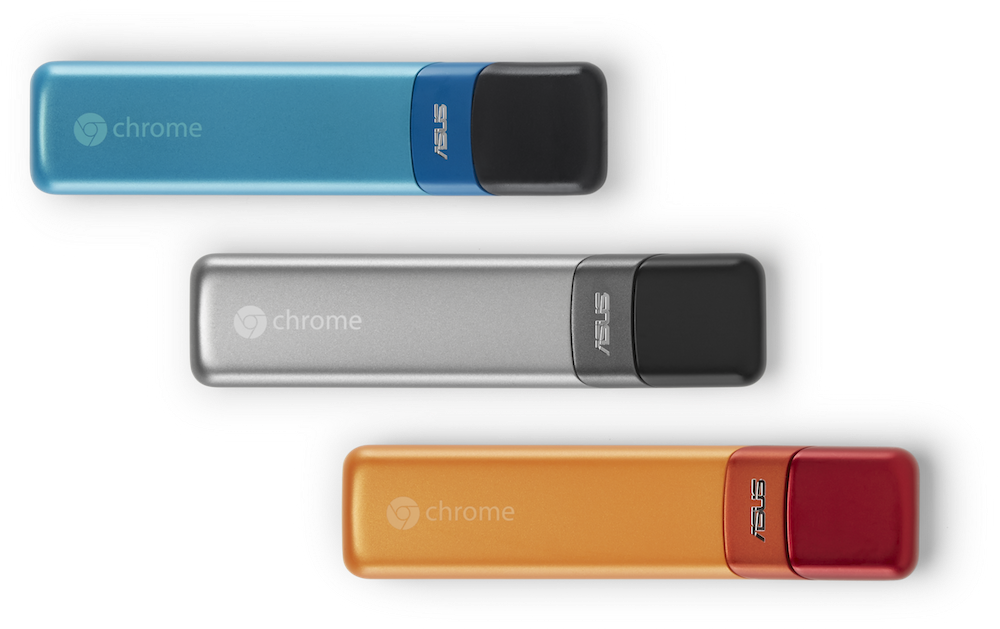
This summer, ASUS will launch a new type of Chrome device: the Chromebit. Smaller than a candy bar, the Chromebit is a full computer that will be available for less than $100. By simply plugging this device into any display, you can turn it into a computer. It’s the perfect upgrade for an existing desktop and will be really useful for schools and businesses.
So whether you’re looking for a smaller Chrome device that packs a big punch or a laptop that can do back bends, there’s a Chromebook for you...and for everyone else, too.
Telefónica Open Future, China Unicom and THTI launch call to accelerate startups in the IoT space
Barcelona, - Telefónica Open Future, the open innovation programme by Telefónica; China Unicom, one of the largest Chinese carriers; and Tsinghua Technology and Innovation (THTI), the technological innovation platform of renowned Tsinghua University, today announced the launch of a joint global call to detect and accelerate innovative startups to develop projects of common interest to the three companies in the Internet of Things (IOT) space.
The announcement was made during the first Telefónica Open Future Showcase inaugurated by José María Álvarez-Pallete, chief operating officer of Telefónica, and was held as part of Four Years From Now (4YFN) - parallel event at Mobile World Congress in Barcelona aimed at the international entrepreneur ecosystem.
The alliance will select and accelerate 10 projects helping them to expand their businesses by leveraging the resources and scale of Telefónica, China Unicom and THTI. Together they offer services to more than 791 million customers and operate an entrepreneurship support network that expands across three continents.
"With the involvement of China Unicom and THTI, this is one of the most significant agreements Telefónica Open Future has signed at an international level because it brings the Chinese entrepreneurship ecosystem closer to those of Europe and Latin America”, said José María Álvarez-Pallete at the opening of the Telefónica Open Future Showcase. “With this alliance and the joint global call that we are launching today, we will offer startups in these three regions the support they need to grow, think differently and take their business to new heights. We are not only offering these startups work spaces, resources and financing but also commercial opportunities building on the clients and extensive networking opportunities of the three companies”
The selected startups will benefit from a network of incubators and accelerators that the three companies have in 17 countries alongside a guaranteed space in any of the three newly created crowdworking spaces that are specifically dedicated to this alliance in Madrid, Beijing and Shanghai.
Each startup will take advantage of a customised programme focused on the acceleration and development of its business according to the degree of maturity and growth potential. The program will include office spaces in the new markets, pilots in the R&D departments of the companies, privileged access to sources of investment and great networking opportunities.
Telefónica, China Unicom and THTI have been collaborating since June 2014 when they signed an agreement to promote a global platform for open innovation by sharing their sources of innovation and resources. Today's announcement is a step forward in that collaboration whereby the companies, in addition to searching for internal synergies between their portfolios, now search for new talent. The collaboration has already helped startups from Telefónica's Open Future programme reach agreements with Chinese companies and likewise Chinese startups have been able to leverage Telefónica's operations around the globe.
Startups from three continents participate in the first Telefonica Open Future Showcase
12 startups that encompass some of the initiatives that make up Telefónica Open Future (Wayra, Amérigo, Telefónica Ventures and company partners, among others) have presented their projects to an audience of more than 400 international investors at 4YFN, an event for entrepreneurs and innovation that is currently being held as part of the Mobile World Congress in Barcelona.
The startups presenting were from Asia, Europe and Latin America at various states of maturity, and working in a variety of different fields. As José María Álvarez-Pallete pointed out during his speech at the 4YFN event, these startups reflect the spirit behind Open Future.
"Telefónica has been a pioneer in supporting entrepreneurship and innovation through various different initiatives in the markets where we operate. Open Future represents a step forward - we want to reach more youngsters, generate a greater impact and play a bigger role in contributing to economic change as more and more industries become digitised. This is only possible with the support of public and private partners willing to share forces, resources and experience”, he pointed out.
Through Wayra, Telefónica Ventures and Amerigo, the three technology investment tools which are part of the programme, Telefónica Open Future has 300 million euros under management, built a portfolio of around 500 companies and generated more than 5,000 jobs. The programme is present in 17 countries and collaborates with 60 partners around the world.
One of the most recent investments made by Telefónica Open Future is the one made through Telefónica Ventures in Sigfox, the company specialising in networks for the IoT. An investment was also made in Carto BD, a startup that focuses on online mapping and was showcased at the 4YFN event. This investment was made through Amerigo, the international network of technology venture capital lead by Telefónica.
Startups participating at Telefónica Open Future showcase
Adjust is a business intelligence platform for mobile app marketers, combining attribution for advertising sources with advanced analytics and store statistics.
Amésanté is a healthcare platform integrating cloud technologies, smart sensor technology wireless communication technologies.
Apparcar is the first park system that lets you find the nearest available spot on the street to your destiny without the use of sensors.
Blueliv is a leading provider of targeted cyber threat information and analysis intelligence for large enterprises, service providers, and security vendors.
Cartobd is software as a service (saas) cloud computing platform that provides gis and web mapping tools for display in a web browser.
EmotionsAR is an augmented reality startup.
Qustodio helps parents to protect kids online.
Firstv1sion is a wearable broadcast system that immerses sports fans into an event through the athlete's' point of view
Geenapp is an app promotion platform that pays people for app promotion and installation (P2P advertising)
Upplication redefines app creation for businesses emphasizing simplicity and helping them to increase their sales and communication with their customers. In 2014 they made applications in 51 different countries.
Visualnacert creates colourful maps to simplify the visualisation of agriculture to make decisions easier and improve the profitability of fields. In 2014 the company made +600k revenue and operated in 4 continents.
VTX, Product search through images for mobile commerce and mobile technology for retail.
About Telefónica
Telefónica is one of the largest telecommunications companies in the world in terms of market capitalisation and number of customers. With its best in class mobile, fixed and broadband networks, and innovative portfolio of digital solutions, Telefónica is transforming itself into a ‘Digital Telco’, a company that will be even better placed to meet the needs of its customers and capture new revenue growth.
The company has a significant presence in 21 countries and a customer base of 341 million accesses around the world. Telefónica has a strong presence in Spain, Europe and Latin America, where the company focuses an important part of its growth strategy.
Telefónica is a 100% listed company, with more than 1.5 million direct shareholders. Its share capital currently comprises 4,657,204,330 ordinary shares traded on the Spanish Stock Market and on those in London, New York, Lima, and Buenos Aires.
About China Unicom
China Unicom has branches and subsidiaries in 31 provinces, municipalities and autonomous regions in China as well as a list of countries and regions abroad, it is the only Chinese telecom operator that is listed in New York, Hong Kong and Shanghai simultaneously. China Unicom has been among Fortune 500 Companies for many consecutive years, it ranks No. 258 among Fortune 500 in 2013. China Unicom mainly operates fixed line communication services, mobile communication services, domestic and international communication facility services, satellite international dedicated links, data communication services, network access services and various value-added telecom services, as well as system integration services related to communication and information business. China Unicom’s revenue, customer base and market capitalization are all among leading telecom operators in the world.
In 2014, China Unicom set up a wholly owned subsidiary – Unicom Innovation Venture Capital Ltd. Together with local governmental authorities and universities in Shanghai, it founded China Unicom Center for International Mobile Internet Entrepreneurship (CIMIE), a constituting function of Unicom Innovation Venture Capital. By combining its incubation services and investment platform, the company will be able to foster innovation, capture new growth opportunities, and attract innovation talents.
About THTI
Tsinghua Holdings Technology and Innovation Holdings Co., Ltd. (“THTI”) is a science and technology service provider and a science park operator, with technological innovation services as its primary business. THTI is a member enterprise and the technological innovation platform of Tsinghua Holdings Co., Ltd. Dedicated to the technological services industry, THTI focuses its strategy on regional innovation and technological company development through chain operations, network, capital and internalization, and gradually developed five main business areas, covering innovation and entrepreneurship, science parks, investment and incubation, technology related finance, and international businesses.
THTI, operates 18 science parks nationwide, with partners in over 50 cities, as well as a strong incubation system consisting of Innoway, Virtue Inno Valley, Binggo Café, Lean One Academy and TIPark Silicon Valley, covering more than three million square meters of science park space, providing incubation services for more than 1,000 technological enterprises, and invested in more than 100 enterprises. THTI is committed to technological services, aiming at becoming a global leading name in technological services, a platform integrating innovation resources, a science park operations expert, and the best partner for innovation and entrepreneurship services.
Deutsche Telekom and Microsoft Announce Strategic Partnership Centered on Mobility and Cloud Services
BARCELONA, – At Mobile World Congress in Barcelona, Spain, Deutsche Telekom and Microsoft Corp. announced a broad, strategic partnership to expand and market Microsoft Lumia smartphones and online services such as Office 365 and OneDrive across sales and marketing channels in all 12 European countries* that Deutsche Telekom is in presently.
Through this partnership, both Deutsche Telekom and Microsoft aim to expand the Microsoft ecosystem to new consumer and business customers, enabling people to do and achieve more. The agreement includes a joint international marketing campaign spanning advertising, sales support and training, custom application development, and experiential activities, tailored by market.
Initially focused on driving business and consumer demand for Microsoft Lumia smartphones and online services, the partnership is also designed to incorporate additional Microsoft products in the future. Deutsche Telekom will be a Windows 10 launch partner.
Niek Jan van Damme, Managing Director, Telekom Deutschland GmbH and member of the board of Deutsche Telekom, is convinced about the strategic value of this collaboration: “Our successful cooperation with Microsoft which we continue to develop for years now, strengthens the position of Deutsche Telekom as the leading provider for connected life. Together with Microsoft’s broad portfolio of devices, services and platforms, we reach customers who wish to switch their phone quickly and easily between professional and private use. Thus, we are able to provide a seamless user experience with benefits for both our private and our business customers.”
“Deutsche Telekom has been a Microsoft device partner since the beginning. Its trusted brand and network excellence in Germany and across key European markets will be a strong force to jointly deliver Microsoft devices and services to more consumers and businesses throughout Europe,” said Florian Seiche, vice president, Europe Region, Mobile Device Sales, Microsoft.
Deutsche Telekom will also offer Microsoft’s new Lumia 640 smartphone, announced in Barcelona on Monday. The Microsoft Lumia 640** will be included in the pan-European marketing campaign that is a pillar of this partnership.
* European countries include Austria, Croatia, Czech Republic, Germany, Greece, Hungary, Macedonia, Montenegro, Netherlands, Poland, Romania and Slovakia.
** Device availability varies market to market.
About Microsoft
Founded in 1975, Microsoft (Nasdaq “MSFT”) is the worldwide leader in software, services, devices and solutions that help people and businesses realize their full potential.
About Deutsche Telekom
Deutsche Telekom is one of the world’s leading integrated telecommunications companies with around 151 million mobile customers, 30 million fixed-network lines and more than 17 million broadband lines (as of December 31, 2014). The Group provides fixed network, mobile communications, Internet and IPTV products and services for consumers and ICT solutions for business customers and corporate customers. Deutsche Telekom is present in more than 50 countries and has approximately 228,000 employees worldwide. The Group generated revenues of EUR 62.7 billion in the 2014 financial year – more than 60 percent of it outside Germany.
Apple Watch Available in Nine Countries on April 24
SAN FRANCISCO — March 9, 2015 — Apple® today announced that Apple Watch™, its most personal device yet and the newest innovative addition to Apple’s ecosystem, will be available on Friday, April 24 to customers in Australia, Canada, China, France, Germany, Hong Kong, Japan, the UK and the US. Apple Watch is an incredibly accurate timepiece, an intimate and immediate communication device and a groundbreaking health and fitness companion. Highly customizable for personal expression, Apple Watch also brings an entirely new way to receive information at a glance and interact with the world through third-party app experiences designed specifically for the wrist.
“Apple Watch begins a new chapter in the way we relate to technology and we think our customers are going to love it,” said Tim Cook, Apple’s CEO. “We can’t wait for people to start wearing Apple Watch to easily access information that matters, to interact with the world, and to live a better day by being more aware of their daily activity than ever before.”
“Conceived, designed and developed as a singular product, Apple Watch merges hardware and software like never before,” said Jony Ive, Apple’s senior vice president of Design. “In Apple Watch, we’ve created three beautifully curated collections with a software architecture that together enable unparalleled personalization in a wearable device.”
Apple Watch introduces revolutionary technologies including the Digital Crown™, an innovative way to scroll, zoom and navigate fluidly without obstructing the display. The Retina® display with Force Touch on Apple Watch senses the difference between a tap and a press, providing a new way to quickly and easily access relevant controls. The all-new Taptic Engine™ discreetly delivers a gentle tap on your wrist whenever you receive a notification or message.
Incredibly Accurate & Customizable Timepiece
An extremely precise timepiece, Apple Watch keeps time to within 50 milliseconds of UTC, the universal time standard.* Apple Watch can be personalized with watch faces ranging from traditional analog such as the Chronograph face, to the information-rich Modular face, or beautifully animated butterflies and jellyfish on the Motion face. Apple Watch goes beyond telling time with specialized functions on the watch face—known in watchmaking as complications—such as the sunrise/sunset, upcoming calendar events or daily activity level. With multiple customizable watch faces and complications, Apple Watch enables millions of possible configurations. Swipe up from the watch face for Glances that quickly show you information you care about, such as the weather forecast, your current location on a map or the music you’re listening to.
Intimate & Immediate Communication Device
Apple Watch enables you to send messages, read email and answer calls to your iPhone® right from your wrist. The Taptic Engine alerts you with a gentle tap so you won’t miss important notifications. With Digital Touch, Apple Watch allows you to communicate in all-new ways by sending a sketch, a tap or even the rhythm of your own heartbeat. Interact quickly and conveniently with the world around you with Apple Watch by paying for coffee using Apple Pay™**, boarding a plane with a Passbook® boarding pass, or raising your wrist to ask Siri® for turn-by-turn directions in Maps.
Groundbreaking Health & Fitness Companion
Apple Watch encourages you to sit less, move more and get some exercise every day. The Activity app provides a simple visual snapshot of your daily activity with three rings that measure active calories burned, brisk activity and how often you’ve stood up to take a break from sitting during the day. Apple Watch provides the detailed metrics you need during dedicated workout sessions for the most popular activities, such as walking, running and cycling through the Workout app. With an accelerometer, a built-in heart rate sensor, GPS and Wi-Fi from your iPhone, Apple Watch smartly uses the best sensors for different types of motion and provides a comprehensive picture of your all-day activity and workouts. The Activity app on iPhone collects your activity and workout data from Apple Watch so you can see your history in greater detail. Apple Watch uses this history to suggest personalized activity goals, reward fitness milestones and keep you motivated.
Apple Watch is available in two different sizes, 38 mm and 42 mm, and in three distinct collections—Apple Watch Sport, Apple Watch and Apple Watch Edition. Apple Watch Sport features a lightweight anodized aluminum case in silver and space gray with a Retina display protected by strengthened Ion-X glass and matching high-performance fluoroelastomer Sport Band in five colors. The Apple Watch collection features highly polished stainless steel and space black stainless steel cases with a Retina display protected by sapphire crystal. The Apple Watch collection comes with a choice of three different leather straps, a stainless steel link bracelet and Milanese loop, and a black or white Sport Band. Apple Watch Edition features cases specially crafted from custom rose or yellow 18-karat gold alloys developed to be twice as hard as standard gold, a Retina display protected by polished sapphire crystal and a choice of uniquely designed straps and bands with 18-karat gold clasps, buckles or pins.
The world’s most vibrant and innovative developer community has been creating all-new experiences specifically designed for Apple Watch. From requesting an Uber, checking in to your American Airlines flight, booking a bike for your Equinox class to remotely controlling your Honeywell Lyric thermostat while away, the possibilities for Apple Watch apps are endless. These experiences extend the functionality of your favorite iPhone apps, while delivering an innovative way to interact—right from your wrist. Popular apps such as Instagram, MLB.com At Bat, Nike+ Running, OpenTable, Shazam, Twitter, WeChat and more will also be available on Apple Watch. The new Apple Watch app that comes with iOS 8.2 on iPhone lets you browse, buy and download apps from the Apple Watch App Store™.
Designed to be worn throughout your day, Apple Watch delivers up to 18-hour all-day battery life*** and comes with a unique charging solution that combines Apple’s MagSafe® technology with inductive charging for a quick connection that simply snaps into place.
By design, the shopping experience for Apple Watch will be the most personalized Apple has ever offered. When Apple Watch becomes available for pre-order from the Apple Online Store (www.apple.com) on Friday, April 10, Apple retail stores and department store shop-in-shops will begin offering customers the chance to preview their choice of Apple Watch and try it on in-store.
Pricing & Availability
Beginning April 10 in Australia, Canada, China, France, Germany, Hong Kong, Japan, the UK and the US, Apple Watch will be available for preview, try-on by appointment at Apple’s retail stores, and available for pre-order through the Apple Online Store (www.apple.com). On April 24, Apple Watch will be available online or by reservation in Apple’s retail stores and select Apple Authorized Resellers in China and Japan. Customers who purchase online or in-store from Apple will be offered Personal Setup to customize and pair Apple Watch with their iPhone.
Apple Watch is available in three collections, Apple Watch Sport, priced at $349 (US) and $399 (US); Apple Watch, available from $549 (US) to $1,099 (US); and Apple Watch Edition, crafted from custom rose or yellow 18-karat gold alloys, with prices starting at $10,000 (US).
Apple Watch will also be available to preview or try on at Galeries Lafayette in Paris, Isetan in Tokyo and Selfridges in London on April 10. Apple Watch will be for sale on April 24 at these select department store shop-in-shops, and at boutiques in major cities across the world including colette in Paris, Dover Street Market in London and Tokyo, Maxfield in Los Angeles and The Corner in Berlin.
Starting today customers can explore and choose their favorite Apple Watch in the Apple Online Store (www.apple.com) or through the Apple Store app for iPhone and iPad.
Apple Watch requires iPhone 5, iPhone 5c, iPhone 5s, iPhone 6 or iPhone 6 Plus running iOS 8.2. or later. iOS 8.2 will be available for download today.
*Accuracy depends on regular syncing with iPhone.
**Apple Pay is only available in the US and through participating banks. See www.apple.com/apple-pay for details.
***Battery life depends on device settings, usage and other factors. Actual results may vary.
Apple designs Macs, the best personal computers in the world, along with OS X, iLife, iWork and professional software. Apple leads the digital music revolution with its iPods and iTunes online store. Apple has reinvented the mobile phone with its revolutionary iPhone and App Store, and is defining the future of mobile media and computing devices with iPad.
HP to Acquire Aruba Networks to Create an Industry Leader in Enterprise Mobility
PALO ALTO, CA and SUNNYVALE, CA–(Marketwired – Mar 2, 2015) – HP (NYSE: HPQ) and Aruba Networks (NASDAQ: ARUN) today announced a definitive agreement for HP to acquire Aruba, a leading provider of next-generation network access solutions for the mobile enterprise, for $24.67 per share in cash. The equity value of the transaction is approximately $3.0 billion, and net of cash and debt approximately $2.7 billion. Both companies’ boards of directors have approved the deal.
Aruba is a Sunnyvale-based industry leader in wireless networking with approximately 1,800 employees. The company had revenues of $729 million in fiscal 2014, and has reported compound annual revenue growth of 30 percent over the last five years.
Aruba boasts a highly regarded innovation engine and specialized sales, marketing and channel model, complementing HP’s leading networking business and go-to-market breadth. Together, HP and Aruba will deliver next-generation converged campus solutions, leveraging the strong Aruba brand. This new combined organization will be led by Aruba’s Chief Executive Officer Dominic Orr, and Chief Strategy and Technology Officer, Keerti Melkote, reporting to Antonio Neri, leader of HP Enterprise Group. With this move, HP will be uniquely positioned to deliver both the innovation and global delivery and services offerings to meet customer needs worldwide.
With the shift to mobile, enterprise networking needs are exceeding the capabilities of legacy infrastructure. At the same time, organizations are shifting rapidly to mobility-centric workplaces for their employees, guests, customers and students. The next-generation 802.11ac Wi-Fi standard is critical in enabling this trend. This new technology will support the faster speeds and access to cloud applications that end-users expect. Enterprises need comprehensive, integrated and secure networking solutions to help them transition legacy systems to the wireless edge. Today’s announcement directly addresses these market trends.
“Enterprises are facing a mobile-first world and are looking for solutions that help them transition legacy investments to the new style of IT,” said Meg Whitman, Chairman, President and Chief Executive Officer of HP. “By combining Aruba’s world-class wireless mobility solutions with HP’s leading switching portfolio, HP will offer the simplest, most secure networking solutions to help enterprises easily deploy next-generation mobile networks.”
“Together with HP, we have a tremendous opportunity to become an even greater force in enterprise mobility and networking,” said Mr. Orr. “This transaction brings together Aruba’s best-of-breed mobility hardware and software solutions with HP’s leading switching portfolio. In addition, Aruba’s channel partners will have the opportunity to expand their businesses with HP offerings. Together, we will build on Aruba’s proven ‘customer first, customer last’ culture, creating an innovative, agile networking leader ideally positioned to solve our customers’ most pressing mobility, security and networking challenges.”
HP and Aruba believe that by combining complementary product portfolios and go-to-market approaches they will be able to accelerate revenue growth and strengthen the financial performance of the combined HP Networking business, and create a leading competitor in the $18 billion and growing campus networking sector. Overall, HP expects the acquisition to be accretive to earnings in the first full year following close.
The transaction is expected to close in the second half of HP’s fiscal year 2015, subject to Aruba stockholder approval, regulatory approvals in the US and other countries as well as other customary closing conditions.
About HP
HP creates new possibilities for technology to have a meaningful impact on people, businesses, governments and society. With the broadest technology portfolio spanning printing, personal systems, software, services and IT infrastructure, HP delivers solutions for customers’ most complex challenges in every region of the world. More information about HP is available at http://www.hp.com.
About Aruba Networks, Inc.
Aruba is a leading provider of next-generation network access solutions for the mobile enterprise. Aruba designs and delivers Mobility-Defined Networks that empower IT departments and #GenMobile, a new generation of tech-savvy users who rely on their mobile devices for every aspect of work and personal communication. To create a mobility experience that #GenMobile and IT can rely upon, Aruba Mobility-Defined Networks™ automate infrastructure-wide performance optimization and trigger security actions that used to require manual IT intervention. The results are dramatically improved productivity and lower operational costs. Listed on the NASDAQ and Russell 2000® Index, Aruba is based in Sunnyvale, California, and has operations throughout the Americas, Europe, Middle East, Africa and Asia Pacific regions.
Leading M2M Alliances Back the GSMA Embedded SIM Specification to Accelerate the Internet of Things
Barcelona:The GSMA has announced that operator members of leading M2M alliances including the Global M2M Association (GMA) and the M2M World Alliance will deploy services using the GSMA Embedded SIM Specification for the remote over-the-air provisioning of machine-to-machine (M2M) devices. In addition to these organisations, network operators América Móvil, China Mobile, KDDI and Tele2 have become the latest operators to commit to launch services based on the GSMA specification. According to GSMA Intelligence, nearly 65 per cent* of global M2M connections are now serviced by operators deployed or committed to the GSMA’s solution, confirming that the industry is moving towards a single, common specification that is helping to accelerate growth and reduce fragmentation in the M2M market.
“The number of leading network operators who have launched or committed to deploy services based on the GSMA Embedded SIM Specification is now more than 20 worldwide,” said Alex Sinclair, Chief Technology Officer, GSMA. “The backing of these leading M2M alliances further demonstrates that the industry is firmly united behind this common and truly global standard, an important factor that will drive the market to scale going forward.”
The M2M World Alliance’s nine operator members, Etisalat, KPN, NTT DOCOMO, Rogers, Singtel, Telefónica, Telstra, VimpelCom and Telenor Connexion, are developing global solutions based on the specification. The GMA is a cooperation of six leading operators, including Deutsche Telekom, Orange, Telecom Italia, TeliaSonera, Bell Canada and SoftBank. It will showcase a live demonstration of their Multi-Domestic Service, leveraging embedded SIM cards at Mobile World Congress.
Global M2M Association
“The growth potential of the Internet of Things will see a huge rise in the number of connected M2M devices placing an increasing amount of pressure on mobile networks. It is important that the players in the mobile ecosystem build on common foundations to ensure that the market can scale, thus creating a reliable and efficient network for IoT services to successfully run on. That is why we chose to implement GMA services compliant with the GSMA Embedded SIM specification,” says Hans Dahlberg, Head of TeliaSonera Global M2M Services and one of the founding members of GMA.
M2M World Alliance
“We believe that our unique and seamless Single Global SIM solution, combined with the GSMA Embedded SIM Specification will drive rapid adoption of M2M communications worldwide,” said Randy Bryson, chairman of the M2M World Alliance. “By integrating the GSMA Embedded SIM Specification, the M2M World Alliance members will provide robust local, flexible and cost effective support for our customers’ diverse M2M and IoT connectivity needs.”
Business Processes Document Published
The GSMA has also published the white paper, “Business Processes for Remote SIM Provisioning in M2M”, to assist OEMs and operators in providing M2M eUICC-based services. The document provides a step-by-step guide on profile swaps and detail on potential deployment models, as well as typical business processes.
Live Solutions Showcased at the GSMA Innovation City
The GSMA will showcase two live demonstrations of the GSMA Embedded SIM Specification at the GSMA Innovation City, where profiles will be swapped over the air. The demonstrations are being supported by the GMA and the M2M World Alliance in cooperation with Giesecke & Devrient (G&D), Sierra Wireless and TST and highlight two real-world scenarios in which the specification can be deployed.
The GSMA Innovation City is located at Stands 3A11 and 3A31 in Hall 3, Fira Gran Via and will be open during Mobile World Congress exhibition hours from Monday 2nd March through Thursday 5th March 2015.
The GSMA Embedded SIM Specification allows mobile network operators to provide scalable, reliable and secure connectivity for M2M connected devices that are often hermetically sealed, such as in the connected car or in smart meters. It also facilitates over-the-air operator provisioning and management, which provides service flexibility to end customers. For more information on the GSMA’s Embedded SIM please go to: http://www.gsma.com/connectedliving/connected-living-mobilising-the-internet-of-things/.
To download a copy of the “Business Processes for Remote SIM Provisioning in M2M” document please go here: http://www.gsma.com/connectedliving/business-processes-for-remote-provisioning-in-m2m/.
-ENDS-
* According to GSMAi, as of Q4 2014, there are 157.7 million cellular M2M connections for all operators committed to launching the GSMA Embedded SIM Specification accounting for 65% of total global cellular M2M connections. GSMAi forecasts 316.8 million connections at the end of 4Q15.
** AT&T, Etisalat, NTT DOCOMO, Telefónica and Vodafone have already launched services based on the GSMA Embedded SIM Specification.
About the GSMA
The GSMA represents the interests of mobile operators worldwide, uniting nearly 800 operators with more than 250 companies in the broader mobile ecosystem, including handset and device makers, software companies, equipment providers and Internet companies, as well as organisations in adjacent industry sectors. The GSMA also produces industry-leading events such as Mobile World Congress, Mobile World Congress Shanghai and the Mobile 360 Series conferences.
One Billion New Unique Mobile Subscribers by 2020, Finds New GSMA Study
Barcelona: An additional one billion people will become mobile subscribers over the next five years, according to a major new GSMA report published at Mobile World Congress today. The new report, ‘The Mobile Economy: 2015’, forecasts that the number of unique mobile subscribers1 will increase from 3.6 billion at the end of 2014 to 4.6 billion by 2020, increasing by four per cent per year (CAGR) over this period. By 2020, almost 60 per cent of the global population will subscribe to mobile services, up from half of the population at the end of 2014.
The study also highlights a rapid migration to 3G/4G mobile broadband networks and rising smartphone adoption, which is fuelling growth in new mobile data services and applications. As the mobile ecosystem continues to expand in reach and size, the mobile industry is forecast to make an increasing contribution to global GDP, public funding and employment, as well as improving the lives of billions of citizens around the world.
“A decade ago, just one in five of the global population was a mobile subscriber – we have now surpassed the 50 per cent milestone and can look forward to connecting a billion new subscribers over the next five years,” commented Anne Bouverot, Director General of the GSMA. “Mobile sits at the heart of a new ecosystem that is uniting the digital and physical worlds, and powering economic growth. At the same time, mobile operators continue to deploy networks to all corners of the globe, connecting unconnected citizens and addressing socio-economic challenges in areas such as digital and financial inclusion, healthcare and education.”
Mobile penetration varies widely by global region. In Europe, nearly 80 per cent of the population were mobile subscribers at the end of 2014, while in Sub-Saharan Africa the figure is only 39 per cent. Global subscriber growth over the next five years will therefore be concentrated in the developing world, driven by the increasing affordability of mobile devices and services and rapidly expanding mobile coverage that serves to connect currently unconnected populations, especially those in rural areas.
The number of global SIM connections2 (excluding M2M connections) is forecast to grow from 7.1 billion in 2014 to 9 billion by 2020. This implies that every unique mobile subscriber will continue to account for roughly 1.8 SIM cards each, on average, during this period. Cellular M2M connections are forecast to reach 1 billion by 2020, bringing the total number of mobile connections to 10 billion by this point.
Rapid Migration to Mobile Broadband and Smartphones
The period out to 2020 will see a rapid migration to mobile broadband technology as 3G/4G network availability and affordability increases. Mobile broadband accounted for 40 per cent of SIM connections in 2014, but will increase to almost 70 per cent of the total by 2020 as subscribers migrate away from 2G networks and devices. As well as expanding 3G/4G coverage reach, this trend is being driven by the rising number of smartphone connections3. Smartphones accounted for 37 per cent of SIM connections in 2014, a figure forecast to rise to 65 per cent by 2020.
The smartphone adoption rate is already at 60 per cent in the developed world, ranging from 51 per cent of SIM connections in Europe to 70 per cent in North America. The developing world will lead smartphone growth over the next five years as the average selling price of smartphones continues to decline, adding a further 2.9 billion smartphone connections by 2020.
Supporting Growth with Investment
The increasing use of mobile broadband-enabled smartphones is fuelling an explosion in mobile data traffic. According to Cisco4, global mobile data volumes are forecast to grow at a CAGR of 57 per cent through to 2019, reaching 24,314 petabytes per month by that point, a result of rising on-demand video consumption via mobile devices.
Mobile operators are making significant investments in next-generation mobile networks to meet capacity demands and expand coverage reach. In 2014, mobile operators invested around US$216 billion in capital expenditure (Capex), a nine per cent year-on-year increase. Investment levels are forecast to reach a cumulative US$1.4 trillion in the six years from 2015 through to 2020.
A Growing Contributor to The Global Economy
The mobile industry is a cornerstone of the global economy. In 2014, the mobile industry contributed US$3 trillion to the world’s economy, equivalent to 3.8 per cent of global Gross Domestic Product (GDP)5. By 2020, it is estimated that the contribution from the industry will increase to US$3.9 trillion, representing 4.2 per cent of projected global GDP by this point.
The mobile industry directly employed 12.8 million people globally in 2014 and indirectly supported a further 11.8 million jobs, bringing the total to 24.6 million. By 2020, this figure is forecast to reach 28.7 million, with 15.3 million men and women directly employed by the industry. Even without factoring in spectrum fees – which generated more than US$14 billion in revenue for governments worldwide last year – it is estimated that the mobile industry contributed US$411 billion to public finances in 2014 via taxation and social security contributions. This public funding contribution is forecast to rise to US$465 billion by 2020.
“Operators require a supportive regulatory framework in order to deliver this new digital ecosystem being built on mobile broadband networks, smartphones and other connected devices,” added Bouverot. “Our new report published today includes a number of steps that policymakers can take to stimulate investment, competition and innovation in the mobile-powered digital economy, including reducing constraints on market-driven restructuring; ensuring operators have access to sufficient spectrum; and supporting operator efforts to expand mobile network coverage into rural areas in a sustainable way.”
To access the full report and related infographics please visit: http://gsmamobileeconomy.com/.
About the GSMA
The GSMA represents the interests of mobile operators worldwide, uniting nearly 800 operators with more than 250 companies in the broader mobile ecosystem, including handset and device makers, software companies, equipment providers and Internet companies, as well as organisations in adjacent industry sectors. The GSMA also produces industry-leading events such as Mobile Wo
LG and Huawei Unveil Round Smartwatches At Mobile World Congress
LONDON, —LG Electronics (LG) will unveil its first all-metal luxury Android Wear device, LG Watch Urbane, at Mobile World Congress (MWC) 2015. As its name suggests, the smartwatch is designed for a sophisticated and cosmopolitan wearer that delivers unparalleled technology and performance.LG Watch Urbane is the perfect devicefor wearers looking to add both style and high-tech flareto their everyday lives.
The LG Watch Urbane follows closely in the footsteps ofthe LG Watch R, the first smartwatch with a full circular Plastic OLED (P-OLED) display, which LG launched in October 2014. While the LG Watch R was designed with the active user in mind, the LG Watch Urbane is more formal with a thinner profile making it perfect for either men or women. Resembling a luxury timepiece, LG combined a classic design and innovative features to add style and convenience to everyday life while raising the already high standards set by its predecessor.
The LG Watch Urbane is crafted around the same 1.3-inch full circle P-OLED display as the LG Watch R but features a narrower bezel that gives it sleeker lines. The LG Watch Urbane has all of the hallmarks of a fine watch, making it the perfect fashion accessory. Its stainless steel body is available in polished silver and is complemented by a beautifullystitched natural leather strap for a more classic look. The strap can be replaced with any 22mm wide band to suit the occasion or the wearer’s mood.Powering all of thisis an intuitive touch-based user interface that makes the LG Watch Urbane compatible with smartphones running Android 4.3 and above.
Like the G Watch R, LG’s latest Android Wear deviceincludes a photoplethysmography (PPG) sensor that can measure a wearer’s heart rate and average pulse during exercise.Always-On ambient mode shows the time on the display at all times in dimmed mode, saving battery life.
“The LG Watch Urbane’s classic design and smart features make it the perfect smartwatch to complement our G Watch and G Watch R, which were designed as more casual and active devices,” said Juno Cho, president and CEO of LG Electronics Mobile Communications Company. “LG Watch Urbane is an important part of our strategy to develop wearable devices that are worn and viewed as everyday accessories, not electronic gadgets.”
Additional details including pricewill be announced in local markets at the time of availability.
About LG Electronics, Inc.
LG Electronics, Inc. (KSE: 066570.KS) is a global leader and technology innovator in consumer electronics, mobile communications and home appliances, employing 82,000 people working in 119 locations around the world. With 2014 global sales of USD 55.91 billion (KRW 59.04 trillion), LG comprises four business units ― Home Entertainment, Mobile Communications, Home Appliance & Air Solution, and Vehicle Components ― and is one of the world’s leading producers of flat panel TVs, mobile devices, air conditioners, washing machines and refrigerators. LG Electronics is a 2014 ENERGY STAR Partner of the Year. For more news and information on LG Electronics, please visit www.LGnewsroom.com.
About LG Electronics Mobile Communications Company
LG Electronics Mobile Communications Company is a global leader and trend setter in the mobile and wearable industry with breakthrough technologies and innovative designs. By continually developing highly competitive core technologies in the areas of display, battery, camera optics and LTE technology, LG creates handsets and wearables that fit the lifestyles of a wide range of people all over the world. While helping to enhance the mobile user experience by incorporating unique, sophisticated designs and intuitive UX features, LG is also committed to guiding consumers into the era of convergence and Internet of Things, maximizing inter-device connectivity between a wide range of smartphones, tablets, wearables, home and portable electronics products. For more information, please visit www.LG.com.
SAMSUNG Launches New Monochrome Single Function Printers Delivering Reliability, Speed and Simplicity for Businesses
RIDGEFIELD PARK, NJ – Samsung Electronics America, Inc. today launched its latest line of monochrome single function printers, the M4530NX and the M4530ND, designed to deliver powerful performance, speed, mobile features and business productivity. These reliable devices are designed to improve workflow and efficiency with enterprise level solutions capabilities via the XOA-Web platform for server based solutions. The M4530 series also shares supplies with the ProXpress M4583FX Multifunction Printer for easy ordering and consumable management.
“In today’s competitive business landscape, Samsung is dedicated to producing reliable, easy to use and cost-efficient devices designed to enable professional users to achieve the most elite printer experience possible,” said Matt Smith, Vice President of Sales and Marketing, Printing Solutions for Samsung’s Enterprise Business Division. “We create solutions that enhance workflow and easily connect to an ecosystem of mobile devices to provide a seamless user experience and maximize efficiency.”
Increased Productivity and Performance
The M4530NX and M4530ND produce quality, high-volume printing at speeds of up to 47 pages per minute. With long life consumable options, 40K toner and a 100K drum, the devices are designed for low total cost of ownership. Large jobs are supported by a 1GHZ dual-core CPU and a 550 sheet cassette, which provides powerful paper handling. The M4530NX with its 4.3-inch touchscreen display and the M4530ND with its built-in numeric keyboard, offer easy access to features and settings for simple printing or more advanced functions such as secure print release.
Improved Workplace Efficiency
Samsung Business Core Printing Solutions (BCPS) is a software suite that runs on the XOA-Embedded platform and was created to improve workplace efficiency. With custom workflows, secure print release, and cloud printing, IT managers can easily implement the kind of print and document management solutions typically seen in the enterprise. Up to five Samsung Printers or MFPs with the XOA-Web platform can run BCPS off of a single device featuring the XOA-Embedded platform, providing serverless print solutions.
Easy Mobile Access
Utilizing the Samsung Mobile Print App along with the NFC and wireless printing option, users can simply tap and print via a wireless connection. Both models also support Google Cloud Print allowing users to print from any device, anywhere.
Available in two versions, M4530ND has a four line LCD, while the M4530NX offers a touch screen display and built in hard drive.
The M4530 series printers are available today through select Samsung resellers and channel partners, Local availability can be determined by calling 1-866-SAM-4BIZ FREE or by visiting www.samsung.com/us/business. Follow us on Twitter @SamsungBizUSA.
About Samsung Enterprise
As a global leader in enterprise mobility and information technology, Samsung provides a diverse portfolio of enterprise technologies including smartphones, wearables, tablets, digital displays, hospitality TVs, printers and medical diagnostic equipment. We are committed to putting the business customer at the core of everything we do by delivering comprehensive products, solutions and services across diverse industries including retail, healthcare, hospitality, education and government. Samsung Electronics America, Inc. (SEA) and the Enterprise Business Division is committed to helping customers realize the promise of a digital business. For more information, please visit samsung.com/business, call 1-866-SAM-4BIZ FREE or follow Samsung Business via Twitter @SamsungBizUSA.
About Samsung Electronics Co., Ltd.
Samsung Electronics Co., Ltd. is a global leader in technology, opening new possibilities for people everywhere. Through relentless innovation and discovery, we are transforming the worlds of TVs, smartphones, tablets, PCs, cameras, home appliances, printers, LTE systems, medical devices, semiconductors and LED solutions. We employ 286,000 people across 80 countries with annual sales of US$216.7 billion. To discover more, please visit www.samsung.com.
FCC Adopts Strong, Sustainable Rules To Protect The Open Internet – Rules Will Preserve Internet Innovation
Washington, D.C. – Ending lingering uncertainty about the future of the Open Internet, the Federal Communications Commission today set sustainable rules of the roads that will protect free expression and innovation on the Internet and promote investment in the nation’s broadband networks.
The FCC has long been committed to protecting and promoting an Internet that nurtures freedom of speech and expression, supports innovation and commerce, and incentivizes expansion and investment by America’s broadband providers. But the agency’s attempts to implement enforceable, sustainable rules to protect the Open Internet have been twice struck down by the courts.
Today, the Commission—once and for all—enacts strong, sustainable rules, grounded in multiple sources of legal authority, to ensure that Americans reap the economic, social, and civic benefits of an Open Internet today and into the future. These new rules are guided by three principles: America’s broadband networks must be fast, fair and open—principles shared by the overwhelming majority of the nearly 4 million commenters who participated in the FCC’s Open Internet proceeding.
Absent action by the FCC, Internet openness is at risk, as recognized by the very court that struck down the FCC’s 2010 Open Internet rules last year in Verizon v. FCC.
Broadband providers have economic incentives that “represent a threat to Internet openness and could act in ways that would ultimately inhibit the speed and extent of future broadband deployment,” as affirmed by the U.S. Court of Appeals for the District of Columbia. The court upheld the Commission’s finding that Internet openness drives a “virtuous cycle” in which innovations at the edges of the network enhance consumer demand, leading to expanded investments in broadband infrastructure that, in turn, spark new innovations at the edge.
However, the court observed that nearly 15 years ago, the Commission constrained its ability to protect against threats to the open Internet by a regulatory classification of broadband that precluded use of statutory protections that historically ensured the openness of telephone networks. The Order finds that the nature of broadband Internet access service has not only changed since that initial classification decision, but that broadband providers have even more incentives to interfere with Internet openness today. To respond to this changed landscape, the new Open Internet Order restores the FCC’s legal authority to fully address threats to openness on today’s networks by following a template for sustainability laid out in the D.C. Circuit Opinion itself, including reclassification of broadband Internet access as a telecommunications service under Title II of the Communications Act.
With a firm legal foundation established, the Order sets three “bright-line” rules of the road for behavior known to harm the Open Internet, adopts an additional, flexible standard to future-proof Internet openness rules, and protects mobile broadband users with the full array of Open Internet rules. It does so while preserving incentives for investment and innovation by broadband providers by affording them an even more tailored version of the light-touch regulatory treatment that fostered tremendous growth in the mobile wireless industry.
Following are the key provisions and rules of the FCC’s Open Internet Order:
New Rules to Protect an Open Internet
While the FCC’s 2010 Open Internet rules had limited applicability to mobile broadband, the new rules—in their entirety—would apply to fixed and mobile broadband alike, recognizing advances in technology and the growing significance of wireless broadband access in recent years (while recognizing the importance of reasonable network management and its specific application to mobile and unlicensed Wi-Fi networks). The Order protects consumers no matter how they access the Internet, whether on a desktop computer or a mobile device.
Bright Line Rules: The first three rules ban practices that are known to harm the Open Internet:
• No Blocking: broadband providers may not block access to legal content, applications, services, or non-harmful devices.
• No Throttling: broadband providers may not impair or degrade lawful Internet traffic on the basis of content, applications, services, or non-harmful devices.
• No Paid Prioritization: broadband providers may not favor some lawful Internet traffic over other lawful traffic in exchange for consideration of any kind—in other words, no “fast lanes.” This rule also bans ISPs from prioritizing content and services of their affiliates.
The bright-line rules against blocking and throttling will prohibit harmful practices that target specific applications or classes of applications. And the ban on paid prioritization ensures that there will be no fast lanes.
A Standard for Future Conduct: Because the Internet is always growing and changing, there must be a known standard by which to address any concerns that arise with new practices. The Order establishes that ISPs cannot “unreasonably interfere with or unreasonably disadvantage” the ability of consumers to select, access, and use the lawful content, applications, services, or devices of their choosing; or of edge providers to make lawful content, applications, services, or devices available to consumers. Today’s Order ensures that the Commission will have authority to address questionable practices on a case-by-case basis, and provides guidance in the form of factors on how the Commission will apply the standard in practice.
Greater Transparency: The rules described above will restore the tools necessary to address specific conduct by broadband providers that might harm the Open Internet. But the Order recognizes the critical role of transparency in a well-functioning broadband ecosystem. In addition to the existing transparency rule, which was not struck down by the court, the Order requires that broadband providers disclose, in a consistent format, promotional rates, fees and surcharges and data caps. Disclosures must also include packet loss as a measure of network performance, and provide notice of network management practices that can affect service. To further consider the concerns of small ISPs, the Order adopts a temporary exemption from the transparency enhancements for fixed and mobile providers with 100,000 or fewer subscribers, and delegates authority to our Consumer and Governmental Affairs Bureau to determine whether to retain the exception and, if so, at what level.
The Order also creates for all providers a “safe harbor” process for the format and nature of the required disclosure to consumers, which the Commission believes will lead to more effective presentation of consumer-focused information by broadband providers.
Reasonable Network Management: For the purposes of the rules, other than paid prioritization, an ISP may engage in reasonable network management. This recognizes the need of broadband providers to manage the technical and engineering aspects of their networks.
• In assessing reasonable network management, the Commission’s standard takes account of the particular engineering attributes of the technology involved—whether it be fiber, DSL, cable, unlicensed Wi-Fi, mobile, or another network medium.
• However, the network practice must be primarily used for and tailored to achieving a legitimate network management—and not business—purpose. For example, a provider can’t cite reasonable network management to justify reneging on its promise to supply a customer with “unlimited” data.
Broad Protection
Some data services do not go over the public Internet, and therefore are not “broadband Internet access” services (VoIP from a cable system is an example, as is a dedicated heart-monitoring service). The Order ensures that these services do not undermine the effectiveness of the Open Internet rules. Moreover, all broadband providers’ transparency disclosures will continue to cover any offering of such non-Internet access data services—ensuring that the public and the Commission can keep a close eye on any tactics that could undermine the Open Internet rules.
Interconnection: New Authority to Address Concerns
For the first time the Commission can address issues that may arise in the exchange of traffic between mass-market broadband providers and other networks and services. Under the authority provided by the Order, the Commission can hear complaints and take appropriate enforcement action if it determines the interconnection activities of ISPs are not just and reasonable.
Legal Authority: Reclassifying Broadband Internet Access under Title II
The Order provides the strongest possible legal foundation for the Open Internet rules by relying on multiple sources of authority including both Title II of the Communications Act and Section 706 of the Telecommunications Act of 1996. At the same time, the Order refrains – or forbears – from enforcing 27 provisions of Title II and over 700 associated regulations that are not relevant to modern broadband service. Together Title II and Section 706 support clear rules of the road, providing the certainty needed for innovators and investors, and the competitive choices and freedom demanded by consumers, while not burdening broadband providers with anachronistic utility-style regulations such as rate regulation, tariffs or network sharing requirements.
• First, the Order reclassifies “broadband Internet access service”—that’s the retail broadband service Americans buy from cable, phone, and wireless providers—as a telecommunications service under Title II. This decision is fundamentally a factual one. It recognizes that today broadband Internet access service is understood by the public as a transmission platform through which consumers can access third-party content, applications, and services of their choosing.
Reclassification of broadband Internet access service also addresses any limitations that past classification decisions placed on the ability to adopt strong open Internet rules, as interpreted by the D.C. Circuit in the Verizon case. And it supports the Commission’s authority to address interconnection disputes on a case-by-case basis, because the promise to consumers that they will be able to travel the Internet encompasses the duty to make the necessary arrangements that allow consumers to use the Internet as they wish.
• Second, the proposal finds further grounding in Section 706 of the Telecommunications Act of 1996. Notably, the Verizon court held that Section 706 is an independent grant of authority to the Commission that supports adoption of Open Internet rules. Using it here—without the limitations of the common carriage prohibition that flowed from earlier the “information service” classification—bolsters the Commission’s authority.
• Third, the Order’s provisions on mobile broadband also are based on Title III of the Communications Act. The Order finds that mobile broadband access service is best viewed as a commercial mobile service or its functional equivalent.
Forbearance: A modernized, light-touch approach
Congress requires the FCC to refrain from enforcing – forbear from – provisions of the Communications Act that are not in the public interest. The Order applies some key provisions of Title II, and forbears from most others. Indeed, the Order ensures that some 27 provisions of Title II and over 700 regulations adopted under Title II will not apply to broadband. There is no need for any further proceedings before the forbearance is adopted. The proposed Order would apply fewer sections of Title II than have applied to mobile voice networks for over twenty years.
• Major Provisions of Title II that the Order WILL APPLY:
o The proposed Order applies “core” provisions of Title II: Sections 201 and 202 (e.g., no unjust or unreasonable practices or discrimination)
o Allows investigation of consumer complaints under section 208 and related enforcement provisions, specifically sections 206, 207, 209, 216 and 217
o Protects consumer privacy under Section 222
o Ensures fair access to poles and conduits under Section 224, which would boost the deployment of new broadband networks
o Protects people with disabilities under Sections 225 and 255
o Bolsters universal service fund support for broadband service in the future through partial application of Section 254.
• Major Provisions Subject to Forbearance:
o Rate regulation: the Order makes clear that broadband providers shall not be subject to utility-style rate regulation, including rate regulation, tariffs, and last-mile unbundling.
o Universal Service Contributions: the Order DOES NOT require broadband providers to contribute to the Universal Service Fund under Section 254. The question of how best to fund the nation’s universal service programs is being considered in a separate, unrelated proceeding that was already underway.
o Broadband service will remain exempt from state and local taxation under the Internet Tax Freedom Act. This law, recently renewed by Congress and signed by the President, bans state and local taxation on Internet access regardless of its FCC regulatory classification.
Effective Enforcement
o The FCC will enforce the Open Internet rules through investigation and processing of formal and informal complaints
o Enforcement advisories, advisory opinions and a newly-created ombudsman will provide guidance
o The Enforcement Bureau can request objective written opinions on technical matters from outside technical organizations, industry standards-setting bodies and other organizations.
Fostering Investment and Competition
All of this can be accomplished while encouraging investment in broadband networks. To preserve incentives for broadband operators to invest in their networks, the Order will modernize Title II using the forbearance authority granted to the Commission by Congress—tailoring the application of Title II for the 21st century, encouraging Internet Service Providers to invest in the networks on which Americans increasingly rely.
• The Order forbears from applying utility-style rate regulation, including rate regulation or tariffs, last-mile unbundling, and burdensome administrative filing requirements or accounting standards.
• Mobile voice services have been regulated under a similar light-touch Title II approach, and investment and usage boomed.
• Investment analysts have concluded that Title II with appropriate forbearance is unlikely to have any negative on the value or future profitability of broadband providers. Providers such as Sprint, Frontier, as well as representatives of hundreds of smaller carriers that have voluntarily adopted Title II regulation, have likewise said that a light-touch, Title II classification of broadband will not depress investment.
Action by the Commission February 26, 2015, by Report and Order on Remand, Declaratory Ruling, and Order (FCC 15-24). Chairman Wheeler, Commissioners Clyburn and Rosenworcel with Commissioners Pai and O’Rielly dissenting. Chairman Wheeler, Commissioners Clyburn, Rosenworcel, Pai and O’Rielly issuing statements.
Chinese Computer Maker Lenovo Under Cyber Attack of Superfish Provides Updates
RESEARCH TRIANGLE PARK, NC – At Lenovo, we make every effort to provide a great user experience for our customers. We know that millions of people rely on our devices every day, and it is our responsibility to deliver quality, reliability, innovation and security to each and every customer. In our effort to enhance our user experience, we pre-installed a piece of third-party software, Superfish (based in Palo Alto, CA), on some of our consumer notebooks. The goal was to improve the shopping experience using their visual discovery techniques.
In reality, we had customer complaints about the software. We acted swiftly and decisively once these concerns began to be raised. We apologize for causing any concern to any users for any reason – and we are always trying to learn from experience and improve what we do and how we do it.
We stopped the preloads beginning in January. We shut down the server connections that enable the software (also in January), and we are providing online resources to help users remove this software. Finally, we are working directly with Superfish and with other industry partners to ensure we address any possible security issues now and in the future. Detailed information on these activities and tools for software removal are available here:
http://support.lenovo.com/us/en/product_security/superfish
http://support.lenovo.com/us/en/product_security/superfish_uninstall
To be clear: Lenovo never installed this software on any ThinkPad notebooks, nor any desktops, tablets, smartphones or servers; and it is no longer being installed on any Lenovo device. In addition, we are going to spend the next few weeks digging in on this issue, learning what we can do better. We will talk with partners, industry experts and our users. We will get their feedback. By the end of this month, we will announce a plan to help lead Lenovo and our industry forward with deeper knowledge, more understanding and even greater focus on issues surrounding adware, pre-installs and security. We are confident in our products, committed to this effort and determined to keep improving the experience for our users around the world.
Superfish may have appeared on these models:
G Series: G410, G510, G710, G40-70, G50-70, G40-30, G50-30, G40-45, G50-45, G40-80
U Series: U330P, U430P, U330Touch, U430Touch, U530Touch
Y Series: Y430P, Y40-70, Y50-70, Y40-80, Y70-70
Z Series: Z40-75, Z50-75, Z40-70, Z50-70, Z70-80
S Series: S310, S410, S40-70, S415, S415Touch, S435, S20-30, S20-30Touch
Flex Series: Flex2 14D, Flex2 15D, Flex2 14, Flex2 15, Flex2 Pro, Flex 10
MIIX Series: MIIX2-8, MIIX2-10, MIIX2-11, MIIX 3 1030
YOGA Series: YOGA2Pro-13, YOGA2-13, YOGA2-11, YOGA3 Pro
E Series: E10-30
Edge Series: Lenovo Edge 15
Beginning in September 2014, we made a decision to ship some of our consumer notebooks with Superfish. This software frustrated some users without adding value to the experience so we were in the process of removing it from our preloads. Then, we saw published reports about a security vulnerability created by this software and have taken immediate action to remove it. Clearly this issue has caused concern among our customers, partners and those who care about Lenovo, our industry and technology in general. For this, I would like to again apologize. Now, I want to start the process of keeping you up to date on how we are working to fix the problem and restore your faith in Lenovo.
We have already taken several critical first steps:
We stopped the preloads and will not include this Superfish software in any devices in the future.
We have worked on our own and with our partners to make your PCs safe from this vulnerability as quickly and easily as possible:
On Thursday, Feb. 19, Lenovo provided a manual fix and by Friday, Feb. 20, we provided an automated removal tool to make it simple for our customers to remove Superfish and related files.
Also on Friday, our partners, Microsoft, McAfee and Symantec updated their software to automatically disable and remove this Superfish software. This means users with any of these products active will be automatically protected. We thank them for their quick response.
Together, these actions mean all new products already in inventory will be protected. Shortly after the system is first powered-on the AV program will initiate a scan and then remove Superfish from the system. For systems which are re-imaged from the backup partition on the HDD Superfish will also be removed in the same manner. For products already in use, Superfish will be removed when their antivirus programs update.
We have communicated as rapidly as possible with customers, partners and industry watchers and influencers. I hope that with every communication, we are better informed and more clear on what is important.
Now, we are in the midst of developing a concrete plan to address software vulnerabilities and security with defined actions that we will share by the end of the week. What I can say about this today is that we are exploring a wide range of options that include:
creating a cleaner PC image (the operating system and software that is on your device right out of the box);
working directly with users, privacy/security experts and others to create the right preload strategy quickly;
and soliciting and assessing the opinions of even our harshest critics in evaluating our products going-forward.
While this issue was limited to our consumer notebooks and in no way impacted our ThinkPads; any tablets, desktops or smartphones; or any enterprise server or storage device, we recognize that all Lenovo customers may have an interest in where we are and what is next. The fact is our reputation touches all of these areas, and all of our customers. Now, we are determined to make this situation better, deliver safer and more secure products and help our industry address – and prevent — the kind of vulnerabilities that were exposed in the last week
Windows 10: Microsoft Unveils A New Generation of Windows With New Designs For Personal Computing
REDMOND, Wash. — Microsoft Corp. on Wednesday unveiled a new generation of Windows, with a wide range of experiences designed to usher in a new era of more personal computing, as well as two new devices designed to extend the Windows experience from large screens to no screens. Windows 10 will be delivered as a service to offer a safer, innovative and updated experience for the supported lifetime of the device. A free upgrade1 for Windows 10 will be made available to customers running Windows 7, Windows 8.1 and Windows Phone 8.1, who upgrade in the first year.
“Windows 10 marks the beginning of the more personal computing era in the mobile-first, cloud-first world,” said Satya Nadella, CEO of Microsoft. “Our ambition is for the 1.5 billion people who are using Windows today to fall in love with Windows 10 and for billions more to decide to make Windows home.”
Windows 10: Making computing more personal
Windows 10 marks the beginning of the more personal computing era, where technology disappears and people are at the center. In this era, the mobility of the experience matters, not the mobility of the device, and experiences should work in a seamless, familiar way across devices. People should be able to naturally interact with technology as they interact with other people — with voice, gestures and gaze. Protecting privacy plays a pivotal role in delivering trustworthy experiences that put people in control of their experience.
On Wednesday, Microsoft showcased a variety of new experiences coming to Windows 10, including the following:
Cortana comes to PC and tablet. The Cortana personal digital assistant, which debuted on Windows Phone last year, will now also be available on Windows 10 PCs and tablets to help people get things done.2 Cortana is a personal helper who learns an individual’s preferences to provide relevant recommendations, fast access to information and important reminders, bringing what matters most to their attention. Interaction is natural and easy via talking or typing, with advanced features to control Cortana for more trustworthiness and transparency.
New browser “Project Spartan” puts the Web to work, for you. Windows 10 will feature the new Microsoft browser, code-named “Project Spartan,” which was built with interoperability in mind. With key features built-in natively to the browser, it will enable greater reliability and better discoverability. Some of the most advanced features in the browser include the ability to annotate whether by keyboard or pen directly on the webpage and easily share with friends; a reading view that is distraction-free, displaying the article in a simplified layout for a great reading experience for Web articles online and offline; and the integration of Cortana for finding and doing things online faster. All of this is offered with a new look and feel built just for Windows 10.
Xbox Live and the new Xbox app bring new gaming experiences to Windows 10. Xbox on Windows 10 lets gamers and developers access the best of the expansive Xbox Live gaming network on both Windows 10 PCs and Xbox One. Players can capture, edit and share their greatest gaming moments with Game DVR, and play new games with friends across devices, connecting millions of gamers around the world. Games developed for the new DirectX 12 application programming interface in Windows 10 will see improvements in speed, efficiency and graphics capability. Players will also be able to play games on their PC, streamed directly from their Xbox One consoles to their Windows 10 tablets or PCs, within their home.3
Office for Windows 10. Office universal apps on Windows 10 deliver a touch-first experience across devices. New versions of Word, Excel, PowerPoint, OneNote and Outlook are designed from the ground up to run on Windows, built for touch, and offer the unmistakable Office experience customers know and love. With the familiar features for Office, people can create and edit Word documents with ease. New inking features in PowerPoint let people annotate slides in real time, and the new touch-first controls in Excel make it easy to create and update spreadsheets without a keyboard or mouse. The next version of the Office desktop suite is also currently in development and Microsoft will have more to share in the coming months.
Additional Windows 10 features and innovations shared today include the following:
Continuum mode. On 2-in-1 devices, Windows 10 will move easily between keyboard and mouse and touch and tablet as it detects the transition and conveniently switches to the new mode.
New universal apps. Windows 10 will offer new experience applications, consistent across the device continuum, for Photos, Videos, Music, Maps, People & Messaging and Mail & Calendar. These built-in apps have an updated design that looks and feels the same from app to app and device to device. Content is stored and synced through OneDrive, enabling people to start something on one device and continue it on another.
“Everything about Windows 10 — the experiences, delivering it as a service and the free upgrade — means that Windows 10 isn’t just another product, it’s an ongoing relationship — one that will give ongoing value to all our customers,” said Terry Myerson, executive vice president of the Operating Systems group at Microsoft. “The new generation of Windows is a commitment — a commitment to liberate people from complex technology and enable them to do great things.”
Windows 10: Powering innovation, inspiring new computing platforms
Windows 10 adapts to the devices customers are using — from Xbox to PCs and phones to tablets and tiny gadgets — and what they’re doing with a consistent, familiar and compatible experience. Windows 10 will run across an incredibly broad set of devices — from the tiniest of sensors as part of the Internet of Things, to servers in enterprise datacenters worldwide. Some devices have 4-inch screens, some have 80-inch screens and some don’t have screens at all. On Wednesday, Microsoft unveiled two devices that will empower customers to experience Windows in incredible new ways.
Windows 10 unlocks holographic future with Microsoft HoloLens
Microsoft shared a revolutionary example of how Windows 10 enables a shift from the traditional machine-centric view of computing to an interaction that is much more personal and humanistic. As the world’s first holographic computing platform, Windows 10 includes a set of APIs that enable developers to create holographic experiences in the real world. With Windows 10, holograms are Windows universal apps, and all Windows universal apps can also work as holograms — making it possible to place three-dimensional holograms in the physical world and enabling new ways to communicate, create and explore that are more personal and human.
To showcase the possibilities of holograms in Windows 10, Microsoft unveiled the most advanced holographic computer in the world. Microsoft HoloLens is the first untethered holographic computer — no wires, phones or connection to a PC needed. Microsoft HoloLens features see-through holographic high-definition lenses and spatial sound so you can view and hear holograms in the world around you. Complete with advanced sensors, a next-generation system on a chip and the addition of a completely new Holographic Processing Unit (HPU) that understands what you are doing and the world around you, Microsoft HoloLens is able to run without any wires while processing terabytes of data from the sensors in real time.
By placing three-dimensional holograms in the world around you, Microsoft HoloLens provides a new view into your reality that can tell what you are looking at and understand what you are saying with your hands and voice. By putting you at the center of the computing experience, Microsoft HoloLens allows you to create, access information, enjoy entertainment and communicate in new and exciting ways.
New Microsoft Surface Hub optimizes Windows 10 experience for groups
Windows 10 is powering a new large-screen device to help teams in the workplace share, ideate and create together. Hardware innovations in multi-touch and digital inking, along with built-in cameras, sensors and microphones, allow the Surface Hub to take advantage of Windows 10, Skype for Business and Office 365 to deliver a new experience designed to make every person — whether remote or onsite — feel as if they’re in the same collaborative space. Specifically, the Surface Hub features state-of-the-art digital white boarding; instant remote conferencing; the ability for multiple people to share and edit content on the screen from a laptop, tablet or phone; and a trusted platform for large-screen apps. Available in two sizes — 55-inch and 84-inch — the Surface Hub removes the current limitations of traditional conference room scenarios to empower teams to create their best work together.
The next Technical Preview for Windows 10 on the PC will be available for free to Windows Insiders in the next week and for the first time on phones later in February. More information on the Windows Insider Program and the Technical Previews can be found at http://preview.windows.com.
Founded in 1975, Microsoft (Nasdaq “MSFT”) is the worldwide leader in software, services, devices and solutions that help people and businesses realize their full potential.
IBM and CSC Expand Partnership to Help Growing Ecosystem Develop Applications to the IBM Cloud
Armonk, NY and Las Vegas– IBM InterConnect- 23 Feb 2015: IBM (NYSE: IBM) and CSC (NYSE: CSC) today announced that they are building on their long-standing strategic alliance by extending IBM’s digital innovation platform, Bluemix, to CSC’s strong developer ecosystem to help global customers accelerate their transition to the cloud and modernize their applications. CSC and IBM are partnering together through the CSC IBM Center of Excellence to bring global, end-to-end service capabilities that give clients greater choice, agility, flexibility and cost savings.
Enterprise clients increasingly are adopting as-a-service-based platforms like Bluemix to speed development of cloud-based applications. Using an open environment based on cloud infrastructure from SoftLayer, Bluemix helps both born-on-the-web and enterprise developers build cloud applications with development tools from IBM and its partner ecosystem, cutting deployment time from months to minutes.
By some estimates, the community of developers will triple over the next four to five years, resulting in a 10-fold increase in the number of new cloud-based solutions. Partnering with IBM to offer Bluemix, CSC can help clients transition faster to their choice of public and private clouds while modernizing their applications to drive business innovation. CSC offers hybrid cloud solutions including IBM SoftLayer, which can be run in numerous configurations to meet customers’ security, data, performance and compliance needs based on the application.
As part of the agreement announced today, IBM will team with CSC to provide joint clients with enablement sessions guiding developers on how to use Bluemix to build cloud-native and cloud-enabled applications. With flexible deployment models, CSC’s clients will be able to automate many of the manual tasks associated with app development to build hybrid cloud solutions across public, private and on-premises infrastructure faster.
“By leveraging Bluemix, we’re creating exciting new opportunities for our customers and developer ecosystem while satisfying the growing demand among clients who are accelerating their move to next-generation cloud solutions,” said Jim Smith, executive vice president & general manager, CSC Global Business Services. “CSC’s customers will be able to more easily and quickly deliver business value in building, deploying, and managing their mobile and cloud applications while reducing the total cost of application management.”
In addition, CSC will elect for select joint clients shared with IBM to attend IBM’s growing network of Bluemix Garages – physical locations where IBM teams with local accelerators to deliver cutting-edge tools, consulting resources and face-to-face connections with other entrepreneurs, developers and mentors.
Through the Bluemix Garage network – which was initially launched in San Francisco in 2014 before expanding to London in November 2014 – CSC’s clients will have the opportunity to collaborate with IBM and developers from companies of all sizes using agile methods. As a result, joint clients will be exposed to a variety of events, technical talks and services from emerging startups that will help spur innovation and drive growth.
Today’s announcement builds on IBM’s existing alliance with CSC to offer clients a broad set of cloud solutions – including mobility, digital and big data & analytics services – that help them increase operational agility, choice, flexibility, and cost-savings.
“It’s been less than a year since Bluemix – a fundamental tenant of IBM’s vision and transformation to a cloud-first innovator – became a reality. Yet the growth of the platform and its ecosystem, including client adoption around the world, the number of partners signing on, and the breadth of services we’ve been able to make available has been phenomenal,” said Steve Robinson, general manager of IBM Cloud Platform Services. “The expansion of our partnership with CSC will not only accelerate the adoption of Bluemix across new global regions but also spur amazing growth and movement to cloud across the entire tech industry.”
For more on the CSC – IBM alliance, go to: http://www.csc.com/global_alliances/alliances/32238-ibm.
About IBM Cloud Computing
IBM is the global leader in open enterprise cloud enabling secure data and infrastructure integration in the cloud. For more information about cloud offerings from IBM, visit http://www.ibm.com/cloud. Follow us on Twitter at @IBMcloud and on our blog at www.thoughtsoncloud.com. Join the conversation #ibmcloud.
About CSC
Computer Sciences Corporation (CSC) is a global leader of next-generation information technology (IT) services and solutions. The Company’s mission is to enable superior returns on our clients’ technology investments through best-in-class industry solutions, domain expertise and global scale. CSC has approximately 72,000 employees and reported revenue of $12.6 billion for the 12 months ended January 2, 2015. For more information, visit the company’s website at www.csc.com.
Intel to Acquire Lantiq; Advancing the Connected Home and Accelerating into Intelligent Access Networks
SANTA CLARA, Calif. and MUNICH, – Intel Corporation has signed a definitive agreement to acquire Lantiq, a leading supplier of broadband access and home networking technologies. The transaction is subject to customary closing conditions and regulatory approvals. The transaction is expected to close in approximately 90 days. Deal terms were not disclosed.
Smart gateways and intelligent access networks are important elements in Intel’s efforts to make everything smart and connected, best with Intel. This acquisition would expand Intel’s success in the cable residential gateway market and broaden its offering to other gateway markets, including DSL, Fiber, LTE, retail and IoT smart routers.
“By 2018, we expect more than 800 million broadband connected households worldwide,” said Kirk Skaugen, senior vice president and general manager of Intel’s Client Computing Group. “Intel has been a global leader in driving broadband into the home and to connected compute devices. The combination of our cable gateway business with Lantiq’s technology and talent can allow global service providers to introduce new home computing experiences and enable consumers to take advantage of a more smart and connected home.”
The combined team would have a comprehensive range of connectivity solutions and home cloud technologies for OEMs, service providers and companies innovating new applications for the home. Together with Intel’s IoT solutions, Intel® Security products and Intel-based client devices, Intel can deliver exciting new connected experiences for consumers.
“Intel and Lantiq share a common vision about the evolution of the connected home and the intelligent network,” said Dan Artusi, Lantiq CEO. “Together we can drive the transformation of the broadband customer premises equipment (CPE) as it becomes a smart gateway that connects an increasingly diverse roster of devices and services in the home.”
Lantiq is based in Munich, Germany, and is a leader in state-of-the-art broadband access technology. More than 100 global operators have deployed Lantiq’s DSL solutions. Lantiq has over 2000 patents related to broadband communications and offers technologies including xDSL solutions with vectoring and G.Fast; fiber-based technologies such as Fiber to the Distribution Point (FTTdp) and GPON; comprehensive gateway home networking and DSLTE systems; ultra-efficient network processors; and comprehensive Ethernet and voice solutions.
About Intel
Intel (NASDAQ: INTC) is a world leader in computing innovation. The company designs and builds the essential technologies that serve as the foundation for the world’s computing devices. As a leader in corporate responsibility and sustainability, Intel also manufactures the world’s first commercially available “conflict-free” microprocessors. Additional information about Intel is available at newsroom.intel.com and blogs.intel.com, and about Intel’s conflict-free efforts at conflictfree.intel.com.
About Lantiq
Lantiq, a leading supplier of broadband access and home networking technologies, offers a broad and innovative semiconductor product portfolio for next-generation networks and the digital home. The company specializes in broadband communications encompassing analog, digital and mixed-signal ICs along with comprehensive software suites. Lantiq is a fabless company and its semiconductor solutions are deployed by major carriers and in home networks in every region of the world. The company’s principal investor is Golden Gate Capital, a San Francisco-based private equity investment firm with approximately $12 billion of capital under management.