Metlife Reaches $3.6 Billion In Agricultural Loans In 2014; International Deals Help Drive Strong Increase
NEW YORK, MetLife, Inc. (NYSE: MET) announced today that it originated $3.6 billion in agricultural loans in 2014 through its Agricultural Investments Department, an increase of 9 percent year-over-year. MetLife is one of the largest agricultural mortgage lenders in North America.
“MetLife continued to strengthen its position as a leader in the agricultural lending industry in 2014,” said Robert Merck, senior managing director and global head of agricultural investments for MetLife. “Our customers know they can rely on MetLife as a trusted source of financing for the long-term growth of their business, and this drives our success year after year.”
Consistent with the company’s global strategy to grow its business in emerging markets, MetLife continued to increase lending in Brazil, originating $360 million in agricultural loans to Brazilian producers of cotton, grains and oilseeds, among other crops. This represents an increase of 26 percent over the $285 million originated in Brazil during 2013.
Agricultural investments are an important part of MetLife’s asset-liability matching program. The long-term nature of these investments makes them a good match for the long-term liabilities the company writes.
In 2014, the average loan-to-value of MetLife’s overall agricultural mortgage portfolio was 44 percent.
“We succeeded in growing our business both domestically and internationally in 2014 because our customers value our strategic approach to this business,” said Barry Bogseth, managing director and head of MetLife’s agricultural portfolio unit. “In 2015, we expect to continue our growth by identifying superior agricultural lending opportunities in the United States and abroad, especially in key emerging markets such as Brazil.”
Highlights of MetLife’s domestic and international agricultural lending transactions for 2014 include:
Red Mountain Timberlands, LLC
$1 billion funding commitment in five tranches
Secured by approximately 2.3 million acres of diverse timberland holdings located in seven states
Red Mountain Timberlands assets are managed by Birmingham-based Resource Management Service, LLC
Amaggi Group
$150 million 12-year floating rate loan
Secured by a qualified real estate mortgage on developed farmland in the state of Mato Grosso, Brazil
Amaggi is a family-owned agricultural conglomerate that is one of the largest domestic producers and traders of farm commodities in Brazil
SDG Lombard, LLC
$22 million financing in two 20-year fixed rate tranches
Secured by two warehouse facilities located in Napa County, Calif.
Security was built by Stravinski Development Group and occupied by affiliate Valley Wine Warehouse
Consolidated Ag Properties, LLC
$15.25 million 25-year term loan fixed for 15 years
Secured by ranch and farmland located in southern Idaho and Utah
The security is used for the production of cattle, sheep, wheat, potatoes, alfalfa and corn
Superior East II, LLC
Commitment to a $14.25 million 20-year fixed rate mortgage loan
Greenfield shuttle train loader facility located in South Central Nebraska
Secured by a ground lease, a 2.5 million bushel grain storage facility and rail loop track
MetLife’s Agricultural Investments Department oversees an agricultural portfolio consisting primarily of mortgages for farms, ranches, food production, agribusiness and timberland. MetLife has provided agricultural financing solutions since 1917 and is one of the largest agricultural mortgage lenders in North America. MetLife has agricultural investments offices in Fresno, Calif., Overland Park, Kan., Memphis, Tenn., and a consulting office in Sao Paulo, Brazil.
About MetLife, Inc.
MetLife, Inc. (NYSE: MET), through its subsidiaries and affiliates (MetLife), is one of the largest life insurance companies in the world. Founded in 1868, MetLife is a global provider of life insurance, annuities, employee benefits and asset management. Serving approximately 100 million customers, MetLife has operations in nearly 50 countries and holds leading market positions in the United States, Japan, Latin America, Asia, Europe and the Middle East. For more information, visit www.metlife.com.
£8.8bn In Surplus For January UK Public Sector Finances, According To Office of National Statistics
Key Points
• From April 2014 to January 2015, public sector net borrowing excluding public sector banks (PSNB ex) was £74.0 billion; a decrease of £6.0 billion compared with the same period in 2013/14.
• In January 2015, PSNB ex was -£8.8 billion (a surplus); an increased surplus of £2.3 billion compared with January 2014.
• In January 2015, self-assessed income tax receipts were £12.3 billion; an increase of £1.7 billion compared with January 2014. The proportion of self-assessed income tax recorded in January and February can vary year-on-year and it is therefore advisable to consider data for the two months (January and February) together.
• Due to the volatility of the monthly data, the cumulative financial year-to-date borrowing figures provide a better indication of the progress of the public finances than the individual months.
• From April 2014 to January 2015, the central government net cash requirement (CGNCR) was £68.6 billion; an increase of £14.6 billion compared with the same period in 2013/14. Cash transfers from the Asset Purchase Facility were £20.4 billion lower in year-to-date 2014/15 thanin the same period in 2013/14, CGNCR without the impact of these transfers was therefore £5.8 billion lower in year-to-date 2014/15 than in the same period in 2013/14.
• At the end of January 2015, public sector net debt excluding public sector banks (PSND ex) was £1,464.0 billion (79.6% of GDP); an increase of £86.1 billion compared with January 2014.
• At the end of January 2015 General Government Gross Debt (Maastricht debt) was £1,586.0 billion (86.2 % of GDP) and General Government Net Borrowing (Maastricht deficit) in 2013/14 was £100.5 billion (5.8% of GDP).
• In December 2014, an additional £2.9 billion contribution to the European Commission was recorded as current expenditure. Latest guidance from Eurostat has resulted in this figure being revised down by £1.2 billion to reflect a repayment from the European Commission to the UK.
Click here for Full Report From the UK Office of Public Finances
Morgan Stanley Global Private Equity Completes Sale of EmployBridge
Morgan Stanley Global Private Equity (MSPE) today announced the completion of the sale of its majority interest in EmployBridge, a leading provider of specialty staffing services, to The Select Family of Staffing Companies, a national provider of workforce management services, for approximately $410 million. MSPE and Constitution Capital acquired EmployBridge for $165 million in May 2011.
MSPE invested in EmployBridge in May 2011, citing strong secular trends in post-recession contingent labor usage by U.S. companies. In September 2012, MSPE invested in Creative Circle, a Los Angeles-based provider of freelance creative talent into advertising and marketing fields, including interactive marketing, digital advertising and traditional media.
“We have focused on human capital management because we believe the companies in this sector have played a critical role during the recent recovery of the U.S. economy and will continue to prosper in the coming years,” said Aaron Sack, Managing Director of MSPE. “Businesses of all sizes have benefited from the flexibility and efficiencies that contingent labor and outsourced human resources provides.”
“Morgan Stanley Global Private Equity works closely with portfolio companies to evaluate organic growth and acquisition strategies, and we are proud of EmployBridge’s many successes over the course of the investment period,” said Jim Howland, Managing Director and an Operating Partner of MSPE. “Since 2011, we have worked with EmployBridge management to successfully complete four add-on acquisitions and achieve substantial growth in revenue during our ownership.”
MSPE was advised on the transaction by William Blair & Company and Debevoise & Plimpton LLP.
Morgan Stanley Global Private Equity is a leading middle-market private equity platform that has invested capital in a broad spectrum of industries for nearly three decades. Global Private Equity focuses on privately negotiated equity and equity-related investments primarily in North America, as well as in Europe and other regions. Combining the talents of seasoned investment professionals and experienced operating partners, the team creates value in portfolio companies primarily through operational improvements. Global Private Equity also leverages the brand and unparalleled global network of Morgan Stanley to source investment intelligence and opportunities. Global Private Equity is part of Morgan Stanley Merchant Banking & Real Estate Investing.
Morgan Stanley Merchant Banking & Real Estate Investing (MB&REI) is the Firm’s direct private investing group that puts capital to work on behalf of a diverse client base, including governments, institutions, corporations, and individuals worldwide. MB&REI employs a consistent, proven value-creation approach across a full range of strategies, including private equity, real assets, and credit. From 22 locations around the world, over 400 experienced professionals with extensive private markets expertise and access to Morgan Stanley’s global franchise provide an unparalleled network to source investment intelligence and opportunities. MB&REI’s deep resources include best-in-class reporting, operations, and risk management, providing investors with a comprehensive approach to disciplined investing.
Morgan Stanley (NYSE: MS) is a leading global financial services firm providing investment banking, securities, investment management and wealth management services. With offices in more than 43 countries, the Firm’s employees serve clients worldwide including corporations, governments, institutions and individuals. For further information about Morgan Stanley, please visit www.morganstanley.com.
AIG Introduces Product Recall Insurance to Cover Risks from Celebrity Endorsements
NEW YORK- American International Group, Inc.’s (AIG) Commercial Insurance division today announced the introduction of Celebrity Product RecallResponse®, a new insurance product designed to help customers respond to risks from a celebrity endorser’s public fall from grace, scandal, or unexpected death.
Provided through AIG’s Lexington Insurance Company, the largest domestic excess and surplus lines carrier in the U.S., Celebrity Product RecallResponse covers certain costs incurred by companies to recall product(s) bearing a celebrity endorser’s name and image. The insurance is triggered by significant news media coverage of an endorser’s actual or alleged criminal act or other distasteful conduct that results in (or is likely to result in) public contempt for the individual and a significant adverse impact on a company’s product.
Coverage includes costs associated with removing products and packaging from the marketplace, including their transportation, disposal, or destruction. The coverage also reimburses companies for the removal of marketing and advertising materials bearing the celebrity’s image.
“Celebrity Product RecallResponse was developed expressly to address exposures companies take on when they associate with well-known individuals to promote their brands,” said Jeremy Johnson, President and CEO of Lexington Insurance Company. “In this age of social media and instant news, reports of indiscretions by celebrities or high profile athletes can spread worldwide instantly, with swift, adverse implications for products or brands associated with the individual.”
Available with standalone policy limits up to $5 million, or by endorsement with limits up to $1 million, the coverage is designed to provide protection for companies of many sizes, including start-ups, small and mid-sized businesses that are engaging a celebrity endorser.
Customers also have access to AIG’s RiskTool Advantage® to help them assess exposure and prepare and execute a recall plan.
American International Group, Inc. (AIG) is a leading international insurance organization serving customers in more than 130 countries. AIG companies serve commercial, institutional, and individual customers through one of the most extensive worldwide property-casualty networks of any insurer. In addition, AIG companies are leading providers of life insurance and retirement services in the United States. AIG common stock is listed on the New York Stock Exchange and the Tokyo Stock Exchange.
AIG is the marketing name for the worldwide property-casualty, life and retirement, and general insurance operations of American International Group, Inc. For additional information, please visit our website at www.aig.com. All products and services are written or provided by subsidiaries or affiliates of American International Group, Inc. Products or services may not be available in all countries, and coverage is subject to actual policy language. Non-insurance products and services may be provided by independent third parties. Certain property-casualty coverages may be provided by a surplus lines insurer. Surplus lines insurers do not generally participate in state guaranty funds, and insureds are therefore not protected by such funds.
Eurozone Economy grows in Gross Domestic Product (GDP) By 0.3% in Euro Area and By 0.4% in the EU28
Seasonally adjusted GDP rose by 0.3% in the euro area1 (EA18) and by 0.4% in the EU281 during the fourth quarter of 2014, compared with the previous quarter, according to flash estimates2 published by Eurostat, the statistical office of the European Union. In the third quarter of 2014, GDP grew by 0.2% in the euro area and by 0.3% in the EU28.
Compared with the same quarter of the previous year, seasonally adjusted GDP rose by 0.9% in the euro area and by 1.3% in the EU28 in the fourth quarter of 2014, after +0.8% and +1.3% respectively in the previous quarter.
During the fourth quarter of 2014, GDP in the United States increased by 0.7% compared with the previous quarter (after +1.2% in the third quarter of 2014). Compared with the same quarter of the previous year, GDP grew by 2.5% (after +2.7% in the previous quarter).
Over the whole year 20143, GDP rose by 0.9% in the euro area and by 1.4% in the EU28.
1. Up to 31 December 2014, the euro area (EA18) included Belgium, Germany, Estonia, Ireland, Greece, Spain, France, Italy,
Cyprus, Latvia, Luxembourg, Malta, the Netherlands, Austria, Portugal, Slovenia, Slovakia and Finland. From 1 January
2015 the euro area (EA19) also includes Lithuania.
The European Union (EU28) includes Belgium, Bulgaria, the Czech Republic, Denmark, Germany, Estonia, Ireland, Greece,
Spain, France, Croatia, Italy, Cyprus, Latvia, Lithuania, Luxembourg, Hungary, Malta, the Netherlands, Austria, Poland,
Portugal, Romania, Slovenia, Slovakia, Finland, Sweden and the United Kingdom.
As part of Eurostat’s guidelines for the dissemination of data when the euro area is enlarged, the aggregate data series
commented on in this News Release refer to the official composition in the most recent quarter for which data is available.
Thus News Releases with data for quarters up to the fourth quarter of 2014 comment on EA18 series, while
Releases with data for the first quarter of 2015 onwards will comment on EA19 series.
Eurostat’s guidelines can be found on the Eurostat website:
http://ec.europa.eu/eurostat/en/web/products-eurostat-news/-/GUIDE_ENLARG_2007
2. European quarterly national accounts are compiled in accordance with the European System of Accounts 2010 (ESA 2010).
The flash estimate of the fourth quarter of 2014 GDP growth presented in this release is based on Member States’ data as
available, covering 97% of EA18 GDP (93% of EU28 GDP). For more details of the flash methodology please refer to News
Release 55/2003 of 15 May 2003.
Data on previous revisions showing that the flash estimation procedure is reliable are available on the Eurostat website:
http://ec.europa.eu/eurostat/web/national-accounts/methodology/quarterly-accounts.
With the flash estimate, euro area and EU GDP figures for earlier quarters are not revised. All figures presented in this
release may be revised with the second estimate of GDP scheduled for the 6 March 2015.
3. This first estimation of annual growth rates are derived by dividing the sum of the four quarters of 2014 by the sum of the
four quarters of 2013. The quarterly values are expressed in millions of euro (chain-linked volumes, reference year 2005)
and include a correction for working day effects.
Merrill Lynch and USC Leonard Davis School of Gerontology Introduce Training Program for Financial Advisors
Merrill Lynch and the University of Southern California Leonard Davis School of Gerontology today announced a ground-breaking training program designed to help Merrill Lynch financial advisors and retirement specialists better understand and address the evolving needs of the nation’s aging population and their families.
The new Merrill Lynch Longevity Training Program offers insights into the latest advances, research and experiences in the field of gerontology, which includes the sociological, psychological and physiological aspects of aging. Participants in the program will learn about the importance of and issues associated with longevity through a deeper exploration of seven life priorities defined through Merrill Lynch Clear®, including health, home, family, giving, leisure, work and finances.
“We’ve partnered with one of the nation’s most prestigious universities, and a pioneer in the study of gerontology, to help ensure that our advisors and specialists have a deeper understanding of the opportunities and challenges presented by increasing longevity,” said David Tyrie, head of Retirement and Personal Wealth Solutions for Bank of America Merrill Lynch. “Greater knowledge of and appreciation for various aspects of aging helps us better connect with our clients, address concerns, and achieve their desired outcomes leading up to and through retirement.”
Participants must complete approximately 12 hours of training over the course of four to eight weeks, delivered through a combination of on-demand videos featuring USC professors, online courses and reference materials, and web-based best practice presentations and knowledge sharing from Bank of America Merrill Lynch subject matter experts, including director of financial gerontology Cyndi Hutchins.
Throughout the training, participants complete scored assessments of content knowledge and application skills and, at the conclusion, receive a Certificate of Completion from USC and up to nine continuing education credits for Certified Financial Planner (CFP), Certified Investment Management Analyst (CIMA) or Chartered Retirement Planning Counselor (CRPC) professional designations.
“As our society continues to rapidly age, anticipating and understanding the unique needs and dreams of older adults is more important than ever,” said Pinchas Cohen, dean of the USC Leonard Davis School of Gerontology. “Increasing longevity can bring longer retirements, changing health care choices, more housing transitions, and many other challenges to financial security and independence. By incorporating gerontology knowledge into the financial advice they receive, we aim to help older individuals accomplish more of the goals they’ve set for themselves and their loved ones.”
An initial group of 50 Merrill Lynch financial advisors and specialists began participating in this first-of-its-kind training program last month. Starting in April, the program will be available to the firm’s more than 14,000 advisors and specialists. The program will then be expanded further beginning in May to include HR and benefit plan professionals at companies for whom Bank of America Merrill Lynch provides retirement and benefit plan services.
Merrill Lynch Clear
Introduced in May 2014, Merrill Lynch Clear is a pioneering approach that offers a more comprehensive way of helping people navigate to and throughout retirement. The result of years of extensive research and thousands of hours of conversations with people about what matters most during this stage of life, Merrill Lynch Clear modernizes the process of preparing for retirement through an exploration of seven distinct life priorities, connecting the financial aspects of life in retirement. Additional information about Merrill Lynch Clear and actionable content and retirement resources can be found at www.ml.com/retire.
USC Leonard Davis School of Gerontology
Founded in 1975, the University of Southern California Leonard Davis School of Gerontology is the oldest and largest school of its type in the world. The school offers the most comprehensive selection of gerontology degree programs found anywhere, a variety of outstanding research opportunities, and a challenging yet supportive academic environment. As a school rooted in a world-class research university located in Los Angeles, the Davis School and its research and services arm, the Ethel Percy Andrus Gerontology Center, are home to current and future leaders in the field. Faculty and students study the human lifespan by exploring the biology, psychology, sociology, policy, economics, medical, and business dimensions of adult life. The Davis School curriculum is aimed at equipping future professionals in the field of aging with the specific skills and knowledge necessary to respond effectively to the needs of an aging population.
Merrill Lynch Global Wealth Management
Merrill Lynch Global Wealth Management is a leading provider of comprehensive wealth management and investment services for individuals and businesses globally. With 14,085 Financial Advisors and $2 trillion in client balances as of December 31, 2014, it is among the largest businesses of its kind in the world. Merrill Lynch Global Wealth Management specializes in goals-based wealth management, including planning for retirement, education, legacy, and other life goals through investment, cash and credit management. Within Merrill Lynch Global Wealth Management, the Private Banking and Investment Group focuses on the unique and personalized needs of wealthy individuals, families and their businesses. These clients are served by more than 150 highly specialized Private Wealth Advisor teams, along with experts in areas such as investment management, concentrated stock management and intergenerational wealth transfer strategies. Merrill Lynch Global Wealth Management is part of Bank of America Corporation.
Financial Stability Oversight Council Announces Changes to Nonbank Designations Process
WASHINGTON – The Financial Stability Oversight Council (Council) today announced that it voted to adopt certain changes and formalize certain practices relating to its process for reviewing nonbank financial companies for potential designation. The Council’s designation authority under Title I of the Dodd-Frank Wall Street Reform and Consumer Protection Act enables the Council to identify and respond to risks that individual nonbank financial companies could pose to U.S. financial stability. Nonbank financial companies that are designated by the Council are subject to consolidated supervision by the Board of Governors of the Federal Reserve System and enhanced prudential standards.
“The changes adopted today represent an important step for the Council that will increase the transparency of our designations process and strengthen the Council overall,” said Treasury Secretary Jacob J. Lew, Chairperson of the Council. “The Council has the unique and critical mission of identifying and responding to risks to U.S. financial stability. It is a young organization that, as it grows and matures, must continue to be flexible and adjust its processes as needed to fulfill its mandate.”
The changes adopted today fall into three categories:
1) Engagement with companies under consideration by the Council: The Council will inform companies earlier when they come under review, and provide additional opportunities for companies and their regulators to engage with the Council and staff, without compromising the Council’s ability to conduct its work.
2) Transparency to the broader public regarding the designations process: The Council will make available to the public more information about its designations work, while continuing to protect sensitive, nonpublic information.
3) Engagement during the Council’s annual reevaluations of designations: These changes create a clearer and more robust process for the Council’s annual reviews of its designations. This process will enable more engagement between designated companies and the Council and staff, with ample opportunity for companies to present information and to understand the Council’s analysis.
The vote today follows a presentation and discussion of each of the specific proposals at the Council’s public meeting in January. Staff of Council member agencies engaged in extensive outreach to stakeholders throughout the fall of 2014 regarding the Council’s designations process. Based on that outreach, staff identified changes to the designations process that would enable earlier engagement with companies under review and increase transparency to the public, without compromising the Council’s ability to conduct its work and protect confidential company information. These changes will increase the strength of the Council and its designations process.
The Council’s new supplemental guidance is effective immediately. In the future, the Council may consider other proposals for changes to the designations process that strengthen the Council’s ability to identify and address potential risks to financial stability. For additional information on these changes, see the following documents:
Supplemental Procedures Relating to Nonbank Financial Company Determinations [LINK]
Frequently Asked Questions on Nonbank Designations (updated February 4, 2015) [LINK]
In addition to adopting the supplemental procedures described above, the Council voted to extend the deadline on its notice seeking public comment regarding potential risks to U.S. financial stability from asset management products and activities. Members of the public are encouraged to submit comments, and all comments provided to the Council will be available on www.regulations.gov. The deadline, which was extended by 30 days, is now March 25, 2015.
Treasury and Education Dept. Raise Awareness of Income-Driven Repayment Options for Federal Student Loans
WASHINGTON – The U.S. Treasury Department and the U.S. Department of Education will continue working with tax preparers during the 2015 tax filing season to increase federal student loan borrowers’ awareness of income-driven repayment plans. This year, two of the largest tax preparers in the country, H&R Block and Intuit, Inc. are using their online tax preparation tools to share information about repayment options, including the President’s Pay As You Earn (PAYE) plan and the Department of Education’s Repayment Estimator with student loan borrowers.
Income-driven repayment plans allow eligible borrowers to lower their monthly federal student loan payments to as low as ten percent of the borrower’s discretionary income. The Repayment Estimator enables borrowers to compare estimates of their monthly student loan payments, projected loan forgiveness where applicable, length of repayment, total interest, and total amount paid under all federal student loan repayment plans.
“Student loans help millions of Americans invest in themselves and contribute to the potential of our country,” said Sarah Bloom Raskin, Deputy Secretary of the Treasury Department. “For students to make the best use of this investment requires arming them with information about flexible repayment options.”
In 2010, President Obama signed into law an income-driven repayment plan for federal borrowers that would lower the cap of a borrower’s monthly payment to 10 percent of discretionary income for borrowers who first take out loans after July 1, 2014. In October 2011, the President took executive action to make the lower monthly payment amount available to eligible borrowers in 2012, rather than 2014. This action made student loans more affordable for more borrowers by reducing their monthly student loan payments.
“A postsecondary education is the single most important investment that Americans can make in their futures,” said Under Secretary Ted Mitchell. “Through these partnerships, we will continue to help empower borrowers with the tools they need to make informed decisions at every step of the process, from selecting a postsecondary institution to managing their student loan debt and staying on track to repayment.”
Intuit is continuing last year’s partnership with the U.S. Departments of Treasury and Education to present TurboTax’s online users with information about income-driven repayment options in the TurboTax product. In addition, for the first time, TurboTax will incorporate information about income-driven repayment options into a TurboTax newsletter to its customers.
H&R Block is also providing information to raise awareness about income-driven repayment options. This year, H&R Block is incorporating information about income-driven repayment options in tax tips accessible to users of H&R Block’s online tax preparation software and to visitors to the H&R Block website.
“Intuit’s mission is to empower individuals to take control of their financial lives. We know that tax time is the perfect opportunity to evaluate one’s personal balance sheet and identify areas to improve one’s financial health. We are excited about partnering again to highlight these important loan repayment programs – just one more way individuals can take control of their finances,” said David Williams, Intuit Chief Tax Officer.
“We’re partnering with the Treasury and Education department because it’s the right thing to do,” said Bill Cobb, H&R Block’s president and chief executive officer. “Rising student loan default rates are a serious problem, but with our deep tax expertise, we’re in a great position to help people better understand their income-driven repayment options.”
In addition to improving awareness of income-driven repayment options, the Administration has taken several steps to help borrowers better manage their federal student loan debt. President Obama signed legislation lowering federal student loan interest rates for millions of students. He proposed improving college affordability for students and federal student loan borrowers by expanding and making the American Opportunity Tax Credit permanent. In his budget, the President proposed simplifying education tax benefits, exempting federal student loan debt forgiveness from taxation for qualified borrowers in income-driven repayment plans, and making two years of community college free as part of the America’s Promise proposal for responsible students.
The Obama Administration is also supporting initiatives like Treasury’s Financial Empowerment Innovation Fund to study decision-making as it relates to higher education, including the effects of providing students with estimates of their post-college salaries, and tech-based tool demonstrations to inform students about their financing options. These efforts complement the Department of Education’s ongoing work to expand the Pay-As-You-Earn income-driven repayment plan to millions of additional borrowers.
Eligibility of Greek Bonds Used As Collateral In Eurosystem Monetary Policy Operations
ECB’s Governing Council lifts current waiver of minimum credit rating requirements for marketable instruments issued or guaranteed by the Hellenic Republic
Suspension is in line with existing Eurosystem rules, since it is currently not possible to assume a successful conclusion of the programme review
Suspension has no impact on counterparty status of Greek financial institutions
Liquidity needs of affected Eurosystem counterparties can be satisfied by the relevant national central bank, in line with Eurosystem rules
The Governing Council of the European Central Bank (ECB) today decided to lift the waiver affecting marketable debt instruments issued or fully guaranteed by the Hellenic Republic. The waiver allowed these instruments to be used in Eurosystem monetary policy operations despite the fact that they did not fulfil minimum credit rating requirements. The Governing Council decision is based on the fact that it is currently not possible to assume a successful conclusion of the programme review and is in line with existing Eurosystem rules.
This decision does not bear consequences for the counterparty status of Greek financial institutions in monetary policy operations. Liquidity needs of Eurosystem counterparties, for counterparties that do not have sufficient alternative collateral, can be satisfied by the relevant national central bank, by means of emergency liquidity assistance (ELA) within the existing Eurosystem rules.
The instruments in question will cease to be eligible as collateral as of the maturity of the current main refinancing operation (11 February 2015).
Wall Street Reform Initiatives That Have Helped Shape The Landscape Of The US Economy – 2016 Budget
When the President took office in 2009, financial markets were in a tailspin. The crisis left millions of Americans unemployed and resulted in trillions in lost wealth. America’s broken regulatory system was the principal cause of that crisis. To ensure financial stability for Americans and businesses, the President fought to reform Wall Street, ultimately signing a bill that represented the most sweeping financial regulatory legislation since the Great Depression. Since that time, Americans are getting back to work and regaining lost equity in their homes. But there is still work to do to protect American consumers and investors, and maintain fairness in the financial system.
In response to the destabilizing 2008 financial crisis, the Administration achieved landmark reform of the Nation’s financial system in 2010 with enactment of the Dodd-Frank Wall Street Reform and Consumer Protection Act (Wall Street Reform). In the years since enactment, Federal agencies have helped make home, auto, and short-term consumer loan terms fairer and easier to understand for average consumers, improved visibility for investors into the shadowy corners and complex instruments of financial markets, and increased financial firms’ planning for and resilience to future financial downturns. The Budget continues to support Wall Street Reform implementation across agencies, including $1.7 billion for the Securities and Exchange Commission and $322 million for the Commodity Futures Trading Commission (CFTC), representing increases over the 2015 enacted level of 15 percent and 29 percent, respectively. These are the only two Federal financial regulators whose budgets are set through annual appropriations. The Budget also reflects continued support for legislation to enable funding the CFTC through user fees like all other financial regulators. The Administration will continue to oppose efforts to restrict the funding independence of the other financial regulators, including the Consumer Financial Protection Bureau, and will fight other attempts to roll back Wall Street Reform.
To finish addressing the weaknesses exposed by the financial crisis, the Government must reform the housing finance system and move forward to wind down the Government-Sponsored Enterprises (GSEs), which have been in conservatorship since September 2008. A bipartisan bill developed in the Senate last year includes many of the Administration’s key housing finance reform principles, including ensuring that private capital is at the center of the housing finance system, and that the new system supports affordable housing through programs such as the Housing Trust and Capital Magnet Funds. The President stands ready to work with Members of Congress in both parties to enact common sense housing finance legislation that embodies these core principles. For additional discussion of the GSEs, see the Credit and Insurance chapter in the Analytical Perspectives volume of the Budget.
Tax Reform That Promotes Growth and Opportunity – US Fiscal Year 2016 Budget Proposal Excerptss
A simpler, fairer, and more efficient tax system is critical to achieving many of the President’s fiscal and economic goals. At a time when middle class and working parents remain anxious about how they will meet their families’ needs, the tax system does not do enough to reward hard work, support working families, or create opportunity. After decades of rising income and wealth inequality, the tax system continues to favor unearned over earned income, and a porous capital gains tax system lets the wealthy shelter hundreds of billions of dollars from taxes each year. In a period where an aging population will put increasing pressure on the Federal budget, a wide range of inefficient tax breaks prevent the tax system from raising the level of revenue the Nation needs. While commerce around the world is increasingly interconnected, an out-of-date, loophole-ridden business tax system puts U.S. companies at a disadvantage relative to their competitors, while also failing to encourage investment in the United States.
The Budget addresses each of these challenges. It reforms and simplifies tax incentives that help families afford child care, pay for college, and save for retirement, while expanding tax benefits that support and reward work. It pays for these changes by reforming the system of capital gains taxation and by imposing a new fee on large, heavily-leveraged financial firms. It raises revenue for deficit reduction by curbing high-income tax benefits and closing loopholes and reforms the business tax system to make it fairer and more pro-growth. It also reinvests in the Internal Revenue Service (IRS), reversing the sharp funding reductions of recent years and improving customer service and tax enforcement.
2.8.1
Supporting Middle Class and Working Families through the Tax Code
The President’s tax proposals would simplify and improve tax benefits that help middle class families afford quality child care, pay for college, and save for retirement, as well as tax benefits that support work and keep millions of children from growing up in poverty. The Budget also proposes the creation of a new “second earner” tax credit benefiting middle-income couples where both spouses work.
Expanding Access to Affordable Child Care. The cost of child care is a major barrier to work for many parents, especially parents of young children, and can put a real strain on the budgets of working families. Through a combination of tax credits and direct subsidies, the Budget would make a major investment in quality, affordable child care for infants and toddlers. Specifically, the Budget would triple the maximum Child and Dependent Care Tax Credit (CDCTC) for families with children under age five. It would also make the full CDCTC available to families with incomes of up to $120,000, benefiting families with young children, older children, and elderly or disabled dependents. Meanwhile, the Budget would eliminate tax preferences for flexible spending accounts for child care expenses, which are poorly targeted and complex, reinvesting the savings in the improved CDCTC. The child care tax reforms would benefit 5.1 million families, helping them cover costs for 6.7 million children. They would complement a proposal, described above, to make direct child care subsidies universally available for young children in lower-income working families.
Simplifying and Improving Education Tax Benefits. A significant portion of Federal spending on higher education occurs through the tax code. But navigating current higher education tax benefits is so complicated that the GAO found that 27 percent of families who claimed one benefit would have been better off claiming another, while 14 percent of eligible families failed to claim any benefit at all. Higher education tax benefits also do not provide enough help for low-and middle-income families that struggle to afford college. Building on bipartisan congressional reform proposals, the Budget proposes to simplify and better target higher education tax benefits, including by consolidating six education tax benefits into just two. The Budget would repeal or let expire duplicative and less effective provisions, including the Lifetime Learning Credit, the tuition and fees deduction, the student loan interest deduction (for new borrowers), and Coverdell accounts (for new contributions), and it would roll back a portion of the subsidy for 529 savings plan (for new contributions). Meanwhile, it would make permanent and expand the American Opportunity Tax Credit, including by indexing the maximum credit amount for inflation, making the credit available for a fifth year of higher education, providing a partial credit to part-time students, and increasing the amount of the credit available to low-income students without income tax liability. To help struggling borrowers, the Budget would also eliminate tax on debt forgiven under Pay-as-You-Earn or other income-based repayment plans. Overall, these reforms would cut taxes for 8.5 million families and students and simplify taxes for more than 25 million families and students that claim education tax benefits.
Expanding Access to Workplace Savings Opportunities. Workers with an easy way to save for retirement through their employer overwhelmingly do so, while tens of millions of American workers without such access by and large do not. Small business and part-time employees are especially unlikely to have access to an employer retirement plan. The Budget proposes to automatically enroll workers without access to employer-based retirement plans in IRAs through payroll deposit contributions at their workplace (with an option to opt out). This proposal would give 30 million more workers access to a workplace saving opportunity. The Budget also proposes to expand the tax credits available to small businesses who set up automatic enrollment IRAs, set up 401(k)s or other employer plans, or start automatically enrolling workers in their existing retirement plans.
Supporting Work and Addressing the Challenges of Dual-Earner Couples. Two earner couples face unique challenges in the workforce. When both spouses work, the family incurs additional costs: commuting; professional expenses; child care; and increasingly, elder care. On top of explicit Federal and State taxes, these work-related costs can be quite burdensome and can contribute to a sense that work is not worth it. To address these challenges, the Budget proposes a new second earner credit of up to $500 for families where both spouses work. The new credit would benefit 24 million couples.
Expanding the Earned Income Tax Credit (EITC) for Workers without Children and Non-Custodial Parents. The EITC is among the Nation’s most effective tools for reducing poverty and encouraging people to enter the workforce. But because the EITC available to them is so small, workers without children and non-custodial parents miss out on these anti-poverty and employment effects of the EITC. The Budget would double the “childless worker” EITC and make the credit available to workers with earnings up to about 150 percent of the poverty line. It would also expand eligibility to workers age 21–24 and age 65–66, so that the EITC can encourage employment and on-the-job experience for young adults, as well as to older workers, harmonizing the EITC rules with ongoing increases in the Social Security full retirement age. The proposal would directly reduce poverty and hardship for 13.2 million low-income workers struggling to make ends meet, and would encourage and support work.
Continuing EITC and Child Tax Credit (CTC) Improvements that Benefit 16 Million Working Families with Children. The Budget starts from a baseline that makes permanent the improvements to the EITC and Child Tax Credit enacted in 2009 and extended in 2010 and 2013. The baseline also makes permanent the American Opportunity Tax Credit, discussed above. The EITC and CTC provisions benefit 16 million families with 29 million children and have likely encouraged thousands of parents to enter or remain in the workforce. In addition to their direct effects in reducing poverty and supporting work, the EITC and the Child Tax Credit have also been found to improve health and educational outcomes for the children whose families receive them. For example, recent research suggests that the 2009 EITC and Child Tax Credit expansions may have boosted college enrollment by two to three percentage points for high school seniors in eligible families.
2.8.2
Reforming Capital Gains Taxation, Imposing a Fee on Large Financial Firms, and Closing Tax Loopholes
Since the 1970s, income concentration in the United States has surged. In the most recent decade and for the highest income groups, much of that surge resulted from growing concentration of capital income and wealth. Today, the top one percent holds more than 40 percent of the Nation’s wealth, and the top 0.1 percent holds more than 20 percent — levels not seen since the 1930s. Meanwhile, the bottom 90 percent has lost ground, with its share of wealth falling since the mid-1980s, and its average wealth falling sharply in the last decade.
A contributing factor in these shifts has been falling tax rates on capital income. While the fiscal cliff deal raised the total capital gains and dividend tax rates to 23.8 percent for high-income households, that is still well below tax rates on earned income and tax rates on capital gains and dividends in earlier decades. Meanwhile, current rules let substantial capital income escape tax altogether.
One of the largest holes in the existing system is what is known as “stepped-up basis.” Under current law, capital gains on assets held until death are never subject to income taxes. Not only do bequests to heirs go untaxed, but the basis of inherited assets is immediately increased (“stepped up”) to the value at the date of death. For example, suppose an individual bequeaths stock worth $50 million to an heir, who immediately sells it. When purchased, the stock was worth $10 million, so the capital gain is $40 million. However, the heir’s basis in the stock is the $50 million when he inherited it — so he owes no tax on the sale.
Each year, hundreds of billions in capital gains escape income tax due to the non-taxation of gains on bequests. Stepped-up basis perpetuates inequality of wealth and opportunity, since the vast majority of the tax benefits accrue to the wealthiest of decedents and their heirs. It also creates a more basic inequity. Retirees who need to spend down their assets in retirement pay tax on their capital gains. But the small minority that can afford to hold onto appreciated assets until death can pass them onto their heirs tax-free.
The Budget would reform the taxation of capital income through two important changes. First, it would increase the capital gains and dividend rate to 28 percent (inclusive of the net investment income tax), the rate at which capital gains were taxed under President Reagan, for the highest-income households. Second, it would end stepped-up basis by treating bequests and gifts as realization events that would trigger tax liability for capital gains. To ensure the proposal creates neither tax nor compliance burdens for middle class families, decedents would be allowed a $200,000 per couple ($100,000 per individual) exclusion for capital gains income, along with a $500,000 per couple ($250,000 per individual) exclusion for personal residences. Tangible personal property other than art and similar collectibles (e.g., bequests or gifts of furniture or other household items) would also be excluded. In addition, family members that inherited small, family-owned and operated businesses would not owe tax on the gains unless and until the asset were sold, and closely-held businesses would have the option to pay tax on gains over 15 years.
The proposed capital income reforms would raise $208 billion over the first 10 years, with larger revenue gains when fully implemented. Not only is the proposal highly progressive, with 99 percent of the revenue coming from the top 1 percent, it would also improve the efficiency of the tax system. By letting very wealthy investors make their capital gains disappear for tax purposes at death, stepped-up basis creates strong “lock-in” incentives to hold onto assets for generations, even when resources could be invested more productively elsewhere. Eliminating stepped-up basis would reduce lock-in and promote higher productivity and growth by encouraging more efficient capital allocation.
The Budget would also impose a new fee on large, highly-leveraged financial institutions. Specifically, the Budget would raise $112 billion over 10 years by imposing a seven basis point fee on the liabilities of large U.S. financial firms — the roughly 100 firms with assets over $50 billion. This fee will complement other Administration policies aimed at preventing future financial crises and making the economy more resilient. Even with the end of “too big to fail,” excessive leverage still creates risks for the broader economy. Alongside capital requirements and other tools that help rein in excessive leverage, a financial fee would improve economic stability by attaching a direct cost to leverage for large firms. The fee will also satisfy the statutory requirement for the President to propose a means to recoup any remaining costs of assistance provided through the Department of the Treasury’s Troubled Asset Relief Program.
The Budget would also close a number of inefficient, unintended, and unfair tax loopholes in the individual tax code. For example, it would end a loophole that lets some high-paid professional avoid Medicare and Social Security payroll taxes, costing the Trust Funds almost $10 billion a year by the end of the decade. It would also prevent wealthy individuals from using loopholes to accumulate huge amounts in tax-favored retirement accounts. While tax-preferred retirement plans are intended to help middle class workers prepare for retirement, loopholes in the tax system have let some wealthy individuals convert these accounts into tax shelters. The Budget would prohibit contributions to and accruals of additional benefits in tax-preferred retirement plans and IRAs once balances are about $3.4 million, enough to provide an annual income of $210,000 in retirement.
The combination of the capital gains reform package, the financial fee, and closing tax loopholes would pay for the pro-middle class, pro-work tax reforms described above, as well as for the complementary investments in child care access and quality, and for the Budget’s proposal to partner with States to make community college free for responsible students.
2.8.3
Making Sure Everyone Pays Their Fair Share and Reducing the Deficit
As described in the first chapter, the President’s Budget takes a number of steps to put the Nation on a sound fiscal footing. Building on the Affordable Care Act (ACA), it introduces additional health reforms that will help maintain the historic slow-down in health care cost and price growth over the last several years. It proposes comprehensive immigration reform that reduces deficits and strengthens Social Security, while also boosting growth by raising productivity. Even with proposed new investments, it would bring discretionary spending to its lowest level on record as a share of GDP.
But even with slower health care cost growth, immigration reform, and spending restraint, an aging population will put increasing pressures on the budget over the next several decades. For example, by the end of the 10-year budget window in 2025, the ratio of retirees to workers will be almost 50 percent higher than it was at the beginning of the 2000s, and it will increase further over the subsequent decade. Given these demographic shifts, the reality is that additional revenue is needed to maintain the Nation’s commitments to seniors without shortchanging investment in future generations.
In addition to raising revenue to pay for tax reforms that help middle class families and support work, as described above, the Budget would also raise an additional $638 billion in revenue for deficit reduction. Rather than obtaining this additional revenue by raising tax rates, the President’s tax reform proposals would reduce the deficit by reforming tax breaks and closing loopholes, making the tax code fairer, simpler and more efficient. Specifically, the Budget would:
Limit the Value of Itemized Deductions and Other Tax Preferences to 28 Percent. Currently, a millionaire who deducts a dollar of mortgage interest enjoys a tax benefit that is more than twice as generous as that received by a middle class family. The Budget would limit the value of most tax deductions and exclusions to 28 cents on the dollar, a limitation that would affect only couples with incomes over about $250,000 (singles with incomes over about $200,000). The limit would apply to all itemized deductions, as well as other tax benefits, such as tax-exempt interest and tax exclusions for retirement contributions and employer-sponsored health insurance.
Observe the “Buffett Rule.” As in past years, the Budget proposes to institute the Buffett Rule, requiring that wealthy millionaires pay no less than 30 percent of income — after charitable contributions — in taxes. This proposal will act as a backstop to prevent high-income households from using tax preferences to reduce their total tax bills to less than what many middle class families pay.
2.8.4
Fixing America’s Broken Business Tax System and Rebuilding Its Infrastructure
In February 2012, the President proposed a framework for business tax reform that would help create jobs and spur investment, while eliminating loopholes that let companies avoid paying their fair share. Consistent with that framework, the Budget includes a reserve for long-run revenue neutral reform, while detailing a number of specific proposals that the President believes should be part of reform, including a detailed international tax reform plan that is new to this year’s Budget.
Key features of the President’s plan include:
Cutting the Corporate Tax Rate and Broadening the Tax Base. The Budget would lower the corporate tax rate to 28 percent, with a 25 percent effective rate for domestic manufacturing, putting the United States in line with major competitor countries and encouraging greater investment here at home. The rate reduction would be paid for by eliminating dozens of inefficient tax expenditures and through additional structural reforms — addressing accelerated depreciation and reducing the tax preference for debt financed investment. Together, these reforms would help achievemore neutral tax treatment of different industries, types of investment, and means of financing, improving capital allocation and contributing to economic growth.
Improving Incentives for Research and Clean Energy. The Budget would make permanent — and pay for — important research and clean energy incentives that the Congress routinely extends on a year-to-year basis, including the Research and Experimentation Tax Credit, the Production Tax Credit, and the Investment Tax Credit. It would also reform these incentives to make them simpler and more efficient, for example by creating a single formula for calculating the Research and Experimentation Tax Credit and making the renewable energy Production Tax Credit refundable so innovative, growing firms can fully benefit.
Simplifying and Cutting Taxes for Small Business. The Budget includes new proposals to make tax filing simpler for small businesses and entrepreneurs so that they can focus on growing their business rather than filling out their tax returns. Building on bipartisan proposals, the Budget would let businesses with gross receipts of less than $25 million — more than 99 percent of all businesses — dispense with many of the tax system’s most complex rules and instead pay tax based on simpler, “cash” accounting. The Budget would also permanently extend and enhance Section 179 expensing to let small businesses write off up to $1 million of investments in equipment up front, so that the vast majority of firms would not have to deal with depreciation rules. The net result is that almost all small businesses would pay taxes based on an income measure much closer to their bank statement: deducting their expenses — including funds reinvested in their businesses — and paying tax based on their cash flow profits.
Reforming the International Tax System. The Budget details the President’s full plan for reforming and modernizing the international business tax system. The core of the President’s proposal is a 19 percent minimum tax on foreign earnings that would require U.S. companies to pay tax on all of their foreign earnings when earned — with no loopholes or opportunities for deferral — after which earnings could be reinvested in the United States without additional tax. Other proposals in the international reform plan would prevent U.S. companies from avoiding tax through “inversions” — transactions in which U.S. companies buy smaller foreign companies, then reorganize the combined firm to reduce U.S. tax liability — and prevent foreign companies operating in the United States from using excessive interest deductions to “strip” earnings out of the United States and avoid U.S. tax. The Department of the Treasury has taken initial steps to reduce the economic benefits of inversions, but the President has been clear that the only way to fully address the issue of inversions is through action by the Congress, preferably as part of broader tax reform.
Devoting One-Time Savings from International Reform to Investment in Infrastructure. As part of transitioning to a reformed international tax system, the Budget would impose a one-time transition toll charge of 14 percent on the up to $2 trillion of untaxed foreign earnings that U.S. companies have accumulated overseas. As explained above, the Budget would devote the one-time revenue from this toll charge to the Highway Trust Fund, financing the President’s six-year Surface Transportation Reauthorization proposal. Devoting one-time transition revenue to infrastructure investments is both pro-growth (see above, The Case for Investing in Infrastructure in Today’s Economy) and fiscally responsible, since — unlike using this temporary revenue for permanent tax cuts or spending increases — devoting it to one-time investments will not increase long-term deficits.
2.8.5
Investing in a High-Performing Internal Revenue Service
Middle class families and small businesses deserve a simpler tax system. But they also deserve an IRS with the resources to answer the phone when they call, promptly issue new guidance clarifying laws and regulations, and ensure that those who try to cheat the system are held accountable. Likewise, reforms to the business and — especially — international tax system depend on an IRS that is capable of going toe-to-toe with high-paid tax lawyers and accountants to enforce the law and make sure corporations, the wealthiest, and ordinary American workers all play by the same rules.
Unfortunately, congressional Republicans have insisted on cutting the IRS budget by about 10 percent since 2010 (adjusted for inflation), severely compromising both customer service and enforcement. The Budget would reinvest in taxpayer services, as well as other IRS responsibilities. Specifically, the Budget’s $12.9 billion investment in the IRS would greatly improve services for taxpayers, including through investments for digital services that will fundamentally change how taxpayers interact with the IRS, such as by creating new online tax filing status and payment options. It also makes investments for the IRS to adequately and fairly administer the tax code. More than $650 million of the Budget’s IRS total is provided through a program integrity cap adjustment for tax enforcement activities that return six times their value in increased revenue.
Building on a Record of Economic Growth and Progress – President Obama’s Fiscal Year 2016 Budget
When the President took office in 2009, the economy was shrinking at its fastest rate in 50 years and shedding over 800,000 private sector jobs per month. The unemployment rate reached 10 percent that year, a level not seen in over 25 years. The housing market was in a free fall and the American manufacturing industry was thought to be in irreversible decline, with the auto industry nearing collapse. The deficit hit a post-World War II high, and health care costs had been rising rapidly for decades.
Today, the U.S. economy is recovering and, in 2014, achieved a number of important milestones. American businesses set a new record for the most consecutive months of job growth: 58 straight months and a total of 11.2 million new jobs, and counting. In 2014, the economy added more jobs than in any year since the 1990s. Significantly, nearly all of the employment gains have been in full-time positions. At the same time, the annual unemployment rate in 2014 fell 1.2 percentage points from the previous year, the largest annual decline in the last 30 years.
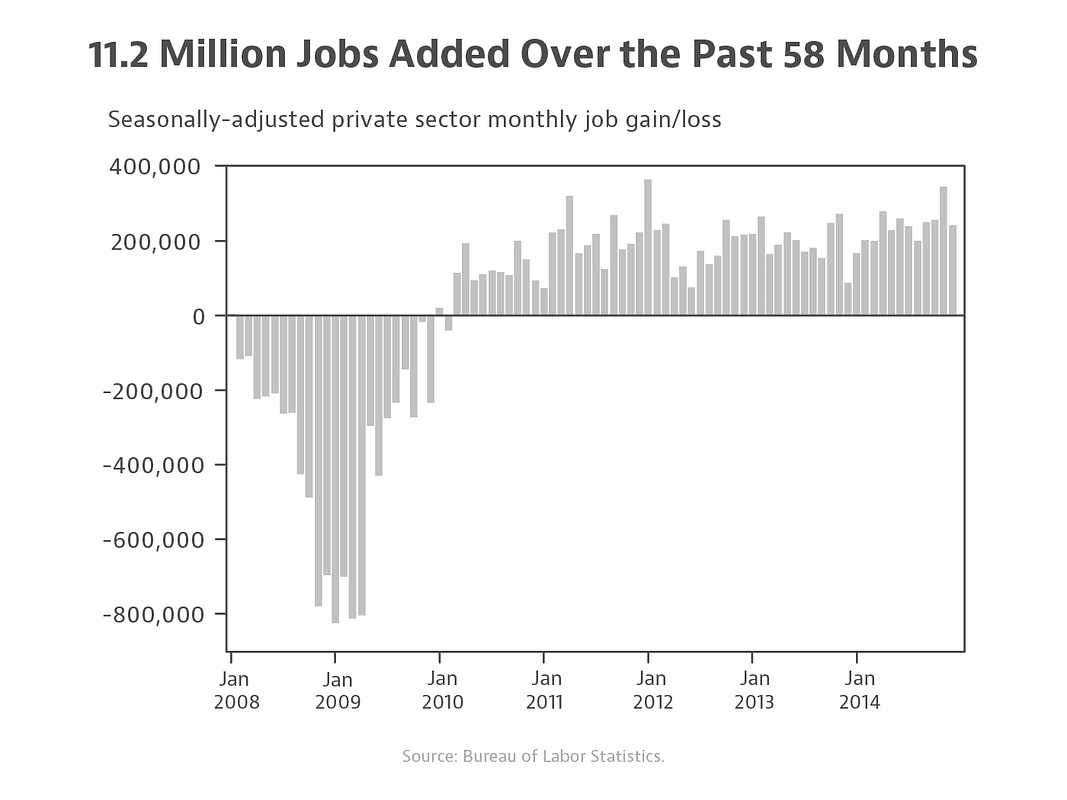
Over the last four years, the United States has put more people back to work than Europe, Japan, and every other advanced economy combined. As the economy strengthened, the unemployment rate fell from a high of 10 percent in 2009 to 5.6 percent at the end of 2014. Long-term unemploy- ment declined from 6.8 million in April 2010 to 2.8 million in December 2014 and fell even faster than overall unemployment over the past year.
For the first time in two decades, the United States has started producing more oil than it imports. Domestic natural gas production set a new record high in 2014. The manufacturing sector continues to experience its strongest period of job growth since the late 1990s. Rising home prices are bringing millions of homeowners back above water, restoring nearly $5 trillion in home equity.
The progress in the economy since the President took office has been steady and it has been real. The President’s decisive actions during the financial crisis brought the economy back from the brink, to the increasingly strong growth seen today. The Administration pushed the Recovery Act to jumpstart the economy and create jobs; rescued the auto industry from near collapse; fought for passage of the Affordable Care Act to provide insurance coverage to millions of Americans and help slow the growth of health care costs; and secured the Dodd-Frank Wall Street reform legislation to help prevent future crises. The American people’s determination and resilience, coupled with the Administration’s work, are driving the economy full steam ahead.
Helping, Not Hurting the Economy: The End of Austerity and the Move Away from Manufactured Crises
During the first years of the Administration, the President and the Congress worked together to enact measures that jumpstarted and strengthened the economy, and made it more resilient for the future. In addition to the Recovery Act, the Affordable Care Act, and Dodd-Frank Wall Street reform legislation, the Congress took bipartisan action in 2010 to temporarily reduce payroll taxes and continue emergency unemployment benefits.
Unfortunately, policies adopted in subsequent years hurt, rather than helped, the economy.
A Retrospective on 2013 Sequestration
When the Congress failed to enact the balanced long-term deficit reduction required by the Budget Control Act of 2011, a series of automatic cuts known as sequestration went into effect, cancelling more than $80 billion in budgetary resources across the Federal Government in 2013. Beyond the economic impacts, these cuts also had severe programmatic impacts, shortchanging investments that contribute to future growth, reducing economic opportunity, and harming vulnerable populations. For example:
Hundreds of important scientific projects went unfunded. The National Institutes of Health funded the lowest number of competitive research project grants in over a decade, providing roughly 750 fewer competitive grants in 2013 compared to the previous year. These unfunded grants included more than a hundred competitive renewal applications that were considered highly meritorious for additional funding in peer review, limiting research into brain disorders, infectious disease, and cancer. Also as a result of sequestration, the National Science Foundation awarded 690 fewer competitive awards than the previous year, resulting in the lowest total number of competitive grants provided since 2006, limiting scientists and students’ ability to pursue cutting-edge, potentially revolutionary discoveries.
Tens of thousands of low-income children lost access to Head Start. Over 57,000 children lost access to Head Start and Early Head Start in school years 2012–2013 and 2013–2014, forgoing critical early learning experiences and health and nutrition services intended to help improve their cognitive, physical, and emotional development. As a result, Head Start enrollment dipped to its lowest level since 2001. In addition, Head Start centers were forced to reduce the number of school days by more than 1.3 million. [1]
Fewer low-income families received housing vouchers. A total of 67,000 Housing Choice Vouchers were lost, resulting in reduced access to affordable, safe, and stable housing for low-income families. Although the Department of Housing and Urban Development and Public Housing Authorities took extraordinary steps to prevent families from losing assistance, many vouchers were withdrawn from families that were in the process of looking for housing or not reissued when families left the program, while many of the families remaining in the program faced higher rents.
While the Bipartisan Budget Act of 2013 replaced a portion of the damaging and short-sighted sequestration cuts in 2014 and 2015 with long-term reforms, they did not go far enough. Without further congressional action, sequestration will return in full in 2016, bringing discretionary funding — or, spending that is approved through the appropriations process — to its lowest level in a decade, adjusted for inflation. In fact, assuming roughly the current allocation of resources across programs, a return to sequestration levels in 2016 would mean the lowest real funding level for research since 2002 — other than when sequestration was in full effect in 2013 — and the lowest real per-pupil funding levels for education since 2000, a major disinvestment in exactly the areas where investment is needed to support growth.
[1] Head Start programs reported the number of days of service reduced because a shortened school year was required to implement the unprecedented reductions in their funding. The total number of days grantees reported eliminated from their school year is multiplied by the number of children affected by those cuts to produce the estimate that 1.3 million days of service were eliminated.
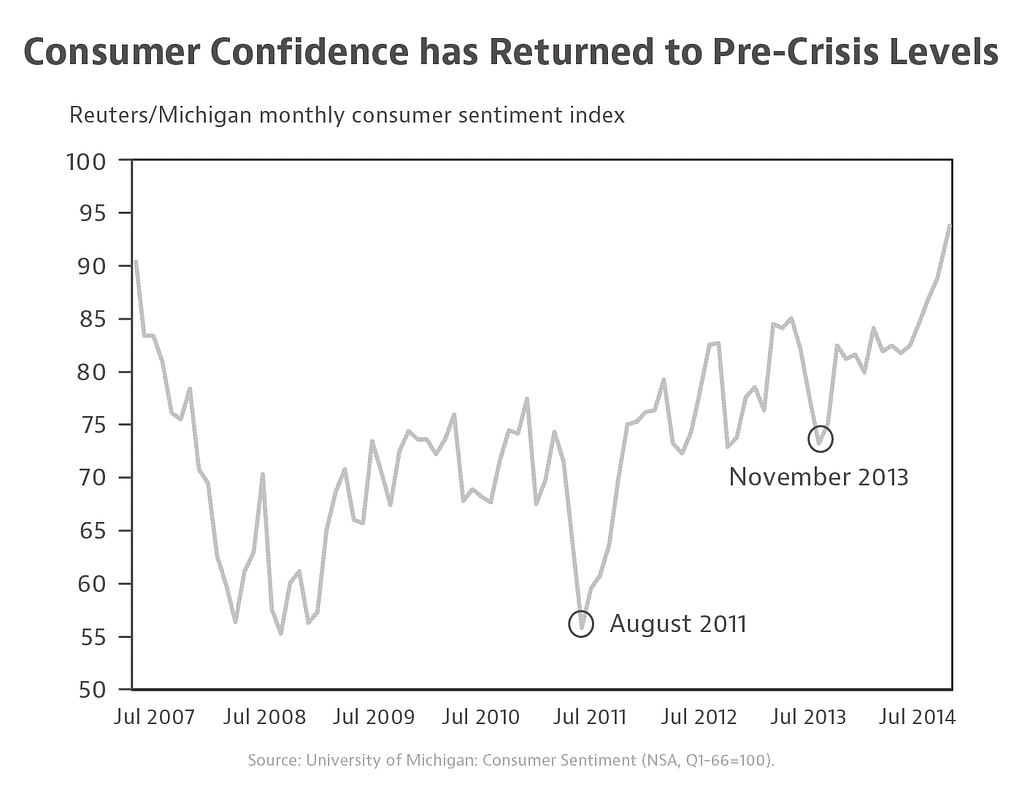
Sequestration cuts that took effect in March 2013 reduced the gross domestic product (GDP) by 0.6 percentage points and cost 750,000 jobs, according to the Congressional Budget Office (CBO). In 2011, and again in 2013, congressional Republicans sought to use the Nation’s full faith and credit as a bargaining chip, driving down consumer confidence and driving up economic policy uncertainty measures. The Federal Government shutdown in October 2013 created further uncertainty and reduced growth in the fourth quarter of 2013 by at least 0.3 percentage points.
Beginning in 2014, however, policymakers moved away from manufactured crises and austerity budgeting, helping to lay the groundwork for job market gains and stronger growth. The President worked with congressional leaders from both parties to secure a two-year budget agreement (the Bipartisan Budget Act of 2013) and enact full-year appropriations bills that replaced a portion of the harmful sequestration cuts and allowed for higher investment levels in 2014 and 2015.
The Council of Economic Advisers estimated that the 2013 budget deal will create about 350,000 jobs over the course of 2014 and 2015, meaning that it has likely contributed to the marked improvement in the labor market this past year. Moreover, thanks in part to the budget deal, 2014 will likely have been the first year since 2010 that Federal fiscal policy did not significantly reduce economic growth.
Increased certainty and a break from the threat of shutdown and other fiscal crises also added to growth, according to several independent analyses. For example, an analysis by Macroeconomic Advisers found that fiscal uncertainty cost 900,000 jobs from 2009 through mid-2013. The crises also negatively impacted consumer confidence, which fell markedly around the time of the 2011 and 2013 manufactured crises, and, along with small business optimism, has only returned to pre-recession levels in the past year (see previous chart). Business leaders, economists, and the Federal Reserve Chair have all attributed stronger growth in part to reduced fiscal headwinds and uncertainty, and business leaders have urged policymakers to avoid a return to manufactured crises and needless austerity.
Fiscal Progress
Since 2010, Federal deficits have shrunk at an historic pace — the most rapid sustained deficit reduction since the period just after World War II. The turn away from austerity in 2014 was accompanied by another steep drop in the deficit, bringing it to 2.8 percent of GDP — the lowest level since 2007, about one-third the size of the deficit the President inherited, and below the 40-year average. Over the past five years, actual and projected deficits have fallen due to three main factors.
First, economic growth has helped accelerate the pace of deficit reduction. Growth in recent years has increased revenues and reduced spending on “automatic stabilizers” programs, such as unemployment insurance, that automatically increase during economic downturns.
Second, since 2010, policymakers have put in place more than $4 trillion in deficit reduction measures through 2025, not counting additional savings achieved by winding down wars in Iraq and Afghanistan. These measures include restoring Clinton-era tax rates on the wealthiest Americans and discretionary spending restraint. Sequestration cuts account for a minority of the discretionary savings achieved since 2010, and have had a negative impact on critical services and public investments in future growth (see above, A Retrospective on 2013 Sequestration).
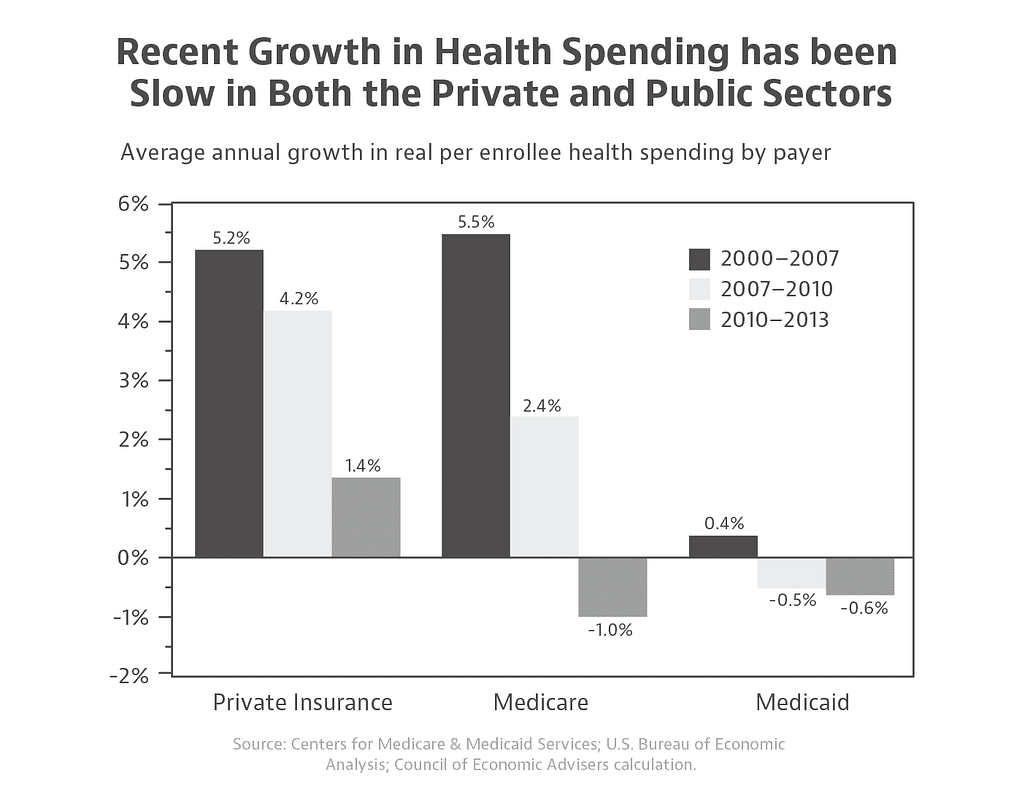
Finally, deficits are falling due to historically slow health care cost growth. The years since 2010 have seen exceptionally slow growth in per-beneficiary health care spending in both private insurance and public programs (see previous chart). As a result, 2011–2013 saw the three slowest years of growth in real inflation-adjusted per-capita national health expenditures since record-keeping began in 1960. While some of the slowdown can be attributed to the Great Recession and its aftermath, there is increasing evidence that much of it is the result of structural changes. These include reforms enacted in the Affordable Care Act that are reducing excessive payments to private insurers and health care providers in Medicare, creating strong incentives for hospitals to reduce readmission rates, and starting to change health care payment structures from volume to value.
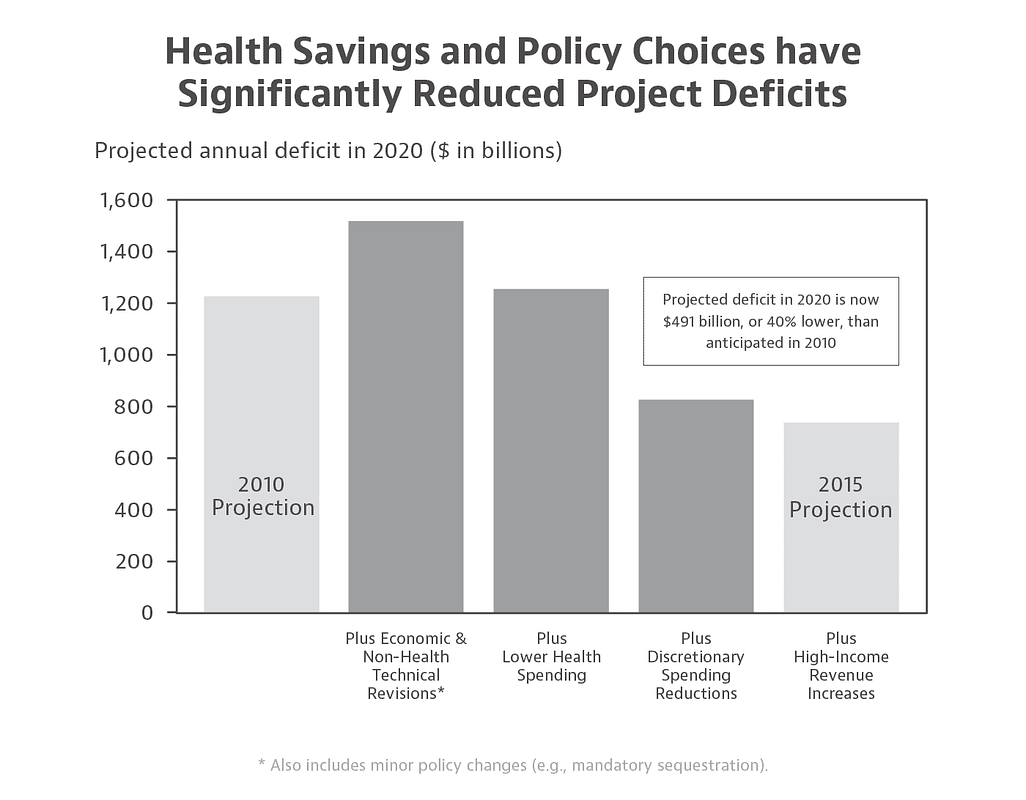
The health care cost slowdown is already yielding substantial fiscal dividends. Compared with the 2011 Mid-Session Review, aggregate projected Federal health care spending for 2020 has decreased by $216 billion based on current budget estimates, savings above and beyond the deficit reduction directly attributable to the Affordable Care Act.
The chart below shows how slower health care cost growth and policy changes are contributing to improving the medium-term budget outlook. In the 2011 Mid-Session Review, published in July, 2010, the Administration projected a 2020 deficit of 5.1 percent of GDP if current policies were to continue. The Budget projects a baseline deficit of 3.3 percent of GDP in 2020, a reduction of 1.9 percentage points, or $491 billion. One major contributor to the improvement is lower-than-expected Federal health spending. Revisions to health spending forecasts based on the historically slow growth of the past several years (and based on the assumption that only a portion of the slowdown will continue) account for about half of the net improvement in the projected deficits. Another important factor is the high-income revenue increases enacted in the American Taxpayer Relief Act of 2012, which contributed about a fifth of the new improvement. Discretionary spending restraint has also played a large role, although the impact of sequestration is much less than the impact of the pre-sequestration Budget Control Act caps and prior appropriations action and less than the savings from winding down wars.
An under-appreciated aspect of the Nation’s recent fiscal progress has been the way these same factors, discussed above, have led to a significant improvement in the long-term outlook (as discussed in more detail in the Long Term Budget Outlook chapter of the Analytical Perspectives volume). Moreover, as discussed below, a number of the President’s Budget policies, and particularly the proposed reforms to health and immigration, will not only substantially reduce deficits over the next 10 years, but will have a growing impact in reducing deficits beyond the next decade.
The Budget: A Roadmap for Continued Economic and Fiscal Progress
The progress that has been made to date is significant, but not sufficient to address either the Nation’s economic or fiscal challenges. The Budget increases investments that will accelerate growth and expand opportunity, while also finishing the task of putting the Nation on a sustainable fiscal path.
Investing in Growth and Opportunity. The Bipartisan Budget Act of 2013 reversed a portion of sequestration and allowed for higher investment levels in 2014 and 2015, but it did nothing to alleviate sequestration in 2016. In the absence of congressional action, non-defense discretionary funding in 2016 will be at its lowest level since 2006, adjusted for inflation, even though the need for pro-growth investments in infrastructure, education, and innovation has only increased due to the Great Recession and its aftermath. Inflation-adjusted defense funding will also be at its lowest level since 2006.
The Budget finishes the job of reversing mindless austerity budgeting and makes needed investments in key priorities, even while setting the Nation on a fiscally responsible course. The proposed increases in the discretionary bud- get caps make room for a range of domestic and security investments that will help move the Nation forward. These include investments to strengthen the economy by improving the educa- tion and skills of the U.S. workforce, accelerating scientific discovery, and continuing to bolster manufacturing. They also include program integ- rity initiatives that will reduce the deficit by many times their cost. As described in the Investing in America’s Future chapter, the Budget proposes to further accelerate growth and opportunity and create jobs through pro-work, pro-family tax re- forms and through mandatory investments — or, direct spending that is determined outside the appropriations process — in surface transportation infrastructure, universal pre-kindergarten, child care assistance for middle-class and work- ing families, and other initiatives.
Putting the Nation on a Sustainable Fiscal Path. The Budget achieves $1.8 trillion of deficit reduction over 10 years, primarily from health, tax, and immigration reform. As described further in the Investing in America’s Future chapter, the Budget includes about $400 billion of health savings that grow over time, extending the life of the Medicare Trust Fund by approximately five years, and building on the Affordable Care Act with further incentives to improve quality and control health care cost growth. It also reflects the President’s support for commonsense, comprehensive immigration reform along the lines of the 2013 bipartisan Senate-passed bill. The CBO estimated that the Senate-passed bill would reduce the deficit by about $160 billion over 10 years and by almost $1 trillion over two decades, while the Social Security Actuary estimated that it would reduce Social Security’s 75-year shortfall by eight percent. In addition, the Budget obtains about $640 billion in deficit reduction from reduc- ing tax benefits for high-income households.
Under the Budget, deficits decline to about 2.5 percent of GDP. Starting in 2016, debt de- clines as well, reaching 73.3 percent of GDP in 2025, a reduction of 1.9 percentage points from its peak. The key test of fiscal sustainability is whether debt is stable or declining as a share of the economy, resulting in interest payments that consume a stable or falling share of the Nation’s resources over time. The Budget meets that test, showing that investments in growth and opportunity are compatible with also putting the Nation’s finances on a strong and sustainable path.
The economic growth and progress the Nation has seen in the President’s first six years in of- fice prove that America’s resurgence is real. As the President said it would be, 2014 was a year of action and a breakthrough year for America; a year that saw accelerated job growth, sharp declines in unemployment, uninsured rates at near-record lows, and a continuation of his- torically slow health care price growth. Now it is time to invest in America’s future to drive economic growth and opportunity, secure the Nation’s safety, and put the Nation’s finances on the road to a more sustainable fiscal outlook. The Budget does just that.
Federal Reserve Issues “Strategies for Improving the U.S. Payment System”
The Federal Reserve today issued “Strategies for Improving the U.S. Payment System,” which presents a multi-faceted plan for collaborating with payment system stakeholders including large and small businesses, emerging payments firms, card networks, payment processors, consumers and financial institutions to enhance the speed, safety and efficiency of the U.S. payment system.
“A safer, more efficient and faster payment system contributes to public confidence and economic growth,” said Federal Reserve Board Governor Jerome H. Powell, who will co-chair the initiative’s oversight committee. “We look forward to working with payment stakeholders to realize this vision.”
“Strategies for Improving the U.S. Payment System” communicates desired outcomes for the payment system and outlines the strategies and tactics the Federal Reserve will pursue, in collaboration with stakeholders, to help the country achieve these outcomes. The paper outlines the Federal Reserve’s intent to establish a task force to identify effective approaches for implementing safe, ubiquitous, faster payment capabilities. The paper also calls for a task force to advise the Federal Reserve on reducing payment fraud and advancing the safety, security and resiliency of the payment system. Additionally, the Federal Reserve will pursue efforts to enhance payment system efficiency through work on standards, directories and business-to-business payment improvements, alongside efforts to enhance Fed-provided services for same-day automated clearing house (ACH), risk management and settlement.
“This plan reflects the contributions and commitment of thousands of payment system participants who shared their expertise and perspectives during the past 18 months,” stated Esther George, president of the Federal Reserve Bank of Kansas City and a member of the Federal Reserve’s Financial Services Policy Committee. “Consequently, we believe the strategies and tactics in the plan have broad support and strong prospects for success.” George will serve as executive sponsor for the payment system improvement initiative, a joint effort of the Federal Reserve Banks and Board of Governors.
The Federal Reserve’s strategic direction for financial services focuses on improving the end-to-end speed, safety and efficiency of the payment system. The Federal Reserve undertook an extensive 18-month research program aimed at identifying key gaps and opportunities,
gaining industry and end-user perspectives on needs and priorities and defining ways to achieve payment improvements. “Strategies for Improving the U.S. Payment System” details the conclusions of those efforts.
To begin the next phase of industry engagement on payment system improvement, President George and Governor Powell will host a webcast, accessible via www.ustream.tv/federalreserve, Leaving the Board at 1:00 p.m. EST on January 29. They will share views on the Federal Reserve’s vision for the future U.S. payment system and plans for collaborating with stakeholders to achieve shared goals. In addition, a subsequent series of FedForum teleseminars on February 4 and 10 will present an overview of the strategies and a question-and-answer session. Register at FedPaymentsImprovement.org Leaving the Board for the FedForum events, and to submit advance questions for the January 29 webcast.
The Federal Reserve will continue to seek input and communicate progress on initiatives from all payment participants through live and virtual forums, surveys, industry- and Federal Reserve-sponsored groups and events, and online feedback mechanisms. To receive communications and invitations, join the FedPayments Improvement Community at FedPaymentsImprovement.org.Leaving the Board
Strategies for Improving the U.S. Payment System (PDF) Leaving the Board
The Financial Services Policy Committee (FSPC) is responsible for the overall direction of financial services and related support functions for the Federal Reserve Banks, as well as for providing Federal Reserve Bank leadership to foster the integrity, efficiency and accessibility of the evolving U.S. payment system. The FSPC is composed of three Reserve Bank presidents and two Reserve Bank first vice presidents.
Federal Reserve Stays Patient But Rate Hikes Are Coming In FOMC Statement Release
Information received since the Federal Open Market Committee met in December suggests that economic activity has been expanding at a solid pace. Labor market conditions have improved further, with strong job gains and a lower unemployment rate. On balance, a range of labor market indicators suggests that underutilization of labor resources continues to diminish. Household spending is rising moderately; recent declines in energy prices have boosted household purchasing power. Business fixed investment is advancing, while the recovery in the housing sector remains slow. Inflation has declined further below the Committee’s longer-run objective, largely reflecting declines in energy prices. Market-based measures of inflation compensation have declined substantially in recent months; survey-based measures of longer-term inflation expectations have remained stable.
Consistent with its statutory mandate, the Committee seeks to foster maximum employment and price stability. The Committee expects that, with appropriate policy accommodation, economic activity will expand at a moderate pace, with labor market indicators continuing to move toward levels the Committee judges consistent with its dual mandate. The Committee continues to see the risks to the outlook for economic activity and the labor market as nearly balanced. Inflation is anticipated to decline further in the near term, but the Committee expects inflation to rise gradually toward 2 percent over the medium term as the labor market improves further and the transitory effects of lower energy prices and other factors dissipate. The Committee continues to monitor inflation developments closely.
To support continued progress toward maximum employment and price stability, the Committee today reaffirmed its view that the current 0 to 1/4 percent target range for the federal funds rate remains appropriate. In determining how long to maintain this target range, the Committee will assess progress–both realized and expected–toward its objectives of maximum employment and 2 percent inflation. This assessment will take into account a wide range of information, including measures of labor market conditions, indicators of inflation pressures and inflation expectations, and readings on financial and international developments. Based on its current assessment, the Committee judges that it can be patient in beginning to normalize the stance of monetary policy. However, if incoming information indicates faster progress toward the Committee’s employment and inflation objectives than the Committee now expects, then increases in the target range for the federal funds rate are likely to occur sooner than currently anticipated. Conversely, if progress proves slower than expected, then increases in the target range are likely to occur later than currently anticipated.
The Committee is maintaining its existing policy of reinvesting principal payments from its holdings of agency debt and agency mortgage-backed securities in agency mortgage-backed securities and of rolling over maturing Treasury securities at auction. This policy, by keeping the Committee’s holdings of longer-term securities at sizable levels, should help maintain accommodative financial conditions.
When the Committee decides to begin to remove policy accommodation, it will take a balanced approach consistent with its longer-run goals of maximum employment and inflation of 2 percent. The Committee currently anticipates that, even after employment and inflation are near mandate-consistent levels, economic conditions may, for some time, warrant keeping the target federal funds rate below levels the Committee views as normal in the longer run.
Voting for the FOMC monetary policy action were: Janet L. Yellen, Chair; William C. Dudley, Vice Chairman; Lael Brainard; Charles L. Evans; Stanley Fischer; Jeffrey M. Lacker; Dennis P. Lockhart; Jerome H. Powell; Daniel K. Tarullo; and John C. Williams.
Achieving Africa’s Growth Agenda – World Economic Forum In Davos
Reports of Africa’s economic demise have been greatly exaggerated. Yes, small pockets of insecurity exist and raise popular fears in the media, but the continent’s economy has never been more stable, diversified, linked, open, resilient and welcoming than it is now, at regional, national and local levels.
Investors seek safe havens for their money to grow, said Bronwyn Nielsen, Senior Anchor and Executive Director, CNBC Africa, South Africa, but en route to business pages, they read news about Ebola outbreaks, violent elections, Boko Haram terrorists and Al-Shabaab militants. Yet painting an entire continent with a single brush of instability doesn’t appear to deter foreign direct investment.
"Foreign direct investment is full steam ahead. There may be pockets of insecurity – external influences, border incursions – but the thing is to build the agriculture sector, for that is the root cause of growth and stability. As we continue to get value for crops, invest in local processing, create jobs locally, we strike at the heart of the cause of the issue," said John G. Coumantaros, Chairman, Flour Mills of Nigeria, Nigeria.
“Once you’re in Africa, you’re in it; you don’t withdraw,” said Sunil Bharti Mittal, Founder and Chairman, Bharti Enterprises, India. Mittal is investing more than $1 billion in 17 countries on the continent. “Upticks of threats in the media are scary, but the reality on the ground is not the same.”
Nor are plunging prices in oil and metals chasing off investors as they once had. Yes, growth is slower. But no nation is facing recession, as had happened in past commodity busts. Why not? Because economies have, wisely and deliberately, diversified, said Oscar Onyema, Chief Executive Officer, Nigerian Stock Exchange (NSE), Nigeria; Global Agenda Council on the Future of Financing & Capital. Crude oil today accounts for a smaller portion of Nigeria’s GDP, offset by the fast-growing entertainment, agriculture, telecommunications and financial sectors.
Coumantaros noted: "By 2050, Nigeria will be as big as the US. Salt, sugar, rice, palm oil, cassava, they're all strong. You wish to import things? You must start to grow it and process it locally. We can't focus on cities and leave the rest of the country behind.”
Diversified economies are also becoming more resilient to shocks as they seek to ease off foreign aid. In 2013 European donors temporarily suspended overseas assistance to Rwanda. The silver lining was that it forced the country to build capacity, seek more reliable revenue, and reduce its exposure to and dependency on bilateral and multilateral programmes. “We began transitioning from development aid to investment aid, concentrating on what attracts aid and people to do business in or with Rwanda in the first place, said Paul Kagame, President of the Republic of Rwanda.
Africa’s economies are also more integrated both within and between nations. Regional free-trade associations are playing a strong role in levelling and lowering barriers to entry, equitably distributing the flow of goods and services. Due to non-tariff barriers, it used to take 22 days to move a container from Mombasa to Kigali. Cross-border discussions identified and resolved issues, and today it takes six days. That provides a classic example of “collective leadership” that responds to political crises, said Jacob G. Zuma, President of South Africa, adding that the challenge is to overcome the colonial legacy where countries did not connect with each other as they do now. “We recognize that African problems demand African solutions.”
All parties strongly agreed that government must invest in infrastructure as a top priority, as doing so would yield immense social, economic and security dividends. On a related note, governments should encourage the free flow of people across borders, showing political will to ease visa restrictions that will ensure broad labour pools. Finally, countries are increasingly in a position where they can demand conditions – such as local processing and manufacturing – on investors, rather than simply allow exports from rural areas to cities, or extraction from the continent to overseas industries. Forging these linkages will ensure broader equity, and fuel growth even further.
The Global Economic Outlook – World Economic Forum In Davos
Despite more pessimism at the World Economic Forum this year than last, central bankers and economic leaders were more upbeat about economic prospects for the year ahead. With the International Monetary Fund (IMF) forecasting 3.5% growth this year, panellists at a session on the global economic outlook pointed to the upside potential of the European Central Bank stimulus package, falling oil prices, structural change in Brazil, China and Japan, and robust growth in the United States.
The ECB decision on quantitative easing (QE) lays the ground for stimulus in the Eurozone but the challenge now is for governments to move ahead with structural reforms. “We have done our part, but the ECB cannot raise productivity, increase employment or encourage investment. That requires a more comprehensive set of reforms,” said Benoît Coeuré, Member of the Executive Board, European Central Bank, Frankfurt. Explaining the ECB’s intervention, he said: “We could not sit by and watch the political foundations of the European project being undermined.”
Other panellists welcomed the ECB package while underlining the need to back up this monetary manoeuvre with structural reforms, including labour market reform and fiscal stimulus to increase aggregate demand. “QE creates the space for the structural reforms and investment,” said Min Zhu, Deputy Managing Director, International Monetary Fund (IMF), Washington DC.
The decline in the oil price is a boost to growth in most economies and will ease the transition to structural reform. This is the case in Brazil despite its growing oil production. Joaquim Levy, Minister of Finance of Brazil, said the country is shifting from increasing incomes of its poorest citizens, which was the focus of its economic policies for the past decade, to building investment, both by companies and the government. “Our goal is to make Brazil a nimbler, more agile market, where it is easier to do business,” he said.
Japan is also well into implementation of a programme that includes aggressive monetary easing, gradual fiscal consolidation, and structural reform that are intended to lay the foundations for 2% growth this year. Haruhiko Kuroda, Governor of the Bank of Japan, is upbeat not only about Japan’s growth prospects but also about China. “China is making huge structural reforms while continuing to grow at 7.5%,” he said.
US economic performance is strong and provides a significant boost to global demand. But Zhu warned that much of the growth is coming from consumers and government spending, with private investment still relatively low. Meanwhile, he called on policy-makers to put the poorest countries, which have been battered by economic headwinds, at the top of the policy agenda.
Technology will play a huge and unpredictable role not only in the real economy but also in the financial sector through payments and trading systems. The potential is huge, said Mark J. Carney, Governor of the Bank of England, but prudence is necessary. “We don’t want to find ourselves in an Uber situation in the financial markets,” he added.
Leaders Confident that ASEAN Economic Community Will Be Launched By End of Year
Davos-Klosters, Switzerland, – Political and business leaders from ASEAN member states told participants at the 45th World Economic Forum Annual Meeting that the ASEAN Economic Community, uniting 10 countries with over 600 million people in a common market, will be a reality by the end of 2015.
“Some in the audience may not believe it, but believe me, we will have a single market by the end of the year,” Pridiyathorn Devakula, Deputy Prime Minister of Thailand, promised. Devakula said that tariff reductions within the community have already been largely accomplished, but work remains on cutting non-tariff barriers.
“The free flows of goods, capital and labour will provide the opportunity for ASEAN to become the factory for the world,” Samdech Samdech Techo Hun Sen, Prime Minister of Cambodia, said. He added that the next step would be for ASEAN to seek free-trade agreements, and that he expected the community to benefit from continued growth in China, from the opening of India’s economy and from renewed dynamism in Japan.
Pham Binh Minh, Deputy Prime Minister and Minister of Foreign Affairs of Vietnam, said: “Greater integration will provide many benefits to the entire ASEAN community.” Integration should spur governments to implement structural reforms, and more developed ASEAN countries should assist their less developed states in catching up.
Abdul Wahid Omar, Minister, Economic Planning Unit, Malaysia, noted that the region has grown at an average of over 6% a year for decades. “We now want to make sure that the economic prosperity we achieve is translated into higher personal income for the people,” he said. Integrations of rules and regulations and the creation of an ASEAN identity – perhaps in part through a common time zone – are logical next steps.
“ASEAN is growing faster than China or India, but it must be seen by outside investors as a single market,” Anthony F. Fernandes, Group Chief Executive Officer, AirAsia, Malaysia, said. Fernandes said the 10 countries still have different regulatory systems and bureaucracies. Government leaders must make it easier for companies and investors to operate in all 10 countries simultaneously. “Not everything will get done by December, but a lot will be fixed and it will be a fantastic platform,” he predicted.
James T. Riady, Chief Executive Officer, Lippo Group, Indonesia, said that unlike northern Asia, with its emphasis on heavy industry that works closely with government, most of ASEAN’s economies depend on entrepreneurship, light industry and services. The ASEAN common market will particularly benefit the services sector, which gains competitiveness with scale. “If the ASEAN Economic Community can become a reality this year, we are at the beginning of something quite fantastic,” he said.
Serge Pun, Chairman, Serge Pun & Associates (Myanmar), Myanmar, said that for years he had been a sceptic about ASEAN, but he is becoming a believer. Protectionist impulses are strong in both government and business, but governments now appear determined to make the ASEAN Economic Community a reality. “I have drawn a lot of optimism from looking at how governments view integration.” He added that the community’s diverse economies are an advantage, as less-developed countries such as Myanmar would welcome the unskilled jobs that more developed ASEAN members are shedding.
The Global Impact of China’s Economic Transformation – World Economic Forum In Davos
China’s economy will not suffer a hard landing even as it braces itself for a further slowdown this year, Li Keqiang, Premier of the People’s Republic of China, told more than 2,500 participants at the 45th World Economic Forum Annual Meeting in Davos-Klosters, Switzerland.
“The Chinese economy will face downward pressures in 2015,” Li said in a keynote speech at a special session of the Annual Meeting. “But the Chinese economy will not head for a hard landing.”
He added that the government will press on with structural reforms, which include liberalizing its services sectors, promoting mass entrepreneurship and innovation, protecting intellectual property rights and deepening its capital markets. “We will move towards the path of reforms. This way we can shift gear without losing momentum and achieve medium- to high-speed growth, and medium- to high-level developments.”
Using the analogy of a skier at Davos, he promised that China will “go at the right speed, keep balance and be courageous”.
Premier Li’s address came a day after the country announced its slowest growth rate in 24 years, with full-year GDP at 7.4% in 2014. The government has prepared the nation to embrace the “new normal” as it focuses on quality rather than speed of growth, and shifts its focus from an export-investment led model to one that is more reliant on consumption and the services sector.
In his address, Li also suggested that China would eschew stimulus measures through monetary easing but instead step up investments in targeted areas, including health, clean energy and transport, as well as provide support to the country’s small and medium enterprises, create employment for young people and optimize income distribution.
The Premier said China’s economic slowdown reflects the profound adjustments in the global economy and is consistent with its larger economic base. A growth at 7%, he pointed out, produces annual increase of $800 billion at current prices, larger than a 10% growth five years ago.
On the internationalization of the renminbi, Li explained that as China’s international trade increases, more countries are demanding the use of the Chinese currency to settle trades and investments. The pool of offshore renminbi has gradually expanded in recent years. Li said China is committed to opening up to the world but the internationalization of the renminbi is going to be a long-term process.
The Co-Chairs of the Annual Meeting 2015 are: Hari S. Bhartia, Co-Chairman and Founder, Jubilant Bhartia Group, India; Winnie Byanyima, Executive Director, Oxfam International, United Kingdom; Katherine Garrett-Cox, Chief Executive Officer and Chief Investment Officer, Alliance Trust, United Kingdom; Young Global Leader Alumnus; Jim Yong Kim, President, The World Bank, Washington DC; Eric Schmidt, Executive Chairman, Google, USA; and Roberto Egydio Setubal, Chief Executive Officer and Vice-Chairman of the Board of Directors, Itaú Unibanco, Brazil.
EU Investment Offensive: Commission and EIB launch new advisory service on financial instruments
On 19 January, the European Commission, in partnership with the European Investment Bank (EIB), is launching fi-compass, a new advisory service on financial instruments for the European Structural and Investment Funds. This service is part of the “one stop shop” advisory hub, to be launched as an important part of the EU Investment Plan.
The work to deliver the Investment Plan is moving fast. Just 50 days after President Juncker announced plans for an EU investment offensive, and the Commission has already launched a legislative proposal for the European Fund for Strategic Investments – to mobilise at least €315 billion in private and public investment across the European Union. With the launch of fi-compass, the Commission and EIB are now moving quickly to deliver on the second pillar of the Investment Plan to make actual investment happen in the economy. This second pillar aims at enhancing technical assistance (with an advisory hub to provide all the necessary financial and technical support to public and private promoters) and providing transparency to investors. A transparent project pipeline of viable projects will be launched with the EIB later this year.
This new fi-compass platform will be launched during a two-day conference attended by European Commission Vice-President Jyrki Katainen responsible for Jobs, Growth and Competitiveness, Commissioner for Regional Policy Corina Creţu, and EIB Vice-President Wilhelm Molterer. They will join Member States and regions at this high-level conference to exchange experience and best practice on the design and use of these instruments.
Speaking ahead of the launch, Vice-President Jyrki Katainen said “There is money out there, but investors tell us that they need well-structured projects and access to clear information to reconnect investment finance with a pipeline of trusted projects. We want to fast track the work to set up a technical hub which will provide a one stop shop for advice and support for potential investors. The launch of fi-compass is an important step in the right direction.”
Commissioner for Regional Policy Corina Creţu commented “I welcome the launch of the fi-compass to pool our joint know-how in order to yield the best impact on the ground. Excellent examples serve as inspiration for other countries, in particular those struggling to draw EU funding and ensure its efficient use. I encourage Member States to double the amount of investments channelled through financial instruments in the new programming period.”
EIB Vice-President Wilhelm Molterer added “The EIB with its technical, sectorial and country-specific expertise has a potential to encourage more widespread use of financial instruments. This expertise has been widely acknowledged by the Commission and the Member States. We will use it to help recipients of EU funds target projects with high economic viability.”
This platform will be an important enabler for Member States to make use of financial instruments under the European Structural and Investment Funds, as Cohesion policy will play a central part in reaching the objectives of the Investment Plan, in terms of strategic and fruitful investments, job creation and sustainable growth.
The Investment Plan set as target to double the use of financial instruments in 2014-2020; by using them, the return of each euro invested in the Member States will be increased. Fi-compass, set up by the European Commission and the EIB, is intended to better equip and strengthen the expertise of the managing authorities and stakeholders working with these financial instruments.
Background:
Financial instruments include loans, guarantees, equity, venture capital and other risk-bearing instruments, possibly combined with interest rate subsidies or guarantee fee subsidies. They represent a resource-efficient way of using EU budget funds to enable investment in the economy.
ESI Funds regulations for 2014-2020 have widened the scope of financial instruments to include all thematic objectives and all five European Structural and Investment Funds: the European Regional Development Fund (ERDF), the Cohesion Fund (CF), the European Social Fund (ESF), the European Agricultural Fund for Rural Development (EAFRD), and the European Maritime and Fisheries Fund (EMFF).
Commissioners for Regional Policy, Agriculture and Rural Development, Employment, Social Affairs Skills and Labour Mobility, Environment, Maritime Affairs and Fisheries, the Vice President of the EIB and Chief Executive Officer of the European Investment Fund have signed a Memorandum of Understanding (MoU) on a partnership for technical assistance and advisory services to support the use of financial instruments under the European Structural and Investment Funds and under the Programme for Employment and Social Innovation (EaSI).
The conference marks the first in a series of actions under the MoU, which will be a 7-year commitment between the Commission and the EIB. The fi-compass advisory platform will provide Member States and their Managing Authorities as well as microcredit providers with support and learning opportunities for developing financial instruments.
The fi-compass advisory platform will be complemented later in the year with the launch of a ‘multi-regional assistance’ initiative bringing together managing authorities and financial institutions. This initiative aims to support the potential use of financial instruments in investment priority areas that are shared by regions from at least two different Member States.