McDonald’s Announces Initial Steps In Turnaround Plan Including Worldwide Business Restructuring And Financial Updates
McDonald’s President and Chief Executive Officer Steve Easterbrook today announced the initial steps of the Company’s turnaround plan including a restructuring of McDonald’s worldwide business and financial updates.
“Today we are announcing the initial steps to reset and turn around our business,” Easterbrook said. “As we look to shape McDonald’s future as a modern, progressive burger company, our priorities are threefold – driving operational growth, returning excitement to our brand and unlocking financial value.”
Easterbrook added, “The immediate priority for our business is restoring growth under a new organizational structure and ownership mix designed to provide greater focus on the customer, improve our operating fundamentals and drive a recommitment to running great restaurants. As we turn around our business, we will look to create more excitement around the brand and ensure that we build on our rich heritage of positively impacting the communities we serve.”
New Market Segments Established
Easterbrook continued, “The first critical step of our operational growth-led plan is to strengthen our effectiveness and efficiency to drive faster and more customer-led decisions. We will restructure our business into four new segments that combine markets with similar needs, challenges, and opportunities for growth.”
Beginning July 1, 2015, McDonald’s will operate under a new organizational structure with the following market segments:
U.S. – the Company’s largest segment, accounting for more than 40% of the Company’s 2014 operating income;
International Lead Markets – established markets including Australia,Canada, France, Germany and the U.K., which operate within similar economic and competitive dynamics, offer similar growth opportunities and collectively represented about 40% of the Company’s 2014 operating income;
High-Growth Markets – markets with relatively higher restaurant expansion and franchising potential including China, Italy, Poland,Russia, South Korea, Spain, Switzerland and the Netherlands. Together these markets accounted for about 10% of the Company’s 2014 operating income; and
Foundational Markets – the remaining markets in the McDonald’s system, each of which has the potential to operate under a largely franchised model. Corporate activities will also be reported within this segment.
Easterbrook added, “Our new structure will be supported by streamlined teams with fewer layers and less bureaucracy, and our markets will be better organized around their growth drivers, resource needs and contributions to the Company’s overall profitability. McDonald’s new structure will more closely align similar markets so they can better leverage their collective insights, energy and expertise to deliver a stronger menu, service, and overall experience for our customers.”
Segment Leadership Team Appointed
“Our new organization creates a structure under which leadership of McDonald’s new segments will be able to more effectively address the common needs of their markets and customers,” Easterbrook said. “It is critical that we position our management talent within our new structure in a way that capitalizes on their skill sets. As such, I am pleased to announce the leadership team for our new segments, effective July 1, 2015.”
“Mike Andres will continue to serve as President – McDonald’s U.S. Mike is a progressive, strategic thinker with the vision necessary to capitalize on the opportunities in the U.S. market.”
“Doug Goare, currently President – McDonald’s Europe, will become President – International Lead Markets. Doug is an exceptional leader with strong management and operations experience and a deep working knowledge of McDonald’s business. Doug is ideally suited to oversee the talented teams in place across this established group of markets as they work to improve their performance.”
“Dave Hoffmann, currently President – McDonald’s Asia/Pacific, Middle East andAfrica (APMEA), will transition to the role of President – High-Growth Markets. Dave is a results-oriented leader with outstanding experience building the brand in emerging markets like China. He is uniquely qualified to lead this new segment in pursuing the tremendous opportunities that exist for McDonald’s across this group of markets.”
“Ian Borden, currently the Chief Financial Officer – McDonald’s APMEA, will assume the role of President – Foundational Markets. In this role, Ian will be responsible for maximizing the potential of these approximately 100 markets that represent about 10% of the Company’s operating income. Ian brings very broad geographical and functional expertise to this role having worked in Canada, Europe and APMEA in various finance and operations leadership positions.”
New Refranchising Target and Financial Updates Announced
“As we restructure our organization and instill greater customer focus, McDonald’s turnaround will be governed by stronger financial discipline, faster decision making and clear management accountability,” said McDonald’s Chief Administrative OfficerPete Bensen. “This new organization structure will unleash more entrepreneurial spirit and more innovation across our system while bolstering what makes McDonald’s a formidable leader in the industry: our incredible network of dedicated franchisees.”
The enhancements to McDonald’s operating approach will be accompanied by plans to further optimize the Company’s restaurant ownership mix, deliver G&A savings and accelerate cash returned to shareholders. Specifically, the Company expects to:
Refranchise 3,500 restaurants by the end of 2018, accelerating the pace of refranchising and increasing the global franchised percentage from the current 81% to about 90%. This marks a significant step forward from our prior plan to refranchise at least 1,500 restaurants by 2016;
Deliver approximately $300 million in net annual G&A savings, most of which will be realized by the end of 2017, in connection with the Company’s organizational restructure, refranchising strategy, and more stringent discipline around spending throughout the organization; and
Return $8 to $9 billion to shareholders in 2015 and to reach the top end of its 3-year $18 to $20 billion cash return to shareholders target by the end of 2016.
Bensen continued, “As part of our business restructuring, we are focused on further optimizing our restaurant ownership mix and expect franchised restaurants to account for approximately 90% of our global restaurant base by the end of 2018. In conjunction with our refranchising plans, we will take a market-by-market approach, set higher financial screens for markets operating company-operated restaurants, and leverage both conventional and developmental licensee structures across the segments. Our new, more heavily-franchised business model will generate more stable and predictable revenue and cash flow streams and will require a less resource-intensive support structure. Finally, we will continue to evaluate opportunities to further enhance value for all shareholders.”
Easterbrook concluded, “These are exciting and liberating moves for our System, and this is how leadership brands evolve to stay in step with their customers. Meaningful, positive measures of improvement will take time. The most impactful measures of our performance will be through the eyes of our customers. While we continue our efforts to regain business momentum through our turnaround plan and improve sales at our more than 36,000 restaurants around the world, our current performance reflects the ongoing pressures of the business, which we expect to persist through at least the first half of the year. We are taking decisive and necessary action to drive foundational improvements in the business and position the Company for long-term growth.”
Chipotle Becomes First National Restaurant to Use Only Non-GMO Ingredients and Shifting Focus to Creating Better Tortilla
DENVER- Apr. 27, 2015– Chipotle Mexican Grill (NYSE: CMG) has achieved its goal of moving to only non-GMO ingredients to make all of the food in its U.S. restaurants – including all of the food at its Asian restaurant concept, ShopHouse Southeast Asian Kitchen. The company is now actively developing new recipes for its tortillas, which are the only food items on its menu that include any artificial additives. Both initiatives underscore Chipotle’s commitment to serving food made from the very best ingredients.
GMOs, or genetically modified organisms, are crops that have had specific changes introduced to their DNA that don’t occur naturally, using the science of genetic engineering. GMOs are common in the American food system. According to the USDA National Agricultural Statistics Service, 94% of corn and 93% of soybeans grown in this country came from GMO strains in 2014. As a result, more than 80% of foods consumed in the U.S. contain genetically modified ingredients, by some estimates, making it very difficult for consumers to avoid GMO ingredients in restaurants or in food purchased in grocery stores.
“There is a lot of debate about genetically modified foods,” said Steve Ells, founder, chairman and co-CEO of Chipotle. “Though many countries have already restricted or banned the use of GMO crops, it’s clear that a lot of research is still needed before we can truly understand all of the implications of widespread GMO cultivation and consumption. While that debate continues, we decided to move to non-GMO ingredients.”
Chipotle became the first national restaurant company to voluntarily disclose GMO ingredients in its food in March 2013, and pledged at that time to move to non-GMO ingredients for all of its food. Most of the company’s use of genetically modified ingredients was tied to soybean oil, which it used to cook chips and taco shells, and in a number of recipes (such as the adobo rub it uses for grilled chicken and steak) and for cooking (both on its grills and for use in sauté pans). Corn and flour tortillas also included some GMO ingredients.
Chipotle suppliers planted non-GMO corn varieties to meet Chipotle’s needs for corn tortillas, and the company replaced soybean oil with sunflower oil to cook its chips and taco shells, and with rice bran oil for other recipes and uses. Both oils are extracted from crops for which there are no commercially available genetically modified varieties. Other GMO ingredients in tortillas were replaced with non-GMO alternatives.
While GMO advocates point to higher costs associated with producing non-GMO foods, Chipotle’s move to non-GMO ingredients did not result in significantly higher ingredient costs for the company, and it did not raise prices resulting from its move to non-GMO ingredients.
With the transition to non-GMO ingredients for its food completed, Chipotle has set its sights on eliminating the few remaining artificial ingredients from its tortillas. Excluding tortillas, the food on Chipotle’s entire menu consists of just 46 ingredients – nearly all of which are simple, whole ingredients that could be purchased at any local supermarket. By contrast, a typical Mexican fast food restaurant may use well over 200 different ingredients.
Tortillas are the only food item on Chipotle’s menu that contains any additives, which include a minimal number of preservatives and dough conditioners. While the company has made significant strides in reducing the number of additives in its tortillas, it is now embarking on a quest to eliminate all of the remaining additives. The goal is to achieve a simple recipe with only a few ingredients, much like tortillas made in more traditional ways that include only wheat flour, oil, water, salt and a starter for flour tortillas, for example.
Achieving this goal will be difficult and take time. Tortillas today are made very quickly and require the use of dough conditioners to give the tortilla the consistency that was once achieved by allowing the dough to rise slowly. Chipotle is working in close partnership with its tortilla suppliers and the Bread Lab at Washington State University to develop a new system of making tortillas that will allow the dough to rise slowly and eliminate the need for the dough conditioners. Eliminating the few preservatives will be slightly easier, but still a challenge simply because tortillas are difficult to keep fresh for long.
The company has developed new tortilla recipes and initial taste tests have been very encouraging, but it’s too early to say how long it will take before these new tortillas will be served at any Chipotle locations.
“We are changing the way people think about and eat fast food, and that means cooking with the very best ingredients – ingredients that are free of additives – but still serving food that is affordable, convenient, and most importantly delicious,” said Ells. “That’s really unusual in fast food, but that’s the quest we are on, and we continue to make progress.”
For more information about Chipotle’s ingredients and its move to non-GMO foods, visit www.chipotle.com/gmo. To learn more about its quest to make tortillas even better, visit www.chipotle.com/tortilla-journey.
ABOUT CHIPOTLE
Steve Ells, founder, chairman and co-CEO, started Chipotle with the idea that food served fast did not have to be a typical fast food experience. Today, Chipotle continues to offer a focused menu of burritos, tacos, burrito bowls (a burrito without the tortilla) and salads made from fresh, high-quality raw ingredients, prepared using classic cooking methods and served in a distinctive atmosphere. Through our vision of Food With Integrity, Chipotle is seeking better food from using ingredients that are not only fresh, but that—where possible—are sustainably grown and naturally raised with respect for the animals, the land, and the farmers who produce the food. A similarly focused people culture, with an emphasis on identifying and empowering top performing employees, enables us to develop future leaders from within. Chipotle opened with a single restaurant in 1993 and currently operates more than 1,800 restaurants. For more information, visit Chipotle.com.
IKEA Takes a New Course in its Food Offering Veggie Balls First of New Nutritious and Sustainable Offerings
(Conshohocken, PA) Today IKEA starts serving its new veggie ball, GRÖNSAKSBULLAR, which is the first step to include a wider variety of nutritious and more sustainable food choices. The veggie ball consists of only vegetables and has a reduced environmental impact; for example, a lower carbon footprint. This is a natural step for IKEA, building on the vision of creating better everyday lives.
While IKEA will continue to focus on offering delicious and affordable food, the company will also add more food options that are nutritious and more sustainable. IKEA menu additions will also be produced in a responsible manner that considers people, planet, and animal welfare, based on our People and Planet Positive strategy. In addition, IKEA Restaurants will be updated to improve the customer experience of IKEA food.
“We will continue to serve delicious food, offering a taste of Sweden at affordable prices, but with increasing focus on the aspects of food that are really important to people: health and sustainability,” said Michael La Cour, Managing Director of IKEA Food Services AB. “We have high ambitions, and our journey in this direction has just begun. I am proud that we now take the first step and start serving veggie balls.”
The new veggie ball, GRÖNSAKSBULLAR, is a good alternative to the popular IKEA meatball, offering tasty chunks of vegetables and a good protein level to support a main meal. With the veggie ball as the centerpiece, new IKEA food dishes have been developed which include fresh ingredients. GRÖNSAKSBULLAR will be available in IKEA U.S. restaurants (except Carson, CA) starting April 9 for $4.49 (10 meatball plate). The IKEA Swedish Food Market will be selling veggie and chicken balls starting June 30, 2015.
The IKEA new food course impacts these areas:
Health – We will provide more food options that include nutritious ingredients and consider portion sizes.
Sustainability – Increased focus on choice of ingredients and responsible production, including animal welfare. Salmon and herring are important parts of our Swedish heritage food. By the end of FY15, our restaurants and all seafood at IKEA will be ASC or MSC certified, except crayfish. We are currently working with the MSC organisation to certify crayfish fisheries.
The food experience – During FY16, IKEA restaurants will be updated to offer a more personal experience and ‘homey’ feeling, incorporating our home furnishing competence and Swedish heritage.
IKEA food co-workers – We want to be a great place to work! Our co-workers are at the heart of our new direction, and we will continuously build their knowledge around health and sustainability.
For more information, please contact : Mona Astra Liss, IKEA US Corporate PR Director, Mona.Liss@IKEA.com, 610.834.0180, ext. 5852
About IKEA Group
The IKEA vision is to create a better everyday life for the many people. Our business idea supports this vision by offering a wide range of well-designed, functional home furnishing products at prices so low that as many people as possible will be able to afford them. There are currently 315 IKEA Group stores in 27 countries. Additionally, there are 40 IKEA stores run by franchises. There are 40 IKEA stores in the US. In FY 14, IKEA Group had 716 million visitors to the stores and 1.5 billion visitors to IKEA.com. IKEA incorporates sustainability into day-to-day business and supports initiatives that benefit children and the environment. For more information, please visit www.IKEA.com, facebook.com/IKEAUSA, @IKEAUSANews, @IKEAUSA, http://pinterest.com/IKEAUSA/, www.youtube.com/IKEAUSA, www.theshare-space.com, www.theshare-space.com/en/Blog
The Search for Harm
In the summer of 2010, Google announced plans to acquire the flight search provider, ITA. As we said at the time, while many people buy their airline tickets online, finding the right flight at the best price can be a real hassle. Today Google Flight Search has made that much easier. Search for “Flight CDG to SFO” and you get the different options right there on the results page. It’s a great example of Google’s increasing ability to answer queries directly, saving people a lot of time and effort — because as Larry Page said over a decade ago “the perfect search engine should understand exactly what you mean and give you back exactly what you want”.
At the time of the ITA acquisition, several online travel companies–Expedia, Kayak, and Travelocity–unsuccessfully lobbied regulators in the US and the European Union to block the deal, arguing that our ability to show flight options directly would siphon off their traffic and harm competition online. Four years later it’s clear their allegations of harm turned out to be untrue. As the Washington Post recently pointed out (in an article headed “Google Flight Search, four years in: not the competition-killer critics feared”) Expedia, Orbitz, Priceline and Travelocity account for 95% of the US online travel market today. It’s a similar situation in Europe too, as this graph for Germany neatly shows:

We’ve seen similar allegations of harm from competitors in other areas. And the European Commission today confirmed that it is sending Google a Statement of Objections (SO) regarding the display and ranking of shopping results.
While Google may be the most used search engine, people can now find and access information in numerous different ways — and allegations of harm, for consumers and competitors, have proved to be wide of the mark.
More choice than ever before
In fact, people have more choice than ever before.
There are numerous other search engines such as Bing, Yahoo, Quora, DuckDuckGo and a new wave of search assistants like Apple’s Siri and Microsoft’s Cortana.
In addition, there are a ton of specialized services like Amazon, Idealo, Le Guide, Expedia or eBay. For example, Amazon, eBay, and Axel Springer’s Idealo are the three most popular shopping services in Germany.
People are increasingly using social sites like Facebook, Pinterest and Twitter to find recommendations, such as where to eat, which movies to watch or how to decorate their homes.
When it comes to news, users often go directly to their favorite sites. For example, Bild and The Guardian get up to 85% of their traffic directly. Less than 10% comes from Google.
Of course mobile is changing things as well. Today 7 out of every 8 minutes on mobile devices is spent within apps — in other words consumers are going to whichever websites or apps serve them best. And they face no friction or costs in switching between them. Yelp, for example, has told investors they get over 40% of their traffic direct from their mobile app. So while in many ways it’s flattering to be described as a gatekeeper, the facts don’t actually bear that out.
Thriving competition online
Which brings me to the competition. Companies like Axel Springer, Expedia, TripAdvisor, and Yelp (all vociferous complainants in this process) have alleged that Google’s practice of including our specialized results (Flight Search, Maps, Local results, etc.) in search has significantly harmed their businesses. But their traffic, revenues and profits (as well as the pitch they make to investors) tell a very different story.
Yelp calls itself the “de facto local search engine” and has seen revenue growth of over 350% in the last four years.
TripAdvisor claims to be the Web’s largest travel brand and has nearly doubled its revenues in the last four years.
Expedia has grown its revenues by more than 67% over the same period — and recently told investors: “We’re seeing increased traffic coming through Google Hotel Finder. It is clearly getting more exposure. And in general … the product continues to improve. And Google has invested in it, we’ll continue to invest in it … From our standpoint, we’re happy to play in any market that Google puts out there and over a long period of time, we have proven an ability to get our fair share in the Google marketplaces.” (Remarkable given their complaints).
Axel Springer continues to invest in search, including the French search engine Qwant, because as the company told investors, “there is a lot of innovation on the search market”.
Indeed if you look at shopping — an area where we have seen a lot of complaints and where the European Commission has focused in its Statement of Objections — it’s clear that (a) there’s a ton of competition (including from Amazon and eBay, two of the biggest shopping sites in the world) and (b) Google’s shopping results have not the harmed the competition. Take a look at these graphs:
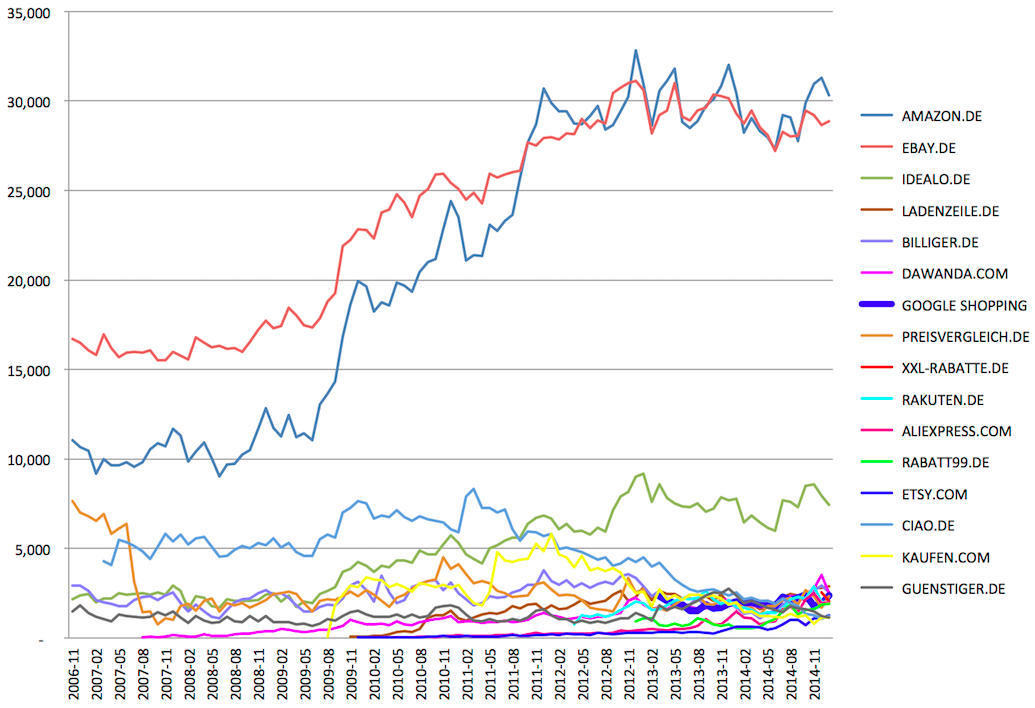


Any economist would say that you typically do not see a ton of innovation, new entrants or investment in sectors where competition is stagnating — or dominated by one player. Yet that is exactly what’s happening in our world. Zalando, the German shopping site, went public in 2014 in one of Europe’s biggest-ever tech IPOs. Companies like Facebook, Pinterest and Amazon have been investing in their own search services and search engines like Quixey, DuckDuckGo and Qwant have attracted new funding. We’re seeing innovation in voice search and the rise of search assistants — with even more to come.
It’s why we respectfully but strongly disagree with the need to issue a Statement of Objections and look forward to making our case over the weeks ahead.
Posted by Amit Singhal, Senior Vice President, Google Search
Canadian Restaurant Industry Revenues Should Grow to Nearly $60 Billion in 2015, Says New GE Capital Report
TORONTO (ON), APRIL 15, 2015 —Canadian consumers continue to spend more and more at chain and branded restaurants, according to GE Capital’s annual Canadian Chain Restaurant Industry Review, an extensive research report on the state of chain foodservice in the country.
The report’s findings will be premiered at the sixth annual Canadian Restaurant Investment Summit May 5-6 in Toronto. See below for details.
Foodservice industry sales are expected to increase 4 percent to $59.8 billion in 2015. Diners spent more than $57.5 billion at commercial foodservice establishments in 2014, an increase of 4.9 percent over 2013 and equal to approximately 4 percent of the national gross domestic product.
Ontario and Quebec have the largest commercial foodservice sales at $22.2 billion and $10.5 billion, respectively, driven primarily by their larger populations. Per capita, Alberta has the largest commercial foodservice sales ($2,137), followed by British Columbia ($1,920). Quebec has the lowest commercial foodservice sales per capita ($1,278).
Nearly two-thirds (63.2 percent) of restaurant expenditures take place at chains, which include local, regional, national or international businesses. Those in Atlantic Canada spend the most at chain restaurants – 70 percent. Quebec has the greatest percentage of independent restaurant expenditures – 44.6 percent in 2014, down from 48.4 percent in 2013.
Highlights of Canadian Chain Restaurant Industry Review
The fourth annual Canadian Chain Restaurant Industry Review, a comprehensive analysis of the state of foodservice companies, will be premiered at the Canadian Restaurant Investment Summit. It includes the annual C-Suite Survey, conducted by fsSTRATEGY and NPD Group Canada.
The greatest opportunity in the foodservice industry today, according to C-Suite Survey participants, is menu innovation and refinement, followed by concept refinement.
“Foodservice industry leaders recognize the need to be dynamic in response to the ever more sophisticated consumer, with more choices, more customization, more segmented or targeted positioning, healthier options and better-quality ingredients and flavors,” said Edward Khediguian, senior vice president of GE Capital’s Franchise Finance business in Canada. “In addition, there’s an awareness of the reduction in the span of concept and segment life cycles. They see the value of trying new concepts, such as fast casual or premium options, to take advantage of the ongoing trend toward eating meals away from home.”
Similar to 2014, operating costs continue to be the single greatest challenge for survey participants. However, in 2015, cost of goods sold was mentioned as a challenge by more respondents. The rising cost of proteins was cited frequently, as well. Labour costs and productivity were mentioned at the same frequency as in 2014.
Sixth Annual Canadian Restaurant Investment Summit
Registration is open for the Canadian Restaurant Investment Summit, which brings together chain executives, franchise operators, investors, lenders and key suppliers from across the country for meaningful insights and a tight focus that’s uniquely Canadian.
The roster of well-known speakers includes:
Curt Steinhorst of The Center for Generational Kinetics, who’ll teach business leaders to handle the generational divide — ranging from Millennials to Baby Boomers — with both employees and customers.
Robert Carter, executive director of NPD Group, and Todd S. Jones, senior managing director of brand management for GE Capital’s U.S. Franchise Finance business, who’ll discuss actionable ideas to execute over the next 12 months to drive business.
JP Soltesz, a senior GE economist, who’ll talk about the impact of oil prices on the restaurant industry and provide a regional economic overview.
For more information, go to http://www.restaurantinvest.ca/. To keep up with conference news, follow along on Twitter (http://twitter.com/CRIS_Toronto).
About GE Capital, Canada
With 17 offices throughout Canada, GE Capital (www.gecapital.ca) offers a wide variety of financial products and services to address commercial financing across many phases of a business’ lifecycle. From equipment finance to working capital and growth financing to large asset-based and restructuring loans, we apply our 30 years of experience in the Canadian market and our wealth of industry expertise to develop custom solutions for businesses. Some of the industries in which we specialize include transportation, construction, manufacturing, aerospace, automotive, mining, energy, wholesale, retail, and restaurant and hotel franchise financing.
GE Capital’s Franchise Finance business is a leading lender to the Canadian restaurant and hospitality industries. We specialize in financing regional and national restaurant businesses of all sizes across the country. In the past 12 years, we’ve financed more than 750 restaurant customers with upwards of 1,525 property locations. That’s in excess of $1.35 billion invested in the Canadian restaurant space. In the Canadian hotel market, we provide financing for nationally known brands in the limited-service and select-service segments of the industry. GE Capital offers customers around the globe an array of financial products, services and insights to help them grow their businesses.
GE (NYSE: GE) imagines things others don’t, builds things others can’t and delivers outcomes that make the world work better. GE brings together the physical and digital worlds in ways no other company can. In its labs and factories and on the ground with customers, GE is inventing the next industrial era to move, power, build and cure the world. www.ge.com
Starbucks and ASU Offer Unprecedented Four Years of College Education with Full Tuition Coverage
SEATTLE and TEMPE, ARIZ.; April 6, 2015 – Starbucks Corporation (NASDAQ: SBUX) and Arizona State University (ASU) today announced that Starbucks College Achievement Plan, first introduced in June 2014, will now offer 100 percent tuition coverage for every eligible U.S. Starbucks partner (employee). As part of its commitment to redefine the role and responsibility of a public company, Starbucks developed this program in partnership with ASU to create additional pathways to opportunity for its partners. Full tuition coverage was previously available to juniors and seniors, but now all eligible part-time or full-time partners can apply for and complete all four years of a bachelor’s degree through ASU’s top-ranked online degree program. In addition to partners receiving full tuition coverage, the company is offering faster tuition reimbursement – now at the end of each semester.
“Everyone deserves a chance at the American dream,” said Howard Schultz, chairman and ceo of Starbucks. “The unfortunate reality is that too many Americans can no longer afford a college degree, particularly disadvantaged young people, and others are saddled with burdensome education debt. By giving our partners access to four years of full tuition coverage, we will provide them a critical tool for lifelong opportunity. We’re stronger as a nation when everyone is afforded a pathway to success.”
Nearly 2,000 Starbucks partners have already enrolled in the program, and this significant expansion will offer a top-notch education to all full-time and part-time partners, with the opportunity to choose from 49 undergraduate degree programs through ASU Online. The company will invest up to $250 million or more to help at least 25,000 partners graduate by 2025.
Over the next three years, Starbucks has also committed to hiring 10,000 “Opportunity Youth,” a population of nearly six million disconnected youth between the ages of 16 and 24 who are not working or in school. With the right skills and training, Starbucks believes Opportunity Youth represent a huge, untapped talent pool for American businesses, and through employment and access to higher education, hopes to help create a sustainable future for these young Americans.
“The College Achievement Plan has been a powerful demonstration of what is possible when an enlightened and innovative corporation joins forces with a forward-thinking research university,” said ASU President Michael Crow. “This program is a clear expression of Starbucks commitment to its partners and ASU’s continuing mission to provide access to higher education to all qualified students.”
United States Secretary of Education, Arne Duncan, looks to this innovative model from Starbucks and ASU as an example for other industries and businesses. “Howard Schultz and Arizona State University President Michael Crow continue to do incredible work together,” said Secretary Duncan. “Today’s announcement from Starbucks and ASU is another win for students. Partnerships like this one show how innovative strategies can expand access to college for thousands of students. I hope more institutions and companies will take their lead to collaborate on ways we can all do more to make higher education more attainable and affordable.”
The value of higher education
There is a clear and demonstrated value of having a college degree, both the opportunity it affords and the measureable impact on earning potential throughout a lifetime.
The disparity between what U.S. college and high school graduates earn has more than doubled in the past 30 years (1). A typical bachelor’s degree recipient can expect to earn 66 percent more (compared with a high-school graduate) over a 40-year career (2).
The benefits are not limited to wages alone. On virtually every measure of economic well-being and career attainment—from personal earnings to job satisfaction to the percentage employed full time—young college graduates are outperforming their peers with less education (3). And, people with a college degree tend to be healthier, and they exercise more (4).
Those with college educations are even shown to live longer than their peers. Between 1990 and 2008, the life expectancy gap between the most and least educated Americans grew from 13 to 14 years among males and from 8 to 10 years among females. This gap has been widening since the 1960s. At age 25, U.S. adults with a college degree can expect to live nine years longer than those with only a high school diploma (5).
A college education promotes civic and community involvement. An individual with a bachelor’s degree is twice as likely to volunteer as a high school graduate (6), and adults with a higher level of education are twice as likely to vote as those with lower education levels.
College education is crucial to getting a middle-class job – millennials with only a high school degree are more than three times as likely to be unemployed as those with a college degree (7).
The fastest-growing jobs in America all require a college degree. By 2018, 63 percent of all jobs in the economy will require postsecondary education and training beyond high school (8).
As an independent, private foundation, Lumina Foundation is committed to increasing the proportion of Americans with post-secondary credentials, and applauds this innovative program from Starbucks and ASU. “The value of a college degree only continues to increase. But so do the costs of achieving that degree,” said Lumina Foundation President and CEO Jamie Merisotis. “Starbucks is not only recognizing the value of higher education, but is actively addressing the disparity in opportunity to achieve a college degree. By investing directly in their partners, they are also investing in the long-term success of their company and the nation.”
In addition to benefitting the individual, educated and employed individuals have a positive impact on the national economy. Persistent high unemployment among young people adds up to $25 billion a year in uncollected taxes. One unemployed 18-24-year-old costs federal and state governments more than $4,100 a year in forgone tax revenue and benefits received (9). Educating America’s young people and giving them the best opportunity for a sustainable future and continued employment is a benefit to our economy and society.
The benefit for Starbucks partners
Through this innovative collaboration, all benefits-eligible partners in the U.S., including Teavana®, La Boulange®, and Evolution Fresh™ partners, who do not already have a college degree, may choose from 49 undergraduate degree programs taught by ASU’s award-winning faculty such as electrical engineering, education, business and retail management. Partners will have no commitment to remain at the company past graduation. This is in addition to the full comprehensive package of benefits that Starbucks offers to its partners – including healthcare coverage, company stock for eligible partners and 401(k) matching. Starbucks is one of the only retailers to offer a stock program that includes part-time retail hourly partners.
ASU’s online degree programs offer the highest quality and most flexibility, ensuring the best chances for success in achieving a degree. Each course is fully designed to make the most of online learning, and ASU’s highly-engaged faculty are retrained for effective online teaching. ASU is a leader in employing innovative educational technology to deliver tailored academic support. They also invest in the student support services that are critical to reducing drop-out rates, and are ranked first in student services by US News & World Report. The diplomas ASU awards to online students are identical to their on-campus degrees, and their session-to-session student retention rates and graduation rates are extremely strong.
“I know that there is an entire company standing behind me saying ‘You can do this.’ And that is an incredible feeling,” said Markelle Cullom, a three-year Starbucks partner enrolled in ASU Online through the College Achievement Plan. “For me, working at Starbucks is the opportunity for a better future.”
Additional details on this announcement, as well as downloadable photo and video assets – including stories from partners currently enrolled in the College Achievement Plan – are all available on the Starbucks Newsroom http://news.starbucks.com/collegeplan.
About Starbucks
Since 1971, Starbucks Coffee Company has been committed to ethically sourcing and roasting high-quality arabica coffee. Today, with stores around the globe, the company is the premier roaster and retailer of specialty coffee in the world. Through our unwavering commitment to excellence and our guiding principles, we bring the unique Starbucks Experience to life for every customer through every cup. To share in the experience, please visit us in our stores or online at http://news.starbucks.com.
About Arizona State University
Arizona State University is one of the nation’s leading public research universities and is ranked among the top 100 universities in the world. Known for innovation and entrepreneurism, ASU has pioneered the model for a New American University with a focus on accessibility and quality education, training students to learn for a lifetime. According to its mission, ASU “will be measured not by who we exclude, but rather by who we include and how they succeed; pursuing research and discovery that benefits the public good; assuming major responsibility for the economic, social, and cultural vitality and health and well-being of the community.”
McDonald’s USA Announces New Antibiotics Policy and Menu Sourcing Initiatives
McDonald’s USA today announced new menu sourcing initiatives including only sourcing chicken raised without antibiotics that are important to human medicine.
In addition, McDonald’s U.S. restaurants will also offer customers milk jugs of low-fat white milk and fat-free chocolate milk from cows that are not treated with rbST, an artificial growth hormone.
“Our customers want food that they feel great about eating – all the way from the farm to the restaurant – and these moves take a step toward better delivering on those expectations,” said McDonald’s U.S President Mike Andres.
McDonald’s has been working closely with farmers for years to reduce the use of antibiotics in its poultry supply. This new policy supports the company’s new Global Vision for Antimicrobial Stewardship in Food Animals introduced this week, which builds on the company’s 2003 global antibiotics policy and includes supplier guidance on the thoughtful use of antibiotics in all food animals.
All of the chicken served at McDonald’s approximately 14,000 U.S. restaurants comes from U.S. farms which are working closely with McDonald’s to implement the new antibiotics policy to the supply chain within the next two years.
“McDonald’s believes that any animals that become ill deserve appropriate veterinary care and our suppliers will continue to treat poultry with prescribed antibiotics, and then they will no longer be included in our food supply,” said Marion Gross, senior vice president of McDonald’s North America Supply Chain.
While McDonald’s will only source chicken raised without antibiotics important to human medicine, the farmers who supply chicken for its menu will continue to responsibly use ionophores, a type of antibiotic not used for humans that helps keep chickens healthy.
“If fewer chickens get sick, then fewer chickens need to be treated with antibiotics that are important in human medicine. We believe this is an essential balance,” Gross added.
In another move, McDonald’s U.S. restaurants later this year will offer milk jugs of low-fat white milk and fat-free chocolate milk from cows that are not treated with rbST, an artificial growth hormone. The milk jugs are popular choices in Happy Meals.
“While no significant difference has been shown between milk derived from rbST-treated and non-rbST-treated cows, we understand this is something that is important to our customers,” Gross said.
All of these actions are the latest steps in McDonald’s USA’s journey to evolve its menu to better meet the changing preferences and expectations of today’s customers. In addition to the menu sourcing changes, McDonald’s USA this week was announced as a founding member of the newly formed U.S. Roundtable on Sustainable Beef. This engagement is a critical step in support of the company’s global commitment and effort to source verified sustainable beef.
“We will continue to look at our food and menu to deliver the kind of great tasting and quality choices that our customers trust and enjoy,” Andres added.
McDonald’s New Employee Benefit Package Including Wage Increase and Paid Time Off at Company-Owned Restaurants
McDonald’s USA today announced enhanced benefits for employees at its company-owned restaurants, including a wage increase and paid time-off for full and part-time crew employees. In addition, the company is expanding its Archways to Opportunities education offerings to provide eligible U.S. restaurant employees – at both company-owned and franchised restaurants – with free high school completion and college tuition assistance.
“We’ve been working on a comprehensive benefits package for our employees – the people who bring our brand to life for customers every day in our U.S. restaurants,” said McDonald’s President and CEO Steve Easterbrook. “We’ve listened to our employees and learned that – in addition to increased wages – paid personal leave and financial assistance for completing their education would make a real difference in their careers and lives.”
On July 1, 2015, starting wages at McDonald’s company-owned restaurants in the U.S. will be one dollar over the locally-mandated minimum wage. The wages of all employees up to restaurant manager will be adjusted accordingly based on tenure and job performance. By the end of 2016, McDonald’s projects that the average hourly wage rate for McDonald’s employees at company-owned restaurants will be in excess of $10.
Also on July 1, full- and part-time crew employees at company-owned restaurants, with at least one year of service, will begin to accrue personal paid time-off. For example, an employee who works an average of 20 hours per week will be eligible to accrue approximately 20 hours of paid time off per year. If these employees don’t take the time off they’ve earned, they will be paid for the value of that time.
These two benefit enhancements apply to McDonald’s company-owned restaurants, which represent more than 90,000 employees and about 10 percent of McDonald’s restaurants nationwide. The more than 3,100 McDonald’s franchisees operate their individual businesses and make their own decisions on pay and benefits for their employees.
“We are acting with a renewed sense of energy and purpose to turn our business around,” Easterbrook said. “We know that a motivated workforce leads to better customer service so we believe this initial step not only benefits our employees, it will improve the McDonald’s restaurant experience. We’ll continue to evaluate opportunities that will make a difference for our people.”
In addition, McDonald’s USA is increasing efforts to help the approximately 750,000 employees who work in a McDonald’s restaurant – company- and independently-owned – achieve a higher level of education by expanding its Archways to Education offerings to include free high school completion and college tuition assistance. This program also reflects the values of the men and women who own McDonald’s franchises, and understand the value of opportunity.
Through Career Online High School (COHS), a national accredited program, eligible restaurant employees can take classes required to earn a high school diploma when and where it’s convenient for them and McDonald’s USA will cover the costs. For those seeking a college education, McDonald’s will assist with college credits and tuition assistance. And, for those who speak English as a second language, McDonald’s is expanding its offering of free English language classes.
“We believe that education is the true game changer as it helps our employees succeed, within our company and beyond,” said McDonald’s U.S. President Mike Andres. “Businesses like ours have a vested interest in helping to create an educated and well-trained workforce. We know that learning doesn’t only take place in the classroom. It also happens in the workplace.”
IHG® Rewards Club Signs Global Partnership With Mahindra Racing Formula E Team
InterContinental Hotels Group (IHG) today announces a multi-year partnership between its industry leading loyalty programme, IHG Rewards Club, and the Mahindra Racing Formula E Team.
Formula E is the world’s first all-electric powered motor racing Championship consisting of a series of races known as ‘ePrix’ all held on city-centre street circuits. Formula E represents cutting-edge engineering and progressive design. It promotes clean energy and sustainability, which makes it a great partner for IHG with its own strong track record of innovation and commitment to achieving sustainability, through its award-winning environmental management tool, the IHG Green Engage™ system.
The partnership will be officially launched at the inaugural Miami Formula ePrix on March 14th 2015, where IHG Rewards Club branding will be unveiled on the Mahindra Racing Formula E Team’s uniforms and cars raced by Bruno Senna and Karun Chandhok. As part of the strategic partnership, IHG will also become the preferred hotel partner of Mahindra Racing Formula E Team worldwide.
The partnership will offer IHG Rewards Club’s valued members various levels of access to the Mahindra Racing Formula E Team and its drivers, both at ePrix and other exclusive member events, in some of the world’s most exciting cities from Miami to Beijing and London.
This latest enhancement is in addition to the other existing industry leading benefits of IHG Rewards Club such as, Reward Nights with no blackout dates and access to a wide selection of offerings in the new global redemption catalogue. The partnership also gives IHG Rewards Club members more opportunity to share rewarding experiences such as these, with their family and friends.
Announcing the partnership, Susanna Freer Epstein, SVP Customer Loyalty Marketing, IHG, said:
“At IHG we aim to build lifetime relationships with our guests and ensure we are offering our most valued IHG Reward Club members fantastic experiences they can share with their family and friends. In Mahindra Racing, we see a like-minded, innovative business that is helping to make this entertaining sport accessible to a global audience.
“Through this new partnership IHG Rewards Club will offer motor racing fans opportunities that are simply not normally available”.
“We are delighted to partner with IHG” said Dilbagh Gill, Team Principal, Mahindra Racing. “IHG Rewards Club precisely reflects the quality of brand partnerships that we are seeking to support our team and in particular, helps us to further excite and engage our growing fan-base worldwide.”
“The team will also benefit from access to the most comfortable hotels and highest levels of guest service as we travel the world, which will no doubt make a real difference to our ability to perform on the track.”
IHG has a history of sponsoring motorsports team, drivers and associations. Crowne Plaza® Hotels & Resorts has been the Official Partner of BMW Motorsports since 2007, represented by motor racing driver and brand ambassadors Joey Hand and triple world champion Andy Priaulx MBE.
From 2015, IHG Rewards Club will take over the BMW partnership which has been evolved to cover IHG Rewards Club branded cars in the British Touring Car Championship, driven by Andy Priaulx, and in the GTLM and GTD classes of the Tudor United Sports Car Championship in the US. It will also support the BMW NA Young Driver Programme, sponsoring up and coming female driver Ashley Freiberg, 23 who is competing in the Continental Tire SportsCar Challenge.
In recent years, the InterContinental® brand was the official partner of Aston Martin racing, whilst the Holiday Inn® brand has had partnerships with Vauxhall and Seat racing teams in the UK and the Jeff Burton race team in NASCAR in the US.
-ends-
About IHG
IHG (InterContinental Hotels Group) [LON:IHG, NYSE:IHG (ADRs)] is a global organisation with a broad portfolio of hotel brands, including InterContinental® Hotels & Resorts, HUALUXE® Hotels and Resorts,Crowne Plaza® Hotels & Resorts, Hotel Indigo®, EVEN™ Hotels, Holiday Inn® Hotels & Resorts, Holiday Inn Express®, Staybridge Suites® and Candlewood Suites®. In January 2015, IHG acquired Kimpton Hotels & Restaurants, the world’s leading boutique hotel business.
IHG manages IHG® Rewards Club, the world’s first and largest hotel loyalty programme with over 84 million members worldwide. The programme was relaunched in July 2013, offering enhanced benefits for members including free internet across all hotels, globally.
IHG franchises, leases, manages or owns over 4,800 hotels and more than 710,000 guest rooms in nearly 100 countries, with over 1,200 hotels in its development pipeline. Over 350,000 people work across IHG’s hotels and corporate offices worldwide.
In January 2015 we completed the acquisition of Kimpton Hotels & Restaurants, adding 62 hotels (11,300 rooms) to our system size and 16 hotels to our development pipeline.
InterContinental Hotels Group PLC is the Group’s holding company and is incorporated in Great Britain and registered in England and Wales.
Visit www.ihg.com for hotel information and reservations and www.ihgrewardsclub.com for more on IHG Rewards Club. For our latest news, visit: www.ihg.com/media, www.twitter.com/ihg, www.facebook.com/ihg or www.youtube.com/ihgplc.
About Mahindra Racing
The Mahindra Group focuses on enabling people to rise through solutions that power mobility, drive rural prosperity, enhance urban lifestyles and increase business efficiency.
A USD 16.5 billion multinational group based in Mumbai, India, Mahindra provides employment opportunities to over 200,000 people in over 100 countries. Mahindra operates in the key industries that drive economic growth, enjoying a leadership position in tractors, utility vehicles, information technology, financial services and vacation ownership. In addition, Mahindra enjoys a strong presence in the agribusiness, aerospace, components, consulting services, defence, energy, industrial equipment, logistics, real estate, retail, steel, commercial vehicles and two wheelerindustries.
In 2014, Mahindra featured on the Forbes Global 2000, a comprehensive listing of the world’s largest, most powerful public companies, as measured by revenue, profit, assets and market value. The Mahindra Group also received the Financial Times ‘Boldness in Business’ Award in the ‘Emerging Markets’ category in 2013.
Culture Makes the Business Difference – Marriott International Named a 2015 World’s Most Ethical Company
Bethesda, Md., – For the eighth time, Marriott International (NASDAQ: MAR) has been recognized by the Ethisphere Institute as a 2015 World’s Most Ethical Company. The World’s Most Ethical Companies designation recognizes organizations that have had a material impact on the way business is conducted by fostering a culture of ethics and transparency at every level of the company.
Marriott was selected for showing leadership in promoting ethical business standards. This recognition is a testament to Marriott’s leadership and commitment to governance, ethics and compliance policies that not only meet legal minimums and industry standards, but exceed them.
“We are very pleased to again be recognized by Ethisphere, and we are fortunate to have a compliance and ethics program that allows us a place on this distinguished list of companies,” says Ed Ryan, Executive Vice President & Chief Counsel. “It’s an honor to be on this list, and our congratulations go to the other companies so recognized.”
Marriott’s reputation and continued success as a global hospitality leader are grounded in its commitment to service and business integrity and in its application of consistently high standards to everything they do. Marriott associates can be observed demonstrating these values in more than its words; it is evident in the associates’ deeds and in the actions of the company leadership.
The company’s business relies upon integrity and good judgment, its Business Conduct Guide and related company standards are available to all members of the Marriott community with guidance on not only what is legal but also what is right. The Guide was written by its associates for its associates. This Guide supports the company’s pledge to uncompromising business standards and a fair and ethical workplace. The guide is published in 15 languages and available on Marriott’s publicly accessible website.
“The World’s Most Ethical Companies embrace the correlation between ethical business practice and improved company performance. These companies use ethics as a means to further define their industry leadership and understand that creating an ethical culture and earning the World’s Most Ethical Companies recognition involves more than just an outward facing message or a handful of senior executives saying the right thing,” said Ethisphere’s Chief Executive Officer, Timothy Erblich. “Earning this recognition involves the collective action of a global workforce from the top down. We congratulate everyone at Marriott for this extraordinary achievement.”
Methodology
The World’s Most Ethical Company assessment is based upon the Ethisphere Institute’s Ethics Quotient™ (EQ) framework developed over years of research to provide a means to assess an organization’s performance in an objective, consistent and standardized way. The information collected provides a comprehensive sampling of definitive criteria of core competencies, rather than all aspects of corporate governance, risk, sustainability, compliance and ethics. The EQ framework and methodology is determined, vetted and refined by the expert advice and insights gleaned from Ethisphere’s network of thought leaders and from the World’s Most Ethical Company Methodology Advisory Panel.
Scores are generated in five key categories: ethics and compliance program (35%), corporate citizenship and responsibility (20%), culture of ethics (20%), governance (15%) and leadership, innovation and reputation (10%).
The full list of the 2015 World’s Most Ethical Companies can be found at http://ethisphere.com/worlds-most-ethical/wme-honorees/.
About Marriott International
Marriott International, Inc. (NASDAQ: MAR) is a leading global lodging company based in Bethesda, Maryland, USA, with more than 4,100 properties in 79 countries and territories and reported revenues of nearly $14 billion in fiscal year 2014. The company operates and franchises hotels and licenses vacation ownership resorts under 18 brands. For more information or reservations, please visit our website at www.marriott.com, and for the latest company news, visit www.marriottnewscenter.com.
About the Ethisphere Institute
The Ethisphere® Institute is the global leader in defining and advancing the standards of ethical business practices that fuel corporate character, marketplace trust and business success. Ethisphere has deep expertise in measuring and defining core ethics standards using data-driven insights that help companies enhance corporate character. Ethisphere honors superior achievement through its World’s Most Ethical Companies® recognition program, provides a community of industry experts with the Business Ethics Leadership Alliance (BELA) and showcases trends and best practices in ethics with the publication of Ethisphere Magazine and The World’s Most Ethical Companies Executive Briefing. Ethisphere is also the leading provider of independent verification of corporate ethics and compliance programs. More information about Ethisphere can be found at: http://ethisphere.com.
McDonald’s USA Announces New Antibiotics Policy and Menu Sourcing Initiatives
OAK BROOK, IL – McDonald’s USA (NYSE: MCD) today announced new menu sourcing initiatives including only sourcing chicken raised without antibiotics that are important to human medicine.
In addition, McDonald’s U.S. restaurants will also offer customers milk jugs of low-fat white milk and fat-free chocolate milk from cows that are not treated with rbST, an artificial growth hormone.
“Our customers want food that they feel great about eating — all the way from the farm to the restaurant — and these moves take a step toward better delivering on those expectations,” said McDonald’s U.S President Mike Andres.
McDonald’s has been working closely with farmers for years to reduce the use of antibiotics in its poultry supply. This new policy supports the company’s new Global Vision for Antimicrobial Stewardship in Food Animals introduced this week, which builds on the company’s 2003 global antibiotics policy and includes supplier guidance on the thoughtful use of antibiotics in all food animals.
All of the chicken served at McDonald’s approximately 14,000 U.S. restaurants comes from U.S. farms which are working closely with McDonald’s to implement the new antibiotics policy to the supply chain within the next two years.
“McDonald’s believes that any animals that become ill deserve appropriate veterinary care and our suppliers will continue to treat poultry with prescribed antibiotics, and then they will no longer be included in our food supply,” said Marion Gross, senior vice president of McDonald’s North America Supply Chain.
While McDonald’s will only source chicken raised without antibiotics important to human medicine, the farmers who supply chicken for its menu will continue to responsibly use ionophores, a type of antibiotic not used for humans that helps keep chickens healthy.
“If fewer chickens get sick, then fewer chickens need to be treated with antibiotics that are important in human medicine. We believe this is an essential balance,” Gross added.
In another move, McDonald’s U.S. restaurants later this year will offer milk jugs of low-fat white milk and fat-free chocolate milk from cows that are not treated with rbST, an artificial growth hormone. The milk jugs are popular choices in Happy Meals.
“While no significant difference has been shown between milk derived from rbST-treated and non-rbST-treated cows, we understand this is something that is important to our customers,” Gross said.
All of these actions are the latest steps in McDonald’s USA’s journey to evolve its menu to better meet the changing preferences and expectations of today’s customers. In addition to the menu sourcing changes, McDonald’s USA this week was announced as a founding member of the newly formed U.S. Roundtable on Sustainable Beef. This engagement is a critical step in support of the company’s global commitment and effort to source verified sustainable beef.
“We will continue to look at our food and menu to deliver the kind of great tasting and quality choices that our customers trust and enjoy,” Andres added.
ABOUT MCDONALD’S USA
McDonald’s USA, LLC, serves a variety of menu options made with quality ingredients to approximately 27 million customers every day. Nearly 90 percent of McDonald’s 14,000 U.S. restaurants are independently owned and operated by businessmen and women. Customers can now log online for free at approximately 11,500 participating Wi-Fi enabled McDonald’s U.S. restaurants. For more information, visit www.mcdonalds.com, or follow us on Twitter @McDonalds and Facebook www.facebook.com/mcdonalds.
Priceline.com Credits Mobile for Driving Last-minute Getaways Among Millennials
Priceline.com believes that the growing volume of last-minute getaways booked via its services can be attributed to millennials’ browsing tendencies on their smartphones, as well as enhanced booking functions in apps that drive impulse purchases of vacations.
A recent survey by Wakefield Research, commissioned by Priceline.com, discovered 49 percent of Americans that did not take a last-minute trip in 2014 regretted not doing so, while 73 percent of millennials claim they are likely to purchase a spur-of-the-moment vacation in the upcoming year. According to the results, 58 percent of respondents believe a 2015 last-minute vacation is on the horizon, proving that this year is an optimal time for booking apps to compete against each other for the upper hand in the crowded mobile travel space.
“In recent years, we’ve seen an increase in our customers’ comfort levels with reserving last-minute vacations,” said Fabiola Carcamo, mobile product director at Priceline.com, New York. “In 2014, 80 percent of reservations made on a mobile were same-day reservations and 25 percent of those are within 5 miles of the hotel.
“This has helped fuel Priceline.com’s efforts to offer a more diverse array of last-minute reservation tools across all devices – Deals Near Me, Tonight Only Mobile Deals and Express Deals – in addition to adding 2,000 new mobile exclusives hotel deals. More specifically, our Express Deals, which allow consumers to select the neighborhood, star level and amenities before reserving a room, grew 10 times since its late 2013 launch,” she said.
“We’ve also seen mobile hotel reservations surge on holidays like Thanksgiving weekend where travelers are taking short trips or choosing to stay an extra night during their travel.”
Favorite times to travel
The study revealed that booking apps and travel brands should be focusing heavily on advertising trips around major late-winter and early-spring holidays, with 42 percent of Americans saying they would like to travel over the long weekend coinciding with Valentine’s Day, while 32 percent are aiming to get away during Easter.
Meanwhile, 11 percent are searching for a getaway during St. Patrick’s Day weekend. Only six percent were planning to travel over the long weekend falling on Martin Luther King, Jr. Day, suggesting that consumers are burnt out on travel after the holidays in December.
Marketing for specific occasions is also a sound strategy, as the survey found many triggers that spurred customers to purchase a last-minute trip. Fifty-five percent of Americans admitted they would be most likely to buy an impulse vacation for a romantic trip, while 42 percent would spring for a getaway centered on a special occasion such as a birthday.
Girls’ and guys’ getaway weekends were also popular choices, as were last-minute trips for weddings and sporting events.
The right marketing tactics
As the booking app space becomes more crowded, brands will be forced to evolve to keep up with consumers’ needs (see story).
While integrating with technologies such as Apple Pay and Touch ID will enable the checkout process to become more streamlined, engaging in seasonal marketing tactics, such as flash sales or themed getaways, will likely elicit a positive response.
The sheer convenience level of last-minute booking sites and mobile apps is poised to make the travel sector even more competitive this year, which will optimize consumers’ extensive options and also fuel brands to be as mobile-friendly as possible.
“Priceline.com is a mobile-first company committed to the highest levels of product development and innovation,” Ms. Carcamo said. “As such, we ensure products are fast, integrated with the latest technology (like Apple Pay) to allow consumers to find hotels, rental cars and flights anywhere, any time.
“Travelers should be on the lookout for new mobile features this year that will make it easier and faster to access last minute travel deals and manage their itineraries while traveling.”
Hiring Workers with Disabilities at Starbucks Largest Distribution Plant
The national unemployment rate for people with disabilities is 11.2 percent – double the jobless rate for the general population, according to the U.S. Department of Labor. Recognizing that disparity, Starbucks is launching an on-the-job training program for people with cognitive and physical disabilities at its Carson Valley Roasting Plant and Distribution Center.
The plant in Minden, Nevada employs 210 people who distribute products to Starbucks® stores worldwide. Several of the partners (employees) have completed the Starbucks Inclusion Academy program which helps them gain skills and work experience in manufacturing and distribution.
The Inclusion Academy is the result of a year-long collaboration between Starbucks and the Nevada Department of Employment, Training and Rehabilitation (DETR). Starbucks provides training space at the Carson Valley plant and instructors for on-the-job and soft-skills practice. The State of Nevada refers candidates to the program, funds the instructor’s salary and pays for the time candidates spend training on the floor. Participants receive three hours of classroom instruction and three hours of work each day for the first four weeks. In the final two weeks, candidates complete an internship in the Starbucks facility.
“The program has opened a lot of eyes,” said Todd McCullough, senior operations manager at the Starbucks facility. “Supervisors and partners look past disabilities and realize we all have different abilities in the workplace.”
McCullough said 13 partners with disabilities who work in the plant have had the “highest attendance and best performance” in the building and enhance the work culture.
“Sometimes in a break room you’ll see that groups separate themselves, but I’ve seen that change over the past year,” he said. “It’s very powerful to see how the whole team engages with people with disabilities.”
Distribution partner Shawn Stainbrook, a Special Olympics athlete, has been at the Carson Valley facility for more than a year. Prior to joining Starbucks he worked for a grocery store for 20 years and said he didn’t feel fulfilled.
“Going to work at Starbucks is enjoyable,” said Stainbrook. “Now I have goals and would say to anyone who doesn’t feel good about where they’re at in life, never give up. You never know what’s around the corner.”
One of the first partners hired at the Carson Valley plant would agree with that advice. McCullough said a partner named Ray, who has difficulty communicating, lived with his parents for most of his life. Since getting a job with Starbucks, Ray has been able to move out and live independently.
In addition to improving the lives of several partners, the Starbucks Inclusion Academy is beneficial for business, said Ken Pierson, DETR Business Development Manager.
“Companies, like Starbucks, that give individuals with disabilities an opportunity to work often end up with some of their most loyal employees,” Pierson said. “The investment in training often results in a high retention rate.”
This week 11 Starbucks Inclusion Academy students will receive graduation certificates from Nevada Governor Brian Sandoval at the Carson Valley plant.
“I want to extend my appreciation to Starbucks for its dedication to working with our community to improve Nevada’s workforce and recognizing the importance of hiring people with disabilities,” said Governor Sandoval. “Collaborations with the private sector are vital to our state and we appreciate the opportunity to work with Starbucks on this endeavor.”
“Starbucks is deeply committed to creating pathways to opportunity for our people and the communities they serve,” added John Kelly, Starbucks senior vice president of global responsibility and public policy. “These graduates remind us to do everything we can to develop an inclusive workplace and a diverse network of suppliers. It’s both the right thing to do and good for business. We are proud to join Governor Sandoval and DETR to launch the first Starbucks Inclusion Academy in Nevada.”
Global Travel & Tourism Partnership named a Finalist in World Travel & Tourism Council’s 2015 Tourism For Tomorrow Awards
LONDON, — The Global Travel & Tourism Partnership (www.gttp.org) has been named one of three finalists in the People Award category of the World Travel & Tourism Council’s 2015 Tourism For Tomorrow Awards. The People Award honors initiatives dedicated to capacity building, training and education to develop a skilled tourism workforce for the future.
The GTTP’s mission is to expand travel and tourism-related educational and career opportunities for secondary school students. The program operates in Brazil, Canada, China, Hong Kong, Hungary, Ireland, Jamaica, Kenya, Russia, South Africa, Tanzania, and the UK.
“To be a finalist recognizes the dedication of the Global Travel & Tourism Partnership’s 12 country leaders and the hard work of teachers in more than 5,000 secondary schools to introduce students to the travel and tourism industry,” said Michel Taride, Group President of Hertz International and Chair of the GTTP’s Advisory Board.
“Our sector needs the enthusiasm, intelligence and hard work of the students when they enter the workforce to ensure sustainable tourism development. They will be the ones shaping and re-shaping the industry in the years ahead. The GTTP program opens a window on our industry for many thousands of students who are deciding on careers,” he continued.
“GTTP in the 12 countries we serve is led by Directors who have other jobs, typically in academia, government, or non-profits,” said Dr. Nancy Needham, executive director of GTTP. “Although each country has different needs and very different conditions, all teachers of the GTTP Passport to the World curriculum play a key role in fostering student appreciation and respect for their own and other’s cultures, their heritage, and their environment. Being named a People Award finalist honors all the efforts of our directors and teachers.”
The WTTC’s 2015 Tourism For Tomorrow Awards are focused upon educating and inspiring travel and tourism businesses and destinations about how to improve the sustainability of the sector. These Awards provide the highest accolade for sustainability in the global travel and tourism industry. Winners will be announced during the 15th WTTC Global Summit, Madrid, Spain on 15/16th April 2015. The Winner Selection Committee is chaired by Fiona Jeffery OBE, Chair of the WTTC Tourism for Tomorrow Awards.
Fiona Jeffery OBE said: “This year’s finalists are maximizing social and economic benefits for local people, reducing negative impacts to the environment and supporting the protection of cultural and natural heritage in destinations, wherever they operate, and selecting the winners among them will be a tough job.”
David Scowsill, President & CEO of WTTC, said: “It is vital that we learn best practice from each other and raise the sector’s ethics to the highest order. The Awards, now in their 11th year, showcase the companies and organizations who are breaking new ground in sustainable tourism development. This year’s finalists demonstrate that, when carefully managed, tourism can be a powerful force for improving livelihoods and protecting our planet for future generations. We want their stories to inspire others in the sector to follow their example. This year, for the first time, the ceremony will be live-streamed so that not only our delegates but the world at large will be able to hear the winners’ stories first hand.”
About The Global Travel & Tourism Partnership
The Global Travel & Tourism Partnership is an industry philanthropic initiative to foster future talent and tackle the global skills shortage. The GTTP educates secondary school students about careers in Travel and Tourism at a time when they are making career and education choices. Demand for the GTTP program is high. GTTP served 36,000 students in 1996, growing to more than 440,000 in 2014, with over one and a half million students trained in total. The program operates in Brazil, Canada, China, Hong Kong, Hungary, Ireland, Jamaica, Kenya, Russia, South Africa, Tanzania, and the UK. The GTTP’s Global Partner Advisory Board is comprised of senior executives from Amadeus, American Express, Carlson Wagonlit Travel, Delta Airlines, Enterprise Holdings, The Hertz Corporation, HRG, KDS, Lufthansa, Starwood and Travelport.
To view the original version on PR Newswire, visit:http://www.prnewswire.com/news-releases/global-travel–tourism-partnership-named-a-finalist-in-world-travel–tourism-councils-2015-tourism-for-tomorrow-awards-300022872.html
Starbucks and Goodwill Help JBLM Veterans Transition to Civilian Jobs
When military friends ask Isaac Burke about his new Starbucks job, he’s quick to smile and point out he “hasn’t had to do any push-ups yet.” Then he adds, “Starbucks is giving me the responsibility and the challenge I was looking for. I recommend it.”
Former Army Captain Burke, a finance officer who ran banking operations for about 2,000 soldiers and contractors in Afghanistan, didn’t know what his career would be once he left the armed forces. As his military service came to an end several months ago, he was certain of one thing.
“I didn’t want to be stuck in a cubicle for the rest of my life,” said Burke.
He also didn’t think he’d want to work for Starbucks, even though Burke is a fan of the company’s coffee. His outlook changed when he met a recruiter for Starbucks military and veteran outreach program at a Goodwill job fair at Joint Base Lewis-McChord in Washington state. The Starbucks recruiter, who is also an Air Force Reservist, explained how the abilities inherent to military service are also traits Starbucks looks for when hiring partners (employees).
“Now I’m learning the business from the ground up – learning how to maintain inventory, manage a team, interact with customers, and a million other things,” said Burke, who started training in January to become a Starbucks assistant store manager.
Burke is one of 220 veterans and family members who have secured a job with the help of Goodwill’s “Operation: GoodJobs.” The program aims to help post-9/11 veterans, their spouses and dependents transition from military life to a successful civilian life.
“We continue to work with our veterans until they too find work. We are in it for the long haul,” said Terry Hayes, CEO of Goodwill of the Olympics and Rainier Region. “With our support, service members and veterans learn to translate their military experience into civilian jobs.”
The Army is looking to reduce the number of troops by 2020, and JBLM is one of the bases around the country that could be impacted with the potential reduction of 11,000 active duty and civilian contractors.
“With all of the people transitioning out of the military and looking for new career opportunities, we feel a sense of urgency to support them,” said John Kelly, Starbucks senior vice president of global responsibility and public policy.
Starbucks has been working with Goodwill for more than a year to provide training, counseling and resources for 1,250 veterans and family members in the Tacoma area. They have also helped 220 veterans and family members secure jobs with companies including Boeing, Fred Meyer, Wells Fargo as well as Starbucks. In addition, 95 former service members have earned credentials to support careers in nursing and computing.
Starbucks and Goodwill celebrated their partnership today by dedicating a new space in the Starbucks Military Community Store located in Lakewood, WA near JBLM. The expanded store area will be used to host free career seminars on the last Friday of each month for active-duty service members, veterans and military spouses. The Lakewood Community store provides 10 cents of each transaction to non-profit organizations that support returning veterans and their families.
Starbucks is committed to hiring at least 10,000 veterans and military spouses by the end of 2018. Read how Starbucks is creating new career pathways for thousands of new partners with a connection to military service here: http://news.starbucks.com/veterans.
GE and Fincantieri Shipyard Delivered the Diadema Cruise Ship, In Partnership the Carnival Corporation
PARIS – 27 January – Chosen repeatedly for more than 10 years by Fincantieri shipyard to equip in-board propulsion for Carnival and Costa vessels, GE’s Power Conversion business has helped the shipyard successfully deliver the Costa Diadema cruise ship to the Carnival Corporation on the 28th of October 2014.
Constructed at the Marghera Shipyards near Venice, Italy, the cruise ship, 306-meters in length and 132,500 gross tonnage in weight, has the capacity to carry up to 5,000 passengers. The Costa Diadema cruise ship benefits from GE’s latest technology and vast experience from the cruise industry. GE’s capability to meet customers’ demanding requirements has supported this valuable relationship with the Carnival Corporation for more than 10 years.
GE has led the consortium providing the electric power and propulsion system including six generators and six aft/bow thruster electrical motors, HV main switchboard and distribution transformers, propulsion transformers, synchro-drives and motors for the Diadema.
The electric power and propulsion system on the ship optimizes the fuel consumption and enhances the overall safety and reliability of the vessels operation.
“Over the past 10 years, GE has been a reliable partner to help us build this ship and resolve various issues. We have a strong reliance on GE and its capability to ensure our passengers a very pleasant and smooth journey.” said Richard-Haslam Jones, Carnival Corporate Shipbuilding, “The successful commissioning and on-time delivery once again demonstrates GE’s capability and expertise in the cruise sector. We have confidence that our partnership will continue for a long time.”
“GE is continuously looking to improve technology provided in cruise ships.” said Paul English, Marine Business Leader, GE Power Conversion, “By using GE’s electric power and propulsion system, ship owners will benefit from a reliable power supply, higher operating efficiency and lower emissions. Our long-lasting relationship with Carnival is irrefutable proof that our solution stands the test of time.”
To continuously support the growing demands of the industry, GE Power Conversion focuses on connecting dots with customer needs and coming up with electric solutions optimized to their challenges.
About GE Power Conversion
GE’s Power Conversion business applies the science and systems of power conversion to help drive the electrification of the world’s energy infrastructure by designing and delivering advanced motor, drive and control technologies that evolve today’s industrial processes for a cleaner, more productive future. Serving specialized sectors such as energy, marine, oil and gas, renewables and industry, through customized solutions and advanced technologies, GE Power Conversion partners with customers to maximize efficiency. To learn more, please visit: www.gepowerconversion.com.
Follow GE’s Power Conversion business on Twitter @GE_PowerConvers and on Linkedin.
About GE
GE (NYSE: GE) works on things that matter. The best people and the best technologies taking on the toughest challenges. Finding solutions in energy, health and home, transportation and finance. Building, powering, moving and curing the world. Not just imagining. Doing. GE works. For more information, visit the company’s website at www.ge.com.
Order Up: Hardee’s and Microsoft Pilot Customer Self-order Kiosks Running on Windows
NEW YORK — At the National Retail Federation’s Annual Convention & EXPO on Monday, Microsoft Corp. and CKE Restaurants Inc. (parent company of Hardee’s® and Carl’s Jr.®) will showcase a self-order kiosk solution running on Windows 8 devices that enables Hardee’s customers to customize and place their own orders. The Dell Optiplex 3030 All-in-One devices are currently deployed as a pilot test in 30 restaurants, including a newly redesigned kiosk-featured restaurant in Nashville, Tennessee. As part of its pilot, Hardee’s will continue to roll out kiosks to additional restaurants in the next few months.
“Hardee’s is changing the way it interacts with its customers, making the ordering process more streamlined, personal and fast,” said Tracy Issel, general manager of Worldwide Retail, Consumer Goods, Hospitality and Travel at Microsoft. “This is just one example of how Microsoft is giving retailers new ways to reinvent the customer experience.”
“Our target market of young, hungry millennials, as well as younger and older customers, love the new ordering kiosks,” said Tom Lindblom, senior vice president and chief technology officer at CKE Restaurants. “The self-ordering kiosk gives the customer a fun, interactive and user-friendly way to control their order. At CKE, we understand that customer expectations are changing quickly, and our relationship with Microsoft allows us to enhance the restaurant experience and better serve our customers’ needs and expectations.”
The kiosks offer these capabilities:
Point-of-service (POS) purchasing. Customers can review menu selections, customize and place orders, and pay for purchases. The device can double as an employee POS when needed.
Order entry and menu updates. The kiosks relay orders directly to the kitchen, allowing customers to get their food more quickly and accurately. Employees can simply update the kiosk menu to include seasonal offerings or price adjustments, or to add language capabilities to suit the store’s customer base.
Reporting and personnel management. Managers can run various sales and shift reports; employees can use the kiosks to clock in and out for shifts and breaks.
The Intel-powered Dell 3030 kiosks with Windows 8 provide a touch-friendly, familiar experience for customers and employees. Restaurants where Hardee’s has deployed the kiosks have seen a dramatic reduction in wait times and an increase in per-ticket totals, all while their customers are creating the perfect burger or biscuit, made just how they like it. For example, guests can add or eliminate ingredients such as holding the mayo on the Mile High Bacon Thickburger® or adding extra bacon to the Bacon, Egg & Cheese Biscuit. According to CKE, one out of every three customers at the Nashville location are using the kiosks, and the kiosks have generated increased sales and more efficient work streams throughout store operations. It also allows the shift workers to focus more time on customer service. See a video of this is action here.
The Hardee’s pilot project is one of several Microsoft retail customer deployments being shown at the NRF Big Show in New York. Microsoft is working with retailers, including GameStop and TGI Friday’s Inc., to showcase seamless and personalized experiences being delivered in real time through the cloud and on smart devices. Additional information about Microsoft’s presence at NRF can be found here. Broadcast media can access b-roll video here.
Founded in 1975, Microsoft (Nasdaq “MSFT”) is the worldwide leader in software, services, devices and solutions that help people and businesses realize their full potential.
Starwood Hotels Sells Philadelphia Airport Complex to The Lightstone Group
STAMFORD, Conn.– Starwood Hotels & Resorts Worldwide, Inc. (NYSE:HOT) today announced that it has completed the sale of the Philadelphia Airport Complex to The Lightstone Group and its affiliates. Located on Island Avenue one mile from Philadelphia International Airport (PHL), the Philadelphia Airport Complex consists of three Starwood properties including the 252-room Sheraton Suites Philadelphia Airport, the 177-room Four Points by Sheraton Philadelphia Airport and the 136-room Aloft Philadelphia Airport. All three properties will be operated by Island Hospitality, undergo renovations and continue to fly the three brand flags.
“We are pleased to announce the sale of the Philadelphia Airport Complex, furthering our asset-light strategy,” said Simon Turner, President of Global Development for Starwood. “The Lightstone Group is a terrific partner for us and we look forward to collaborating with them on the future success of these hotels.”
Starwood purchased the Philadelphia Airport Complex in 1998 and converted the two existing hotels to its Sheraton and Four Points by Sheraton brands. The company then built and added Aloft Philadelphia to the complex in 2008. In close proximity to the city’s downtown, the hotels are convenient to several major corporations, including Atlantic Aviation, United Parcel Service and Boeing Corporation, and to the South Philadelphia Sports Complex – home to Wells Fargo Center, Lincoln Financial Field and Citizens Bank Park.
The Lightstone Group currently owns two Starwood properties – Aloft Rogers-Bentonville and Aloft Tucson University.
About Starwood Hotels & Resorts Worldwide, Inc.
Starwood Hotels & Resorts Worldwide, Inc. is one of the leading hotel and leisure companies in the world with more than 1,200 properties in 100 countries, and 181,400 employees at its owned and managed properties. Starwood is a fully integrated owner, operator and franchisor of hotels, resorts and residences with the following internationally renowned brands: St. Regis®, The Luxury Collection®, W®, Westin®, Le Méridien®, Sheraton®, Four Points® by Sheraton, Aloft®, and Element®. The Company boasts one of the industry’s leading loyalty programs, Starwood Preferred Guest (SPG®), allowing members to earn and redeem points for room stays, room upgrades and flights, with no blackout dates. Starwood also owns Starwood Vacation Ownership, Inc., a premier provider of world-class vacation experiences through villa-style resorts and privileged access to Starwood brands. For more information, please visit www.starwoodhotels.com.
About The Lightstone Group
The Lightstone Group, founded in 1988, is a privately held real estate company with one of the most diversified real estate portfolios in the United States. Today, Lightstone’s portfolio consists of more than 11,000 multifamily units, 8.1 million square feet of office, hotel, retail and industrial assets, and 12,000 fully-improved residential lots throughout the United States. Lightstone and its affiliates have been one of the largest developers of outlet shopping centers in the United States over the last 10 years. The company has owned, managed and developed 25 outlet centers totaling more than 8 million square feet. Lightstone is one of the most active residential and hospitality developers in New York City with more than $1 billion of projects under development in Manhattan, Brooklyn and Queens.
Intel, Royal Caribbean International Bring Tablets to the Sea
SANTA CLARA, Calif., – Intel Corporation and Royal Caribbean International teamed up to integrate Intel-powered tablets onboard Quantum of the Seas, the world’s first “Smartship.”
Signaling a new modern age of cruising, Royal Caribbean is installing 15,000 Intel-based Dell Venue* tablets at point-of-sale locations on the new ship. It is also using 40,000 Intel-powered tablets built by HEXA Electronics*, to give to every crew member throughout its fleet, providing them an easy way to stay connected with friends and family while at sea.
The Windows 8.1* tablets for Royal Caribbean are powered by the Intel® Atom™ processor that delivers lightning-fast processing power along with long battery life and an easy-to-use interface.
The tablets at point-of-sale will perform various hospitality functions, including check-in, reservations, entertainment options, activity scheduling and billing transactions throughout the ship, thus providing a better experience for guests and more efficiency for crew members.
The Royal Caribbean crew tablets also include the productivity applications bundle from Intel, valued at $233 per tablet and available through the Intel Business App Portfolio program with apps such as Dictionary*, DocuSign* and McAfee Anti-Virus Plus*.
Crew members can also enjoy Intel-powered tablets in their personal time, including access to apps such as Skype*, Bing* and Office365* to stay up to date on everything happening back home and to keep in touch with their loved ones while at sea.
“Introducing Intel-powered tablets to our onboard crew is part of our effort to provide the best guest experience possible,” said Bill Martin, CIO of Royal Caribbean Cruises Ltd. “Keeping our crew happy by giving them easy ways to connect with family and friends and the world through the Intel-powered tablets is also an integral part in reaching that goal. We are excited to work with Intel in providing high-quality tablets for our staff and crew members.”
“Our collaboration with Royal Caribbean demonstrates how Intel-powered tablets can help the travel industry deliver better experience and more efficient services to its customers,” said CJ Bruno, Intel vice president and general manager of the Americas. “We are also excited that Royal Caribbean will provide tablets to all of its crew members for business and personal use. This will allow Royal Caribbean’s employees to personally experience the amazing performance of Intel-powered tablets across commercial and consumer applications.”
Royal Caribbean crew members began receiving tablets in November, starting with the world’s first “Smartship,” Quantum of the Seas, which was delivered on Nov. 20.
About Intel
Intel (NASDAQ: INTC) is a world leader in computing innovation. The company designs and builds the essential technologies that serve as the foundation for the world’s computing devices. As a leader in corporate responsibility and sustainability, Intel also manufactures the world’s first commercially available “conflict-free” microprocessors. Additional information about Intel is available at newsroom.intel.com and blogs.intel.com and about Intel’s conflict-free efforts at conflictfree.intel.com.
Pizza Hut Opens First Restaurant In South Africa – Milestone Spotlights Company’s Expansion In Emerging Markets
DALLAS, TEXAS, and JOHANNESBURG, SOUTH AFRICA, – Pizza Hut, a division of Yum! Brands (NYSE: YUM), today announced the opening of its first restaurant in Africa. The introduction of Pizza Hut on the Continent reflects the Company’s expansion in emerging markets. Pizza Hut is the world’s largest pizza chain with $12 billion in global sales and more than 15,000 restaurants in 93 countries worldwide.
“Africa is an emerging continent with more than 1 billion people and endless possibilities for us to grow Pizza Hut over the long-term,’ said Scott Bergren, CEO, Pizza Hut and Chief Innovation Officer, Yum! Brands. “We’re pleased to bring Pizza Hut to South Africa and look forward to expanding the Brand in other African countries in the future. We’ve just scratched the surface of growth and we’re aggressively accelerating Pizza Hut’s development across the Delivery, Express, and Dine-In channels globally.’
The new Pizza Hut is located in Johannesburg, South Africa. The restaurant features a modern design, digital menu boards and free Wi-Fi as well as online ordering and delivery. In addition to Pizza Hut’s international favorites, the menu features popular items that appeal to local taste preferences with toppings like Boerewors sausage and pizza made with Peri-Peri sauce.
“South Africa is a huge opportunity for Pizza Hut with its rapidly growing middle class and progressive consumers who love pizza,’ said Randall Blackford, General Manager, Pizza Hut Africa. “We have a great team that knows how to do business in South Africa and we’re confident that it can become a sizeable business for Pizza Hut in the future.’
Pizza Hut plans to open more restaurants in South Africa in 2014 which will create approximately 200 local jobs. Over the next three years, the Company expects to open dozens of stores in the country, employing more than 2,500 people.
Blackford added, “We consider South Africa a stepping-stone into the rest of the Continent. Based on our Company’s experience successfully developing KFC in South Africa and other countries, we plan to use the same model to introduce Pizza Hut to Namibia, Angola and Zambia over the next year.’
Pizza Hut’s parent company, Yum! Brands which also owns KFC and Taco Bell, is investing in Africa and working with franchisees to expand its presence across the Continent. With more than one billion people, 53 countries, enormous mineral wealth and consumer spending predicted to reach $2.5 trillion by 2020, the Company sees an opportunity for growth in Africa over the next several years. South Africa is a key emerging market for Yum! Brands. It has an emerging economy and well-developed financial, energy and transportation sectors, a growing middle class and a large, youthful population of more than 52 million people. The Company and its franchisees have developed KFC into the dominant quick-service restaurant brand in South Africa with more than 735 restaurants. In addition, KFC has more than 250 restaurants in 16 other countries across Africa.
Yum! Brands is the worldwide leader in emerging markets with more than 14,000 restaurants and a nearly two-to-one advantage over the nearest competition. The Company opened over 1,950 new restaurants outside the U.S. in 2013 with 82 percent of the development occurring in emerging markets. With only two restaurants per million people in the top 10 emerging markets, compared to 58 restaurants per million in the U.S., Yum! believes it is on the ground floor of global growth. Yum! and its franchise partners plan to invest $10 Billion and have more than 20,000 restaurants in emerging markets by 2020.
ABOUT PIZZA HUT
Pizza Hut, a subsidiary of Yum! Brands, Inc. (NYSE: YUM), delivers more pizza, pasta and wings than any other restaurant in the world. In 2014, Pizza Hut was named the Harris Poll Equitrend (R) Pizza Brand of the Year and was the recipient of the Innovation and Leadership in Advertising Award from the American Advertising Federation, 10(th) District. The only pizza company to be named a top ten franchise in 2013 by Entrepreneur Magazine, Pizza Hut began 56 years ago in Wichita, Kansas, and today operates more than 15,000 restaurants in more than 90 countries.
ABOUT YUM! BRANDS
Yum! Brands, Inc., based in Louisville, Kentucky, has over 40,000 restaurants in more than 125 countries and territories. Yum! is ranked #216 on the Fortune 500 List with revenues of over $13 billion and in 2014 was named among the top 100 Corporate Citizens by Corporate Responsibility Magazine. The Company’s restaurant brands – KFC, Pizza Hut and Taco Bell – are the global leaders of the chicken, pizza and Mexican-style food categories. Outside the United States, the Yum! Brands system opened over five new restaurants per day, making it a leader in international retail development.