EU Commission Sends Statement of Objections to MasterCard on Cross-border Rules and Inter-regional Interchange fees
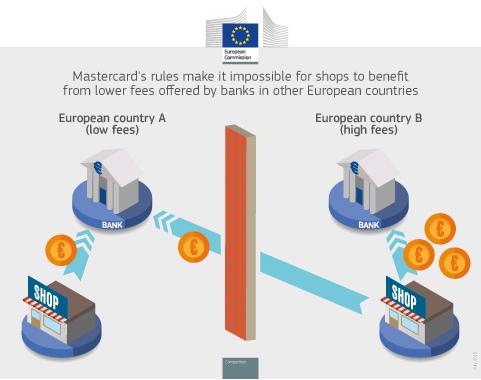
Brussels, The European Commission today has sent a Statement of Objections to MasterCard. The Statement of Objections outlines the Commission’s preliminary view that MasterCard’s rules prevent banks from offering lower interchange fees to retailers based in another Member State of the European Economic Area (EEA), where interchange fees may be higher. As a result, retailers cannot benefit from lower fees elsewhere and competition between banks cross-border may be restricted, in breach of European antitrust rules. The Statement of Objections also alleges that MasterCard’s interchange fees for transactions in the EU using MasterCard cards issued in other regions of the world breach European antitrust rules by setting an artificially high minimum price for processing these transactions. The sending of a Statement of Objections does not prejudge the outcome of the investigation.
Commissioner Margrethe Vestager, in charge of competition policy, said: “Many consumers use payment cards every day, when they shop for food, clothes or purchase anything online. We currently suspect MasterCard is artificially raising the costs of card payments, which would harm consumers and retailers in the EU. We have concerns both in relation to the rules MasterCard applies to cross-border transactions within the EU, as well as the fees charged to retailers for receiving payments made with cards issued outside Europe. MasterCard now has an opportunity to respond to our charges”.
Payments by card play a key role in the Single Market, both for domestic purchases and for purchases across borders or over the internet. European consumers and businesses are making more than 40% of their non-cash payments per year through payment cards.
Every time a consumer uses a payment card in a shop or online, the bank of the retailer (the ‘acquiring bank’) pays a fee called an ‘interchange fee’ to the cardholder’s bank (the ‘issuing bank’). The acquiring bank passes the interchange fee on to the retailer who includes it, like any other cost, in the final price he charges consumers for his products or services. Interchange fees are thus passed on to all consumers, even to those who do not use cards but pay in cash.
The Commission’s concerns
Banks use MasterCard to set on their behalf the interchange fees that apply between them. The Commission takes the preliminary view that MasterCard and its licensees (who issue MasterCard branded cards to cardholders or acquire transactions with those cards for retailers) form an association of undertakings. It also takes the preliminary view that the practices outlined in the Statement of Objections violate EU and EEA rules that prohibit cartels and other anticompetitive business practices (Article 101 of the Treaty on the Functioning of the European Union and Article 53 of the EEA Agreement).
In particular, the Statement of Objections raises two concerns:
Interchange fees still vary considerably from a Member State to another. MasterCard’s rules prevent retailers in a high-interchange fee country from benefitting from lower interchange fees offered by an acquiring bank located in another Member State (so called “cross-border acquiring”). The Commission is concerned that MasterCard’s rules on cross-border acquiring limit banks’ possibilities to compete cross-border on price for services to receive card payments and so restrict competition in breach of EU antitrust rules, leading to higher prices for retailers and consumers alike.
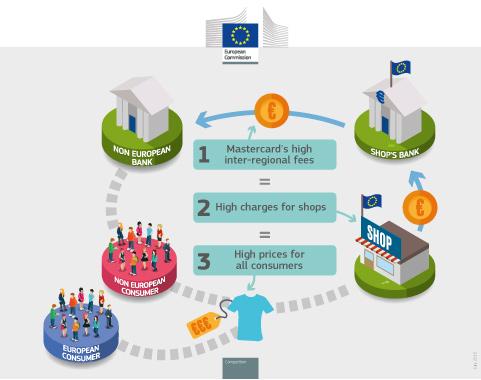
A second concern of the Commission is that the high levels of MasterCard’s “inter-regional interchange fees” are not justified. These fees are paid by an acquiring bank for transactions made in the EU with MasterCard cards issued in other regions of the world. For example, the fees paid by an acquiring bank when a Chinese tourist uses his card to pay his restaurant bill in Brussels are up to five times higher than those paid when a consumer uses a card issued in Europe. As these inter-regional fees represent hundreds of millions of euros each year, the Commission is concerned that these high inter-regional fees increase prices for retailers and may in turn lead to higher prices for products and services for all consumers, and not only those using cards issued outside the EU or paying with cards.
If the Commission’s preliminary view is confirmed, it can impose a fine on MasterCard.
Background
A Statement of Objections is a formal step in Commission antitrust investigations in which the Commission informs the parties in writing of the objections raised against them. The addressee of a Statement of Objections can reply in writing and may also request an oral hearing to present its comments on the case. The Commission may then take a decision on whether the conduct addressed in a Statement of Objections is compatible or not with European antitrust rules.
The Commission opened proceedings in the present case against MasterCard in April 2013. Today’s Statement of Objections is also the latest in a series of previous actions on interchange fees:
In December 2007, the Commission found that MasterCard’s interchange fees on cross-border transactions in the EEA (e.g. when a Belgian citizen uses his card to pay in a shop in France) restrict competition between banks (also see MEMO). In September 2014, the Commission’s findings in the decision were confirmed by the Court of Justice.
In 2009, to comply with the Commission’s decision, MasterCard capped the (intra-EEA) cross-border interchange fees applied by its member banks to 0.20% for debit cards and 0.30% for credit cards, but they did not reduce their other interchange fees.
In December 2010 and February 2014 respectively, the Commission also adopted decisions making legally binding commitments offered by Visa Europe (an association of banks) to cap at the same levels (0.20% and 0.30%) the interchange fees set in the EEA for debit cards and credit cards.
Most transactions in the EEA are domestic transactions (i.e. when a consumer uses his card in his own country), and were not covered by the Commission’s proceedings. The interchange fees on these transactions show wide variations between countries. They have been challenged by national competition authorities and ultimately lowered in several countries. In April 2015 the EU’s Council of Ministers and the European Parliament adopted the Interchange Fee Regulation, which from December 2015 on will cap interchange fees for cards issued and used in Europe (maximum of 0.20% for debit cards and 0.30% for credit cards). The Interchange Fee Regulation will lead to lower costs for European retailers and establish a level playing field for the card payment market as a whole. However, the caps of the Regulation do not apply to inter-regional transactions, one of the two issues of the current investigation.
Slower Growth in Emerging Markets, a Gradual Pickup in Advanced Economies says IMF world Economic Outlook Update
Global growth is projected at 3.3 percent in 2015, marginally lower than in 2014, with a gradual pickup in advanced economies and a slowdown in emerging market and developing economies. In 2016, growth is expected to strengthen to 3.8 percent.
A setback to activity in the first quarter of 2015, mostly in North America, has resulted in a small downward revision to global growth for 2015 relative to the April 2015 World Economic Outlook (WEO). Nevertheless, the underlying drivers for a gradual acceleration in economic activity in advanced economies—easy financial conditions, more neutral fiscal policy in the euro area, lower fuel prices, and improving confidence and labor market conditions—remain intact.
In emerging market economies, the continued growth slowdown reflects several factors, including lower commodity prices and tighter external financial conditions, structural bottlenecks, rebalancing in China, and economic distress related to geopolitical factors. A rebound in activity in a number of distressed economies is expected to result in a pickup in growth in 2016.
The distribution of risks to global economic activity is still tilted to the downside. Near-term risks include increased financial market volatility and disruptive asset price shifts, while lower potential output growth remains an important medium-term risk in both advanced and emerging market economies. Lower commodity prices also pose risks to the outlook in low-income developing economies after many years of strong growth.
Developments Affecting the Forecast
Weaker First-Quarter Growth
In the first quarter of 2015, the starting point for this update of the IMF’s global economic forecasts, world growth—at 2.2 percent—fell some 0.8 percentage point short of the forecasts in the April 2015 WEO. The shortfall reflected to an important extent an unexpected output contraction in the United States, with attendant spillovers to Canada and Mexico. One-off factors, notably harsh winter weather and port closures, as well as a strong downsizing of capital expenditure in the oil sector contributed to weakening U.S. activity.
Outside North America, positive and negative surprises were roughly offsetting. Growth in output and domestic demand in emerging market and developing economies broadly weakened, as expected.
Oil Price Rebound
Oil prices have rebounded more than expected in the second quarter of 2015, reflecting higher demand and expectations that oil production growth in the United States will slow faster than previously forecast. Nevertheless, the average annual oil price expected for 2015—US$59 a barrel—is in line with the oil price assumption in the April 2015 WEO, with a somewhat smaller increase forecast for 2016 and beyond, as global oil supply is running well above 2014 levels and global oil inventories are still rising. The reduction in oil investment may, however, lead to a somewhat weaker boost to activity in North America from lower oil prices than expected earlier.
Inflation
With the rebound in oil prices, fuel end-user prices have started rising. Monthly headline inflation has thus started to bottom out in many advanced economies, but the impact of disinflationary factors earlier in the year was stronger than expected, particularly in the United States. Core inflation has remained broadly stable well below inflation objectives. In many emerging market economies, notably those with weak domestic demand, headline inflation has declined.
Rise in Bond Yields
Longer-term sovereign bond yields have risen by about 30 basis points in the United States and by about 80 basis points on average in the euro area (excluding Greece) since April. However, financial conditions for corporate and household borrowers have remained broadly favorable. Higher yields partly reflect improving economic activity and the bottoming out of headline inflation, while in the euro area, they also reflect a correction after earlier declines to extremely compressed levels in response to increased bond purchases by the European Central Bank.
Other Factors
In currency markets, the dollar has depreciated by some 2 percent in real effective terms relative to the baseline values assumed for the April 2015 WEO, while the euro has appreciated by about 1 percent. But compared to average levels in 2014, the euro and the yen are still at depreciated levels and will, therefore, continue to support the recovery in the euro area and Japan in 2015–16. Given the constraints on monetary policy in these economies because of the zero lower bound on policy interest rates, this is expected to be a net positive for the global economy, as discussed in the April 2015 WEO. Bond yields and risk premiums in emerging market economies have risen broadly in line with those on advanced economy instruments. But capital flows to those economies are estimated to have decreased in 2015 compared to the second half of 2014, and many have seen further currency depreciation.
More recently, the bank holiday in Greece and subsequent referendum, along with increased uncertainty about the prospects for and nature of any future support from the international community, have led to sharply higher spreads on Greek sovereign bonds, especially at short maturities. Elsewhere, financial market reactions have been relatively muted, with some decline in the prices of risky assets and a modest increase in the prices of safe-haven sovereign bonds.
After a major rally over the past year, with the Shanghai composite index up by over 150 percent when it peaked in mid-June, the Chinese stock market has declined by about 30 percent in recent days, with the authorities taking several steps to contain the decline and the rise in market volatility.
Overall, as discussed below, these developments have not changed the broad outlook picture for the global economy, although they are expected to result in somewhat lower annual global growth in 2015 owing to the impact of the weaker first-quarter growth on annual growth in advanced economies (Table 1).
The Updated Forecast
Advanced Economies
Growth in advanced economies is projected to increase from 1.8 percent in 2014 to 2.1 percent in 2015 and 2.4 percent in 2016, a more gradual pickup than was forecast in the April 2015 WEO. The unexpected weakness in North America, which accounts for the lion’s share of the growth forecast revision in advanced economies, is likely to prove a temporary setback. The underlying drivers for acceleration in consumption and investment in the United States—wage growth, labor market conditions, easy financial conditions, lower fuel prices, and a strengthening housing market—remain intact.
The economic recovery in the euro area seems broadly on track, with a generally robust recovery in domestic demand and inflation beginning to increase. Growth projections have been revised upward for many euro area economies, but in Greece, unfolding developments are likely to take a much heavier toll on activity relative to earlier expectations. In Japan, growth in the first quarter of 2015 was stronger than expected, supported by a pickup in capital investment. However, consumption remains sluggish and more than half of quarterly growth stemmed from changes in inventories. With weaker underlying momentum in real wages and consumption, the pickup in growth in 2015 is now projected to be more modest.
Emerging Markets and Developing Economies
Growth in emerging market and developing economies is projected to slow from 4.6 percent in 2014 to 4.2 percent in 2015, broadly as expected. The slowdown reflects the dampening impact of lower commodity prices and tighter external financial conditions—particularly in Latin America and oil exporters, the rebalancing in China, and structural bottlenecks, as well as economic distress related to geopolitical factors—particularly in the Commonwealth of Independent States and some countries in the Middle East and North Africa.
In 2016, growth in emerging market and developing economies is expected to pick up to 4.7 percent, largely on account of the projected improvement in economic conditions in a number of distressed economies, including Russia and some economies in the Middle East and North Africa. As noted in earlier WEO reports, in many other emerging market and developing economies, much of the growth slowdown in recent years has amounted to a moderation from above-trend growth.
Risks to the Forecast
The distribution of risks to the near-term outlook for global growth is broadly unchanged from that in the April 2015 WEO and is slightly tilted to the downside. The main risks highlighted in April remain relevant. In view of the muted consumption response so far, a greater boost from lower oil prices is still an upside risk, especially in advanced economies.
Disruptive asset price shifts and a further increase in financial market volatility remain an important downside risk. Term and risk premiums on longer-term bonds are still very low, and there is a possibility of markets reacting strongly to surprises in this context. Such asset price shifts also bear risks of capital flow reversals in emerging market economies. Developments in Greece have, so far, not resulted in any significant contagion. Timely policy action should help to manage such risks if they were to materialize. Nevertheless, recent increases in sovereign bond yields in some euro area economies reduce upside risks to activity in these economies, and some risks of a reemergence of financial stress remain. Further U.S. dollar appreciation poses risks of balance sheet and funding risks for dollar debtors, especially in some emerging market economies. Other risks include low medium-term growth or a slow return to full employment amid very low inflation and crisis legacies in advanced economies, greater difficulties in China’s transition to a new growth model, as illustrated by the recent financial market turbulence, and spillovers to economic activity from increased geopolitical tensions in Ukraine, the Middle East, or parts of Africa.
Policy Priorities
The projected pickup in global growth, while still expected, has not yet firmly materialized. Raising actual and potential output through a combination of demand support and structural reforms continues to be the economic policy priority.
In advanced economies, accommodative monetary policy should continue to support economic activity and lift inflation back to target. In a number of countries with fiscal space, the near-term fiscal stance should be eased, especially through increased infrastructure investment. In economies with high public debt, the pace of fiscal consolidation needs to strike an appropriate balance between debt reduction and imposing a drag on economic activity. Efforts at implementing structural reforms remain urgent across advanced economies, both to tackle crisis legacies and to raise potential output.
In emerging market and developing economies, macroeconomic policy space to support demand is generally more limited but should be used to the extent possible. In many of these economies, demand support should come from fiscal policy rebalancing aimed at boosting longer-run growth, through tax reform and spending reprioritization. In oil importers, lower oil prices have reduced price pressures and external vulnerabilities, which will ease the burden on monetary policy. In oil exporters, public spending should be adjusted to lower oil revenue where there is no fiscal space. Exchange rate depreciation can help to offset the demand impact of oil-related terms-of-trade losses in countries with flexible exchange rate regimes. Structural reforms to raise productivity and remove bottlenecks to production are urgently needed in many economies.
IMF Suggests US Federal Reserve Should Delay Interest Rate Rise Until 2016
The U.S. economy’s momentum in the first quarter was sapped by unfavorable weather, a sharp contraction in oil sector investment, and the West Coast port strike. But the underpinnings for a continued expansion remain in place. A solid labor market, accommodative financial conditions, and cheaper oil should support a more dynamic path for the remainder of the year. Despite this, the weaker outturn in the first few months of this year will unavoidably pull down 2015 growth, which is now projected at 2.5 percent. Stronger growth over the next few years is expected to return output to potential before it begins steadily declining to 2 percent over the medium term.
Inflation pressures remain muted. In May headline and core personal consumption expenditure (PCE) inflation declined to 0.2 and 1.2 percent year on year, respectively. Long-term unemployment and high levels of part-time work both point to remaining employment slack, and wage indicators on the whole have shown only tepid growth. When combined with the dollar appreciation and cheaper energy costs, inflation is expected to rise slowly staring later in the year, reaching the Federal Reserve’s 2 percent medium-term objective by mid 2017.
An important risk to growth is a further U.S. dollar appreciation. The real appreciation of the currency has been rapid, reflecting cyclical growth divergences, different trajectories for monetary policies among the systemically important economies, and a portfolio shift toward U.S. dollar assets. Lower oil prices and increasing energy independence have contained the U.S. current account deficit, despite the cyclical growth divergence with respect to its main trading partners and the rise in the U.S. dollar. Nevertheless, over the medium term, at current levels of the real exchange rate, the current account deficit is forecast to widen toward 3.5 percent of GDP.
Despite important policy uncertainties, the near term fiscal outlook has improved, and the federal government deficit is likely to move modestly lower in the current fiscal year. Following a temporary improvement, the federal deficit and debt-to-GDP ratios are, however, expected to begin rising again over the medium term as aging-related pressures assert themselves and interest rates normalize. In the near-term, the potential for disruption from either a government shutdown or a stand-off linked to the federal debt ceiling represent important (and avoidable) downside risks to growth and job creation that could move to the forefront, once again, later in 2015.
Much has been done over the past several years to strengthen the U.S. financial system.
However, search for yield during the prolonged period of low interest rates, rapid growth in assets in the nonbank sector, and signs of stretched valuations across a range of asset markets point to emerging pockets of vulnerabilities. The more serious risks are likely to be linked to: (1) the migration of intermediation to the nonbanks; (2) the potential for insufficient liquidity in a range of fixed income markets that could lead to abrupt moves in market pricing; and (3) lifeinsurance
companies that have taken on greater market risk. But several factors mitigate these downsides. In particular, the U.S. banking system has strengthened its capital position (Tier 1 capital as a ratio of risk-weighted assets is at about 13 percent) and appears resilient to a range of extreme market and economic shocks. In addition, overall leverage does not appear excessive, household and corporate balance sheets look generally healthy, and credit growth has been modest.
The consultation focused on the prospects for higher policy rates and the outlook for, and policy response to financial stability risks, integrating the findings of the latest IMF Financial Sector Assessment Program for the U.S.
Executive Board Assessment2
Executive Directors agreed with the thrust of the staff appraisal. They noted that the economic recovery continues to be underpinned by strong fundamentals, despite a temporary setback, while risks remain broadly balanced. Directors observed that considerable uncertainties, both domestic and external, weigh on the U.S. economy, with potential repercussions for the global economy and financial markets elsewhere. These include the timing and pace of interest rate increases, prospects for the dollar, and risks of weaker global growth. Directors stressed that managing these challenges, as well as addressing longstanding issues of public finances and structural weaknesses, are important policy priorities in the period ahead.
Directors agreed that decisions on interest rate increases should remain data-dependent, considering a broad range of indicators and carefully weighing the trade-offs involved. Specifically, they saw merit in awaiting clear signs of wage and price inflation, and sufficiently strong economic growth before initiating an interest rate increase. Noting the importance of the entire path of future policy rate changes, including in terms of the implications for outward spillovers and for financial markets, Directors were reassured by the Federal Reserve’s intention to follow a gradual pace of normalization. They welcomed the Federal Reserve’s efforts, and commitment to continue, to communicate its policy intentions clearly and effectively. Directors acknowledged that financial stability risks could arise from a protracted period of low interest rates. In this regard, they underscored the importance of strong regulatory, supervisory, and macroprudential frameworks to mitigate these risks.
Directors commended the authorities for the progress in reinforcing the architecture for financial sector oversight. They concurred with the main findings and recommendations of the Financial Sector Assessment Program assessment. Directors highlighted the need to complete the regulatory reforms under the Dodd-Frank Act and to address emerging pockets of vulnerability in the nonbank financial sector. They encouraged continued efforts to monitor and manage risks in the insurance sector, close data gaps, and improve the effectiveness of the Financial Stability Oversight Council while simplifying the broader institutional structure over time. Directors
looked forward to further progress in enhancing cross-border cooperation among national regulators, and the framework for the resolution of cross-jurisdiction financial institutions.
Directors noted that there remain a range of challenges linked to fiscal health, lackluster business investment and productivity growth, and growing inequality. They agreed that reforms to the tax, pension, and health care systems will help create space for supporting near-term growth, including through infrastructure investment. Directors reiterated the need for a credible medium-term fiscal strategy that would anchor ongoing consolidation efforts, underpin debt sustainability, and reduce fiscal uncertainties. They called for renewed efforts to implement structural reforms to boost productivity and labor force participation, tackle poverty, address remaining weaknesses in the housing market, and advance the multilateral trade agenda.
Minister No More! After Greece Debt Crisis Vote Finance Minister Yanis Varoufakis Resigns His Position
The referendum of 5th July will stay in history as a unique moment when a small European nation rose up against debt-bondage.
Like all struggles for democratic rights, so too this historic rejection of the Eurogroup’s 25th June ultimatum comes with a large price tag attached. It is, therefore, essential that the great capital bestowed upon our government by the splendid NO vote be invested immediately into a YES to a proper resolution – to an agreement that involves debt restructuring, less austerity, redistribution in favour of the needy, and real reforms.
Soon after the announcement of the referendum results, I was made aware of a certain preference by some Eurogroup participants, and assorted ‘partners’, for my… ‘absence’ from its meetings; an idea that the Prime Minister judged to be potentially helpful to him in reaching an agreement. For this reason I am leaving the Ministry of Finance today.
I consider it my duty to help Alexis Tsipras exploit, as he sees fit, the capital that the Greek people granted us through yesterday’s referendum.
And I shall wear the creditors’ loathing with pride.
We of the Left know how to act collectively with no care for the privileges of office. I shall support fully Prime Minister Tsipras, the new Minister of Finance, and our government.
The superhuman effort to honour the brave people of Greece, and the famous OXI (NO) that they granted to democrats the world over, is just beginning.
EU Zone Economic Growth and Job Creation at Four-year Highs in Second Quarter
Eurozone economic growth rose to a four-year high in June, as levels of new business and employment continued to expand at solid rates. The final Markit Eurozone PMI® Composite Output Index posted 54.2 in June, up from 53.6 in May and fractionally above the earlier flash estimate. The upturn in June also took the average index reading
for the second quarter as a whole to a four-year high.
Rates of growth improved in both the manufacturing and service sectors during June. Manufacturing production rose at the joint-quickest pace in a year, while the expansion in service sector business activity was the fastest since May 2011. National PMI data signalled that Ireland remained at the top of the PMI growth league table in June, seeing its rate of output expansion accelerate to a six-month high. Spain stayed in second position, despite its pace of growth slowing sharply to the
weakest in the year so far.
Economic growth accelerated in Germany, Italy and France during June, hitting a two-month high in Germany, 12-month peak in Italy and 46-month record in France.
Furthermore, the French manufacturing sector signalled an expansion of output for the first time since May 2014, meaning that all of the ‘big-four’ manufacturing and service sectors recorded concurrent growth. The last time this was achieved was during April 2014.
The survey also indicated that both employment and new business had risen at the strongest rates (on average) for four years over the second quarter as a whole, despite growth easing slightly in June in both cases. Rates of job creation in Germany, France and Spain all remained broadly steady in June, but eased to a four-month low in Italy and two-month low in Ireland.
Although input price inflation slowed from May’s three year high, costs nonetheless continued to rise on the back of higher oil prices, wages bills and import costs (the latter reflecting the euro’s recent depreciation). June saw a further marginal decrease in average output charges. Germany, Spain and Ireland reported increases, whereas further price discounts were offered in France and Italy.
Services:
Service sector business activity growth accelerated to a four-year high in June, as output expanded in each of the ‘big-four’ eurozone economies. At 54.4 in June, up from 53.8 in May, the Eurozone Services Business Activity Index posted an identical reading to its earlier flash estimate. Output has now risen in each of the past 23 months.
By nation, the strongest performance was registered by Ireland, where output rose at the sharpest pace since September 2006. Spain was some way back in second position, as its rate of service sector growth eased to a six-month low.
Rates of output expansion quickened in Germany (two-month high), France (46-month high) and Italy (12-month high). In the case of Germany and Italy, this was despite a slight moderation in the pace of expansion in new orders. France saw new business rise to the greatest extent since August 2011. Job creation was registered for the eighth month running, with the pace of increase just shy of May’s four-and-a-half year peak. Employment increased across the ‘big-four’ nations and Ireland.
Growth rates in staffing levels slowed slightly in Germany, Italy and Ireland. Meanwhile, France and Spain saw the strongest job creation since December 2011 and September 2007 respectively.
The outlook† for the sector also remained positive in June, with eurozone service providers reporting they expect business activity to be higher in one year’s time. Optimism ticked higher in Germany and France, but edged lower in Italy, Spain and Ireland. June data showed a further divergence in firms’ input prices and output charges. Cost burdens increased during the month, although the pace of inflation eased from May’s 29-month record. In contrast, selling prices were discounted for the
forty-third month running amid reports of efforts to satisfy client demands.
Germany and Ireland reported output charge increases, while selling prices were broadly unchanged in Spain. France and Italy both reported accelerated rates of decline in output charges. †for business optimism, companies are asked whether they expect levels of business activity in one year’s time to be higher, the same or lower than the current month.
Comment:
Chris Williamson, Chief Economist at Markit said: “Despite the escalation of the Greek crisis in the second half of the month, the final PMI for June came in slightly above the ‘flash’ estimate, suggesting the turmoil has so far had little discernible impact on the real economy.
“Business activity expanded at the strongest rate for just over four years in June and hiring remained reassuringly resilient, with job creation also running at its highest for four years in the past two months. “The survey data point to GDP rising 0.4% in the second quarter, with the upturn led by Spain and Ireland alongside ongoing robust growth in Germany, but with recoveries also now building momentum nicely in Italy and France.
“The combination of ECB stimulus and low inflation appears to be boosting spending among consumers and businesses, offsetting ‘Grexit’ anxiety. However, with growth of new business slowing for a third month running, the survey is hinting that some risk aversion is creeping in which could hit growth in coming months if the Greek crisis is not resolved soon.”
ACE to Acquire Chubb for $28.3 Billion in Cash and Stock – Combined Company to Assume Renowned Chubb Name
ZURICH and WARREN, NEW JERSEY — JULY 1, 2015 — ACE Limited (NYSE: ACE) and The Chubb Corporation (NYSE: CB) announced today that the Boards of Directors of both companies have unanimously approved a definitive agreement under which ACE will acquire Chubb. Under the terms of the transaction, Chubb shareholders will receive $62.93 per share in cash and 0.6019 shares of ACE stock. Based on the closing price of ACE stock on June 30, 2015, the total value is approximately $124.13 per Chubb share, or $28.3 billion in the aggregate. This is the equivalent of $125.87 per Chubb share using ACE’s 20-day volume weighted average share price for the period ending June 30, 2015.
Upon closing of the transaction, ACE shareholders will own 70% of the combined company, and Chubb shareholders will own 30%. The consideration represents an approximately 30% premium to Chubb’s
closing price of $95.14 on June 30, 2015.
Together, ACE and Chubb will create a global leader in commercial and personal property and casualty (P&C) insurance, with enhanced growth and earning power and an exceptional balance of products as a result of greater diversification and a product mix with reduced exposure to the P&C industry pricing cycle. The combined company will remain a growth company with complementary products, distribution, and customer segments, a shared commitment to underwriting discipline and outstanding
claims service, and substantially increased data to drive new, profitable growth opportunities in both developed and developing markets around the world. The combination will create efficiencies that will provide flexibility for the company to invest in people, technology, products and distribution as well as improve the company’s competitive profile. Additionally, the balance sheet’s size and strength will elevate the combined company into the elite group of global P&C insurers. As of December 31, 2014, on an aggregate basis, the combined company had total shareholders’ equity of nearly $46 billion and cash, investments and other assets of $150 billion.
Growth and Earning Power of the Combination
“We are thrilled to announce the acquisition of Chubb, a venerable company with a great brand,” said Evan G. Greenberg, Chairman and CEO of ACE Limited. “This transaction advances our strategy in a meaningful way and represents an outstanding opportunity to create significant value over a reasonable period of time for both ACE and Chubb shareholders. We are combining two great underwriting companies that are highly complementary. We will make each other better and create a unique company in a class of its own that has greater growth and earning power than the sum of the two companies separately.”
John D. Finnegan, Chairman, President and CEO of Chubb, said, “This is a compelling transaction for all Chubb and ACE stakeholders. The combination brings together two highly respected and successful companies with complementary capabilities, assets and geographic footprints. We are confident that it will deliver strong value to Chubb shareholders, including an immediate premium and participation in the future growth and profitability of a well-positioned combined company. We are pleased that the
combined company will adopt the Chubb brand and view this as an affirmation that both companies share a commitment to the attributes of quality and service the brand represents. We look forward to working together as we create a best-in-class global franchise in P&C insurance.”
Complementary Presence and Capabilities
In the United States commercial lines business, ACE provides a broad range of products and services for industrial commercial, multinational and upper middle market companies with distribution substantially through a major brokerage presence. Chubb is primarily a middle-market commercial, specialty and surety insurer with a broad product portfolio and a major agency presence. In personal insurance, Chubb is a leading provider of personal lines coverage to high net worth customers in the U.S. while ACE has been increasingly focused on these customers as well.
Outside the U.S., ACE is a premier commercial insurer with a presence in 54 countries and a broad product, customer and distribution capability. Chubb’s operations in 25 countries will complement and deepen ACE’s presence. ACE has a leading market position in global accident and health (A&H) and both companies offer complementary personal lines offerings in Canada, Europe, Asia and Latin America. The combined company will have a leading position in professional lines globally with broad product
offerings for all sizes of commercial customers.
“We will be well balanced with greater presence and capabilities in product areas that have less exposure to the commercial P&C cycle,” continued Mr. Greenberg. “We have complementary product strengths – where one of us is not present, the other is. Where one of us is strong, the other is even stronger. Where there is overlap in product, generally one of us is more present at the large end of the corporate market while the other is serving the smaller or mid-market segment. The data and insight
we will gain from our respective skills and experience will allow us to do so much more. For example, Chubb will enhance ACE’s ability to serve the upper middle market, while ACE will provide more products to serve Chubb’s middle market clients, and our combined strengths will enable us to pursue the small and micro markets globally.
“Finally, we will benefit from each other’s complementary cultures, including a shared passion for underwriting discipline and outstanding claims service. Operating under the Chubb name, with sustained long-term underwriting profit and a larger invested asset base that will benefit from rising interest rates, we will take advantage of the growth opportunities and significant efficiencies to be gained between us. Together, we will grow more substantially and at a faster rate, producing greater earnings, than we could achieve as two separate companies. We look forward to welcoming the talented Chubb employees and their customers and distribution partners to the ACE family.”
Attractive Shareholder Returns
It is expected that the transaction will be immediately accretive to earnings per share and book value, and by year three, the transaction will be accretive to EPS on a double-digit basis and will be accretive to ROE. It is anticipated that the ROI will exceed ACE’s cost of capital within two years, result in a doubledigit return by year three, and tangible book value per share will return to its current level in three years.
Management, Board of Directors, Name and Headquarters
Upon completion of the transaction, the combined company will be led by Mr. Greenberg as Chairman and Chief Executive Officer. Mr. Finnegan has agreed to serve as Executive Vice Chairman for External Affairs of North America and will assist with integration. The company’s Board will be expanded from 14 directors to 18 directors with the addition of four independent directors from Chubb’s current Board.
Chubb will continue to operate under its name while the combined company transitions to operate under the Chubb name globally. The combined company will remain a Swiss company with principal offices in Zurich. Chubb’s headquarters in Warren, New Jersey, will house a substantial portion of the headquarters function for the combined company’s North American Division. ACE will continue to maintain a significant presence in Philadelphia, where its current North American Division headquarters
is based.
Financing, Efficiencies, Closing and Approvals
ACE intends to finance the cash portion of the transaction through a combination of $9 billion of ACE and Chubb excess cash plus $5.3 billion of senior notes with a range of maturities to be determined. ACE intends to target a debt-to-total capital ratio of approximately 20% following the acquisition, within the guidelines for the company’s ratings.
By the third year after closing, the company expects to realize annual expense savings of approximately $650 million pre-tax where both companies overlap. The company also expects to achieve meaningful growth that will result in substantial additional revenue. By year five, earnings accretion is expected to be balanced between revenue and expense-related synergies. The efficiencies created will provide greater flexibility for the company to invest in people, technology, product and distribution.
The transaction is expected to close during the first quarter of 2016, subject to approval by ACE and Chubb shareholders, the expiration or termination of the applicable waiting period under the Hart-ScottRodino
About ACE Group
ACE Group is one of the world’s largest multiline property and casualty insurers. With operations in 54 countries, ACE provides commercial and personal property and casualty insurance, personal accident and supplemental health insurance, reinsurance and life insurance to a diverse group of clients. ACE Limited, the parent company of ACE Group, is listed on the New York Stock Exchange (NYSE: ACE) and is a component of the S&P 500 index. Additional information can be found at: www.acegroup.com.
About Chubb
Since 1882, members of the Chubb Group of Insurance Companies have provided property and casualty insurance products to customers around the globe. These products are offered through a worldwide network of independent agents and brokers. The Chubb Group of Insurance Companies is known for financial strength, underwriting and loss-control expertise, tailoring products for the needs of high-networth individuals and commercial customers in niche markets and select industry segments, and
outstanding claim service.
The Chubb Group of Insurance Companies is the marketing term used to describe several separately incorporated insurance companies under the common ownership of The Chubb Corporation. The Chubb Corporation is listed on the New York Stock Exchange (NYSE: CB) and, together with its subsidiaries, employs approximately 10,300 people throughout North America, Europe, Latin America, Asia and Australia. For more information regarding The Chubb Corporation, including a listing of the insurers in the Chubb Group of Insurance Companies, visit www.chubb.com.
Assistant Attorney General Leslie Caldwell Speaks at the ABA’s National Institute on Bitcoin and Other Digital Currencies
It is a pleasure to address today’s ABA National Institute on Bitcoin and Other Digital Currencies. As head of the Justice Department’s Criminal Division, I am privileged to lead over 600 attorneys who investigate and prosecute federal crime, help develop criminal law and formulate law enforcement policy. Our talented prosecutors perform crucial work in many of the areas relevant to today’s discussion, including the fight to combat money laundering, financial fraud, child exploitation and cybercrime.
This afternoon, I’d like to discuss the department’s approach to the emerging virtual currency landscape, our ongoing efforts to prosecute those who commit crimes by using virtual currency, and our view that compliance and cooperation from exchanges, companies and other market actors can ensure that emerging technologies are not misused to fund and facilitate illicit activities.
The department is aware of the many legitimate actual and potential uses of virtual currency. It has the potential to promote a more efficient online marketplace. It also potentially can lower costs for brick and mortar businesses, by removing the need to pay credit card-related costs. And in theory, it can help speed and reduce the cost of cross-border transactions. But we also have seen that criminals have been among the first to enthusiastically embrace the use of virtual currency, primarily in crime involving the internet.
Many of the inherent features of virtual currencies are exactly what makes them attractive to criminals. Many criminals like virtual currency systems because these systems conduct transfers quickly, securely and with a perceived level of anonymity. For others, the irreversibility of payments made in virtual currency and lack of oversight by a central financial authority is appealing. Finally, the ability to conduct international peer-to-peer transactions that lack immediately available personally identifying information has made decentralized virtual currency attractive to those who wish to cover their money trail.
As a result, virtual currency facilitates a wide range of traditional criminal activities as well as sophisticated cybercrime schemes.
Much of the illicit conduct involving virtual currency occurs through online black markets such as the now-shuttered Silk Road, which operated on an anonymized “dark web” network that masked users’ physical locations, making them difficult to track. Similar online black markets continue to operate, offering on a global scale, a wide selection of illicit goods and services. While these have included more traditional crimes such as narcotics trafficking, stolen credit card information, and hit-men for hire, we have also seen a significant evolution in criminal activity.
For example, Bitcoin has been utilized to fund the production of child exploitation material through online crowd-sourcing – a development rarely seen before the prevalence of virtual currency. It has also been used to buy and sell lethal toxins over the internet and as a payment method for virtual kidnapping and extortion, allowing near-instantaneous transactions across the globe between perpetrators of phishing and hacking schemes and their victims.
Despite the significant challenges in investigating, much less prosecuting, this activity, the department already has a strong record of bringing cases in which virtual currencies were used to facilitate criminal conduct. While the burgeoning assortment of online exchanges, virtual currencies and virtual marketplaces has created a complex and evolving environment or “ecosystem” as this audience knows it, we too are keeping pace and will pursue those who exploit vulnerabilities in that ecosystem for illegal gain.
In this arena, we rely principally on money services business, money transmission and anti-money laundering statutes. While individual users who are not acting as exchangers or transmitters are not required to register with FinCEN, many virtual currency systems, exchangers and related services are. Additionally, most states also require money transmitters to obtain a state license in order to conduct business in that state, and some like New York have established virtual-currency specific licensing requirements. Any failure to register or obtain a license may subject a money transmitter to criminal prosecution, and a money transmitter that knowingly moves funds connected to a criminal offense also faces prosecution for money laundering, regardless of licensing status. Whether the currency involved is virtual or traditional, the department enforces these critical laws to prosecute money services businesses that engage in money laundering or facilitate crime by flouting registration and licensing requirements.
The department’s enforcement actions have evolved along with the virtual currency ecosystem. Our first major action against a virtual currency service used for illicit purposes was in 2007, when the Criminal Division’s Asset Forfeiture and Money Laundering Section (AFMLS), together with our Computer Crime and Intellectual Property Section (CCIPS), spearheaded the prosecution against e-Gold and its owners on charges related to money laundering and operating an unlicensed money transmitting business. E-Gold was a popular online currency exchange, and was a favored hub for cybercriminals in part because of the lack of account holder identity verification. An e-mail address was the only information needed to set up an account, allowing global anonymous transactions. After a multi-agency investigation, e-Gold and three associated individuals pleaded guilty in 2008 to charges of money laundering and operating an unlicensed money transmitting business.
In the wake of e-Gold’s demise, the virtual currency system Liberty Reserve was created. As alleged in our pending indictment, Liberty Reserve was structured and operated to help users conduct illegal transactions anonymously and launder the proceeds of their crimes.
Liberty Reserve quickly became one of the principal money transfer agents used by cybercriminals around the world to distribute, store and launder the proceeds of their illegal activity. Like e-Gold, any would-be account holder needed little more than a working email address to move funds around the globe. Again, this virtual currency platform became a favorite of cybercriminals and other tech-savvy wrongdoers, enabling them to engage in anonymous financial transactions, all conducted in violation of BSA requirements.
Before the government shut down Liberty Reserve in 2013, it had accumulated more than one million users worldwide, including more than 200,000 in the United States, who conducted approximately 55 million transactions through its system totaling more than $6 billion in funds. These funds included suspected proceeds of credit card fraud, identity theft, investment fraud, computer hacking, child pornography, narcotics trafficking and other crimes.
In a case jointly spearheaded by AFMLS and prosecutors from the Southern District of New York, several of Liberty Reserve’s top executives, including a co-founder of the company, the IT Manager and its Chief Technology Officer, have pleaded guilty to money laundering and operating an unlicensed money transmitting business and have been sentenced up to five years in prison. The creator of Liberty Reserve was extradited to the United States from Spain in October 2014 and is currently awaiting trial, where he is, of course, presumed innocent.
The department has also taken action against a number of individuals and groups who sought to exploit decentralized systems such as Bitcoin and anonymized dark web servers to finance illicit trade and activity in online black markets.
The first major prosecution of a dark market website was by the Southern District of New York in a case against Ross Ulbricht, aka “Dread Pirate Roberts,” who was arrested in October 2013 and convicted by a jury for his role in creating and operating Silk Road, an online black market whose payment operations exclusively used Bitcoin.
Silk Road – designed to act as a black-market bazaar completely free from government regulation and oversight – attempted to enable its users to exchange illegal drugs and other unlawful goods and services anonymously and beyond the reach of law enforcement. It emerged as one of the most extensive criminal marketplaces on the internet. Before it was dismantled by law enforcement, Silk Road was used by thousands of drug dealers and other vendors to distribute hundreds of kilograms of illegal drugs and other unlawful goods and services to well over a 100,000 buyers, and has been linked to at least six overdose deaths around the world. Further, Silk Road was also used to launder hundreds of millions of dollars derived from these unlawful transactions. And just a few weeks ago, in a federal courtroom in New York City, Ulbricht was sentenced to a term of life in prison – a cautionary tale for all those who would use dark spaces on the internet to flout the law.
The Silk Road story, however, did not end with Ross Ulbricht. Two federal agents, sworn to uphold the law, were also apparently lured by the perceived anonymity of virtual currency.
Carl Force, a Special Agent with the Drug Enforcement Administration, and Shaun Bridges, a Special Agent with the U.S. Secret Service, were both assigned to the Baltimore Silk Road Task Force, which investigated illegal activity in the Silk Road marketplace.
Force served as an undercover agent. According to court documents, Force went rogue and developed additional online personas to engage in complex bitcoin transactions to steal hundreds of thousands of dollars from the government and from the targets of the investigation. Independently, Bridges also allegedly engaged in an even larger direct theft, illegally diverting over $800,000 in virtual currency to his personal account.
Both individuals have been charged by the Criminal Division’s Public Integrity Section and prosecutors from the Northern District of California with wire fraud, theft of government property and money laundering. These investigations and prosecutions should send a strong message to those who would exploit technology to commit crimes: no matter how anonymous people might feel using virtual currency, their actions are not untraceable. People should not assume that law enforcement will not notice when they act on the dark web, or that we are not keeping up with emerging technology. Our successful prosecutions have shown that neither the supposed anonymity of the dark web nor the use of virtual currency is an effective shield from arrest and prosecution.
In addition to the operators of Silk Road and the drug traffickers who conducted their deals online in bitcoin, prosecutors from the Southern District of New York have also taken action against those who enabled this activity through the operation of Bitcoin currency exchanges. We understand that there are legitimate exchanges, and many of those are working closely with FinCEN and other regulators to ensure compliance with the law. But there are also many exchanges that don’t concern themselves with following the law.
From approximately December 2011 to October 2013, Robert Faiella ran an underground Bitcoin exchange on the Silk Road website under the alias “BTCKing,” and sold bitcoin to users to fund their purchases on the site.
Faiella would run bitcoin orders through Charlie Shrem, who operated a New York-based company that acted as a bitcoin to fiat currency exchange. Although Shrem was the company’s Anti-Money Laundering Officer and had registered the company with FinCEN as a money services business, Shrem failed to report any of BTCKing’s activity, despite knowing it was being used for illegal purchases. Shrem’s assistance enabled BTCKing to finance Silk Road transactions without collecting any personal identifying information from customers. Faiella pleaded guilty to operating an unlicensed money transmitting business involving funds he knew were intended to support unlawful activity, and Shrem pleaded guilty to aiding and abetting Faiella’s operations. Just this past winter, they were sentenced to four and two years in prison, respectively.
While these cases demonstrate that the criminal use of virtual currency has grown rapidly in recent years, its comparative scale versus traditional money laundering still pales in magnitude. Few virtual systems currently can accommodate the hundreds of millions of dollars we have seen in certain large-scale money laundering schemes involving government-issued currency. That said, as virtual currencies become more mature and better understood by criminals, we expect to see an increase in both individualized criminal activity and large-scale money laundering enterprises.
In some ways, companies and individuals operating in the virtual currency ecosystem are at a crossroads, and they have an opportunity to help virtual currency emerge from its association with criminal activities. While there obviously are good and legitimate reasons to use these currencies, industry participants are now on notice that criminals too, make regular use of them. So, to ensure the integrity of this ecosystem and prevent its penetration by crime, the industry must raise the level of its game on the compliance front.
That includes strict compliance with money services business regulations and anti-money laundering statutes. I understand that you have heard from our partners at FinCEN this morning about our collaborative efforts to investigate and enforce anti-money laundering laws, and you’ll also hear more from Katie Haun this afternoon about the investigation of the virtual currency business Ripple Labs, which operated an unlicensed money transmitting business.
Ripple sold a virtual currency called “XRP,” but failed for a time to register with FinCEN as a money service business and failed to establish and maintain appropriate anti-money laundering protections. Importantly, the department resolved this investigation after Ripple agreed to a number of substantial remedial measures. This includes cooperation in other ongoing investigations, a change in business model and oversight by independent auditors, an extensive look-back through their previous activities and development of an extensive compliance framework.
The resolution with Ripple Labs underscores the importance of having a strong compliance program to ensure adherence to the law. Virtual currency exchangers and other marketplace actors comprise the front line of defense against money laundering and other financial crime. Robust compliance programs, such as those imposed on Ripple Labs, are essential to keeping crime out of our financial system. If a money services business finds itself subject to a criminal investigation, we will look, as we do in all cases involving potential prosecution of a business entity, at the factors set forth in the Principles of Prosecution of Business Organizations, or Filip Factors. Two of the Filip Factors in particular, the existence of an effective and well-designed compliance program and a company’s remedial actions, including steps to improve upon an existing compliance regime, are explicitly set forth as factors prosecutors should consider.
As you know, there is no “one-size-fits-all” compliance program. Rather, effective anti-money laundering and other compliance programs must be tailored to meet the circumstances, size, structure and risks encountered by each entity. And virtual currencies, with their perceived anonymity, pose compliance risks that money transmitters such as Western Union do not face. Industry participants must address those risks, even when it may be costly to do so.
Just as in any other corporate investigation, when reviewing the conduct of, for example, an exchange, the department will examine whether a company has meaningfully addressed compliance. We have resolved cases against many financial institutions and other entities, and are deeply familiar with hallmarks of a genuine compliance program.
We expect virtual currency businesses to take compliance risk as seriously as they take any other business risk. Now, we recognize that new entrants in emerging fields may find that compliance requires a significant expenditure of resources, and we will be context-specific in analyzing appropriate compliance frameworks including consideration of the size and scope of the business. But a real commitment to compliance is a must, particularly given the significant risks in the virtual currency market. In the long run, investment in effective compliance programs will be well worth it, especially in the event that a company has to interact with law enforcement.
In many ways, I think that is a message that everybody gathered here today can appreciate. As the virtual currency markets attempt to move past their association with the Silk Roads and Liberty Reserves of the online world, are used to finance legitimate activity, and are becoming increasingly subject to regulation, robust compliance with existing anti-money laundering laws and regulations is necessary – indeed, critical – to bolster the reliability and value of virtual currency.
The challenges posed by the cases I’ve described are not unique to the virtual currency world. Indeed, these dark web criminals are merely using new tools to conduct the same old crimes, committing what is essentially street crime like drug trafficking and extortion, but over computer networks.
For those investors, exchanges and compliance officers who deal in virtual currency, compliance is of paramount importance. Adherence to regulations and state license requirements can reduce the liability of corporations who invest or deal in virtual currency. As seen with Ripple Labs, compliance and remediation can lead to a more favorable resolution of criminal investigations and adhering to anti-money laundering guidelines allows the legitimate use of virtual currency to grow and be responsive to infiltration and abuse by criminal elements. While the department will aggressively investigate and prosecute criminal activity that is funded through virtual currency, money services businesses that fall under the department’s scrutiny can also receive credit for meaningful and sincere compliance efforts.
Your compliance and cooperation will make it more difficult for those who seek to operate illicit and underground marketplaces and will be a key element for law enforcement to shed light on these illegal virtual currency transactions. It also will help to ensure the continued viability of virtual currency systems in the future.
Thank you for the opportunity to address this year’s National Institute on Bitcoin and Other Virtual Currencies.
European Union President Jean-Claude Juncker’s Speaks on the Situation as it Stands with Greece
What is at stake here is the essential spirit of European shared solidarity and responsibility. Other European countries went through very difficult times – Ireland, Portugal, Spain, Cyprus and Latvia – to name only these few countries.
All governments took very difficult decisions; some of them paid a very high political price for their solidarity and their financial support to help the most vulnerable countries.
This is what the order of priorities should be: responsibility before individual biographies, countries before parties.
As a former president of the Eurogroup I have seen first-hand how difficult it has been for these countries to work through the crisis and the social hardship that came with it. But political leaders in those countries showed responsibility and made the necessary decisions which are now obviously paying off.
You know well that the Greek people are very close to my heart. This is not paying lip service. I tried again and again and I showed it in recent years that I am on the side of the Greek people and that I place my trust in them too.
I know the hardship they have been through and I have always said that we have to pay more attention to the social fairness of our programmes.
Over the last five months I have been personally involved in the entire process of negotiations – sometimes day, sometimes night. For me Greece’s exit of the eurozone has never been and will never be an option. But I always told my Greek friends that by saying that Grexit is not an option, they shouldn’t believe that at the very end of the process I will be able to present against others a final answer and a final solution to be given to what I have to describe as a primarily Greek problem.
I have explored all the possibilities to accommodate the Greek concerns and to make a deal with the Greek authorities – in the interest, first and above all of the Greek people – while creating, and this is important, at the same time the right conditions for an unanimous agreement with all the other 18 democracies that are lending billions of their taxpayers’ money to Greece.
On our side these negotiations have always been in a true European spirit – based on rules, based on mutual trust. There has never been an “ultimatum or take-it-or-leave-it-approach”. Our sole concern has always been and still is to help make a fair and balanced deal.
I have done everything that can be done to facilitate an agreement – on process as on substance.
On process: we have adjusted our working methods to the wishes of the Greek government: This should not be forgotten this was not an easy thing to be done. No talks happened in Athens, the Brussels Group was created instead of the Troika, we offered continuity in the talks in the face of constantly changing Greek interlocutors and negotiating teams. I worked together with Jeroen Dijsselbloem for talks on a more political level as was the wish of the Greek authorities. This was not left to anonymous technocrats. We had again and again talks at the highest political level between myself, I have been elected by the European Parliament after the result of the European elections campaign and Mr. Dijsselbloem, who is an elected member, who is the chief of the Eurogroup, we brought all the debates to the political level, not leaving this, as I said, to anonymous technocrats. But this was a highly political debate as it had never been before.
My team and I myself have never been short of determination or patience waiting for the Greek proposals which often were delayed or deliberately altered.
This also shows our flexibility and our will to reach a compromise also in regard of content. It was about procedures and it was and is about content.
On content: We went very far to achieve socially fair measures that at the same time can support growth and the necessary fiscal consolidation, and which take account of the requests of the Greek Government.
This is certainly a demanding and comprehensive package, but it is a fair one. And I must stress that it has been developed through months and months, days and days of discussions and debates.
Let me clarify a few things:
There are no wage cuts in this package. And nobody is allow to give the impression that there are wage cuts in this package.
There are no pension cuts in this package. No pension cuts in this package.
In fact, it’s a package which creates more social fairness, more growth and a more modern and transparent public administration.
You should be aware that in many instances, we in the European Commission, had to be the ones insisting on the most socially fair measures. I would have expected the Greek government to push this agenda in line with its campaign manifesto.
Let me illustrate this.
This is not a stupid austerity package. Some of the measures of course will hurt in the near term. But the package goes well beyond fiscal measures and proposes a clear way forward. Moreover, this package lowers the fiscal targets and gives more time to the Greek government to achieve them. Compared to the previous deal, the one we had, it is more than 12 billion EUR less savings that are requested from Greece in the coming years. And in fact the Greek government has already agreed to this and welcomed it. Although we had to discuss in a very intense manner amongst institutions as you know.
By the way, fiscal consolidation does not mean austerity: it means keeping public finances in control while boosting opportunities for jobs and growth. Many Member States have even higher fiscal targets despite having lower levels of debt.
There are, as I said, no wage cuts in this package.This was never, never ever on the table. What is on the table is a proposal tomodernise the wage grid of the public sector. And, for the private sector, we have agreed to review collective bargaining practices. Our only request has been that this should be done in line with the best European practices in cooperation with the institutions and ILO which are the specialists when it comes to this question.
There are no cuts in the level of pensions in this package. Even the Greek government agrees that the Greek pension system urgently needs further reform to be sustainable. It should be fairer so that everyone contributes to the welfare system according to their means. There is a menu of measures to achieve that, starting with removing incentives for early retirement. The government could also substitute measures with alternatives ones as long as the numbers add up.
I am repeating this sentence: The government could also substitute measures with alternatives ones as long as the numbers add up.
The package of the three institutions and President of the EG means more social fairness:
by targeting support to the most vulnerable, for instance through a guaranteed minimum income scheme.
by making sure that the efforts required from everyone are proportionate to their income,
by targeting cuts in areas which do not affect the average wallets of the average citizens, such as through defense cuts
We were asking for cuts in the defence budget and I think we are totally right.
More social fairness by challenging vested interests, such as removing favorable tax treatments for ship-owners. It took some time if not hours to convince the Greek government – I had to do the job of the Greek government to impose a less-favorable tax treatment for ship owners, although this is common sense and in line with tax justice.
The package means more social fairness by fighting corruption. Ordinary people are not those who are corrupted. Others are. We have to fight against corruption if we want to be credible.
More social fairness by supporting more transparency and efficiency of the public administration, including an independent tax administration. Who could be against an independent tax administration. This is the normal rule in all European countries. The same rule has to be applied to Greece and the government agrees to that undertaking.
Once more, we were the ones pushing for these elements. Our offers of technical assistance have not been entirely taken up.
This package of the three institutions and President of the Eurogorup – and I have to underline that Mr Dijsselbloem did an excellent job for the last months, an excellent job – also means more growth and more investment. I believe growth can restart soon and fast once there is a deal. But there are no quick fixes to some of Greece’s underlying problems. We need a thorough set of reforms.
For instance, why is the price of energy and some commodities among the highest in Europe? Because there is a lack of competition and a refusal to tackle vested interests.
Why is the tax collection so poor? Greece needs a stable tax system to promote investment.
And that is why I favoured the proposal to increase corporate tax, but not to the proposal for a one-off retrospective tax for 2014 profits.
The biggest impediment to jobs, growth and investment at the moment is uncertainty. Uncertainty, which can only be removed by agreeing a deal that provides a credible framework for the Greek economy and people. The confidence effect of a deal, the predictability it would bring, together with the injection of liquidity into the economy from disbursements will restore job creation and growth.
So what did happen? And where are we now?
As you know, the Greek authorities walked away from the negotiation table unexpectedly I have to say on Friday night. The negotiations were not finished and the agreement was never finalised. Again on Friday, we were working on further openings and the Commission together with others was proposing to limit the increase of the hotel VAT in Greece to 13 per cent instead of 23 per cent envisaged earlier
The fact that our Greek colleagues of the negotiation team were leaving the negotiation table happened at the worst moment.
President Dijsselbloem and I explained to Mr. Tsipras that a deal on these measures could unlock new disbursements of financial aid allowing Greece to meet its financial needs over the next coming months. We also told him that the Eurogroup was ready to discuss debt measures, in line with the Eurogroup statement of November 2012, already this autumn to ensure the long-term sustainability of Greek public finances. We have already discussed with Klaus Regling, managing director of the European Stability Mechanism how this could be done. Mr Tsipras knows this.
And a deal could also have ensured that we, the Commission, could go ahead with a package for a “new start for jobs and growth” package of 35 billion euro to help the Greek economy getting back on tracks.
Vice-President Dombrovskis was spending hours, days together with all the other Commissioners involved to put together all the elements needed to provide Greece of a growth package of 35 billion euro. This is not only about fiscal consolidation, this is also about pushing forward the growth opportunities for the Greek economy. It is a huge part of the package the Commission, myself together with Vice-President Dombrovskis have been proposing to our Greek friends.
You can see we really moved mountains until the very last minute when Greek authorities closed the door. All elements of a credible and comprehensive deal were on the table.
So I don’t have, unlike recent press speculation suggests, new proposals to make today. I am describing the proposals which were on the table and which were of the nature that we could have – I have to say easily – reached an agreement at the Eurogroup meeting of last Saturday.
What do the Greek people know about our flexibility and determination to help them? What do they know about the details of our common proposals? What do they know about this latest offer we were obliged not to take influence on the Greek votes but to inform the Greek public what is on the table about this offer we published yesterday? So they put together all the elements that we went through all together with the Greek authorities. What do the Greek people know about all this? And the reason why I am addressing the press and via you the Greek people: they have to know what is the truth. They have to know what is on the table. They have to know all the elements of the debates we had for such a long time together when we were sitting around the same table.
I think that the Greek government knows all these elements and it would be advisable to tell the truth to the Greek people instead of simplifying his own message to a ‘no’ message for next Sunday.
In a democracy – and the Greek democracy has the absolute right to put this question for referendum – the absolute right in democracy is to ask people to give their advice.
Every citizen deserves the whole story and the truth and they have to know that – on our side – the door is still open.
This is a highly important moment for the Greek people and for the people of Europe.
It’s the time for Greeks to speak up and to shape their own destiny for this generation and the generations to come.
It is time for Greece’s political leaders to shoulder their responsibility, to tell their people what is really at stake, that it will not be easy but necessary; others did it. Ask the Irish, ask the Portuguese, ask the Spaniards and many others. It is a moment of truth.
I will never let the Greek people down – and I know that the Greek people don’t want to let down the European Union.
Greece is a member of the European family and I want this family to stand together.
Statement on behalf of the European Commission by Jonathan Hill on the capital controls imposed by the Greek authorities
The European Commission takes note of temporary restrictions on the free movement of capital which were announced by the Greek authorities on Sunday evening and have now been published in the official gazette.
In accordance with the Treaty on the Functioning of the European Union, Member States may take measures in respect of capital movements which are justified on grounds of public policy or public security.
In accordance with the case law of the Court of Justice of the European Union, measures may also be introduced for other overriding reasons of general public interest. Such exceptions to the principle of the free movement of capital must be interpreted very strictly, and be non-discriminatory, as well as suitable and proportionate in light of the objective. This also means that capital controls must be applied for the shortest possible period.
As guardian of the Treaties and with a view to safeguarding the integrity of the single market, the Commission has made an immediate, preliminary assessment of the Greek measures that introduce the controls and finds them to be, prima facie, justified.
In the current circumstances, the stability of the financial and banking system in Greece constitutes a matter of overriding public interest and public policy that would appear to justify the imposition of temporary restrictions on capital flows. Maintaining financial stability is the main and immediate challenge for the country.
While the imposed restrictive measures appear necessary and proportionate at this time, the free movement of capital will however need to be reinstated as soon as possible in the interest of the Greek economy, the Eurozone, and the European Union’s single market as a whole. The Commission will closely monitor the situation and the implementation of the imposed restrictive measures on capital movements.
JPMorgan Chase Launches Global Think Tank Dedicated to Delivering Data-Rich Analyses and Expert Insights
Washington, DC – JPMorgan Chase & Co. today launched the JPMorgan Chase Institute, a global think tank that will deliver better data, analyses and expert insights designed to address global economic challenges. The new think tank released a groundbreaking inaugural report, Weathering Volatility: Big Data on the Financial Ups and Downs of U.S. Individuals, that uses proprietary data from JPMorgan Chase to provide one of the most in-depth views into how Americans’ income and spending habits fluctuate significantly on a yearly and monthly basis.
Diana Farrell is the founding President and CEO of the Institute. Previously, she was a director and the Global Head of the McKinsey Center for Government and the McKinsey Global Institute at McKinsey & Company. She also served as the Deputy Director of the White House National Economic Council and Deputy Assistant to the President on Economic Policy from 2009-2011.
With an unprecedented level of high-quality data from JPMorgan Chase, the Washington, DC-based Institute will help policymakers, businesses and nonprofit leaders use real-time data and thoughtful analysis to make smarter economic policy decisions that advance global prosperity.
“Real-time data and factual analysis are critical to understanding and responding to our changing global economy,” said Jamie Dimon, Chairman and CEO, JPMorgan Chase & Co. “JPMorgan Chase has the data to help tackle the economic challenges we continue to face. That’s why we set up the Institute – to analyze the data and produce insights that will help leaders in the public, private and nonprofit sectors make more informed choices.”
The Institute was established with the goal of putting the broad spectrum of data within the firm to use for the public good. Over time, the Institute will analyze the granularity, diversity and interconnectedness of the economy and publish analyses on a range of global economic issues. Future research plans include more groundbreaking analytic work on the financial behavior of individuals, insights on the small business sector and expert profiling of global trade and capital flows. The Institute will also bring together prominent thinkers to discuss and analyze the Institute’s findings and develop policies to advance economic prosperity.
“How exposed are individuals to income and consumption volatility over time? Do earning and spending patterns differ across the income spectrum? How much of a financial buffer do households need to weather their exposure to volatility?” said Diana Farrell. “With data-driven analysis, the JPMorgan Chase Institute will be able to answer these and other questions and provide insight to policymakers around the globe to make more informed economic decisions.”
Inaugural Report: Income and Spending Fluctuations of U.S. Consumers
The Institute’s inaugural research report, Weathering Volatility: Big Data on the Financial Ups and Downs of U.S. Individuals showed that individuals across the income spectrum experienced high levels of income volatility and even higher levels of spending volatility.
Seven in ten (70 percent) individuals experienced an annual change in income of at least 5 percent between 2013 and 2014. More than a quarter (26 percent) of individuals experienced at least a 30 percent change. Only 30 percent saw consistent income between 2013 and 2014.
Spending was even more volatile than income. More than eight in ten (84 percent) individuals experienced monthly changes of at least 5 percent over the course of 2013 and 2014. Only one in six (16 percent) saw consistent spending between 2013 and 2014, while one in four (24 percent) people experienced more than a 30 percent change in annual spending during that period.
Income and consumption were more volatile on a month-to-month basis than on an annual basis; 60 percent of people experienced high levels of volatility on a month-to-month basis. The report showed that volatility was not limited to lower income individuals, but was similarly evident across the income spectrum.
Moreover, the data show that income and spending changes did not move in tandem. Three in four people (72 percent) experienced changes in income and spending that did not mirror each other. One in three people (33 percent) saw their annual spending changes positively exceed changes in their income. About four in ten (39 percent) people saw their income changes positively exceed changes in their spending. Only 28 percent experienced income and spending changes of the same direction and magnitude.
Finally, most households did not have a sufficient financial buffer to weather the volatility to which they are often exposed, such as a large medical expense that took place at the same time as a loss in income. A typical middle-income household needs a financial buffer of approximately $4,800 in liquid assets – roughly 14 percent of annual income after taxes – to sustain the typical monthly fluctuations in income and spending observed during this time frame. But, according to the Survey of Consumer Finance, they had only $3,000 in liquid holdings. Similar gaps exist between the buffer needed and actual liquid holdings for individuals across all incomes, except the top income earners.
“Individuals are dealing with high levels of income volatility and even higher levels of spending volatility. Business leaders and policymakers should closely evaluate these trends when taking steps to advance global prosperity,” said Farrell. “Potential solutions include analytical platforms that help people track their earning and spending patterns, policy interventions or new financial products to help people smooth income and spending or put these fluctuations to good use, for example, to help them save money.”
The Institute’s research drew from detailed transaction information for nearly 30 million Chase customers, constructing a unique data asset of 2.5 million account holders. The Institute examined income and spending habits on a transaction-by-transaction basis between October 2012 and December 2014 to draw conclusions about fluctuations in earning and spending among U.S. individuals.
“The data asset that the JPMorgan Chase Institute is creating is unlike any other that currently exists in the field of consumer finance,” said Jonathan Parker, an economist at the Massachusetts Institute of Technology, expert in the field of consumer finance and a member of the academic advisory group for the JPMorgan Chase Institute. “It has the potential to help us better understand people’s financial lives – basic questions about how they earn, spend and save.”
“The JPMorgan Chase Institute data asset gives us a new window into the volatility people experience that can inform innovation in financial tools, products and policies,” said Michael Barr, Professor of Law at the University of Michigan Law School, former Assistant Secretary for Financial Institutions at the U.S. Treasury Department and also a member of the academic advisory group for the Institute.
Commitment to Privacy and Security
The JPMorgan Chase Institute has adopted rigorous security protocols and checks and balances to ensure all customer data are kept confidential and secure. Strict protocols are informed by statistical standards employed by government agencies. Additionally, the Institute’s work with technology, data privacy, and security experts will help maintain industry leading standards.
Before the Institute receives any data, all unique identifiable information – including names, account numbers, addresses, dates of birth, and social security numbers – is removed. The Institute also has put in place privacy protocols for its researchers and only allows aggregated data to be published.
About the JPMorgan Chase Institute
The JPMorgan Chase Institute is a global think tank dedicated to delivering data-rich analyses and expert insights for the public good. Its aim is to help decision makers – policymakers, businesses, and nonprofit leaders – appreciate the scale, granularity, diversity, and interconnectedness of the global economic system and use better facts, real-time data and thoughtful analysis to make smarter decisions to advance global prosperity. Drawing on JPMorgan Chase & Co.’s unique proprietary data, expertise, and market access, the Institute develops analyses and insights on the inner workings of the global economy, frames critical problems, and convenes stakeholders and leading thinkers. For more information visit: jpmorganchase.com/institute.
Fannie Mae Eliminates Desktop Underwriter Fee and Enhances Its Industry Leading Tools to Give Lenders Greater Efficiency
WASHINGTON, DC – Fannie Mae (FNMA/OTC) announced that it will eliminate fees on its Desktop Underwriter® automated underwriting system and Desktop Originator® tool, enhance its EarlyCheck™ loan verification tool, and soon introduce a new loan delivery system. These changes are designed to help its customers originate mortgages with increased certainty, efficiency and lower costs.
“We continue to strive to have lenders choose Fannie Mae because we provide the most insightful, innovative and effective tools in the industry,” said Andrew Bon Salle, Executive Vice President, Single-Family Business at Fannie Mae. “For years, our technology tools have been the tools of choice for mortgage lenders across the industry. We want to continue to provide value to our lenders and we don’t want technology fees to get in the way of lenders using our technology to its full potential. That is why we have introduced tools such as Collateral Underwriter, EarlyCheck and Servicing Management Default Underwriter at no cost to lenders or servicers, and why today we are also eliminating our DU fee. We will continue to innovate to provide extraordinary value to our partners and help them succeed.”
The company announced the following:
Enhanced EarlyCheck – This fall, Fannie Mae will update its EarlyCheck application with additional loan-level data integrity capabilities, to help lenders have confidence that the loans they deliver to Fannie Mae have accurate, complete data and meet Fannie Mae’s requirements. These updates will align with the data standards in Fannie Mae’s Loan Delivery tool, meaning lenders can have more confidence that loans can be delivered to Fannie Mae prior to doing so. Over time, Fannie Mae will continue to update EarlyCheck with additional capabilities, including loan eligibility rules, so that lenders have additional certainty that the mortgages they deliver meet Fannie Mae’s standards.
DU fees eliminated – Fannie Mae currently offers Collateral Underwriter™ and EarlyCheck to lenders at no charge to encourage lender use and drive industry-wide collateral and data quality. Effective immediately, Fannie Mae will offer Desktop Underwriter (DU) and Desktop Originator on a no-fee basis, as well. Fannie Mae is removing these fees to allow more lenders to access the value of DU in their underwriting processes and to enable the company to continue to bring innovative solutions to the mortgage process, driving certainty, loan quality and greater efficiency.
A new loan delivery interface – Fannie Mae is currently developing a new platform for lenders to deliver loans. This new platform is designed to provide lenders with a more intuitive and easier-to-navigate user interface, enhanced reporting capabilities, and improved delivery edit messaging that will help lenders deliver loans more efficiently and with greater transparency and certainty. The new loan delivery system is expected to be available to lenders in late 2015, and Fannie Mae will provide guidance to customers over the coming weeks.
Fannie Mae’s suite of risk management tools was recently integrated to help lenders underwrite and deliver quality loans with greater certainty and transparency:
Desktop Underwriter – Desktop Underwriter, the leading technology tool that supports lenders’ underwriting processes across the mortgage industry, provides lenders a comprehensive credit risk assessment that determines whether a loan meets Fannie Mae’s eligibility requirements. Over 1,800 lenders use DU in their underwriting process to determine whether a loan meets Fannie Mae’s eligibility requirements.
Collateral Underwriter – Since being introduced to the market in early 2015, over 1,000 lenders have registered to use Collateral Underwriter to streamline their appraisal review processes and reduce risk. To date, over 300,000 appraisals have been reviewed using the tool.
EarlyCheck – Over 600 lenders are registered to use EarlyCheck to evaluate loan eligibility prior to delivering mortgages to Fannie Mae. Nearly 60% of loans delivered to Fannie Mae in the first quarter of 2015 came through an EarlyCheck review first.
US Third Estimate of GDP for the First Quarter of 2015 – By Whitehouse
Real GDP for the first quarter was revised up this morning, reflecting slightly higher growth in personal consumption, private investment, and government expenditures than previously estimated. The small first-quarter decline in overall GDP was driven by a number of factors including harsh winter weather and tepid foreign demand. However, the combination of consumption and investment—the most stable and persistent components of output—continued to rise at a robust year-over-year pace. This solid trend matches the strong pace of job growth and employment reduction observed over the last year. The President is working to build on these underlying trends by opening our exports to new markets with high-standards free trade agreements, boosting investment in infrastructure, and avoiding harmful budget cuts like the sequester.
FIVE KEY POINTS IN TODAY’S REPORT FROM THE BUREAU OF ECONOMIC ANALYSIS
1. Real gross domestic product (GDP) edged down 0.2 percent at an annual rate in the first quarter of 2015, according to the third estimate from the Bureau of Economic Analysis. This report reflects an upward revision of 0.5 percentage point to overall GDP growth. The slower first quarter follows a solid increase of 3.6 percent at an annual rate during the second half of 2014. Over the past four quarters, GDP rose 2.9 percent. First-quarter growth was likely affected by a number of transitory factors including unusually severe weather, the West Coast ports dispute, and various measurement issues. A decline in net exports was another important contributor to weak GDP growth. Indeed, net exports subtracted nearly 2 full percentage points from quarterly GDP growth. Furthermore, structures investment subtracted about 0.6 percentage point from GDP (see point 4), reflecting reduced oil drilling in the wake of last year’s decline in oil prices. Despite the decrease in GDP, real gross domestic income—an alternate measure of economic output—increased 1.9 percent at an annual rate in the first quarter.
Real private domestic final purchases (PDFP), the sum of consumption and fixed investment, rose 1.6 percent at an annual rate in the first quarter, faster than overall GDP but below last year’s pace. Real PDFP—which excludes noisy components like net exports, inventories, and government spending—is generally a more reliable measure of future GDP growth than current GDP. Over the past four quarters, PDFP grew 3.5 percent, a faster rate than overall GDP.
2. The upward revision to first-quarter GDP was spread across many components of economic output. Personal consumption expenditures contributed 0.2 percentage point to the upward revision with improvements in estimates of both goods and services consumption. Private investment contributed another 0.3 percentage point with a mix of small upward revisions to structures investment, intellectual property investment, inventories, and residential investment. State and local government investment contributed the remaining 0.1 percentage point to the upward revision. Exports and imports saw offsetting revisions, leaving net exports essentially unrevised on balance.
3. Government spending has decreased as a share of GDP in recent quarters, while private investment has risen to offset it. Over the past two years, government expenditures (consumption and investment) as a share of GDP declined 1.1 percentage points. The decline reflects reduced government spending in both the Federal and the State and local sectors. State and local spending has begun to expand after contracting in the early part of the recovery, but continues to decline as a share of output. Personal consumption and net exports have composed a largely stable share of total output over this period, while private investment has risen to offset the government decline. Private investment includes the contributions of the business sector and the household sector. Although business investment growth has trended upward in recent years, the first quarter saw a sharp energy-driven decline (see point 4); meanwhile, residential investment growth has strengthened in recent quarters (see point 5).
4. Most of the first-quarter slowdown in business investment is explained by reduced drilling and mining activity following last year’s large oil price decline. Business fixed investment declined 2.0 percent at an annual rate in the first quarter after growing 6.2 percent over the four quarters of 2014. More than half of that gap is explained by the 49 percent annualized first-quarter decline in mining exploration, shafts, and wells, which includes petroleum drilling. Despite the large impact on first-quarter growth, mining and drilling comprised only 7 percent of business fixed investment in 2014. Other structures investment beyond mining and drilling—which is also sensitive to energy prices, but less so—also declined, explaining roughly another tenth of the business investment slowdown. Equipment investment and intellectual property investment rose in the first quarter, but more slowly than their recent trend. These other categories explain about one quarter of the slowdown in business fixed investment.
5. Residential investment growth has picked up over the past year, but it has not returned to the growth rates attained earlier in the recovery. Over the past four quarters, residential investment has grown 5.5 percent at an annual rate—the strongest year-over-year growth since 2013. However, growth remains well below the levels attained in 2012 and 2013. One encouraging sign for residential investment is household formation, which includes young adults moving out of parental homes. Household formation is just one driver of housing demand (other major elements include credit availability and deterioration of the existing stock), but it rose in the fourth quarter of 2014, providing scope for more residential construction and investment going forward.
Posted by Whitehouse.gov
Australia to join the Asian Infrastructure Investment Bank
The Government today announces that Australia will become a founding member of the Asian Infrastructure Investment Bank (AIIB).
The decision comes after extensive discussions between the Government, China and other key partners around the world.
There is an estimated infrastructure financing gap of around US$8 trillion in the Asian region over the current decade.
The AIIB will be part of the solution to closing this gap.
Joining the AIIB presents Australia with great opportunities to work with our neighbours and largest trading partner to drive economic growth and jobs.
The AIIB will work closely with the private sector, paving the way for Australian businesses to take advantage of the growth in infrastructure in the region.
The governance of the AIIB will be based on best practice, ensuring that all members will be directly involved in the direction and decision making of the bank in an open and transparent manner.
We look forward to working with other members to lay the foundations for an effective new multilateral institution which is expected to be operational by the end of the year.
Australia will contribute around A$930 million as paid-in capital to the AIIB over five years and will be the sixth largest shareholder. The AIIB will have paid-in capital of US$20 billion ($A25.2 billion) with total authorised capital of US$100 billion (A$126.2 billion).
The Treasurer will attend the Articles of Agreement signing ceremony at the Great Hall of the People, Beijing on Monday 29 June.
Lifting the Small Boats by Christine Lagarde, Managing Director, IMF – Address at Grandes Conferences Catholiques Brussels
Good evening! I am absolutely delighted to participate again in this prestigious conference, and I would like to thank Vice Premier Reynders for his kind introduction.
Last month, on May 6th, I almost choked on my morning yoghurt when I saw the front page of a leading business newspaper. There it was – a league table of the world’s best paid hedge fund managers. It showed that the highest earner was able to pocket $1.3 billion in 2014. One man, $1.3 billion!
Together, the 25 best-paid hedge fund managers earned a combined $12 billion last year, even as their industry suffered from largely mediocre investment performance.
This reminded me of a famous Wall Street joke – about a visitor to New York who admired the gorgeous yachts of the richest bankers and brokers. After gazing long and thoughtfully at these beautiful boats, the visitor asked wryly: “Where are the customers’ yachts?” Of course, the customers could not afford yachts, even though they dutifully followed the advice of their bankers and brokers.
Why is this relevant right now? Because the theme of growing and excessive inequality is not only back in the headlines, it has also become a problem for economic growth and development. I would like to take an economic perspective on this with you tonight. I will not focus on the gorgeous yachts of the super-rich, who have become the face of a new Gilded Age. It is not immoral to enjoy one’s financial success.
But I would like to bring into the discussion what I would call the “small boats” – the livelihoods and economic aspirations of the poor and the middle class.
In too many countries, economic growth has failed to lift these small boats – while the gorgeous yachts have been riding the waves and enjoying the wind in their sails. In too many cases, poor and middle-class households have come to realize that hard work and determination alone may not be enough to keep them afloat.
Too many of them are now convinced that the system is somehow rigged, that the odds are stacked against them. No wonder that politicians, business leaders, top-notch economists, and even central bankers are talking about excessive inequality of wealth and income. And these concerns can be heard across the political spectrum. In the United States, for example, President Obama and Republican leaders in the Congress agree that this is one of the defining issues of our time – one that needs not only a diagnosis but a cure.
My key message tonight is this: reducing excessive inequality – by lifting the “small boats” – is not just morally and politically correct, but it is good economics.
You do not have to be an altruist to support policies that lift the incomes of the poor and the middle class. Everybody will benefit from these policies, because they are essential to generate higher, more inclusive, and more sustainable growth.
In other words, if you want to see more durable growth, you need to generate more equitable growth. With this in mind, I would like to focus on three issues:
The global economic outlook.
The causes and consequences of excessive inequality.
The policies needed for stronger, more inclusive, and more sustainable growth.
1. The Global Economic Weather Is Not Helping Much
Let me start by describing the global economic weather map, as we see it. According to the IMF’s spring forecast, the global economy will grow 3.5 percent this year – about the same as last year – and 3.8 percent in 2016.
Advanced economies are doing slightly better than last year. In the US, the outlook still is for a strong expansion – the weak first quarter was just a temporary setback. Prospects in the Euro Area are improving, partly because of monetary easing by the European Central Bank. And Japan seems to finally reap the first rewards of its “three arrows” recovery strategy (monetary, fiscal, and structural).
Forecasts for most emerging and developing economies are slightly worse than last year, mainly because commodity exporters are affected by price declines, especially for oil. And recent data releases have reinforced this picture. But there is a tremendous diversity of national trends – from still strong growth in India to recession in Brazil and Russia.
So the good news remains that the global recovery continues. But growth remains moderate overall and uneven across countries.
What about the years beyond 2016, the second half of this decade? Well, here is where I have to share some not-so-good news with you. Our view at the IMF is that the growth potential of both advanced and emerging economies is likely to be lower in the years to come. This is partly because of changing demographics and lower productivity. Our concern is that this will bring more challenges in the labor markets, less-solid public finances, and slower improvements in living standards.
This is the “new mediocre” about which I have been warning. For the “small boats”, it means that the wind is picking up, but it is not strong enough to reduce high unemployment. It is not strong enough to bolster middle-class incomes and drive poverty reduction. It is simply not strong enough to lift the “small boats” – even as the yachts are enjoying the breeze out on the high seas.
So, what is going on? Are we to resign in the face of unfavorable weather? Is there no hope for the captains of the “small boats”, whether they are here in Belgium or anywhere in the world?
2. Causes and Consequences of Excessive Inequality
The short answer is: there is hope, but to see it, we need to step back and look at the global picture before we zoom in on the country level.
Imagine lining up the world’s population from the poorest to the richest, each standing behind a pile of money that represents his or her annual income.
You will see that the world is a very unequal place. There is obviously a vast gulf between the richest and the poorest. But if you look at the changes in this lineup over time, you will notice that global income inequality – that is, inequality between countries – has actually fallen steadily over the past few decades.
Why? Because average incomes in emerging market economies, such as China and India, have risen much faster than those in richer countries. This shows the transformative power of international trade and investment. The massive global flows of products, services, people, knowledge, and ideas have been good for global equality of income – and we need more of that. So we can further reduce the gap between countries.
But – and this is a big ‘but’ – we have also seen growing income inequality within countries. Over the past two decades, inequality of income has risen substantially in most advanced economies and major emerging market economies, especially in Asia and Eastern Europe.
In advanced economies, for example, the top 1 percent of the population now account for about 10 percent of total income. And the gap between rich and poor is even wider when it comes to wealth. Oxfam estimates that, in 2016, the combined wealth of the world’s richest 1 percent will overtake that of the other 99 percent of people. In the United States, a third of total wealth is held by 1 percent of the population. Latin America has been a bright spot with declining inequality levels – although it remains the world’s most unequal region.
If you put all this together, you see a striking divergence between a positive global trend and mostly negative trends within countries.
China, for example, has been at the sharp end of both trends. By lifting more than 600 million people out of poverty over the past three decades, China has made a remarkable contribution to greater global equality of income. But in the process, it has become one of the world’s most unequal societies – because many rural areas remain poor and because income and wealth have risen sharply in the cities and at the top levels of Chinese society.
In fact, economies like China and India seem to fit neatly into a traditional narrative which says that extreme inequality is an acceptable price to pay for economic growth. Much like air pollution, some may be tempted to say that inequality is simply part of the deal – get over it!
New consensus
But there is a growing new consensus that countries should not accept this Faustian tradeoff. For example, analysis1 by my colleagues at the IMF has shown that excessive income inequality actually drags down the economic growth rate and makes growth less sustainable over time.
Earlier this week, we released our latest IMF analysis2 which provides the hard numbers for my key message – that you need to lift the “small boats” to generate stronger and more durable growth.
Our research shows that, if you lift the income share of the poor and middle class by1 percentage point, then GDP growth increases by as much as 0.38 percentage points in a country over five years. By contrast, if you lift the income share of the rich by 1 percentage point, then GDP growth decreases by 0.08 percentage points. One possible explanation is that the rich spend a lower fraction of their incomes, which could reduce aggregate demand and undermine growth.
In other words, our findings suggest that – contrary to conventional wisdom – the benefits of higher income are trickling up, not down. This, of course, shows that the poor and the middle class are the main engines of growth. Unfortunately, these engines have been stalling.
A recent OECD study, for example, shows that the living standards of the poor and lower middle class in advanced economies have been falling relative to the rest of the population. This kind of inequality holds back growth because it discourages investment in skills and human capital – which leads to lower productivity in a large part of the economy.
Drivers of excessive inequality
So, the consequences of excessive income inequality are increasingly clear – but what about its causes?
The most important drivers of extreme inequality are well known – technological progress and financial globalization.3 These two factors have tended to widen the earnings gap between higher- and lower-skilled individuals, especially in advanced economies.
Another factor is the overreliance on finance in major economies such as the United States and Japan. Of course, finance – especially credit – is essential to any prosperous society. But there is growing evidence, including from IMF staff4, that too much finance can distort the distribution of income, corrode the political process, and undermine economic stability and growth.
In emerging and developing economies, extreme income inequality is largely driven by an inequality of access – to education, health care, and financial services. Let me give you some examples:
Almost 60 percent of the poorest youth population in sub-Sahara Africa has fewer than 4 years of schooling.
Nearly 70 percent of the poor in developing economies give birth without access to doctors or nurses.
More than 80 percent of the poor in developing economies do not have bank accounts.
Of course, another major factor is low social mobility. Recent studies have shown that advanced economies with lower levels of mobility across generations tend to have higher levels of income inequality. In these countries, parents’ income is a major determinant of children’s income. It suggests that, if you want to move up in society, you need to grow up on the right side of the tracks. This doesn’t sound fair.
With these kinds of disadvantages – with this kind of inequality of opportunity – millions of people have little or no chance of earning higher incomes and building up wealth. This is – in the words of Pope Francis – an “economy of exclusion”.5
3. Policies for Stronger, More Inclusive, More Sustainable Growth
Policymakers can, in our view, generate a swell under the bow of the “small boats”. There are recipes for stronger, more inclusive, and more sustainable growth in all countries.
The first priority – the number one item on the list – should be macroeconomic stability. If you do not apply good monetary policies, if you indulge in fiscal indiscipline, if you allow your public debt to balloon, you are bound to see slower growth, rising inequality, and greater economic and financial instability.
Sound macroeconomic policies are the poor’s best friend – and so is good governance. Endemic corruption, for example, can be a strong indicator of profound social and economic inequality.
The second priority should be prudence. We all know that actions need to be taken to reduce excessive inequality. But we also know that a certain level of inequality is healthy and helpful. It provides incentives for people to compete, innovate, invest, and seize opportunities – to upgrade their skills, start new businesses, and make things happen.
At their best, entrepreneurs have what economist John Maynard Keynes called “animal spirits” – a sometimes boundless confidence in their own unique ability to shape the future. In other words, standing out from the crowd is an essential driver of prosperity.
The next priority should be to adjust policies to country-specific drivers of inequality, including political, cultural, and institutional settings. No more one-size-fits-all, but smart policies – potential game changers – that could help reverse the trend towards greater inequality.
Smart fiscal policy
One potential game changer is smart fiscal policy. The challenge here is to design tax and spending measures that have minimal adverse effects on incentives to work, save, and invest. The objective must be to promote both greater equality and greater efficiency.
This means widening the tax revenue base by – for example – clamping down on tax evasion; reducing tax relief on mortgage payments from which the rich benefit most6; and reducing or removing tax relief on capital gains, stock options, and the profits of private equity investments funds, known as “carried interest”.
In many European countries, it also means reducing high labor taxes, including through cuts to employer social security contributions. This would provide a strong incentive to create more jobs and more full-time positions – which would help stem the tide of part-time and temporary jobs that have contributed to rising income inequality.
On the expenditure side, it means expanding access to education and health care. In many emerging and developing economies, it means reducing energy subsidies – which are costly and inefficient – and using the freed-up resources for better education, training, and stronger safety nets.
According to a recent IMF study, governments around the world will subsidize the cost of oil, gas and coal to the tune of $5.3 trillion this year. This is the equivalent of what they spend on public health each year.
Promoting greater equality and efficiency also means relying more on so-called conditional cash transfers. These are immensely successful anti-poverty tools that have contributed significantly to the reduction in income inequality in countries such as Brazil, Chile, and Mexico.
During my recent visit to Brazil, I had the opportunity to visit a favela and witness first-hand the so-called Bolsa Familia program. This program provides aid to poor families – in the form of pre-paid debit cards – on condition that their children go to school and take part in government vaccination programs.
Bolsa Familia has proven to be both efficient and cost-effective: for expenditure of 0.5 percent of GDP per year, 50 million people are being supported – that’s one in every four Brazilians.
Structural reforms
In addition to these smart fiscal policies, there is another potential game changer – smart reforms in vital areas such as education, health care, labor markets, infrastructure, and financial inclusion. These structural reforms are essential to lift potential economic growth and boost income and living standards over the medium term.
If I had to pick the three most important structural tools to reduce excessive income inequality, it would be education, education, education. Whether you live in Lima or Lagos, in Shanghai or Chicago, in Brussels or Buenos Aires, your income potential depends on your skills, your ability to harness technological change in a globalized world.
Higher incomes require higher human capital and policies that bring together more teachers and students in 21st-century class rooms, with better books and access to online resources. Emerging and developing economies need to promote more equal access to basic education, while advanced economies need to focus more on the quality and affordability of university education. Even those countries with the highest educational standards should do more.
Another important tool is labor market reform. Think of well-calibrated minimum wages and policies to support job search and skill matching. Think of reforms to protect workers rather than jobs. In the Nordic countries, for example, workers have only limited job protection, but they benefit from generous unemployment insurance that requires jobseekers to find new positions. This model7 makes the labor market more flexible – which is good for growth – while safeguarding the interests of workers.
Labor market reforms also have an important gender dimension. Across the globe, women have been facing a triple-disadvantage. They are less likely than men to have a paid job, especially in the Middle East and North Africa. If they do find paid employment, it is more likely to be in the informal sector. And if they eventually get a job in the formal sector, they earn just three-quarters as much as men – even with the same level of education, and in the same occupation.
Countries like Chile and the Netherlands have shown that you can sharply increase female labor force participation through smart policies that emphasize affordable childcare, maternity leave, and workplace flexibility. You also need to remove legal barriers and tax discrimination that continue to hold back women in many countries.
Worldwide, there are about 865 million women who have the potential to contribute more fully to the economy. So the message is clear: if you care about greater shared prosperity, you need to unleash the economic power of women.
You also need to foster greater financial inclusion, especially in developing economies. Think of microcredit initiatives that turn poor people – mostly women – into successful micro-entrepreneurs – as I could recently see in Peru. Think of initiatives to build credit histories for people without bank accounts. Think of the transformative impact of cell-phone-based banking, especially in Sub-Saharan Africa.
By improving their access to basic financial services, poor families in developing economies can invest more in health and education, which leads to higher productivity and higher income potential. If you want to reduce excessive income inequality in developing economies, you need to increase financial equality.
Conclusion
All these policies and reforms require leadership, courage, and collaboration. This is why I am calling on politicians, policymakers, business leaders, and all of us here to translate good intentions into bold and lasting actions.
In particular, policymakers need to take advantage of what I think is a once-in-a generation opportunity for development.
In September, the United Nations will host a major summit that will seek to replace the Millennium Development Goals with a new set of Sustainable Development Goals. And a U.N. conference next month will try to finance this ambitious new development agenda.
In December, leaders from196 countries will meet in Paris to seek agreement on a comprehensive deal to cut carbon emissions. This deal would go a long way towards protecting the interests of the poorest members of society who are the first victims of climate change.
There are many cynical voices out there, questioning the need for action in these areas and declaring defeat well before the battle has begun. We must be able to prove these cynics wrong – by focusing minds, by forging partnerships, and by setting the right goals.
I sincerely hope that, by the end of this year, we will be able to look back and say, ‘we did it’. “We re-energized global economic growth.’ ‘We reached a historic agreement on climate change.’ ‘And we launched a brand new development agenda with ambitious goals and solid financing.’
On all these issues, I see an important role for the IMF. Our key mandate is to promote global economic and financial stability. This is why we have been deeply involved in development – by helping our 188 member countries to design and implement policies and by lending to countries in times of distress, so they can get back on their feet.
In Sub-Saharan Africa, for example, many countries have applied sound macroeconomic policies over the past decade, and they are now reaping the benefits in the form of stronger growth and higher living standards. The IMF has supported these efforts through new instruments, such as zero-interest loans, as well as increased financing and capacity building.
We are also stepping up our research on inequality, gender, and climate-related issues because they are – as we say – macro-critical.
In addition, we are looking into how we might increase access to our loans for developing countries to help them buffer external shocks. In particular, we will increase our focus on helping the poorest and most fragile countries.
Consider the latest migrant tragedies in the Mediterranean and on Southeast Asian shores. These cramped migrant boats represent the most fragile states and communities. They are the smallest of the “small boats” – a powerful reminder of the most extreme inequality of wealth and income. The economy of exclusion is staring us right in the face.
It is often said that we should measure the health of our society not at its apex, but at its base. By lifting the “small boats” of the poor and the middle class, we can build a fairer society and a stronger economy. Together, we can create greater shared prosperity – for all.
Thank you.
1 IMF note on Redistribution, Inequality, and Growth.
2 IMF note on the Causes and Consequences of Income Inequality.
3 These two factors feature prominently in the academic literature and public discussions about inequality. The results of our latest note on the Causes and Consequences of Income Inequality confirm the findings in the literature.
4 A recent IMF note on Rethinking Financial Deepening shows that, after a point, financial development damages growth. An IMF Working Paper and a recent BIS paper argue that it is possible to have too much finance.
5 Apostolic Exhortation by Pope Francis: “Just as the commandment ‘Thou shalt not kill’ sets a clear limit in order to safeguard the value of human life, today we also have to say ‘thou shalt not’ to an economy of exclusion and inequality.”
6 Half the rich world’s governments allow their citizens to deduct the interest payments on mortgages from their taxable income
7 For more information on the Nordic model: IMF note on Labor Market Policies, IMF paper on Jobs and Growth.
IRS, Industry, States Take New Steps Together to Fight Identity Theft, Protect Taxpayers
WASHINGTON — The Internal Revenue Service joined today with representatives of tax preparation and software firms, payroll and tax financial product processors and state tax administrators to announce a sweeping new collaborative effort to combat identity theft refund fraud and protect the nation’s taxpayers.
The agreement — reached after the project was originally announced March 19 — includes identifying new steps to validate taxpayer and tax return information at the time of filing. The effort will increase information sharing between industry and governments. There will be standardized sharing of suspected identity fraud information and analytics from the tax industry to identify fraud schemes and locate indicators of fraud patterns. And there will be continued collaborative efforts going forward.
“This agreement represents a new era of cooperation and collaboration among the IRS, states and the electronic tax industry that will help combat identity theft and protect taxpayers against tax refund fraud,” IRS Commissioner John Koskinen said. “We’ve made tremendous progress, and we will continue these efforts. Taxpayers filing their tax returns next filing season should have a safer and more secure experience.”
Koskinen convened a Security Summit on March 19 with the chief executive officers and leaders of private sector firm and federal and state tax administrators to discuss emerging threats on identity theft and expand existing collaborative efforts to stop fraud.
Three specialized working groups were established as part of the Summit, with members from the IRS, states and industry co-chairing and serving on each team. During the past 12 weeks, the teams focused on developing ways to validate the authenticity of taxpayers and information included on tax return submissions, information sharing to improve detection and expand prevention of refund fraud, and threat assessment and strategy development to prevent risks and threats.
The groups agreed to several important new initiatives in this unprecedented effort, including:
Taxpayer authentication. The industry and government groups identified numerous new data elements that can be shared at the time of filing to help authenticate a taxpayer and detect identity theft refund fraud. The data will be submitted to the IRS and states with the tax return transmission for the 2016 filing season. Some of these issues include, but are not limited to:
Reviewing the transmission of the tax return, including the improper and or repetitive use of Internet Protocol numbers, the Internet ‘address’ from which the return is originating.
Reviewing computer device identification data tied to the return’s origin.
Reviewing the time it takes to complete a tax return, so computer mechanized fraud can be detected.
Capturing metadata in the computer transaction that will allow review for identity theft related fraud.
Fraud identification. The groups agreed to expand sharing of fraud leads. For the first time, the entire tax industry and other parts of the tax industry will share aggregated analytical information about their filings with the IRS to help identify fraud. This post-return filing process has produced valuable fraud information because trends are easier to identify with aggregated data. Currently, the IRS obtains this analytical information from some groups. The expanded effort will ensure a level playing field so everyone approaches fraud from the same perspective, making it more difficult for the perpetration of fraud schemes.
Information assessment. In addition to continuing cooperative efforts, the groups will look at establishing a formalized Refund Fraud Information Sharing and Assessment Center (ISAC) to more aggressively and efficiently share information between the public and private sector to help stop the proliferation of fraud schemes and reduce the risk to taxpayers. This would help in many ways, including providing better data to law enforcement to improve the investigations and prosecution of identity thieves.
Cybersecurity framework. Participants with the tax industry agreed to align with the IRS and states under the National Institute of Standards and Technology (NIST) cybersecurity framework to promote the protection of information technology (IT) infrastructure. The IRS and states currently operate under this standard, as do many in the tax industry.
Taxpayer awareness and communication. The IRS, industry and states agreed that more can be done to inform taxpayers and raise awareness about the protection of sensitive personal, tax and financial data to help prevent refund fraud and identity theft. These efforts have already started, and will increase through the year and expand in conjunction with the 2016 filing season.
“Industry, states and the IRS all have a role to play in this effort,” Koskinen said. “We share a common enemy in those stealing personal information and perpetrating refund fraud and we share a common goal of protecting taxpayers. We want to build these changes into the DNA of the entire tax system to make it safer.”
Many major system and process changes will be made this summer and fall by the participants in order to be ready for the 2016 filing season. The public-private partnership also will continue this cooperative, collaborative approach to address not just short-term issues but longer-term issues facing the tax community and taxpayers.
The partnership parties recognize the need to continuously improve our tax system defenses for combating this threat to taxpayers and our tax system, Koskinen added. Those defenses include a continually improving multi-level identity proofing and authentication capability that anticipates and stops threats.
“I applaud the industry and the states for stepping forward to take on this challenge and making the needed changes,” Koskinen. “This is good for taxpayers, good for tax administrators and good for the tax community.”
Koskinen emphasized that a continuing theme throughout this effort focuses on protecting taxpayer information and privacy. “Working together we can achieve results that none of us, working alone, could accomplish,” he said.
In addition to companies from the private sector, the summit team included several groups including the Electronic Tax Administration Advisory Committee (ETAAC), the Federation of Tax Administrators (FTA) representing the states, the Council for Electronic Revenue Communication Advancement (CERCA) and the American Coalition for Taxpayer Rights (ACTR).
World Economic Forum on Africa 2015 – Watch Videos of the Summit Held In Cape town South Africa
Press Conference: Reimagining Africa’s Future: A blueprint for sustainable business
Press Conference: Reimagining Africa’s Future: A blueprint for sustainable business
Accenture and the NBI recently conducted a study titled: “Reimagining Africa’s Future: A blueprint for sustainable business”. In this session, they will unpack and discuss how businesses in Africa can deliver $350bn a year in benefits and significantly enhance the lives of Africans by focusing on sustainability. The report features contributions from 30 leading CEOs from across Africa and aims to help African businesses drive a new wave of economic growth and social development across the continent.
Speakers: William Mzimba, Peter Lacy, Joanne Yawitch, Oliver Cann
Where Next for Africa's Capital Markets?
African capital markets attract about 1% of global private equity flows. How can the region’s capital markets deepen and broaden?
Dimensions to be addressed:
– Integrating and harmonizing cross-border market regulation
– Increasing long-term corporate and government bonds
– Advancing initial public offering activity
This session was developed in partnership with The Wall Street Journal.
Speakers: Maria Ramos, Hendrik Toit, John Rwangombwa, Raymond Mcguire, Matina Stevis
The US Economy Added 280,000 Jobs in May, According to the US Labor Department
Total nonfarm payroll employment increased by 280,000 in May, and the unemployment rate was essentially unchanged at 5.5 percent, the U.S. Bureau of Labor Statistics reported today. Job gains occurred in professional and business services, leisure and hospitality, and health care. Mining employment continued to decline.
Household Survey Data
In May, both the unemployment rate (5.5 percent) and the number of unemployed persons (8.7 million) were essentially unchanged. Both measures have shown little movement since February.
Among the major worker groups, the unemployment rates for adult men (5.0 percent), adult women (5.0 percent), teenagers (17.9 percent), whites (4.7 percent), blacks (10.2 percent), Asians (4.1 percent), and Hispanics (6.7 percent) showed little or no change in May.
The number of unemployed new entrants edged up by 103,000 in May but is about unchanged over the year. Unemployed new entrants are those who never previously worked.
The number of persons unemployed for less than 5 weeks decreased by 311,000 to 2.4 million in May, following an increase in April. The number of long-term unemployed (those jobless for 27 weeks or more) held at 2.5 million in May and accounted for 28.6 percent of the unemployed. Over the past 12 months, the number of long-term
unemployed is down by 849,000.
In May, the civilian labor force rose by 397,000, and the labor force participation rate was little changed at 62.9 percent. Since April 2014, the participation rate has remained within a narrow range of 62.7 percent to 62.9 percent. The employment-population ratio, at 59.4 percent, was essentially unchanged in May.
The number of persons employed part time for economic reasons (sometimes referred to as involuntary part-time workers) was about unchanged at 6.7 million in May and has shown little movement in recent months. These individuals, who would have preferred full-time employment, were working part time because their hours had been cut back or because they were unable to find a full-time job.
In May, 1.9 million persons were marginally attached to the labor force, down by 268,000 from a year earlier. (The data are not seasonally adjusted.) These individuals were not in the labor force, wanted and were available for work, and had looked for a job sometime in the prior 12 months. They were not counted as unemployed because they had not searched for work in the 4 weeks preceding the survey.
Among the marginally attached, there were 563,000 discouraged workers in May, down by 134,000 from a year earlier. (The data are not seasonally adjusted.) Discouraged workers are persons not currently looking for work because they believe no jobs are available for them. The remaining 1.3 million persons marginally attached to the labor force in May had not searched for work for reasons such as school attendance or family responsibilities.
Establishment Survey Data
Total nonfarm payroll employment rose by 280,000 in May, compared with an average monthly gain of 251,000 over the prior 12 months. In May, job gains occurred in professional and business services, leisure and hospitality, and health care. Employment in mining continued to decline.
Professional and business services added 63,000 jobs in May and 671,000 jobs over the year. In May, employment increased in computer systems design and related services (+10,000). Employment continued to trend up in temporary help services (+20,000), in management and technical consulting services (+7,000), and in architectural and
engineering services (+5,000).
Employment in leisure and hospitality increased by 57,000 in May, following little change in the prior 2 months. In May, employment edged up in arts, entertainment, and recreation (+29,000). Employment in food services and drinking places has shown little net change over the past 3 months.
Health care added 47,000 jobs in May. Within the industry, employment in ambulatory care services (which includes home health care services and outpatient care centers) rose by 28,000. Hospitals added 16,000 jobs over the month. Over the past year, health care has added 408,000 jobs.
Employment in retail trade edged up in May (+31,000). Over the prior 12 months, the industry had added an average of 24,000 jobs per month. Within retail trade, automobile dealers added 8,000 jobs in May.
Construction employment continued to trend up over the month (+17,000) and has increased by 273,000 over the past year.
In May, employment continued on an upward trend in transportation and warehousing (+13,000). Truck transportation added 9,000 jobs over the month.
In May, employment continued to trend up in financial activities (+13,000). Over the past 12 months, the industry has added 160,000 jobs, with about half of the gain in insurance carriers and related activities.
Employment in mining fell for the fifth month in a row, with a decline of 17,000 in May. The loss was in support activities for mining. Employment in mining has decreased by 68,000 thus far this year, after increasing by 41,000 in 2014.
Employment in other major industries, including manufacturing, wholesale trade, information, and government, showed little change over the month.
The average workweek for all employees on private nonfarm payrolls remained at 34.5 hours in May. The manufacturing workweek was unchanged at 40.7 hours, and factory overtime remained at 3.3 hours. The average workweek for production and nonsupervisory employees on private nonfarm payrolls edged up by 0.1 hour to 33.7 hours.
In May, average hourly earnings for all employees on private nonfarm payrolls rose by 8 cents to $24.96. Over the year, average hourly earnings have risen by 2.3 percent. Average hourly earnings of private-sector production and nonsupervisory employees rose by 6 cents to $20.97 in May.
The change in total nonfarm payroll employment for March was revised from +85,000 to +119,000, and the change for April was revised from +223,000 to +221,000. With these revisions, employment gains in March and April combined were 32,000 more than previously reported. Over the past 3 months, job gains have averaged 207,000 per month.
US Economy Expanded Between April and May says Federal Reserve Report on Current Economic Conditions
Reports from the twelve Federal Reserve Districts suggest overall economic activity expanded during the reporting period from early April to late May. Activity in the Richmond, Chicago, Minneapolis, and San Francisco Districts was characterized as growing at a moderate pace, while the New York, Philadelphia, and St. Louis Districts cited modest growth. Contacts in the Boston District reported mixed conditions, and the Cleveland and Kansas City Districts indicated a slight pace of expansion. Compared to the previous report, the pace of growth slowed slightly in the Dallas District but held steady in the Atlanta District. Outlooks among respondents were generally optimistic, with growth expected to continue at a modest to moderate pace in several districts.
Manufacturing activity generally held steady or increased over the reporting period, except for in the Dallas District where it was slightly weaker and in the Kansas City District where it fell markedly. Strength was seen in transportation equipment manufacturing, while continued weakness was reported in primary and fabricated metals products and energy-related industries. Most districts reported an uptick in retail spending, and outlooks were positive, with retailers expecting continued sales growth in 2015. Overall vehicle sales rose, particularly for trucks and SUVs which auto dealers in some districts attributed to lower gasoline prices. Travel and tourism expanded across most reporting districts, except for the New York and Kansas City Districts.
Demand for nonfinancial services increased, and staffing firms reported steady or higher activity. Port activity was strong in the Richmond, Atlanta, and Dallas Districts, but reports on other freight and transportation services activity were mixed. Most districts said residential and commercial real estate activity and construction improved since the last report. Home prices continued rising and low home inventories continued to constrain sales activity in some areas of the country. Overall loan demand increased, with particular strength noted in the New York District. Credit quality and delinquency rates were stable or improved. Credit standards were mostly unchanged, except for scattered reports of easing in the Philadelphia, St. Louis, Atlanta, and San Francisco Districts.
The agricultural sector improved as significant rainfall alleviated the dry spell or improved growing conditions in several districts. However, drought conditions persisted in the San Francisco District and the outbreak of the avian flu severely impacted poultry producers in the Chicago and Minneapolis Districts. Oil and natural gas activity continued to decline in most districts, except for Cleveland where the rig count leveled off. Coal production was flat to down.
Employment levels were up slightly over the reporting period, with some reports of layoffs. Wages rose slightly. Prices were stable or ticked up, although manufacturers in some districts cited lower input prices.
Manufacturing
Manufacturing was mostly flat to up over the reporting period, except for in the Dallas District where it was steady to slightly weaker and in the Kansas City District where it declined sharply. Growth was moderate in the Boston, Atlanta, Chicago, and St. Louis Districts. The Philadelphia District reported slight growth, while factory activity was mostly flat in the New York, Cleveland, Richmond, San Francisco, and Minneapolis Districts.
Growth rates varied across industries. Demand for transportation equipment manufacturing was strong in the Cleveland and Chicago Districts, and machinery manufacturers reported solid gains in the Philadelphia District and were expanding operations in the St. Louis District. Demand for high-tech products softened in the Dallas District, but sales of semi-conductors picked up in the San Francisco District. Manufacturers of construction materials and/or machinery continued to see strengthening demand in the Cleveland and Chicago Districts, but unusually wet weather caused demand to flatten in the Dallas District. Demand increased for rubber and plastics products in the Philadelphia and Richmond Districts, and contacts in the biotech and pharmaceutical industries in the San Francisco District reported strong growth and record levels of activity in mergers and acquisitions. Reports of weaker activity for primary and/or fabricated metals manufacturing came from the Philadelphia, Richmond, St. Louis, Kansas City, and Dallas Districts. Reports on the steel industry were mixed; the Cleveland and San Francisco Districts reported some continued weakness, in part due to a strong dollar, while some contacts in the Richmond and Chicago Districts said steel shipments and/or capacity utilization picked up over the reporting period. The impact of the strong dollar was felt in other industries as well, with the Boston, Cleveland, Chicago, Minneapolis, and Dallas District noting its negative impact on export sales or capital investment in segments with significant overseas exposure.
The downturn in the oil and gas industry tempered manufacturing growth in over half the districts, particularly for industries dependent on the energy sector. These districts were Boston, Philadelphia, Cleveland, Chicago, Minneapolis, Kansas City and Dallas. The Kansas City District reported that manufacturing production fell most sharply in the district’s energy-producing states like Oklahoma and New Mexico. The Dallas District noted that oilfield machinery sales remained weak and were down significantly from a year ago, and the Philadelphia District said businesses involved in natural gas and pipeline work noted negative impacts from decreased drilling activity and lowered capital expenditures. Contacts in the Boston District said the slowdown in oil and gas investment has been much bigger and faster than anticipated.
Cleveland and San Francisco District contacts generally increased their capital spending budgets over the reporting period, while contacts in the Minneapolis and Kansas City Districts noted declines and Boston and Philadelphia District contacts said capital expenditures were steady. Overall outlooks among manufacturers were generally positive, with some exceptions in the Cleveland, Kansas City, and Dallas Districts.
Consumer Spending and Tourism
Consumer spending increased across the districts since the prior report, except in the Richmond District, where retail sales were unchanged, and in the New York District, where retail sales fell slightly. Retailers in the New York District and mall retailers in the Philadelphia District said April sales were down year over year and attributed some of the weakness to the Easter holiday falling earlier this year. The Boston, Cleveland, and Kansas City Districts observed stronger sales on a year-over-year basis. A few districts noted weak demand for apparel, including Boston, Philadelphia and Chicago. The Chicago and San Francisco Districts reported strong sales in the entertainment and gaming sector. Contacts in the Cleveland and San Francisco Districts said low gasoline prices provided a tailwind for consumer spending, while contacts in the Atlanta District said this had yet to materialize. Inventory levels were mostly reported as satisfactory. A contact in the New York District said delays at West Coast ports have subsided while contacts in the Cleveland, Atlanta, and Dallas Districts said they were still being negatively impacted by residual effects of the strike. Outlooks among retailers were mostly positive, expecting continued growth throughout 2015.
Auto sales were up across the districts, except for in New York where they were flat on net and in Cleveland where they declined slightly. Sales growth was strongest in the Richmond, Chicago, and San Francisco Districts. Lower gasoline prices continued to spur a shift from cars to light trucks or SUVs in the Cleveland, Atlanta, and Chicago Districts, and auto dealers in the St. Louis and San Francisco Districts also noted stronger growth in trucks and SUVs relative to other models. A Philadelphia District contact said auto dealers were in a slower growth mode as a result of strong sales in 2014, and noted that current sales volumes were approaching record highs. Auto inventories rose in the Kansas City and Richmond Districts, and in the Chicago District inventories were elevated for car dealerships due to increased demand for SUVs and trucks. Outlooks were generally optimistic for further auto sales growth in 2015.
Tourism and travel improved in several districts but showed signs of continued slowing in the New York District and moved down in Kansas City. Hotel occupancy was up in the Boston, Richmond, and San Francisco Districts, and was strong in the Atlanta District. In the New York District, Manhattan hotels and Broadway theatres reported lower revenues. Restaurant sales increased in the Boston, Philadelphia, and San Francisco Districts but remained weak in the Kansas City District, although contacts there anticipate growth in coming months. Strong summer hotel and resort bookings were noted in the Philadelphia, Richmond, Atlanta, and Minneapolis Districts.
Nonfinancial Services
Demand for nonfinancial services, such as information technology, healthcare, and professional and business services generally expanded since the previous report. The Kansas City and San Francisco Districts noted moderate growth in demand for information technology services, while mixed business conditions were reported by software and IT services contacts in the Boston District. Revenues at engineering and architectural services firms increased, according to Richmond’s report. Activity in healthcare services was strong according to reports from the Richmond and San Francisco Districts, and a few San Francisco District contacts noted that the Affordable Care Act was a source of continued growth. The Richmond and Dallas Districts noted continued strength in accounting services. The Dallas District report cited mixed demand for legal services, while activity at legal firms in the San Francisco District remained weak and contacts said that many new graduates were underemployed or working in other fields. Service providers in the Boston, Philadelphia, and Dallas Districts have an optimistic outlook and professional and high-tech services contacts in the Kansas City District reported solid capital spending plans.
Staffing services demand generally grew at a stable or improved pace since the prior report. Demand for staffing services ticked up in the Cleveland and Dallas Districts, and grew at steady pace in the Philadelphia and Chicago Districts. A recruiting firm in the Minneapolis District said demand expanded at a faster clip compared with the past few years, and a staffing contact in the Richmond District said employers were making hiring decisions more quickly. In contrast, an employment agency in the New York District said hiring activity slowed slightly from the brisk pace seen in March, and reports from staffing agencies in the Boston District were mixed, ranging from strong growth in demand to continued weakness.
Reports on transportation services and freight activity were mixed. Transportation firms saw stronger activity in the Kansas City District. Demand for air travel was stable in the Dallas District. Port activity remained strong in the Richmond, Atlanta, and Dallas Districts, and ports continued to get diverted traffic from the West Coast, according to Richmond’s report. Rail traffic held steady or declined in reporting districts. Demand for trucking services was characterized as brisk in the New York District, while slight increases relative to the last report were noted in Richmond. Trucking activity expanded year over year in the Atlanta District, but fell in the Philadelphia District. Trucking firms in the Dallas District saw mixed demand. Reports on freight volumes were mixed in the Cleveland District, and contacts seeing softer demand cited the slowdown in the steel and energy industries as a source of the weakness. Air freight volumes declined in the Dallas District, while intermodal transportation and transport of seasonal goods increased, according to Cleveland’s report.
Construction and Real Estate
Residential real estate activity and construction expanded in most districts since the prior report, and outlooks were largely positive. Homes sales rose strongly in the Minneapolis District on a year-over-year basis, while more modest to moderate gains were reported by all of the remaining districts, except for Philadelphia where builders reported mixed conditions for new home sales and brokers noted slightly slower existing-home sales in April on a year-over-year basis.
Sales of low- and medium-priced homes outpaced sales of higher-priced homes in the Kansas City District. Contacts in the Cleveland District said most new-home contracts were in the move-up price points, while the Dallas District noted declining sales in Houston for mid-priced new homes. Tight inventories were restraining sales growth in the Boston and New York Districts, although pending sales were up in the Boston District, suggesting that closings would rise in coming months. Home prices rose across much of the country, which contacts in some districts attributed to low inventories relative to demand.
Residential construction was flat to up during the reporting period, although a few districts reported a slower pace of homebuilding activity due to financing and capacity constraints and severe weather. Residential construction activity increased slightly in the Chicago District, where contacts expressed concern that the current strong pace of apartment construction was unsustainable. Homebuilding was flat in the Minneapolis and Kansas City Districts. Rainfall delayed lot deliveries and new home starts in the Dallas District, and several builders in the Cleveland District commented that there is desire to build more speculative homes, but capacity and financing constraints have made it difficult to increase inventory.
Apartment demand was strong in the Dallas District, and held steady in the Richmond District. Tight inventories and strong sales continued to push up prices, except for at the high end of the Manhattan market, according to New York’s report. Condo sales rose in the Richmond District, but declined in the Boston District. Rents and prices increased in districts that commented on them, and one San Francisco District contact said that high apartment prices have led young buyers to consider single-family homes. Strength in multifamily construction was reported in the Cleveland, Atlanta, and San Francisco Districts, and the Richmond District continued to experience steady apartment building activity.
Commercial real estate leasing and construction activity improved in most districts, and outlooks were optimistic. The New York District reported a strengthening industrial market and steady office and retail leasing demand. In the Boston District, demand for office space held steady at a decent to solid pace, except for in Hartford where demand was slow. The Dallas District continued to see active industrial, retail, and office leasing activity, with the exception of the Houston office market. Both commercial real estate development and leasing activity increased across the San Francisco District, mostly fueled by growth in the technology industry. Contacts in the St. Louis District noted a tight office market for Class A space, and continued commercial and industrial construction. Commercial building increased in the Chicago District driven by demand for industrial and office space, and new hotel and office development in downtown Chicago was compelling retailers to relocate. The Cleveland and Atlanta Districts noted increased construction backlogs, and shortages of skilled labor remained a constraint on construction activity in some districts, such as Boston, Cleveland, and San Francisco.
Banking and Finance
Lending activity increased during the reporting period. Several districts, including Philadelphia, Richmond, Atlanta, St. Louis, and San Francisco reported modest to moderate increases in loan volumes. The New York District noted a strong, broad-based pick up in loan demand since the previous report; however, the Dallas District reported slower overall growth. Commercial and industrial loan demand improved in the Philadelphia, Cleveland, St. Louis, and San Francisco Districts, though it was characterized as stable in the Richmond and Kansas City Districts. Business lending expanded at a slower pace in the Dallas District, and the Chicago District saw an uptick in loan demand from small and large businesses, but weaker middle-market lending activity, particularly from the oil and gas industry. Commercial real estate financing held steady in the Kansas City District, while exhibiting continued strong growth in the New York, Cleveland, Chicago, and Dallas Districts.
On the consumer lending side, several districts noted increased demand for auto loans, including Philadelphia, Cleveland, Atlanta, St. Louis, and Dallas. Demand for credit cards fell in the St. Louis District, but grew strongly according to Philadelphia’s report.
Reports on mortgage lending were mixed. Residential real estate lending rose in the San Francisco District, where one contact reported increased hiring of loan originators, processors, and underwriters to meet growing mortgage demand. The Richmond, Chicago, St. Louis, Kansas City, and Dallas Districts reported an uptick in residential mortgage loans, and contacts in the Cleveland District said the increase in residential mortgage demand was largely for new home purchases. Refinancing activity was unchanged in the New York District; however, it weakened in the Richmond and Chicago Districts. Home equity loan demand rose in the Cleveland District, but was characterized as low in the Chicago District.
Credit conditions generally remained stable or improved. Widespread declines in delinquency rates were seen in the New York and St. Louis Districts, and delinquencies edged down in the Cleveland District from already low levels. Most bankers in the Philadelphia and Kansas City Districts expressed continued confidence in the quality of their loan portfolios. The Dallas District reported that default rates and charge-offs were at all-time lows, and consumer credit quality improved slightly in the Chicago District.
Credit standards remained largely unchanged, with a few exceptions. The Philadelphia and St. Louis Districts noted slight easing of credit standards for mortgages and C&I loans, respectively. Competition among some lenders led to looser credit standards in the Atlanta District, and contacts in the San Francisco District commented that some financial institutions were relaxing lending standards or looking for new revenue sources in part due to downward pressure on net interest margins.
Agriculture and Natural Resources
Agricultural conditions improved for most reporting districts, except for in San Francisco where drought conditions persisted. Significant rainfall alleviated drought conditions and/or improved growing conditions in much of the Atlanta, Minneapolis, Kansas City, and Dallas Districts. Overly wet areas in the Richmond and St. Louis Districts dried enough for planting to move ahead, while in the Dallas District wet field conditions prevented some producers in South Texas from planting crops in time. Crop planting was underway across the reporting districts and progressing at an above-average pace in the Chicago, St. Louis, and Minneapolis Districts, and for soybeans in the Atlanta District. Contacts across several districts reported that crop prices for cotton, wheat, corn, and soybeans remained low and in some cases moved lower over the reporting period, while cattle prices remained historically high. The St. Louis, Minneapolis, and Kansas City Districts said farm income declined. The Chicago District said poultry flocks were hit hard by avian flu, and the Minneapolis District noted that the outbreak was expected to cost Minnesota producers more than $300 million.
Reports indicated that oil and natural gas drilling activity continued to decline in the Atlanta, Minneapolis, Kansas City, Dallas, and San Francisco Districts, while the Cleveland District said the number of rigs operating in the Marcellus and Utica shale regions leveled out in April after sharp declines in the first quarter. A survey of energy services firms in the Minneapolis District showed that 75 percent of respondents had lower revenues than a year ago and half had lower capital expenditures, and contacts in the Dallas District also noted a drop in capital expenditures this year. The Kansas City District reported continued layoffs at regional oil and gas firms, but contacts said that if a further rebound in oil prices occurs and holds, drilling could ramp back up later this year. Coal production declined in the Richmond and St. Louis Districts but was little changed in the Cleveland District. The Cleveland District noted declines in coal prices over the reporting period while coal prices were reported as flat in the Richmond District.
Employment, Wages, and Prices
Employment levels were up slightly across districts over the reporting period. Reports of hiring came from a variety of industries, and the Boston, Richmond, Atlanta, and St. Louis Districts noted employment gains in manufacturing. Some instances of layoffs were mentioned by the St. Louis, Minneapolis, and Dallas Districts. The Richmond District cited employment declines in West Virginia’s coal and gas industries and the Minneapolis District said online job openings in the energy-producing area of North Dakota were down significantly from a year ago. Reports of labor shortages spanned several districts including Boston, New York, Philadelphia, Cleveland, Richmond, Atlanta, Chicago, and Kansas City. An ongoing and widespread shortage of truck drivers was noted in the New York, Cleveland, and Kansas City Districts. Firms in the Cleveland, Atlanta, Chicago, and Minneapolis Districts reported difficulty retaining employees. The New York District said a sizeable proportion of service-sector firms plan to expand employment in the months ahead.
Slight growth in wages was reported by most districts. A tight market for skilled construction labor in the Boston, Dallas, and San Francisco Districts pushed up wages for workers there, and staffing services firms in Boston, New York, and Dallas noted rising wages. The Richmond, Kansas City, and San Francisco Districts noted higher wages in the restaurant and/or hospitality industries. Some contacts in the IT sector in the San Francisco District reported rapid wage gains, and their counterparts in Boston noted rising wages as well. Employers in the Atlanta District were monitoring how recent minimum pay announcements from a number of employers would affect local labor markets. Contacts across various industries in the Chicago District reported a willingness to raise wages when necessary to attract and retain workers, and a notable share of reporting firms in the Minneapolis District also said they were increasing starting pay for most job categories to attract new hires.
Districts reported stable or slightly increased prices overall during the reporting period. Several districts–Boston, Philadelphia, Cleveland, and Kansas City–noted softer input prices in the manufacturing sector, while the Richmond District reported that manufacturing prices paid accelerated slightly, and manufacturers in the New York and Dallas Districts said input prices were stable. The New York District reported upward pressure on input costs among service sector firms, and there were reports of increased transportation costs and/or fuel prices in the Cleveland, Minneapolis, Kansas City, and Dallas Districts. Selling prices rose among service-sector firms in the Philadelphia and San Francisco Districts, among manufacturers and retailers in the Richmond District, and among retailers and restaurants in the Kansas City District. Manufacturers in the Cleveland District were reluctant to pass through lower input prices to customers. Selling prices were stable in the New York and St. Louis Districts and among retailers in the Cleveland and Chicago Districts. Low oil prices and the strong dollar reduced input and transportation costs for agricultural producers in the San Francisco District, putting downward pressure on prices in that sector.
Return to topReturn to top
First District–Boston
Business contacts report mixed conditions in the First District. Retailers and manufacturers cite moderate revenue or sales increases from a year ago. Staffing firms’ results range from “strong” low double-digit percentage increases to flat or down slightly, while software and information technology (IT) services firms’ reports are less positive, including some revenue declines. Residential and commercial real estate market contacts cite little change since the last report. Product prices and input prices are reported to be generally steady. Contacts in software and IT services, staffing, and one in construction, say wage levels are increasing; most other employers say they are raising wages only selectively if at all. Hiring plans of responding firms remain subdued.
Retail and Tourism
First District retailers contacted for this round report year-over-year comparable-store sales increases between 1 percent and 5 percent, which some contacts say indicate better consumer sentiment. However, other contacts report seeing softer sales in specific regions or categories, such as men’s and women’s casual apparel. While they admit that these spotty softer sales may be transitory, a few respondents express less confidence than most contacts did in the last round, and one notes that the Conference Board’s Consumer Confidence Index showed a substantial year-over-year drop in New England in April. Respondents say inventories are well managed and prices remain steady. Most contacts are still planning for additional hiring and capital spending, as they continue to expect improvement in the U.S. economy.
Boston-area hotel occupancy rates were up 3.5 percent year-over-year in the first quarter. While April figures are not yet available, analysts expect strong hotel revenues based on the Boston Marathon and continued strength in business and leisure travel; forecasts for Memorial Day business and the high summer travel season are very strong. Attendance at museums and other attractions was down 12 percent year-over-year in 2015:Q1, but a good portion of this drop is attributed to the severe winter weather. Notwithstanding the extreme weather in the first quarter, international visitors were up about 8 percent year-over-year, and restaurant business was up 1.35 percent year-over-year.
Manufacturing and Related Services
Eleven of twelve responding manufacturers report stronger sales versus the same period a year earlier. The only firm to report weaker sales is a manufacturer of health and fitness equipment which attributed part, but not all, of the decline to strengthening dollar, discussed further below. A firm that owns an industrial distribution business indicates that sales in the energy sector and to customers dependent on energy like specialty steel have been slow. Our contact comments that the slowdown in oil and gas investment has been much bigger and faster than anyone anticipated. Our contacts do not report Europe as weighing as much on their sales as in previous rounds, but it is not yet a source of strength.
Half of respondents comment on the strength of the dollar and its negative impact on their sales overseas. A manufacturer of laboratory equipment says their sales would have been up 15 percent, not up only 7 percent, if not for currency changes. A tool manufacturer says that customers are delaying purchases to see if currency changes are permanent or temporary.
Contacts report the usual competitive pressures on their selling prices. On the input side, four manufacturing contacts report softness in pricing. Two contacts, a manufacturer of aerospace and defense equipment and a tool maker, used the word “deflation” to describe the market for their supplies.
Inventories appear to be stable with changes largely due to idiosyncratic issues. None of our contacts have revised their capital spending plans. The manufacturer of fitness equipment reporting slower sales says it may revise its capital spending plans if the weakness continues.
Employment is stable or higher for most firms. An exception is the manufacturer of fitness equipment who reports reducing its temporary workforce. The tool manufacturer says employment is up substantially because it has been “on-shoring”–moving production back to the United States from overseas. The company also says that the use of U.S. labor has “resonated with consumers,” leading to substantial market share gains and sales increases.
The outlook is positive for all of our contacts; they expect continued growth in the next few quarters. That said, no one views the current economic situation as a “boom.”
Software and Information Technology Services
First District software and information technology services contacts report “mixed” business activity in recent months, with total revenue ranging from down 4 percent to up 9 percent year-over-year. Contacts attribute softer business performance to overall uncertainty in the global economy, foreign currency depreciation in Europe and Asia, and a weaker-than-expected manufacturing sector. Two contacts note that an increased number of clients delayed project start times or downsized deals in recent months. Most firms are holding selling prices steady; one firm raised prices slightly. Capital and technology spending has largely remained flat. Two contacts report reductions in headcount in order to increase efficiency, while one firm added to headcount. Most firms are increasing wages by 3 percent to 5 percent, with increases concentrated in specialized, technical roles. Looking forward, contacts either maintain the same level of optimism or are slightly less optimistic than three months ago, expressing concern about the continued strong dollar and volatility in the overall macroeconomy.
Staffing Services
Reports from First District staffing firms are varied, with some firms citing strong business growth in the low-double-digit range, and others reporting continued softness, despite weather improvements. All respondents indicate that labor demand has strengthened in recent months, with upticks in demand for both permanent and temporary labor. They also say that while overall labor supply has increased, it remains a challenge to identify and attract specialized, technical workers to meet client demand. However, some staffing firms are having more success than others in recruiting these highly-skilled workers. Contacts report that legal, paralegal, executive assistant, software development, engineering, and nursing roles are particularly difficult to fill. In response, firms continue to utilize referrals, LinkedIn, and other social media tools to attract top candidates. Both bill and pay rates have increased by 4 percent to 20 percent in recent months, with the steeper increases reflecting greater supply-demand imbalance. Looking forward, some contacts are optimistic, but others are concerned that growth will continue to be tempered by the mismatch between client demand and available labor supply. Some contacts also express uncertainty about continued growth in the overall economy and about the cost implications of the Massachusetts sick leave law.
Commercial Real Estate
Reports from commercial real estate contacts in the First District are mixed. A Hartford contact had expected leasing activity to improve with the arrival of spring, but he reports that the improvement failed to materialize and leasing activity remains slow in each of the office, retail, and industrial sectors. However, Greater Hartford’s investment sales market is experiencing robust demand and steady transaction volume. In Greater Boston, office leasing activity is holding steady at a solid pace and fundamentals are roughly unchanged. Also in Greater Boston, construction activity is steady at a brisk pace and the outlook calls for increased construction activity in the health care sector. Boston’s office construction activity consists mostly of build-to-suit projects rather than speculative structures. In Portland, the vacancy rate is declining in the class A office market amid brisk leasing activity, and rents are expected to rise (if slowly) in each of Portland’s office, retail, and industrial sectors in the coming year. In Providence, office leasing volume is described as decent and business sentiment is improving. According to one contact, scarcities of skilled construction labor relative to demand for such labor in the region–and associated wage increases–are starting to hinder additional construction activity.
Residential Real Estate
Closed sales of single family homes reported in April (reflecting sales under contract in February and March) were up on an annual basis in every state in the First District with the exception of Massachusetts, where the number of closed sales declined. While closed sales in Massachusetts have been lower than a year earlier in 7 of the last 11 months, the number of pending sales increased year-over-year in 25 of the last 26 months. Contacts attribute this pattern to an inventory shortage and strong consumer demand, stating that “sellers may be more willing to let consumers out of contracted agreements if an inspection fails or financing falls through because they know another buyer will line up.” Inventory in Massachusetts continues to decline, while building and zoning laws continue to make new construction difficult. Similar to Massachusetts, inventory decreased in every state in the First District except Connecticut. Pending sales have also increased in all six states, suggesting that closed sales will continue to rise in upcoming months. Median sales price increased in four states; the median price declined in Connecticut and was unchanged in Rhode Island relative to a year ago. Connecticut contacts state that decreases in the median sales price may be due to sales of distressed homes, which continue to work their way through the judicial system. Massachusetts contacts say that consumer demand plus inventory shortages have driven year-over-year increases in the median sales price for 29 out of the last 30 months.
Unlike the single-family home market, the condominium market saw closed sales decrease in five of the New England states; New Hampshire was the exception. The median sales price for condos rose in Massachusetts and New Hampshire, remained unchanged relative to a year ago in Connecticut, and decreased in Maine, Vermont, and Rhode Island. Declining sales and increasing prices for condos in Massachusetts are attributed to inventory shortages, just as in the single-family home market; the Commonwealth currently has only 2.4 months of condo supply available. Condominium inventories decreased year-over-year in every state in the First District.
Contacts describe housing markets across the First District as very active. They say they expect buyer demand to persist through the spring market and into the summer.
Return to topReturn to top
Second District–New York
The Second District’s economy has continued to expand at a modest pace since the last report. Businesses report that selling prices remain mostly stable, though service sector firms indicate ongoing upward pressure on input prices and wages. Labor market activity has been more subdued in recent weeks. Consumer spending showed further signs of weakening in April, though there were some indications of a rebound in early May. Housing markets were steady to stronger; office and retail markets were mixed, while the market for industrial space continued to strengthen. Commercial construction and multi-family residential construction have picked up thus far in the second quarter. Finally, banks report stronger loan demand, continued narrowing in loan spreads, and lower delinquency rates across the board.
Consumer Spending
Retailers report that sales were weak and generally below plan in April but rebounded, to varying degrees, in early May. Two major general merchandise chains and a major upstate New York mall all indicate that sales were down from a year earlier and generally short of plan in April. Unseasonably cold weather and a shift in Easter from April to March this year were blamed for only part of the weakness in April. Retail contacts reported that sales picked up in May but were still described as on or below plan, with underlying demand characterized as somewhat weak in both months. Inventories are generally said to be at satisfactory levels, with one contact noting that delays at west coast ports have subsided. Prices are reported to be generally steady; one major chain indicates that pricing is less promotional than a year ago, while another chain reports that it is somewhat more so.
Auto dealers report mixed results for April and early May. Rochester area dealers report that new vehicle sales were down slightly from a year earlier in April and remained soft in May. Buffalo area dealers indicate that sales picked up somewhat in April and May, following a weak March. Though growth has been slow in both areas, sales activity remains at a fairly high level. Contacts note some tightening in auto lending standards, but generally report that credit conditions remain in good shape. Tourism activity in New York City has shown further signs of slowing in recent weeks: both Manhattan hotels and Broadway theaters report some recent weakening in revenues, and a retail contact notes some softening in tourism-related sales.
Construction and Real Estate
The District’s housing markets have been mixed but generally stronger since the last report, with lean inventories reported in many areas. Buffalo area real estate contacts report that, after a weak first quarter, the housing market has strengthened noticeably in April and early May: low inventories have restrained sales activity somewhat but have buoyed prices and prompted bidding wars. Reports from Realtors associations across New York State more broadly point to a moderate pickup in the housing market, with inventories down and prices running about 5 percent ahead of comparable 2014 levels. Northern New Jersey has seen more modest gains, with one contact noting that an ongoing overhang of foreclosures continues to weigh on the market. New York City’s co-op and condo market has been mixed but generally steady since the last report. Low and declining inventories and strong demand continue to drive up prices in Brooklyn and Queens. The same pattern is occurring in Manhattan, except at the high end of the market, where abundant new development has pulled down sales prices of luxury apartments.
Residential rental markets have been mixed but mostly stronger thus far in the second quarter. Apartment rents are running 2-5 percent ahead of a year ago across most of the District, though they have leveled off in Manhattan. Rental vacancy rates declined in northern New Jersey and across upstate New York, but were little changed in Long Island and most of New York City. Multi-family construction has been increasingly robust across most of the District.
Commercial real estate markets across the District have been mixed, with industrial markets continuing to strengthen but office and retail markets generally steady. Office availability rates have edged down in upstate New York and northern New Jersey, though they remain quite elevated in the latter. Rates remain steady across Manhattan but have risen to multi-year highs in Westchester and Fairfield counties. The market for retail space has also been generally stable, with rents rising modestly in most areas. Industrial markets, however, have generally strengthened: industrial vacancy rates have declined across upstate New York, northern New Jersey, and New York City and are at or near multi-year lows across most of the District. Industrial rents have been rising steadily across most of the District. While industrial construction has been subdued, office construction has picked up across northern New Jersey, upstate New York and particularly in Manhattan.
Other Business Activity
Manufacturing firms report that activity has been flat thus far in the second quarter. However, business contacts in most industry sectors report that activity has expanded moderately. The trucking industry has done particularly well, helped by reduced diesel prices and brisk demand, as well as catching up on transporting the backlog of goods from west coast ports. While manufacturing contacts report that input prices have been stable, service sector firms report upward pressure on input prices, as well as wages. However, both manufacturers and service firms continue to report that selling prices remain generally stable.
The labor market has shown signs of leveling off since the last report. Fewer contacts in both manufacturing and other sectors report that they are expanding employment, on net, though a sizable proportion of service-sector firms plan to expand employment in the months ahead. One major New York City employment agency reports that hiring activity has slowed somewhat from the brisk pace seen in March but that the job market continues to improve at a modest pace, with slight upward pressure on salaries. The pool of job candidates remains tight–particularly for IT workers–with one contact noting that candidates from outside the New York City area are deterred by high housing costs. A trucking industry contact also notes an ongoing widespread shortage of drivers.
Financial Developments
Small to medium-sized banks in the District report widespread increases in demand across all loan categories–particularly non-residential mortgages–while demand for refinancing was unchanged. Contacts indicate that credit standards remained unchanged across all loan categories. Bankers report a decrease in spreads of loan rates over cost of funds across all loan categories, except on consumer loans. Finally, bankers report widespread decreases in delinquency rates across all loan categories.
Return to topReturn to top
Third District–Philadelphia
Aggregate business activity in the Third District continued to grow at a modest pace during this current Beige Book period. Staffing firms and other general service-sector firms continued to report a moderate pace of growth; auto sales grew moderately as well–a slight pick-up in pace from the prior reporting period. Nonauto retailers and contacts involved in both the construction and leasing of commercial real estate continued to report modest growth. Manufacturers, meanwhile, continued to report only slight growth, while transportation activity appeared to decline slightly. Brokers reported modest growth in regard to existing home sales, and residential builders reported mixed construction and sales activity. Reports from tourism contacts were generally positive with encouraging signs for a solid summer season.
Lending volumes appeared to accelerate to a modest pace of growth, and credit quality continued to improve. As in the previous Beige Book, contacts reported slight increases in wages and home prices. Contacts continued to anticipate moderate growth of economic activity over the next six months.
Manufacturing
Overall, Third District manufacturers continued to report a slight pace of growth during the latest Beige Book period. New orders grew slightly, while shipments remained mostly flat. Gains in activity appeared to be stronger among the makers of industrial machinery, paper products, and rubber and plastic products; activity appeared weaker among the makers of primary and fabricated metal products. Contacts whose businesses are involved in natural gas and pipeline work noted negative impacts of low energy prices through decreased drilling activity and lowered capital expenditure budgets.
Expectations of business activity growth during the next six months have changed little since the last Beige Book report and remained positive at levels typical for an expansionary period. Additionally, firms had higher expectations of future employment and steady capital expenditures.
Retail
Retail sales grew modestly over the year, on average, according to Third District contacts. For area malls, April sales appeared to have been negatively impacted by an earlier Easter this year, which likely pushed back holiday-related purchases into March. An outlet mall operator reported moderate sales growth for April over the year but said that sales would have been higher if Easter had fallen later in the month. Regular malls reported a more negative impact. Year-over-year sales for April for regular mall retailers were down overall and for apparel; however, when combined with March sales, which were stronger, to account for the effect of the Easter shift, net sales were modestly positive. Contacts also reported restaurant sales increased moderately at both malls and outlet malls in April, which they attributed to nicer weather and more discretionary spending by consumers. Contacts continued to expect modest growth throughout 2015.
Auto dealers reported moderate growth in sales year over year, a slight pick-up in pace from the last reporting period. A Pennsylvania contact reported that sales in April were slightly better than last year, which itself was a strong year. Sales in New Jersey were flat through April over the year. One New Jersey contact showed little concern about the slower growth, noting that sales were strong in 2014 and current year-to-date statewide sales volumes are approaching record highs. Contacts cited anecdotal evidence suggesting strong sales in May in both Pennsylvania and New Jersey. Auto dealers remained optimistic for continued growth in 2015.
Finance
Third District financial firms have reported modest overall increases in total loan volume since the previous Beige Book. Strong growth was reported for commercial and industrial lending, credit card lines, and auto loans. Loans secured by real estate grew modestly, and other consumer credit lines declined slightly. On a year-over-year basis, loans secured by real estate were up slightly, while most other loans were up modestly. Banking contacts generally expressed continued confidence in the quality of their loan portfolios. According to a mortgage servicing contact, the mortgage industry continues to normalize and lending standards appear to be loosening somewhat. Newer vintages of mortgages have not performed as well as vintages from a few years ago but continue to perform well historically. Contacts are generally optimistic for continued growth prospects in 2015.
Real Estate and Construction
Third District homebuilders have reported mixed conditions and little overall growth since the last Beige Book. Traffic remained disappointing through April, and contract signings were down. Moreover, homebuilders continued to report an absence of young first-time homebuyers. Contacts indicated that activity in May has been slow and inconsistent after having been stronger at the beginning of the year. Brokers reported that existing home sales slowed somewhat in April on a year-over-year basis throughout most of the larger urbanized areas of the Third District, including the Jersey Shore. An exception was the Greater Philadelphia area, where a broker indicated that the market was starting to fare better in April, with sales in the region improving on 2014 and 2013–which had been a stronger year–as well. Further, pending sales increased in April, suggesting to him that the pipeline is picking up, though the active inventory of houses in the fastest-selling price points remains low. Overall, prices are rising slightly.
Nonresidential real estate contacts reported that construction and leasing activity continued at a modest pace. New construction continued to be driven by projects in downtown Allentown and Philadelphia that include office, retail, and residential components. Throughout the Third District, industrial/warehouse projects and suburban office renovations remain active and in demand. Contacts attributed a little continued rent pressure on office space to some emerging employment growth. Demand and rent pressures are greatest in downtown Philadelphia and have been spilling over into suburban areas, especially for Class A or better office space. Contacts remained optimistic for the ongoing growth of both new construction and leasing activity in 2015.
Services
Overall, Third District service-sector firms have continued to report moderate growth in activity since the previous Beige Book. Firms continued to report increases in new orders and sales, on net. A central Pennsylvania staffing contact reported that demand for services has remained consistently strong since the previous Beige Book, with hiring occurring across sectors, including health, education, and manufacturing. The contact noted some difficulty in finding enough qualified people to fill open positions and that the most in-demand skill is accounting. According to a transportation services analyst, even taking into account a temporary lull due to regulatory constraints, both trucking and rail activity looked weaker compared with a year ago. Several service-sector firms reported little or no wage pressures. Service-sector contacts continue to be optimistic that growth trends for their firms will remain positive over the next six months.
Third District tourist areas reported steady activity along with strong early booking activity heading into the summer season. Contacts reported strong rental rates for season resorts in southern New Jersey along the shore. Casinos that remain open in Atlantic City following last year’s downsizing are showing some improvement; although the overall number of visitors is slightly reduced, existing casinos have been able to realize higher occupancy rates. A Delaware banking contact noted that outlet shopping centers along the Delaware shore have seen elevated traffic counts and that a forecast for a below-average hurricane season this year is encouraging for summer shore activity.
Prices and Wages
The overall price level has continued to increase slightly since the previous Beige Book period. Nonmanufacturing firms continued to report increases in the prices they pay for inputs and the prices received for their goods and services. Furthermore, the share of firms reporting higher prices for their goods and services has grown notably since the prior period. Most manufacturing firms reported steady input prices and prices for their own products. Contacts reported expectations of stable prices for food and commodities. Most contacts, including those from staffing firms, continued to note little significant change in wage pressures.
Return to topReturn to top
Fourth District–Cleveland
On balance, the Fourth District’s economy expanded at a slight pace since our last report. Activity at manufacturing plants was mixed. Nonresidential building contractors reported a strong boost in activity; homebuilders saw a mild pickup in single-family starts during April following a slow first quarter. Retail sales were marginally higher than those of a year ago, while new car sales fell slightly year-over-year. Activity in the Marcellus and Utica Shales leveled out after a sharp decline in the first quarter. Most freight haulers indicated that volume has softened over the period. The demand for business and consumer credit continued to move slowly higher.
Payrolls were little changed on net. Staffing firms reported a pickup in the number of job openings in healthcare, IT, and manufacturing. However, job placements did not keep pace because of difficulty in finding qualified applicants, especially for technical positions. Upward pressure on wages is limited to experienced and technically skilled personnel. Overall, input and finished-goods prices were steady. We heard reports about declines in prices for steel, beef, and dairy products, and rising prices for some building materials and diesel fuel.
Employment and Wages
The pace of hiring is expected to be modest across industry sectors this year, with some bias toward replacement. Newly created positions typically require a higher-level skill set than in the past. The average increase in wages and salaries is expected to be about 2 to 3 percent; however, firms are increasing wages in selected occupations at a much higher rate than for the labor market as a whole. High-skilled workers have enough confidence in the job market that they are not hesitant about moving from one employer to another. As a result, firms are increasing budgets for retention initiatives. Since younger workers show a greater propensity for changing jobs, several contacts indicated that they are increasing wages of new hires at a faster pace than for continuing employees in order to support retention of these workers. Firms typically are absorbing the higher labor costs as opposed to attempting a pass through to customers.
Manufacturing
Factory contacts reported that demand was little changed during the past six weeks. Suppliers to the aerospace, motor vehicle, and construction industries continue to see strong or strengthening demand. One contact noted that his customers are returning to normal buying patterns since petroleum-based raw material prices began stabilizing. Factors tempering growth include exposure to weakening foreign markets, a downturn in the oil and gas industry, and a strong dollar. The near-term outlook for business prospects was mixed. While some producers expect strong growth, an equal number anticipate weakness or a decline compared to that of a year ago. The steel industry is still struggling because of declining prices, a strong dollar, and rising imports, especially from China. Nonetheless, the underlying domestic demand for steel was characterized as good, but flat. Steel producers and service centers see little change in the coming months. Year-to-date auto production at District assembly plants through April fell 3 percent below the prior year level.
A sizeable number of our contacts indicated that they have increased their capital budgets over the period. Monies are being allocated primarily for equipment (machinery and IT) and maintenance projects. One manufacturer noted that anticipated changes to the tax code are a bigger impediment to capital spending than are interest rate increases. Input prices were mainly flat or lower. Contacts cited price reductions for iron and steel, petroleum-based products, and energy. Producers were reluctant to pass through lower input prices to customers.
Real Estate and Construction
Year-to-date sales through March of new and existing single-family homes were moderately higher as compared to those of the same time period in 2014. The average sales price rose about 7 percent. First-quarter single-family construction starts were down compared to those of a year-ago; however, builders reported that housing starts picked up in April. New-home contracts remain concentrated in the move-up price point categories. Prices are trending higher because of rising labor costs and lower existing-home inventory. Several builders commented that the market for spec homes exists, but because of capacity constraints and difficulty obtaining construction financing, it is difficult to increase their inventory. Despite this, homebuilders remain optimistic. They predict new-home sales for all of 2015 will rise on average about 15 percent on a year-over-year basis. Homebuilders also believe that the expectation of higher interest rates should serve as an impetus for potential buyers to sign purchase contracts. One builder remarked that while the labor market is strengthening, it is not yet at a point that will generate a significant number of new-home contracts.
Nonresidential contractors reported a strong boost in activity over the period, with a bias toward private work. On balance, the number of inquiries has increased. General contractors reported that their margins are increasing. Labor capacity was frequently mentioned as a factor that will restrain growth going forward. Backlogs were characterized as strong or strengthening. Demand is greatest for office space, industrial structures, multifamily housing, and university construction. Financing is more readily available to successful developers than it has been in the recent past.
Capital spending by general contractors was mainly for technology, new equipment, and maintenance. Materials prices were stable during the past six weeks. Over the course of the year, builders anticipate input price increases of about 3 percent, primarily for concrete, wood, and fabricated metal products. Subcontractors remain busy. They are being challenged by a labor shortage and as a result are more selective when bidding. Subcontractors are pushing through rate increases, which they attribute to capacity constraints and a need to raise margins.
Consumer Spending
Reports on retail sales were mixed. Contacts experiencing higher revenues over the period attributed them to lower gasoline prices and improvements in the weather and job market. That said, an apparel retailer noted that weak wage growth is a barrier to accelerated consumer demand. Some contacts reported that they are still being negatively impacted by residual effects of the west coast port strike. Product lines in highest demand included women’s apparel, home furnishings, and health and wellness products. Same store revenues were marginally better than they were a year ago. Third-quarter sales are expected to be slightly above those of a year ago, with a higher rate of growth projected for on-line sales versus brick-and-mortar sales. Vendor and shelf prices were mainly stable. Restaurateurs reported rising demand by customers for more expensive, but locally produced products. Although there is downward pressure on beef and dairy prices, some food retailers have raised prices in response to rising employee healthcare costs. Capital spending was mainly for e-commerce operations and existing-store maintenance and remodeling.
Year-to-date sales of new motor vehicles through April were slightly below those of a year ago. A strong consumer preference for SUVs and light trucks continued. New inventory is somewhat light because of production cutbacks. After lower-than-expected sales during the past couple of months, dealers are projecting strong sales during the summer and anticipate that unit volume for the year will be on par with that of 2014. Year-to-date pre-owned vehicle sales are moderately higher compared to last year’s, a situation which was attributed to an increase in lease turn-ins. Credit unions and OEM captive finance operations are becoming more aggressive in financing new-car purchases.
Banking
Business loan portfolios expanded, but at a slow pace. Demand was strongest for C&I and CRE loans. Bankers reported that rising confidence in the economy provided the impetus for higher capital spending by manufacturers and moving ahead with construction projects. Some strengthening in consumer credit demand was reported. Auto lending remains strong, and there has been an increase in the use of home equity products. Interest rates for business and consumer credit were stable. Most of our contacts noted a seasonal increase in their residential mortgage business, which was heavily weighted toward new home-purchase. Delinquencies slowly trended lower from already low levels. No changes were made to loan-application standards. Core deposits remain strong. One banker observed that consumers and small businesses are cautious about borrowing and have learned the value of liquidity. Banks’ capital spending was primarily for technology and building maintenance.
Energy
Little change in District coal production was reported. Spot prices for steam and metallurgical coal declined since our last report. The number of drilling rigs operating in the Marcellus and Utica Shales leveled out in April, after declining about 25 percent since late last year. Natural gas production remains at a high level, but the pace of growth is declining. We heard reports about a potential drop in wellhead prices as a result of storage levels above what is typical for this time of year. Otherwise, wellhead prices are holding within a narrow range. After adjusting capital budgets downward earlier in the year, spending is on plan, with monies being allocated mainly for maintenance projects and equipment. Reports indicate a more broad-based decline in prices for materials and equipment over the period.
Freight Transportation
Reports on freight volume were mixed. While a few contacts continue to operate at high levels of capacity utilization, most freight haulers reported that volume has softened over the period. They believe that markets generally are not as robust when compared to the fourth quarter, and they cited the downturn in the steel, and oil and gas industries. Growth was seen in intermodal transportation and the transport of seasonal products. The outlook for the next few months is uncertain. Fleets continue to aggressively replace older equipment. Little change in costs was noted other than an increase in diesel fuel that was passed through via the surcharge. A strong pricing environment was attributed to capacity issues. A driver shortage continues to put upward pressure on the driver pay scale across the industry.
Return to topReturn to top
Fifth District–Richmond
The Fifth District economy grew at a measured pace since the previous report. Growth in manufacturing shipments and new orders leveled off, although expectations for the months ahead remained positive. Retail sales were also little changed on balance; however, revenues strengthened at non-retail services firms and tourism picked up. Loan demand increased moderately. Residential real estatebuyer traffic was steady and commercial real estate activity increased modestly. Agricultural conditions improved and planting moved ahead. Energy production was soft. The demand for labor increased modestly.
According to our most recent surveys, manufacturing and service sector hiring improved slightly in recent weeks, while average wages rose. Manufacturing prices paid accelerated slightly, while prices of finished goods rose more slowly. Retail prices grew moderately faster, and prices were little changed at non-retail services firms. Energy prices were flat to lower.
Manufacturing
Manufacturing activity remained tepid overall since our last report. Growth in shipments and new orders leveled off, although expectations for the months ahead remained positive. A furniture manufacturer in southern Virginia reported no change in shipments, but his volume of new orders rose due to strong demand from the annual furniture market. A manufacturer of dental products in North Carolina reported a vast improvement in sales since our previous report, partly due to new customer growth. Additionally, a North Carolina textile company reported that production for auto-related business was very good in the last month. A business contact said manufacturing activity in West Virginia was mixed, noting that shipments had increased for some steel, plastics, and rubber manufacturers, but remained flat for a fabricated metal producer and a chemical manufacturer. On the other hand, a Maryland pipe manufacturer stated that business was soft in the past month, with slower growth in new orders and shipments. An executive at a fabricated metal product company in South Carolina reported that sales decreased in recent weeks. According to our most recent survey,prices of raw materials rose at a somewhat faster pace, while price growth of finished goods slowed slightly.
Ports
Port officials reported stronger import volumes in the weeks since our last report, although exports have weakened. Container traffic continued to grow at a brisk pace. According to one port official, core exports, such as automotive components, remained solid but are not growing overall, owing at least in part to the strong dollar. However new business has increased in agricultural exports such as soybean meal and wheat being shipped to developing nations. Imports of roll-on, roll-off cargo are up slightly year-over-year at another port. District ports continued to get some West Coast diversions and overflow from congested ports.
Retail
Retail sales were little changed on balance since the previous Beige Book, with scattered reports of strength. On the positive side, the manager of a West Virginia sporting goods store said he had a good spring and recent efforts to control inventory had reduced year-over-year levels. However, he continued to face online competition from his suppliers. Sales of cars and light trucks remained robust. According to a dealer in the Washington beltway area, his firm has increased inventory and is hiring staff to keep up with the increase in demand. Prices in the retail sector rose moderately faster since the prior report.
Services
Revenues strengthened at non-retail services firms in the weeks since the previous report. Executives at healthcare systems said that demand for services remained strong. Revenues increased for professional, scientific, and technical firms, such as engineering and architect services. A partner in an accounting firm reported that demand for services remained constant at solid levels. Trucking firm executives reported only a slight seasonal uptick in demand. Services prices increased at a relatively steady pace.
Tourism picked up since the prior report. An hotelier in western North Carolina said tourism in his region “has been booming;” bookings were strong and reservations for the end of this season were also slightly ahead of a year ago. On the outer banks of North Carolina, bookings were solid, with numerous events planned. Moreover, several new, year-round businesses have opened. The manager of a resort hotel in western Virginia reported current bookings were seasonally flat while late summer bookings were solidly up year-over-year. A few contacts reported increased competition from new hotels. Room rates and rental rates increased modestly at a few locations.
Finance
Loan demand increased moderately since our previous Beige Book. Residential mortgage demand rose across much of the District, although a West Virginia lender said demand was flat. A central Virginia banker noted that his increased activity stemmed from existing home sales and lot closings. Demand for residential refinance loans slowed in Virginia and West Virginia. Reports on commercial lending were mixed. Construction and development lending picked up according to executives in Maryland, Virginia, and South Carolina, particularly for government, education, and medical facilities as well as church expansions. Commercial and industrial lending, however, was reported as flat in South Carolina and West Virginia. Regulatory burdens, especially for commercial lending, were cited by several contacts as damping growth prospects. Credit quality was widely reported as stable, except in West Virginia where quality declined slightly. Credit standards were also largely unchanged, although a Virginia lender said that conventional mortgage guidelines had relaxed somewhat. Interest rates were reported to be marginally lower in Maryland and Virginia, while upward rate pressure was reported in West Virginia.
Real Estate
District housing market activity increased at a moderate pace since the previous report. Realtors reported steady buyer traffic and a slight improvement in housing inventories. Average sale prices increased slightly in some markets while days on the market varied. A broker in Richmond stated that the spring market has been strong in certain areas and there are more new construction transactions. Additionally, a residential builder in Maryland reported that activity in recent weeks had been very good, with a solid number of sales and increased prices. A Realtor in Fredericksburg, Virginia reported strong demand for single-family townhomes and a contact in Richmond reported increased condo sales. Multifamily leasing and construction activity remained steady throughout the District, with reports of higher rental rates.
Commercial real estate market activity increased modestly since the previous report. Several Realtors reported that rental rates firmed up since our previous report. Vacancy rates decreased modestly in Washington D.C., Richmond, Baltimore, Charlotte, Hampton Roads, and Charleston, South Carolina. However, vacancy rates were mostly unchanged in Charleston, West Virginia and in Virginia Beach. Sales of retail space improved in Virginia Beach, weakened in Baltimore, and were unchanged in Washington D.C., with most of the activity in smaller spaces. A broker in Richmond reported that sales activity increased. Additionally, a contact in Charlotte stated that sales and sale prices rose since our previous report. A commercial real estate contact in Baltimore said that the market there has picked up; he noted that sales of office buildings increased downtown and that the medical office sector remained strong. A broker in Hampton Roads reported that condo construction and commercial sales have increased.
Agriculture and Natural Resources
Since our previous Beige Book, agriculture contacts reported improved business conditions. Farmers in South Carolina, North Carolina, and Virginia said that the previously wet conditions from the late spring improved, and in some cases reversed to dry conditions. A nursery executive in Virginia stated that the late arrival of spring weather had a small negative effect on planting timelines, but his six-month outlook is positive. Planting started for corn and soybeans, while hay harvesting has begun. Softwood and hardwood forestry products grew on trend. Low crop prices persisted for cotton, wheat, and soybeans, while corn prices continued to decline.
Natural gas production was unchanged since our previous report and prices declined. Coal production decreased, although the pace of decline slowed in northern West Virginia. Coal prices were unchanged.
Labor Markets
Since our previous Beige Book, the demand for labor increased modestly. In particular, demand picked up for accountants, administrative professionals, IT workers, nurses, supervisors and managers, and skilled tradespeople. Typical seasonal hiring in leisure and hospitality has begun, according to a staffer in Maryland. On the outer banks of North Carolina, demand for these workers exceeds supply. A staffing agent in South Carolina said that employers were making hiring decisions more quickly and converting temporary workers to permanent with shorter tryout periods. Conversely, employment declined in West Virginia’s coal and gas industries. Throughout the District, contacts reported problems finding employees with both hard and soft skills. For example, manufacturers in Virginia and South Carolina said it was difficult to find programmers and machinists, while employers in Virginia and West Virginia struggled to find employees with a good work ethic. Slight upward wage pressures continued throughout the District, specifically for those positions in highest demand. A Virginia resort manager said that tightening labor markets have put upward pressure on hotel workers’ wages; he plans to raise wages again this summer. According to our most recent surveys, hiring in manufacturing and the overall service sector strengthened slightly, while average wages in both sectors rose moderately.
Return to top Return to top
Sixth District–Atlanta
Sixth District business contacts reported economic activity continued at a steady pace from April to May. The outlook among contacts remains optimistic with most firms expecting either the same or a slightly higher level of growth for the remainder of the year.
District merchants continued to note a softness in sales growth over the reporting period. Auto sales increased, particularly for light trucks and larger vehicles. The tourism sector saw a pickup in activity. According to residential real estate contacts, new and existing home sales were slightly up, inventories were down, and home prices modestly appreciated compared with a year ago. Commercial real estate contacts noted demand continued to improve and nonresidential construction increased from a year ago. Purchasing managers in the manufacturing sector cited notable increases in new orders and production. Banking contacts indicated that there was ample credit available to qualified borrowers and overall loan demand continued to grow. District firms continued to add to payrolls; however, reports of difficulties filling a range of positions persisted. Wage and non-labor input cost pressures remained subdued.
Consumer Spending and Tourism
District retailers continued to experience softness in sales growth from April to May. On balance, contacts indicated that the expected increase in consumer spending due to the decline in gasoline prices had yet to materialize. Some retailers noted inventory challenges resulting from the labor dispute at west coast ports. Auto dealers, on the other hand, reported increased sales of light trucks and larger vehicles, which they attributed to lower gasoline prices. The outlook among District merchants remains generally optimistic.
Reports on tourism and business travel were positive. Florida, Georgia, and Louisiana reported strong occupancy rates at hotels and resorts. Hospitality contacts continued to report increasing capital expenditures on infrastructure as well as strong advanced bookings of hotel rooms and conferences going into the summer season.
Real Estate and Construction
District brokers continued to report improvements in home sales activity. Many contacts reported that home sales were slightly up compared with the year earlier level. The majority of brokers indicated that inventory levels had fallen from the prior year’s level and noted that buyer traffic was flat to slightly up compared with a year earlier. Brokers continued to report modest home price appreciation, and they expect home sales activity to increase over the next three months.
Incoming signals from District builders improved. Most builders characterized construction activity as flat to up slightly from the year-ago level. New home sales activity and buyer traffic was also described as slightly up from a year earlier. The majority of builder contacts indicated that their inventory of unsold homes was down from a year ago. Most builders reported some degree of home price appreciation. The outlook among builders for new home sales and construction activity over the next three months remained positive, with the majority indicating that they expect activity to increase.
District commercial real estate brokers indicated that demand continued to improve, but they cautioned that the rate of improvement varied by metropolitan area, submarket, and property type. Commercial contractors indicated that nonresidential construction activity increased from the year-ago level across the District and noted the strength in apartment construction persisted. On balance, most contacts reported a backlog that was greater than their year earlier level. The outlook among District commercial real estate contacts remained positive.
Manufacturing and Transportation
District manufacturing contacts indicated that business activity expanded since the last report. New orders and production were notably higher, and employment levels continued to increase. Supplier delivery times for inputs were slightly longer than the previous period and finished inventory levels rose slightly. The outlook remained similar to the previous report, with a little less than half of purchasing agents expecting production levels to be higher over the next three to six months.
District transportation contacts continued to report varying levels of activity during the reporting period. Ports continued to report strong growth in containerized, bulk, and break-bulk cargo. Railroad contacts reported that total traffic, as compared with a year ago, was flat to slightly down. Trucking activity expanded as compared with year earlier levels. Most contacts expect higher levels of activity over the course of the year.
Banking and Finance
On balance, bankers described credit conditions as unchanged from April to May. Credit remained readily available for qualified borrowers. Contacts reported increased loan demand attributed to an improved business climate rather than anticipation of higher interest rates in the near future. Competition between some lenders resulted in looser lending standards. Pricing for both commercial and consumer loans was extremely competitive as many financial institutions strived to grow their loan portfolios. Auto lending continued to grow at a steady pace.
Employment and Prices
Many businesses reported that they added to payrolls, generally in response to increased demand or expectations of higher sales growth. Contacts noted that employee retention was becoming a challenge, as a growing number of employees were being recruited away by other firms or leaving for different jobs. Firms continued to cite difficulties filling positions in professional and skilled roles, and some contacts also reported challenges filling lower-skilled, entry-level positions. The outlook for employment remains positive, with many firms indicating plans to hire over the next twelve months.
Wage pressures remained muted, despite a growing expectation that compensation may have to be adjusted in the future to retain and attract workers. Employers were closely watching how the recent minimum pay announcements from a number of high-profile employers would affect local labor markets. Non-labor input cost pressures remained subdued, helping to support ongoing improvement in profit margins. According to the Atlanta Fed’s survey of business inflation expectations, unit costs are expected to increase 1.9 percent over the coming year, up from 1.7 percent earlier in the year.
Natural Resources and Agriculture
Reductions in drilling activity attributed to oil price declines continued to impact District oil and gas support services, leading to decreased business activity and a pickup in layoffs. Contacts continued to cite delays in investment of industrial refining and onshore drilling projects, specifically ones that had not already begun.
Significant rain alleviated drought conditions in much of the District. Florida’s orange forecast was below both the previous month’s reading and last year’s production level, primarily due to citrus greening. Some Alabama producers reported planting less cotton in favor of crops commanding better prices or crops that cost less to produce (such as soybeans and peanuts). By mid-May, soybean planting was ahead of the five-year average in Louisiana, Mississippi, and Tennessee. Cotton planting in Alabama and Georgia and rice planting in Louisiana and Mississippi were short of their five-year averages.
Return to topReturn to top
Seventh District–Chicago
Growth in economic activity in the Seventh District remained moderate in April and early May, and contacts expected growth to continue at a similar pace over the next six to twelve months. Consumer spending, business spending, and manufacturing production all grew moderately, while construction and real estate activity increased at a somewhat slower pace. Credit conditions improved some. Cost pressures generally changed little, with low prices for most raw materials and a slight increase in wages. Overall, crops prices fell and livestock prices rose.
Consumer Spending
Growth in consumer spending was moderate in April and early May. Contacts reported strong sales in the restaurant, entertainment, and sporting goods sectors, while the seasonal pickup in home furnishings and lawn and garden equipment came in as expected. Relatively slower growth persisted in apparel and food and beverages. Sales at high-end and discount stores were stronger than at traditional middle-market stores. New and used vehicle sales continued at a strong pace, and the pace is expected to persist through 2016. Despite recent increases, relatively low gas prices continued to shift the sales mix from cars to light trucks and SUVs.
Business Spending
Growth in business spending remained moderate. Most manufacturers and retailers reported comfortable inventory levels. Exceptions included steel service centers, where stocks remained elevated because of the large volume of imports in the beginning of the year, and auto dealers that sell high volumes of cars, where inventories were elevated because of the shift in demand towards light trucks. The pace of capital spending picked up somewhat and plans for the next six to twelve months continued to indicate steady growth in expenditures. Outlays were again primarily for replacement of industrial and IT equipment, though many contacts also reported spending for capacity expansion. Of those currently expanding capacity, most reported that increased demand was motivating the increase, though many also said the increase was a by-product of replacing obsolete equipment with newer capital. Employment growth picked up some since the last reporting period and contacts continue to expect moderate growth over the next 6 to 12 months. Many contacts said it was becoming more difficult to retain employees. In addition, a staffing firm reported steady demand for its services, with ongoing difficulty filling openings with qualified workers. Contacts continued to indicate that demand was strongest for skilled workers, particularly for many occupations in professional and technical areas and in skilled manufacturing and building trades.
Construction and Real Estate
Construction and real estate activity increased modestly on balance over the reporting period. Demand for residential construction ticked up across all sectors, but some contacts questioned whether the strong pace of multi-family construction can be sustained. Pent-up demand from the winter weather resulted in a modest increase in home sales despite a tight supply of new listings, particularly in the entry-level single-family market. Residential rents and home prices were up slightly. Nonresidential construction activity was somewhat higher, driven by demand for industrial buildings and offices. Commercial real estate activity grew at a strong pace, particularly in urban centers and select suburbs. Contacts reported that new hotel and office developments in downtown Chicago were forcing retailers to relocate, and that in the best locations retail rents and occupancy rates were at all-time highs.
Manufacturing
Manufacturing production continued to grow at a moderate pace in April and early May. The auto industry remained a source of strength for the District, with contacts citing improvements in the labor market and low gasoline prices as bolstering demand. Growth in the aerospace industry also remained strong. Capacity utilization in the steel industry picked up from the previous period as imports slowed. However, steel service centers’ order volumes remained low. Specialty metals manufacturers reported slight gains in new orders, with the exception of those supplying the oil and gas industry, who continued to experience slowing orders. Sales of heavy trucks grew steadily, supported by low diesel fuel prices and improvements in the overall economy. Demand for heavy machinery continued to grow slowly, with steady demand for construction machinery offset by weak demand for agricultural and mining equipment. Manufacturers of construction supplies again reported slow but steady growth. Contacts across sectors with significant overseas exposure noted that the strong dollar was hurting sales.
Banking and Finance
Credit conditions continued to improve over the reporting period. Financial market volatility remained low and credit spreads declined slightly. Contacts reported a small uptick in business loan demand and credit line utilization from both small and large firms. Middle market loan demand was weaker, especially from those in the oil and gas industry, although demand for owner-occupied commercial real estate and equipment financing remained strong. Consumer loan demand flattened, except for mortgage originations, which increased slightly. Mortgage rates increased over the reporting period, leading to a decline in mortgage refinancing volume. Multiple contacts cited low home equity loan utilization as evidence that consumers are continuing to deleverage. Pricing competition for prime and super prime auto loans remained strong amid steady auto loan demand. Consumer credit quality improved slightly.
Prices and Costs
Overall, cost pressures changed little in April and early May. Energy prices were up slightly, but remained low. Steel and other primary metals prices also remained low, and retail prices were little changed. Food prices overall continued to decline slightly, and price increases for fresh meat and dairy products cooled somewhat. Wage pressures increased slightly. Some retail contacts noted higher minimum wages as well as the planned wage increases by major retail chains, while contacts across industries reported a willingness to raise wages when necessary to attract workers as well as to retain their most productive employees. Wage pressures continued to be more pronounced for high skilled workers than for low skilled workers.
Agriculture
Corn and soybean planting proceeded rapidly, exceeding the pace of last spring. The emergence of corn and soybean plants was generally ahead of the five-year average. Although precipitation has been adequate for most of the District, there were drought conditions in some parts of Wisconsin. The good start to the year raised expectations of a big fall harvest and helped push corn and soybean prices lower. Strong production pushed milk prices lower, yet some dairy product prices were higher, especially butter. Hog prices increased from their recent lows, as supplies became tighter due to a seasonal decline in production. Cattle prices remained high. Poultry flocks, especially egg layers in Iowa, were hit hard by bird flu, and egg prices increased in response.
Return to topReturn to top
Eighth District–St. Louis
Economic activity in the Eighth District has increased at a modest pace since the previous Beige Book. Recent reports of planned activity have been mostly positive on net with both retailers and auto dealers reporting increased sales. A survey of Eighth District businesses indicated that wages grew moderately, employment growth was modest, and prices charged to consumers were generally unchanged. Overall residential and commercial real estate market conditions improved in most parts of the District. A survey of District banks showed moderate improvement in overall lending activity. Finally, spring plantings in the southern portion of the District recovered thanks to drier weather.
Consumer Spending
Consumer spending grew at a modest rate since the previous report. In Little Rock, retailers and restaurateurs reported that seasonal sales and catering orders were higher than one year ago; a high-end jeweler reported that luxury goods are faring well and has made plans to increase inventories. In Memphis, a major sporting goods retail facility opened in late April. Multiple contacts in the hospitality industry report increasing travel demand in the District. However, the convention center in Louisville announced that it will close in late summer for two years for renovations and expansion.
Auto dealers reported increased year-over-year sales, on net. About half of dealers reported selling more high-end cars than low-end cars; the rest reported no change in the composition of automobiles sold. While a majority of auto dealers reported that sales of SUVs or trucks increased relative to other models, a sizable minority stated that low gas prices had little to no effect on overall sales.
Manufacturing and Other Business Activity
Reports of plans for manufacturing activity have been mostly positive since our previous report. Several manufacturing companies reported plans to add workers, expand operations, and/or open new facilities, while a smaller number reported layoffs. Firms in transportation equipment, furniture, food and beverage, and machinery manufacturing plan to hire new employees and expand operations. In contrast, firms that manufacture wood products and primary metals reported plans to lay off workers or close facilities. News from plastics and rubber products manufacturers was mixed, with District firms reporting both positive and negative outlooks for hiring.
Reports of plans in the District’s service sector have been mixed since the previous report. Firms that provide warehousing and storage reported new hiring and expansion plans. In contrast, several firms in air transportation and technical services plan to lay off employees. Firms that provide administrative services, truck transportation, and healthcare reported both layoffs and new hires.
Employment, Wages, and Prices
Sixty percent of contacts indicated wages were higher during the past three months than during the same period last year; the remaining contacts indicated that wages remained about the same. Half of contacts reported that employment during the past three months was unchanged from the same period last year, while 40 percent reported employment was higher or somewhat higher, and the remainder indicated a slight decline. Two-thirds of hiring managers are actively looking for employees, mainly for professional, technical, sales, and administrative positions. Fifty-eight percent of contacts reported that prices charged to customers were about the same during the past three months relative to last year, while 26 percent reported an increase in prices and 16 percent reported a decrease. The majority of contacts reported they are not raising prices to offset higher labor compensation costs.
Real Estate and Construction
Home sales increased in the Eighth District on a year-over-year basis. April 2015 year-over-year home sales were up 10 percent in Louisville, 11 percent in Memphis, and 16 percent in St. Louis. By contrast home sales decreased 8 percent in Little Rock. Contacts in the District expect the demand for single-family homes to stay the same or increase in the next quarter. Contacts noted that residential construction activity was slightly higher than in previous months and expect this trend to continue in the next quarter.
Commercial and industrial real estate market conditions were positive throughout most of the District. Contacts across the District noted tight office market conditions in class A space. Contacts in Louisville noted that many firms have outgrown their current office space and expect rent growth to accelerate in the second half of 2015. Commercial and industrial construction activity continues to be positive throughout most of the District. Contacts across the District reported an increase in speculative industrial space.
Banking and Finance
A survey of District banks showed moderate improvement in overall lending activity over the past three months. For commercial and industrial loans, credit standards eased somewhat, creditworthiness of applicants improved, demand was slightly stronger, and delinquencies were lower. For residential mortgage loans, credit standards were unchanged, demand was modestly stronger, creditworthiness of applicants improved, and delinquencies were lower. For credit cards, standards were slightly higher, demand was lower, creditworthiness of applicants was mostly unchanged, and delinquencies were lower. For auto loans, credit approval standards were unchanged, demand was unchanged to slightly higher, delinquencies were lower, and creditworthiness of applicants improved modestly.
Agriculture and Natural Resources
District agricultural bankers expect farm income, capital spending, farmland values, and cash rents to decline on a year-over-year basis in the second quarter of 2015. As of early May, District planting progress had recovered from weather-related delays experienced earlier. In particular, planting progress rates exceeded the 5-year average for corn, cotton, rice, sorghum, and soybeans. An Arkansas poultry farmer noted dark meat exports were down substantially. The farmer attributed the decline to international fears resulting from instances of the avian flu found outside of the District. District coal production continued to fall behind in April with 7.4 percent fewer tons produced than in the same month last year. Year-to-date production is 5.7 percent lower than at the same time last year.
Return to topReturn to top
Ninth District–Minneapolis
The Ninth District economy showed signs of moderate growth since the previous report. Increased activity was noted in consumer spending, tourism, commercial construction, and professional services; residential real estate activity grew at a brisk pace. Activity was flat in manufacturing, residential construction, and commercial real estate, while activity decreased in energy and mining, and agricultural conditions were mixed. Labor markets tightened further since the last report. Wage increases remained mild, with some signs of increased wage pressures; with the exception of gasoline, prices were relatively stable.
Consumer Spending and Tourism
Consumer spending increased moderately. According to a recent survey of District business leaders conducted by the Minneapolis Fed, 40 percent of respondents noted that retail spending increased over the past three months, while 12 percent reported that sales had decreased. Recent same-store sales at a retailer in Minnesota increased slightly from a year earlier, and sales at a mall in North Dakota were about even with a year earlier. Vehicle sales in Minnesota in 2015 are expected to exceed last year’s levels, according to an auto dealers association. However, retailers in the energy-producing areas of western North Dakota reported slower traffic and sales during the past two months, as drilling activity slowed.
Travel and tourism increased from last year. Recent tourism activity was above year-ago levels in northwestern Wisconsin, according to an official. A travel agency in Minnesota noted that leisure travel bookings for March and April were up over 10 percent; summer bookings were looking strong with many higher-end trips planned. However, hotel occupancy rates in western North Dakota were lower than a year earlier, and passenger totals at North Dakota airports dropped 3 percent in March compared with a year ago.
Construction and Real Estate
Commercial construction activity increased. In Sioux Falls, S.D., the value of April commercial permits increased from a year ago. In Billings, Mont., commercial permits significantly increased in value in April from a year earlier. Residential construction activity in the District was level overall. In the Minneapolis-St. Paul area, the value of April residential permits increased slightly compared with April 2014. In western North Dakota, recent residential construction continued at a solid pace. April single-family residential building permits in Billings decreased slightly in value from the previous year. The value of April residential permits in Sioux Falls decreased from a year earlier.
Activity in commercial real estate markets was steady since the previous report. A commercial real estate analytics firm noted that first-quarter 2015 industrial and retail vacancy rates in Minneapolis-St. Paul dropped slightly from the end of 2014. Residential real estate activity increased at a brisk pace from a year ago. Compared to a year ago, western Wisconsin home sales increased 25 percent in April, and the median sales price rose 12 percent. Also, Minnesota home sales were up 20 percent in April, the inventory of homes for sale was flat, and the median sales price rose 12 percent. In the Sioux Falls area, April home sales were up 4 percent, inventory decreased 14 percent, and the median sales price increased 1 percent relative to a year earlier.
Services
Activity at professional business services firms increased since the previous report. For instance, a developer of training software noted a recent increase in sales, a recruiting firm noted that recent growth was faster than the pace of the past few years, and an architectural firm noted that recent bidding activity was stable. Rural hospitals and specialty clinics reported expansions in service offerings from a year ago. A hospital administrator in Minnesota noted that demand for services increased due to broader insurance coverage.
Manufacturing
District manufacturing was level since the last report. An index of manufacturing activity released by Creighton University (Omaha, Neb.) increased in April from the previous month in Minnesota and South Dakota; the index fell in North Dakota, but was at levels consistent with slight growth in all three states. A recreational vehicle maker announced plans for expansions in two locations, and a producer of truck accessories announced a facility expansion. Meanwhile, a plant that produces industrial gas-processing equipment shut down, citing reduced demand. Some contacts noted a deceleration in industrial capital investment in response to the recent increase in the dollar’s exchange value. Among manufacturing respondents to the District business leader survey, 29 percent reported that the dollar’s rise had decreased sales; however, most noted that sales were unchanged.
Energy and Mining
The slowdown in the energy and mining sectors continued. The District drilling rig count fell further since the last report. In a survey of District energy services firms conducted in March, 75 percent of respondents reported that revenues decreased compared with a year earlier, and half reported that capital expenditures decreased. Output at mines producing sand for hydraulic fracturing was expected to decline this year; one facility was idled in Wisconsin. Contacts noted that copper mines have cut planned capital expenditures. A Minnesota iron ore processing facility recently filed for Chapter 11 bankruptcy protection.
Agriculture
District agricultural conditions were mixed in early spring. Progress in crop planting was well ahead of its five-year average in District states. While dry conditions persisted in some areas, drought conditions abated in much of the District owing to heavy precipitation in recent weeks. According to results of the Minneapolis Fed’s first-quarter (April) survey of agricultural credit conditions, 79 percent of respondents said farm incomes fell in the previous three months, with a similar outlook for the second quarter. The outbreak of avian flu was expected to cost Minnesota turkey producers more than $300 million. Prices received by farmers in March decreased from a year earlier for corn, soybeans, wheat, hay, milk, chickens, and hogs; prices for eggs and cattle increased.
Employment, Wages, and Prices
Labor markets tightened further since the last report. According to an ad hoc survey by the Minneapolis Fed, 39 percent of respondents reported that their ability to retain employees has decreased over the past 12 months, while 3 percent said it has improved. A survey of Minnesota small-business owners indicated that respondents expect hiring to be similar to last year. A survey of Minnesota manufacturers also found that hiring plans for the upcoming year are similar to a year ago, with about two-thirds of respondents expecting their staff levels to remain the same; attracting qualified candidates to fill vacancies was described as difficult by 71 percent of respondents, compared with 67 percent in last year’s survey. A new distribution center in Minnesota is expected to employ 1,000 people, and a window maker plans to hire 300 workers as part of an expansion. In contrast, a food processing plant will temporarily lay off over 200 employees and a food manufacturer will lay off 100 workers. Online job openings in the energy-producing area of North Dakota were down 23 percent in April compared with a year earlier.
Wage increases remained mild, with some signs of increased wage pressures. About a quarter of respondents to the Minneapolis Fed’s ad hoc survey were raising starting pay for most job categories to attract new hires. Three health care systems in Minnesota have agreed to a minimum wage of $15 per hour under recent contract agreements.
With the exception of gasoline, prices were relatively stable. Metals prices were about level since the previous report. However, mid-May Minnesota gasoline prices were about 30 cents per gallon higher than at the beginning of April but were still 75 cents per gallon lower than a year ago.
Return to topReturn to top
Tenth District–Kansas City
Economic activity in the Tenth District grew slightly overall in April and May but with mixed conditions across sectors. Consumer spending rose moderately, and transportation and wholesale trade firms reported stronger sales activity. District real estate activity continued to increase at a modest pace, with positive expectations for coming months. Professional and high-tech contacts noted a moderate increase in activity from previous months, and bankers reported a slight rise in loan demand and declining deposits. District manufacturing activity declined sharply, and substantial weakness in the energy sector persisted. Farm income levels declined from the previous survey period, although crop conditions improved. Prices rose slightly in most industries and wage growth was steady, with many firms indicating plans to increase wages over the next year.
Consumer Spending
Consumer spending activity rose moderately and remained higher than a year ago, with solid expectations heading forward. Retail sales picked up in April and May and were considerably higher than year-ago levels. Several retailers noted an increase in sales for building materials and home improvement products, while sales of luxury and custom-made items remained weak. Expectations for future sales were strong, and inventory levels were expected to pick up slightly. Auto sales increased moderately and were up compared to last year, with further growth expected in the months ahead. Dealer contacts noted a particular increase in sales of used vehicles, while sales of large trucks and SUVs slowed slightly. Auto inventories rose from the previous survey, and most contacts expected levels to continue to increase. Restaurant sales remained moderately weak and below year-ago levels, although contacts anticipated positive growth in coming months. District tourism activity was strong in April but moderately weaker in May as the winter season wound down and spring storms increased. Tourism contacts expected sluggish growth for the months ahead.
Manufacturing and Other Business Activity
Manufacturing activity declined sharply in April and May, while other business activity was considerably more positive. Manufacturing production contracted at the sharpest pace since mid-2009, and producers’ expectations for future activity also fell moderately. The downturn was mostly attributable to declines in plastics, food, and aircraft production and further weakness in metals and machinery products. Production fell most sharply in energy-producing states like Oklahoma and New Mexico, but it was also down in most other District states. Manufacturers’ capital spending plans fell from the previous survey, and export orders remained weak. Transportation and wholesale trade firms reported stronger activity than in the previous survey, with sales considerably above year-ago levels and solid expectations for future months. Professional and high-tech services contacts noted a moderate increase in sales from the last survey, and firms expected activity to rise steadily in the months ahead. Most transportation, wholesale trade, professional, and high-tech businesses reported solid capital spending plans.
Real Estate and Construction
District real estate activity continued to increase at a modest pace in April and May, and expectations were positive for the coming months. Residential real estate sales increased moderately since the previous survey period, with low- and medium-priced homes outpacing sales of higher-priced homes. Home prices continued to make strong gains, and inventories fell at a modest pace. Expectations for sales and prices remained robust, and inventories were expected to decline further. Residential construction activity was unchanged as new housing starts and construction supply sales were flat. Builders and construction supply contacts expected a modest rise in residential construction activity in the coming months. Commercial real estate activity continued to increase modestly in April and May as vacancy rates decreased and absorption rates, completions, construction underway, sales and prices increased. The commercial real estate market was expected to strengthen at a modest pace over the coming months.
Banking
Bankers reported a slight increase in overall loan demand, stable loan quality, and declining deposit levels since the last survey. Respondents indicated a slight increase in demand for residential real estate loans, while demand for commercial real estate, commercial and industrial, consumer installment loans and agricultural loans remained relatively steady. Most bankers indicated loan quality was unchanged compared to a year ago, and the majority of contacts expected it to remain the same over the next six months. Credit standards remained largely unchanged in all major loan categories. A larger number of respondents reported declining deposit levels compared to the last survey, principally in CDs.
Energy
The slowdown in the District’s energy sector persisted and expectations remained cautious. The number of active oil drilling rigs declined moderately since the last survey period, and layoffs continued at regional oil and gas firms. Drilling activity was concentrated in more productive areas and in locations where drilling rights needed to be retained. Crude oil inventories at the key Cushing, Oklahoma storage hub finally began to edge down in May as oil production slowed slightly in some key producing areas. Oil prices rebounded somewhat in April and May, but most contacts expected prices to remain volatile for the remainder of the year. Several respondents said that if a further rebound in oil prices occurs and holds, drilling could ramp back up later this year, as technology and other efficiency gains within the industry have led to somewhat lower breakeven prices. Natural gas prices increased somewhat in mid-May as demand for electrical generation grew.
Agriculture
Farm income declined since the last survey period due to persistently low crop prices. Corn, soybean and wheat prices remained significantly below year-ago levels, dampening farm income expectations despite improved growing conditions due to timely rains. Reduced working capital and high input costs boosted demand for new farm loans as well as renewals and extensions on already-existing loans. District bankers also reported a slight rise in carry-over debt relative to last year. Although sufficient funds were available to meet increased loan demand, loan repayment rates declined and were expected to fall further in the next several months. Deteriorating financial conditions in the crop sector put downward pressure on non-irrigated and irrigated cropland values, but ranchland values remained strong amid positive profit margins for cow-calf operations.
Wages and Prices
Prices in the majority of industries continued to grow slightly and wage growth was steady, with more firms planning to increase wages within the next year. Retail selling prices rose slightly, and restaurant menu prices continued to increase modestly. Manufacturers’ raw material and finished goods prices declined at a slower pace than in the previous survey, and contacts expected prices to rise modestly in the coming months. Transportation input and output prices increased slightly, while construction materials prices declined modestly. Wages in the transportation and restaurant sectors rose modestly, while wages in retail were steady. Respondents continued to highlight shortages for truck drivers and auto technicians, as well as difficulty finding entry-level and sales staff. Contacts in most sectors said they expected labor costs to increase within the next twelve months.
Return to topReturn to top
Eleventh District–Dallas
The Eleventh District economy grew at a slightly slower pace over the past six weeks than in the previous report. Manufacturers mostly reported steady or weaker demand. Retail sales rose at a weaker-than-expected pace but auto sales were generally strong. Demand for nonfinancial services improved, and real estate activity generally remained solid. Loan demand rose at a slower pace than in the prior reporting period. The energy sector continued to decline, while rainfall notably improved District agricultural conditions. Price pressures remained subdued and employment held steady or increased. Outlooks were mostly positive, but weaker in a few sectors compared with the prior report.
Prices
Most responding firms said prices held steady over the past six weeks. Manufacturers generally reported stable selling prices and input costs. Retailers and auto dealers noted steady prices, and staffing and professional and technical services firms said billing rates were unchanged since the prior report. Airlines reported lower fees and airfares. Leisure and hospitality contacts noted slower growth in costs, and a trucking company reported raising rates to cover increased labor costs.
The price of West Texas Intermediate crude oil and natural gas rose over the reporting period, but firms remained pessimistic in their outlook for 2015. Retail gasoline and on-highway diesel prices increased moderately as well.
Labor Market
Employment in most industries held steady or increased, but there were reports of layoffs. Auto dealers, retailers and professional and technical service firms noted stable employment, except for one retail firm that reported hiring for new store locations. Airlines, staffing and transportation services firms reported slight increases in payrolls, and construction contacts continued to report a tight labor market. Some construction-related materials manufacturers reported layoffs due to weaker-than-expected demand. Two energy firms said that after cutting new hires, contractors and some employees, they were now using retirements to reduce staff.
Wages were mostly flat to up from six weeks ago. Contacts noted continued upward wage pressure for skilled workers in construction and high-tech manufacturing. Transportation manufacturers said healthcare costs were driving up compensation costs, and airlines, primary metals manufacturers and staffing and transportation services firms noted slight upward wage pressures. In contrast, a few firms reported reduced wage pressure and said it was easier to find workers due to layoffs in the oil fields.
Manufacturing
Manufacturers said demand was flat to down over the reporting period, but outlooks remained mostly positive. Demand for construction-related materials was flat. Unusually wet weather, particularly in the Dallas-Fort Worth area, delayed construction activity, but some weakening in demand in Houston was reported as well. Outlooks of construction-related manufacturers were weaker than the prior report. Primary metals producers reported steady demand, although one contact noted weaker-than-expected sales. Fabricated metals producers saw a drop in orders over the past six weeks, which contacts attributed to wet weather, the strong dollar and low oil prices. Food producers said demand was flat during the reporting period but up slightly from a year ago, with the exception of one contact who noted a sharp drop in sales.
Demand for high-tech manufacturing softened over the past six weeks. Contacts noted continued slowing in sales of consumer electronics and communication equipment, and one contact said demand for personal computers remained weaker-than-expected. Contacts expressed concern about second-quarter outlooks, but were cautiously optimistic that overall growth would be positive this year. Demand for transportation manufacturing was unchanged over the past six weeks, but up from year-ago levels. Oilfield machinery sales remained weak and were significantly below year-earlier levels. One contact noted that oil and gas equipment manufacturers were actively seeking work from aerospace and other industries.
Gulf Coast refineries slightly increased operating rates, while chemical producers credited narrower margins and fewer sales to rising foreign production and the strong dollar. Outlooks remained positive, although the refining side of the business continued to be more profitable than chemicals.
Retail Sales
Retail sales increased at a slower pace than the previous reporting period and below contacts’ expectations. Retailers attributed slowing growth to the strong dollar, which has crimped tourist spending, and to West Coast port congestion, which delayed shipments of seasonal goods. But one respondent added that business in general was slower than expected. Three national retailers said Texas sales underperformed the national average, while one national retailer said Texas was in line with the nation. Outlooks were optimistic and contacts expect overall sales to increase this year.
Automobile demand continued to be strong, although one contact said that sales were below expectations because of a slight slowdown in the local economy and unusually wet weather. Inventories were in good shape, and one contact noted that auto manufacturers were more confident in general and less worried about oversupply than they have been since the recession. Outlooks were optimistic.
Nonfinancial Services
Most nonfinancial services firms reported a slight pickup in demand, and outlooks were more optimistic than in the prior report. Demand for staffing services was the strongest in Dallas, although some contacts said demand in Houston had improved since the last report. Finance, accounting, auditing, food service and hospitality were noted as areas of strength. Demand for professional and technical services rose slightly. A software programing firm continued to report strong demand, particularly in Houston and Austin. Accounting firms said tax business continued to wind down, but year-over-year growth remained robust. Law firms saw a decline in litigation activity and in demand from energy firms but increased real estate and financial work.
Sea and courier cargo volumes rose over the reporting period, while air and rail cargo volumes declined and reports from trucking firms were mixed. Outlooks among transportation services firms were positive. Airlines said passenger demand was unchanged over the past six weeks, but below year-ago levels. The outlook for domestic travel remained positive, while the outlook for international travel, particularly to South America, was weak. Leisure and hospitality contacts said demand growth slowed during the reporting period. Activity in and around major cities continued to be strong, while demand in oil-producing areas of South Texas and the Permian Basin slowed notably.
Construction and Real Estate
Home sales continued to grow, but reports on the pace of growth were mixed. Contacts in Austin and Dallas-Fort Worth reported continued strong demand. Contacts in Houston saw continued strength in home sales at lower price points, but reported softening in sales of mid-priced new homes. Lot deliveries and new home starts were delayed in part due to unusually wet weather across much of the state. Apartment demand remained strong.
Commercial real estate activity was generally strong, and outlooks were cautiously optimistic. Demand for office space was fairly solid, except for in Houston where leasing activity slowed and contacts noted an uptick in the level of sublease space. A few energy firms in Fort Worth are also seeking to sublease office space. Industrial and retail leasing and construction remained active, with industrial demand in Dallas-Fort Worth shifting from large to small and mid-sized tenants.
Financial Services
Overall loan demand increased at a slower pace than in the previous report. Business lending generally slowed in the last month, largely driving this deceleration. Consumer lending, however, picked up for some contacts. Loans to auto dealers as well as consumer auto loans grew at a faster clip, and growth in mortgage lending ticked up. Commercial real estate loans continued to grow strongly, especially in Dallas and Austin. Default rates and charge-offs on loans were at all-time lows, indicative of strong loan quality. Deposit volumes fell at consumer lending-based banks, however, deposits at business lending-based banks continued to increase at a moderate pace. Net interest rate margins continued to squeeze bank earnings amidst tough competition and low interest rates. Outlooks deteriorated since the last report.
Energy
The rig count and demand for oilfield services fell in the Eleventh District, with losses concentrated in the Permian Basin. Outlooks remain negative, with most firms expecting a 30 and 40 percent drop in capital expenditures this year and further cuts in 2016. One silver lining is that contacts said industry costs continued to decline, with firms reporting 20 to 30 percent reductions in drilling and completion costs since the beginning of 2015.
Agriculture
Significant rainfall across much of the district greatly improved soil moisture and pasture conditions and helped replenish ponds and lakes. However, wet field conditions prevented some producers in South Texas from planting crops by the insurance deadline, and the heavy storms in North Texas damaged some of the wheat crop. Prospects for the 2015 crop year are nonetheless strong, with above-average yields expected. Grain prices generally moved down and cotton prices remained below profitable levels for producers. The cattle sector continued to benefit from strong demand and historically high prices.
Return to topReturn to top
Twelfth District–San Francisco
Economic activity in the District expanded at a moderate pace during the reporting period of early April to late May. Overall price inflation firmed somewhat, while wage gains picked up a bit but remained moderate on balance. Retail sales and demand for consumer services grew moderately. Manufacturing activity was mixed but appeared to have been flat overall. Agricultural output expanded. Real estate activity strengthened, predominantly in the multifamily sector. Lending activity expanded, largely spurred by growth in real estate financing.
Prices and Wages
Overall price inflation firmed somewhat in the District during the reporting period. Prices for both health-care services and prescription drugs rose significantly. Leisure and hospitality contacts reported that prices in that sector have fully bounced back from their recession lows, and they expect continued growth throughout the remainder of this year. Low oil prices and the strong dollar reduced input and transportation costs for agricultural producers, putting downward pressure on prices in that sector, in general. However, prices increased noticeably for pork and poultry as a result of supply disruptions.
Wage pressures varied widely but increased somewhat on balance. Some contacts in the information technology sector reported rapid wage gains for workers with specialized skills, although other technology contacts reported more limited wage growth. In the construction sector, growing competition for skilled labor has created appreciable upward pressure on wages. Wage gains for lower skilled workers were mixed, with some contacts in the restaurant and hospitality industries reporting significant increases and others reporting limited upward pressure.
Retail Trade and Services
Retail sales grew at a moderate pace. Several contacts mentioned that low fuel prices provided a tailwind for consumer spending on other products. Automobile sales grew robustly relative to the same period last year, particularly for light trucks and SUVs. Consumers exhibited strong demand for entertainment and gaming products, and some contacts reported difficulties meeting this demand growth due to inadequate availability of skilled labor. Sales of food and beverages rose, but contacts noted a shift towards lower-priced products. Business investment spending in the retail sector held largely steady, with most investment activity aimed at enhancing productivity.
Demand for business and consumer services grew further on balance. Sales expanded smartly for restaurants and hotels, particularly in Southern California, although one contact noted that fast food sales slowed slightly throughout the District. Demand for technology services continued to grow moderately, with expansion primarily evident for cloud computing, security, and data analytics products. Activity in the health-care services industry was strong with a few contacts citing the Affordable Care Act as a source of ongoing growth. Demand for legal services generally remained weak, and contacts reported that many new graduates in that field are either underemployed or working in other sectors. Capital investment among service providers was flat on balance during the reporting period.
Manufacturing
Activity in the manufacturing sector was mixed but flat overall. Contacts in the biotech and pharmaceutical manufacturing industries reported strong growth and a record level of activity in mergers and acquisitions. Sales of semiconductors picked up a bit over the reporting period. Deliveries of commercial aircraft increased, but new orders fell significantly compared with the same period last year, suggesting slower demand growth ahead. Sources in the steel industry reported that global excess supply and a strong dollar continue to restrain demand for domestically produced steel. Sales of wood products in the District remained weak, reportedly due to weak demand from other parts of the country. Capacity utilization rates among various manufacturers were down from 2014 levels and remained well below long-term averages in some cases. However, capital spending for productivity enhancements grew further, with assorted contacts noting continued spending for new technology and equipment upgrades.
Agriculture and Resource-Related Industries
Agricultural output grew but conditions remained challenging in the resource extraction sector. Contacts reported excess supply and low prices for some agricultural products, notably potatoes and dairy, reflecting global competition and an appreciated dollar that has reduced exports. In contrast, demand for livestock, notably cattle, has been strong, keeping prices and profitability high. Growers of nuts and raisins also saw strong demand, propelled in part by an increase in exports that occurred despite the elevated value of the dollar. However, drought conditions continue to strain water resources, and contacts expressed concern that this could lead to a decline in fruit and nut production during the harvest season. Capital investment in the agricultural sector expanded at a modest pace, with most spending aimed at enhancing productivity. Resource extraction activity fell as low oil prices continued to depress drilling.
Real Estate and Construction
Real estate activity expanded on balance, led by strong growth concentrated in a handful of metropolitan areas. Construction of multifamily residential structures grew at a brisk pace, with some contacts reporting vacancy rates below those observed at the peak preceding the recession that began in 2007. Single-family home sales grew at moderate rate; one contact noted that high prices in the multifamily market have led young buyers to consider single-family units. Commercial real estate construction and leasing activity grew overall, with growth concentrated in a few areas with vibrant technology sectors. Shortages of skilled labor remained a constraint on construction activity in some fast-growth areas. Expanded construction activity spurred additional equipment purchases by construction companies, including some aimed at enhancing productivity.
Financial Institutions
Lending activity in the District rose moderately over the reporting period. Demand for commercial and industrial loans grew further, accompanied by significant increases in real estate lending in some areas. One contact reported increased hiring of loan originators, processors, and underwriters to meet growing demand for mortgages. Several sources reported that nonperforming loans declined and liquidity remained strong throughout the financial sector. However, regulatory constraints and low interest rates continued to exert downward pressure on net interest margins, and several contacts reported that some financial institutions relaxed their lending standards or began looking for new revenue streams. Capital spending was largely flat, with investments focused on equipment and software to enhance productivity or meet regulatory requirements.
Strengthening Investment Key to Improving World Economy’s B-minus Grade, says OECD
Global growth will gradually strengthen towards its pre-crisis trend rate by late 2016 as activity becomes more evenly shared across the major economies and overall external imbalances are less marked than in the run-up to 2007, according to the OECD’s latest Economic Outlook.
Labour markets are gradually healing in the advanced economies and risks of deflation have receded.
But the global economy can be characterised as only achieving a muddling-through “B-minus ” grade. Global growth in the first quarter of 2015 was weaker than in any quarter since the crisis. And although this softness is seen as transitory, productivity growth continues to disappoint, reflecting in part tepid business investment which has weakened the spread of new technologies.
Weak investment in many economies is hindering an increase in consumption, job creation and wage rises, and eroding the prospects for long-term sustainable growth.
“The global economy is projected to strengthen, but the pace of recovery remains weak and investment has yet to take off” OECD Secretary-General Angel Gurría said. “The failure to trigger strong, sustainable growth has had very real costs in terms of lost jobs, stagnant living standards in advanced economies, less vigorous development in some emerging economies, and rising inequality nearly everywhere.” (read full speech)
The Outlook says increases in capital spending are needed to push economies onto a higher growth path. For policy makers, translating investment into sustained growth also requires paying attention to low-wage workers, as well as tackling the consequences of rising inequality for education, a key factor undermining growth in the longer term.
Download the data in excel
The OECD sees global growth at 3.1% in 2015, rising to 3.8% in 2016. This is less than the 3.6% and 3.9% foreseen in the previous Outlook in November 2014, largely on account of the unexpected weakness seen in the first quarter of 2015. Global growth is expected to pick up through 2015 and 2016 thanks to low oil prices, widespread monetary easing and a reduction in the drag from fiscal consolidation in the major economies.
US GDP growth is projected to be 2.0% in 2015 and 2.8% in 2016, a downward revision from the November 2014 forecast of 3.1% this year and 3.0% in 2016. While the stronger dollar and adverse weather weighed on growth in early 2015, unemployment continues to fall. Supportive monetary policy and lower oil prices should continue boosting demand.
Output in the Euro area is expected to rise by 1.4% this year and 2.1% in 2016, more than forecasted in the previous Outlook, when the projections were 1.1% for 2015 and 1.7% for 2016. Bolder-than-expected monetary easing by the ECB has been accompanied by substantial depreciation of the euro, which should reinforce the positive demand effect of a pause in fiscal consolidation and the drop in oil prices.
Japanese growth is projected at 0.7% in 2015 (compared with 0.8% in the previous Outlook) and 1.4% in 2016 (1.0% previously). Lower oil prices, stronger exports reflecting the weaker yen and real wage gains are among the factors driving the recovery.
In China, the 2015 GDP growth forecast has been revised down to 6.8%, from 7.1% in the November Outlook, and to 6.7% from 6.9% for 2016. The deceleration reflects the restructuring underway in the Chinese economy as services replace manufacturing and real estate investment as the main driver of growth.
Growth in India is expected to remain strong and stable in 2015 (at 7.3%) and 2016 (7.4%). The recessions in Russia and Brazil are projected to give way to low but positive growth in 2016.
“To move from a “B-minus” grade to an “A” means boosting investment in order to create jobs and stimulate consumption”, said OECD Chief Economist Catherine Mann. “It means putting in place structural policies to raise productivity and encourage competitive markets as part of a package combining monetary and fiscal policies that deliver adequate demand growth and reduce policy uncertainty.”
World Bank: Europe’s Recovery Is Strengthening, albeit Slowly and with Significant Risks
BRUSSELS, —Economic growth is expected to continue to pick up across Europe, from zero in 2013 and 1.3 percent in 2014, to 1.8 percent and 2.0 percent in 2015 and 2016 respectively. Central and eastern European countries (EU-CEE) will continue to grow above the European average, with growth expanding over 2.4 percent in 2015, based on robust consumer demand, the gradual return of investment, and continued export growth, says the new World Bank EU Regular Economic Report launched today in Brussels.
The pick-up in 2014 was particularly strong in Germany, Hungary, Ireland, Poland, and the United Kingdom, while southern European countries finally returned to growth following significant financial and economic restructuring, and despite growing concerns about financial strains in Greece and generally weak global trade.
“Exports have been the main driver of growth in many EU-CEE countries, such as Poland, Bulgaria, and Romania,” said Mamta Murthi, World Bank Country Director for Central Europe and the Baltic Countries. “That has been partly due to foreign direct investment (FDI) helping countries integrate into global value chains and ‘push’ exports. However, as FDI has declined following the crisis, there is greater need for countries to focus on improving business environments, developing skills, encouraging innovation, investing in infrastructure, and reducing regulatory barriers to encourage renewed FDI and export growth.”
According to the report, strengthening economic growth and improvements at the labor market will help to limit the share of people at risk of poverty and social exclusion. Since 2008, the EU-CEE share of people at risk of poverty increased to over 23 percent, as slower growth resulted in job losses, especially among the young and less skilled, pushing them below the poverty line. Going forward, the report says that economic recovery and reduction in unemployment rates, along with increased fiscal space for social expenditures in some EU-CEE countries, will lead to the gradual decline in poverty.
While the growth outlook for Europe is moderately optimistic, fueled by the one-off fall in oil prices and ECB quantitative easing, the report says that several risks need to be carefully managed, including: (1) the potential increase in financial market volatility as the US and EU implement divergent monetary policy; (2) fresh pressure on public finances from the combination of low inflation and modest growth; (3) the limited availability of new lending for investment, due to low returns and incomplete bank reforms; and (4) the potentially negative impact on confidence stemming from ongoing financial strains in Greece or ongoing geopolitical tensions in Ukraine.
According to Theo Thomas, Lead Economist in the World Bank’s Europe and Central Asia region and Team Leader of the EU RER, “The medium and long term challenge in many countries is to shift policy from fiscal and macroeconomic adjustment towards structural measures to promote growth and competitiveness. Structural reforms include continuing to reduce labor market rigidities, enhancing the business environment, reducing barriers to trade (including in services within the EU), and promoting the skills needed for dynamic job creation and innovation. This will need to be combined with affordable social policies that help to protect the most vulnerable, while promoting greater social and labor market inclusion.”
Donor Support Crucial to West Bank and Gaza’s Recovery – IMF Survey
The West Bank and Gaza will need policy discipline and donor support in the short run, but a new financing model will be essential over the medium term for sustained private-sector-led growth, the IMF says.
The Gazan economy is struggling to rebuild in the wake of the violent conflict last summer that resulted in losses of over $4 billion. The war also affected confidence in the West Bank, where Israeli restrictions on the movement of labor, access to resources, and trade continue to undermine growth prospects.
The IMF has issued its latest report on the economy of the West Bank and Gaza in advance of the May 27 meeting of the Ad Hoc Liaison Committee, a coordination mechanism chaired by Norway for development assistance to the Palestinian people.
IMF mission chief Christoph Duenwald spoke to the IMF Survey about the report’s findings, outlining what the Palestinian Authority can do to turn the economy around and how the international community can assist.
IMF Survey: The Gaza-Israel conflict dealt a harsh blow to the Palestinians in the summer of 2014. What was the impact on the economy of West Bank and Gaza?
Duenwald: Gaza, where the war played out, saw real GDP decline by 15 percent last year. According to official estimates, the losses from the war are over $4 billion, about 35 percent of West Bank and Gaza’s GDP. Tens of thousands of homes and enterprises were destroyed or damaged, businesses shut down, and utilities and infrastructure were severely damaged.
The humanitarian impact of the war was devastating. More than 2,100 Palestinians died during the conflict, with thousands more injured, and a third of the population was internally displaced. After 51 days of war, there was a truce that ended the fighting, but there’s no permanent truce yet between the two sides.
C:\Users\MBurke\AppData\Local\Microsoft\Windows\Temporary Internet Files\Content.Outlook\ZZ3XGEFR\realGDP (5).jpg
IMF Survey: Can you provide an update on where things stand now with the economy?
Duenwald: The economy faces very severe challenges. Even if you don’t factor in last year’s conflict, growth in recent years has not been sufficient to absorb the rapidly growing labor force, so unemployment rates have been very high, especially in Gaza.
In Gaza, reconstruction is proceeding slowly, which reflects in part limitations on the import of construction materials into Gaza. Still, we expect some rebound this year from a low base, with real GDP growing at 7 percent. A big challenge in Gaza is the high unemployment rate, which stands currently at 43 percent overall and at 60 percent among the youth. With the rebuilding of Gaza stalled and many youth unemployed, there is a risk of social unrest.
In the West Bank, we project very modest growth in 2015, after the non-transfer of revenues collected by Israel on the Palestinian Authority’s behalf led to sharply reduced wage payments to civil servants. Now that these transfers have resumed, growth should recover modestly, averaging around 1 percent in 2015.
IMF Survey: What is the IMF’s role in assisting the West Bank and Gaza?
Duenwald: While the IMF cannot provide financial support to the West Bank and Gaza because it is not a member country, we have been providing policy advice in the macroeconomic, fiscal, and financial areas since 1994. We established an IMF Resident Representative Office for the West Bank and Gaza in July 1995 to help fulfill the IMF’s mandate to assist the Palestinian Authority as specified under the Oslo Accords. We’ve also been providing technical assistance to support capacity building in the areas of tax administration, public expenditure management, banking supervision and regulation, and macroeconomic statistics.
IMF Survey: What measures should the authorities take to close the financing gap and put the economy on the path to fiscal sustainability?
Duenwald: The intense fiscal pressures earlier this year caused by the Israeli withholding of clearance revenue (tax revenues collected by Israel on behalf of the Palestinian Authority) were nimbly handled by the authorities. Still, as in previous years, the IMF staff project a large financing gap this year, of nearly half a billion dollars. This means that expenditure is higher than revenue, donor aid, and other financing combined by that amount.
There are also significant downside risks—shortfalls in donor aid, higher-than-expected expenditures, and litigation risks that could involve payment of a large deposit in escrow in connection with the Sokolow lawsuit against the Palestinian Authority and Palestinian Liberation Organization in a New York court.
For 2015, we are advising the Palestinian Authority to keep a tight control over spending, especially the wage bill. We are recommending phasing out the fuel tax subsidy, while using direct cash transfers to protect the poor. There is also scope to strengthen revenue collection. But these measures alone will not close the gap, so stepped up donor assistance is needed.
IMF Survey: With very high unemployment, there’s a limit to how much revenue they can mobilize.
Duenwald: Exactly—that’s why it’s such a difficult situation. It is aggravated by lack of progress on national reconciliation between main Palestinian factions. Hamas remains largely in control of Gaza, and very little tax revenue is collected there yet there are significant expenses. So, if this financing gap is not met by donors or other financing, the West Bank and Gaza will continue to accumulate arrears. This means that private suppliers to the government would not be paid, and the impact of that would ripple through the economy and undermine confidence in the private sector. These developments would, in turn, affect revenue collection.
Over the medium term, we see a critical need to change the financing model. Currently, large deficits with heavy emphasis on current spending and shrinking capital spending are partially financed by generous (but at times fickle) donor aid. This has left financing gaps that are filled by arrears accumulation or bank borrowing. We think that it’s important from a sustainability perspective to change this approach to one that delivers gradually lower deficits with a pro-growth reorientation of government spending, and sustained predictable donor aid.
IMF Survey: The Palestinians have been in a precarious economic position for some time. What can be done to turn the situation around?
Duenwald: The West Bank and Gaza is an economy that is subject to restrictions imposed by Israel on the movement of labor, on access to resources, and on regional and international trade. Those restrictions will likely remain in place as long as there’s no peaceful solution to the conflict.
So I would emphasize four points:
• First, the need for peace between Israel and Palestinians. The overarching factor that constrains growth and greater integration with the global economy is Israeli restrictions—although the Israeli government emphasizes that security concerns limit its ability to lift the restrictions. Until a political solution to the Israeli-Palestinian conflict is found, these restrictions are likely to stay largely in place, although some easing is hoped for in the interim. The key to truly turning this situation around is peace.
• Second, the need for national reconciliation. Another requirement is a fully unified government. Currently there’s a divide between the main political factions, and it will be important for there to be a unified government that speaks with one voice operating in both Gaza and the West Bank. For Gaza specifically, a turnaround would also require a removal of the limitations on imports of construction materials, for donors to make good on the substantial support promised at the Cairo conference last October, and a lifting of the blockade of Gaza.
• Third, the need for reforms by the Palestinian authorities themselves. It is critical that the Palestinian Authority, which has made a lot of progress in institution building over the years, continue on a path of reform, with disciplined fiscal policies and courageous structural reforms. Safeguarding the financial system, which the Palestinian Monetary Authority has managed well so far, is a critical component of the overall policy framework.
• Fourth, the continued importance of donor aid. For the time being, the West Bank and Gaza cannot survive without continued donor aid, so it is important for the international community, which faces many competing demands for aid, to continue their support.