Yara Acquires Tata Chemicals’ Urea Business in India for USD 400 million
Oslo, 10 August 2016: Yara International ASA has entered into an agreement to acquire the Tata Chemicals Ltd (“TCL”) Babrala urea plant and distribution business in Uttar Pradesh for USD 400 million on a debt and cash free basis, including normalized net working capital.
“This acquisition represents another significant step in our growth strategy, creating an integrated position in the world’s second-largest fertilizer market. India has strong population growth and increasing living standards, and significant potential to improve agricultural productivity,” said Svein Tore Holsether, President and Chief Executive Officer of Yara.
The plant has an annual production of 0.7 million tonnes ammonia and 1.2 million tonnes urea, and generated revenues and EBITDA of respectively USD 350 million and USD 35 million in the financial year ended 31 March 2016. The plant was commissioned in 1994, and is the most energy efficient plant in India, with energy efficiency on a par with Yara’s best plants.
“We are impressed with the world-class operations we have seen in Babrala. The workforce is committed to high HESQ standards, and has a solid safety track record. This well operated plant and its highly skilled employees will make an excellent addition to Yara’s global production system,” said Holsether.
Yara has operated in India since the 1990s, focusing in recent years on premium product sales in the West and South of the country, delivering strong volume growth and margins well above Yara’s average for the region.
“Our growth in India can be further accelerated with this acquisition, creating a larger market footprint for Yara and enabling increased premium product sales in particular. We will place great emphasis on successful integration of the operations, and will put in place an integration team consisting of highly experienced TCL and Yara employees, the latter from both our existing India operations and our regional management,” said Terje Knutsen, SVP and Head of Yara Crop Nutrition.
The agreement will be subject to regulatory approvals and sanctioning by the relevant courts in India, a process which is expected to take 9-12 months after which closing of the transaction can take place.
DuPont Industrial Biosciences Launches New DuPont™ SYNERXIA® Fermentation System
WILMINGTON, Del., Today, DuPont Industrial Biosciences announced the launch of its DuPont™ SYNERXIA® Fermentation System, a ground-breaking approach to fermentation that will help ethanol producers improve their yields by up to 2 percent, while lowering total sugar levels at drop by up to 25 percent.
“We believe that the best technology delivers performance and is easy to use,” said Troy Wilson, global business leader, Grain Processing. “The SYNERXIA® Fermentation System launched today is designed to do just that – deliver better performance and take the guesswork out of dosing glucoamylase with bioengineered yeast.”
The system includes SYNERXIA® PRIME ADYT, a bioengineered yeast paired with the world’s only commercial dry trehalase. Compared to cream yeast, DuPont’s active dry yeast requires no special storage or handling.
The system also includes SYNERXIA® PRIME LC, a new glucoamylase blend that delivers three times the debranching activity of conventional glucoamylase. The glucoamylase included in the SYNERXIA® Fermentation System liberates more glucose for the yeast to ferment, improving ethanol yield.
Additional benefits include 20-25 percent lower sugar levels at drop and full end-to-end onsite technical support.
Representatives from DuPont Industrial Biosciences will be on hand at the Fuel Ethanol Workshop (FEW) in Milwaukee, Wisconsin, June 20-23 to discuss the new offering with customers. Attendees also are encouraged to listen to Vivek Sharma, one of the developers of the system, on the FEW Innovation Stage Tuesday, June 21, at 2:40 p.m. CT.
DuPont Industrial Biosciences works with customers across a wide range of industries to improve products and make processes more sustainable. Through a unique combination of biotechnology, chemical and material science capabilities, we are focused on providing market-driven, biobased solutions to meet the needs of a growing population, while protecting our environment for future generations.
DuPont (NYSE: DD) has been bringing world-class science and engineering to the global marketplace in the form of innovative products, materials, and services since 1802. The company believes that by collaborating with customers, governments, NGOs, and thought leaders we can help find solutions to such global challenges as providing enough healthy food for people everywhere, decreasing dependence on fossil fuels, and protecting life and the environment. For additional information about DuPont and its commitment to inclusive innovation, please visit www.dupont.com.
Thermo Fisher Scientific to Acquire FEI Company
WALTHAM, Mass. & HILLSBORO, Ore.– Thermo Fisher Scientific Inc. (NYSE:TMO), the world leader in serving science, and FEI Company (NASDAQ:FEIC), the leader in high-performance electron microscopy, today announced that their boards of directors have unanimously approved Thermo Fisher’s acquisition of FEI for $107.50 per share in cash. The transaction represents a purchase price of approximately $4.2 billion.
FEI designs, manufactures and supports high-performance electron microscopy workflows that provide images and information at micro-, nano- and picometer scales. Through its industry-leading offering, FEI enables customers across life sciences and materials science markets to make breakthrough discoveries and increase productivity. Based in Hillsboro, Oregon, FEI has more than 3,000 employees worldwide and maintains R&D, sales and manufacturing operations primarily in Europe and the U.S. The business, which had 2015 revenues of $930 million, will become part of Thermo Fisher’s Analytical Instruments Segment.
“The addition of FEI’s leading electron microscopy platform is an outstanding strategic fit with our company and will create significant value for our customers and our shareholders,” said Marc N. Casper, president and chief executive officer of Thermo Fisher Scientific. “In life sciences, there is growing adoption of electron microscopy to study the structure of proteins. The technologies we gain with FEI will complement our mass spectrometry leadership, putting Thermo Fisher in the best position to capitalize on this important trend. As the unrivaled leader in life sciences, we will also be able to leverage our global scale and commercial reach to extend the use of FEI’s products within our large biopharma customer base. Finally, the transaction will be immediately accretive to our earnings and will create value for our shareholders through cost and revenue synergies.”
Don Kania, president and chief executive officer of FEI, said, “We are pleased to reach this agreement with Thermo Fisher, which offers a number of important benefits to FEI shareholders, customers and employees. Our shareholders will see substantial and immediate value through the terms of this transaction. Our customers will benefit from the shared commitment Thermo Fisher and FEI have to innovation and customer service. And our employees will see new opportunities as our development and market expansion plans accelerate by being part of Thermo Fisher, a large and growing company. Fundamentally, this transaction bolsters our already strong position in the marketplace and allows us to play an increasing role in enabling our customers to accelerate breakthrough discoveries, increase productivity and provide solutions to global challenges.”
Casper concluded, “We are very excited to welcome our new colleagues from FEI to the Thermo Fisher team and look forward to realizing the significant benefits of the transaction for all our key stakeholders. FEI’s commitment to R&D, strong IP foundation, and excellent services and software offerings are a great fit with our Analytical Instruments business and will create exciting new opportunities to drive growth.”
Benefits of the Transaction
Leading Electron Microscopy Platform Complements Mass Spectrometry Leadership to Accelerate Advancements in Structural Biology. FEI’s high-end electron microscopes (EM) are complementary to Thermo Fisher’s mass spectrometry systems used for protein identification and characterization. FEI’s Cryo-EM technology, for example, is a disruptive technique used increasingly for the analysis of proteins in structural biology. With its global scale and commercial reach, Thermo Fisher also has the opportunity to drive the adoption of FEI’s technologies among its life sciences customers, particularly in biopharma.
Creates New Opportunities to Expand Presence in Attractive Materials Science Market. FEI brings unique imaging technologies that improve quality and productivity, and expand Thermo Fisher’s capabilities in materials science. Its 3D nano-characterization and nano-prototyping technologies, for example, are critical tools that support the growing trend toward development of devices that are increasingly smaller and more complex to manufacture. Thermo Fisher will benefit from FEI’s strong presence in the semiconductor market, creating a new growth opportunity within this customer set.
Proprietary, Global Services Business Generates High-Margin, Recurring Revenue Stream. FEI brings an industry-leading services business supported by more than 800 employees in over 20 countries, enabling customers to achieve maximum productivity from their instruments. The services business drives high-margin, recurring revenues that represent approximately 25% of total FEI sales, and will contribute to Thermo Fisher’s growing services capabilities.
Delivers Attractive Financial Benefits. The transaction is expected to be accretive to Thermo Fisher’s adjusted EPS1 by $0.30 in the first full year after close. Thermo Fisher expects to realize total synergies of approximately $80 million by year three following the close, consisting of approximately $55 million of cost synergies and approximately $25 million of adjusted operating income1 benefit from revenue-related synergies.
Approvals and Close
The transaction, which is expected to be completed by early 2017, is subject to the approval of FEI shareholders and the satisfaction of customary closing conditions, including applicable regulatory approvals. Thermo Fisher intends to use proceeds from committed debt financing and cash on hand to fund the transaction.
Advisors
JP Morgan is acting as financial advisor to Thermo Fisher, and Wachtell, Lipton, Rosen & Katz is serving as legal counsel. Goldman, Sachs & Co. is acting as financial advisor to FEI, and Wilson Sonsini Goodrich & Rosati is serving as legal counsel.
Use of Non-GAAP Financial Measures
In addition to the financial measures prepared in accordance with generally accepted accounting principles (GAAP), we use certain non-GAAP financial measures, including adjusted EPS and adjusted operating income, which exclude certain acquisition-related costs, including charges for the sale of inventories revalued at the date of acquisition and significant transaction costs; restructuring and other costs/income; and amortization of acquisition-related intangible assets. Adjusted EPS also excludes certain other gains and losses that are either isolated or cannot be expected to occur again with any regularity or predictability, tax provisions/benefits related to the previous items, benefits from tax credit carryforwards, the impact of significant tax audits or events and the results of discontinued operations. We exclude the above items because they are outside of our normal operations and/or, in certain cases, are difficult to forecast accurately for future periods. We believe that the use of non-GAAP measures helps investors to gain a better understanding of our core operating results and future prospects, consistent with how management measures and forecasts the company’s performance, especially when comparing such results to previous periods or forecasts.
About Thermo Fisher
Thermo Fisher Scientific Inc. (NYSE:TMO) is the world leader in serving science, with revenues of $17 billion and more than 50,000 employees in 50 countries. Our mission is to enable our customers to make the world healthier, cleaner and safer. We help our customers accelerate life sciences research, solve complex analytical challenges, improve patient diagnostics and increase laboratory productivity. Through our premier brands – Thermo Scientific, Applied Biosystems, Invitrogen, Fisher Scientific and Unity Lab Services – we offer an unmatched combination of innovative technologies, purchasing convenience and comprehensive support. For more information, please visit www.thermofisher.com.
About FEI
FEI Company (Nasdaq:FEIC) designs, manufactures and supports a broad range of high-performance microscopy workflow solutions that provide images and answers at the micro-, nano- and picometer scales. Its innovation and leadership enable customers in industry and science to increase productivity and make breakthrough discoveries. Headquartered in Hillsboro, Ore., USA, FEI has over 3,000 employees and sales and service operations in more than 50 countries around the world. More information can be found at: www.fei.com.
Nestlé Research refuels intrepid pilots as Solar Impulse embarks for US West Coast
Mountain View, CA, – Nestlé Research is on board today as Solar Impulse, the world’s first attempt to circumnavigate the globe in a solar powered aircraft began its first U.S. leg from Honolulu to Mountain View. Nestlé Research is working hand in hand with pilots Bertrand Piccard and André Borschberg, to ensure that they have the nutritional fuel they need to sustain themselves throughout their global voyage.
This global mission presents an unprecedented endurance test. Staying healthy and well-nourished is vital to mission success. To help the pilots withstand extreme temperatures, low oxygen and high stress levels while navigating a 1’600 kg sliver of carbon fibre 8’500 m above the earth, a team of eight Nestlé Research experts and scientists has developed healthy and tasty, tailor-made menus as well as innovative packaging solutions.
Nestlé Research has worked closely with the Solar Impulse team for over five years, developing a range of meals and snacks that can withstand extreme variations in temperature and climatic conditions, while meeting the specific nutritional needs of the pilots. As part of the mission, a dedicated nutrition expert will provide ongoing support and will monitor the pilots’ health and collect relevant data for future products. Throughout their journey across the US and the Atlantic Ocean, the pilots will be fueled by meals made and packaged at Nestlé Research Center in Lausanne, Switzerland.
“We are proud to be part of this historic mission as it continues across U.S.,” said Paul Grimwood, Chairman and CEO of Nestlé USA. “Our partnership with Solar Impulse exemplifies Nestlé’s 150-year history and continued investment in nutrition research and innovation. We take great pride in being able to contribute our knowledge and expertise to keep the Solar Impulse pilots healthy and energized as they continue their journey of discovery around the world.”
The scientific rigor required to produce nutritionally balanced, easy to prepare and consume meals at 8’500 m, and with temperatures fluctuating from -20C° to +35C° is substantial. Specially designed menus take into account the stresses the pilots’ bodies endure and the fluctuation of their nutritional needs at different altitudes. Nestlé experts prepared a high-altitude diet high in carbohydrates and water with higher levels of fat to help the pilots cope with the colder temperatures. When the plane is flying below 3’500 m, the pilots consume larger, higher-protein meals.
Innovative packaging ensures that the pilots’ food stays fresh for up to three months without artificial preservatives. The packaging is also designed to allow the pilots to easily prepare and consume the food, as they are operating in a confined space and at times are wearing oxygen masks.
The data captured during the flight and the learnings from the five years of work with Solar Impulse will provide valuable insights for the development of future products, such as foods that meet targeted needs for specific population groups. For example, designing meals for pilots who have substantial caloric needs as they face restricted movement and limited appetites in-flight has yielded valuable insights that Nestlé Research could apply when designing specific food solutions for elderly populations.
The daily food supply consists of up to 11 meals and includes popular brands such as Nestlé® Pure Life® water, NESCAFÉ®, Nestlé FITNESS® breakfast cereals, NIDO® milk powder, RESOURCE® protein shake, GERBER® yogurt, CAILLER® chocolate and a range of reheatable custom-made meals including mushroom risotto, potato gratin and arroz con pollo (steamed rice with chicken).
“The right food and nutrition are critical to the success of our mission, sustaining us for the long journey around the earth. By working closely with the team at Nestlé Research, we have the confidence that we will have the energy and fulfilment necessary to achieve our goals as we are pushed to our physical limits,” said Bertrand Piccard, Initiator, Chairman and Pilot of Solar Impulse.
A dedicated Nestlé research scientist is following the plane, managing the diet and nutrition of the pilots and ensuring that the correct amounts of food are available. Completion of the flight is expected in the summer and the plane is scheduled to be spanning 35,000 kilometres and some 500 hours of actual flying time.
About Solar Impulse
Swiss pioneers Bertrand Piccard (Chairman) and André Borschberg (CEO) are the founders, pilots and driving force behind Solar Impulse, the first aircraft able to fly day and night without a drop of fuel – propelled solely by the sun’s energy. With the Si2 aircraft, they will attempt the first Round-The-World Solar Flight in 2015. Supported by Main Partners Solvay, Omega, Schindler, ABB, and Official Partners Google, Altran, Bayer MaterialScience, Swiss Re Corporate Solutions, Swisscom and Moët Hennessy, this historic first aims at demonstrating that clean technologies can achieve the impossible.
After the original Solar Impulse Si1 prototype which holds 8 world records, Si2 engineers have designed and constructed a new single-seater aircraft made of carbon fiber. It has a 72 meter wingspan (larger than that of the Boeing 747) for a weight of just 2,300 kg, equivalent to that of a car. The 17,248 solar cells built into the wing supply electric motors (17.5 CV each) with renewable energy. The solar cells recharge four lithium batteries totaling 633 kg each, which allow the aircraft to fly at night and therefore have virtually unlimited autonomy.
The Si2 Round-The-World flight will take-off from the Abu Dhabi (UAE), in early March and return by late July 2015. The route includes stops in Muscat, Oman; Ahmedabad and Varanasi, India; Mandalay, Myanmar; and Chongqing and Nanjing, China. After crossing the Pacific Ocean via Hawaii, Si2 will fly across the U.S.A. stopping in Phoenix, the Midwest, and New York City at JFK. After crossing the Atlantic Ocean, the final legs include a stop-over in Southern Europe or North Africa before completing the Round-The-World flight at its final destination in Abu Dhabi.
About Nestlé Research
Nestlé has the largest research and development organisation of any food company in the world, with about 6,000 people involved in R&D, as well as a number of research partnerships with businesses and universities.
We have 39 Research and Development Centres, and Product Technology Centres, around the world. Nestlé Product Technology Centres develop innovative technologies and manufacturing processes that are the basis of new product development, and apply these technologies in our operations. Our R&D centres have both a global role and local role, by meeting regional needs, or providing technical expertise in specific areas, such as beverage system technology.
DuPont Advanced Materials Introduces New Conductive Ink for Digital Printing
Research Triangle Park, N.C., – DuPont Advanced Materials (DuPont) is launching a new electronic ink for inkjet printing that offers the high conductivity and strong adhesion required for rapid digital design, prototyping and full-scale manufacturing. The technology will enable digital printing for electronic components and circuits in applications where extremely fine lines are required, such as OLED panels, solar cells, printed antennae and touch panels.
“As the leader in the printed electronics industry, we must stay one step ahead of our customers’ needs,” said Kerry Adams, segment manager, DuPont Advanced Materials. “Our new conductive ink for digital printing will open the door to the next important wave of innovations enabled by printed electronics.”
DuPont’s newest conductive ink, PE410, enables rapid prototyping and a smooth transition from “lab to fab” with the versatility to scale up to industrial high-volume inkjet print heads and machines. This allows circuit designers to immediately test a new design, quickly make necessary edits, and, due to reduced silver laydown, save on material costs. The technology also can be adapted to non-planar printing, enabling a series of new and emerging applications.
“Based on industry benchmarks, we find DuPont’s new conductive inkjet ink to provide the best combination of important properties available among competitive products,” said Jeroen van den Brand, program director, Holst Centre. “When considering the low sintering temperature, conductivity, adhesion, print head stability, fine line capability and substrate compatibility, DuPont’s solution is the leader.”
DuPont will feature its new inkjet ink, PE410, along with its other printed electronic technologies during LOPEC (April 6-7, in Munich, Germany, hall B0 booth #310) and Printed Electronics Europe (April 27-28, in Berlin, Germany, booth #D14). Highlights include:
Stretchable inks for wearable electronics that provide a manufacturing-ready alternative to traditional methods of embedding electronics in clothing and are used to create thin, form-fitting circuits that can be seamlessly bonded with many standard fabrics.
A suite of in-mold electronic inks which help create lighter, less expensive and more beautiful electronic devices by reducing the need for rigid circuit boards. These inks enable circuits to be printed directly onto plastic substrates and allow electronic features such as electronic controls, capacitive switches and LED lighting, to be readily integrated in applications such as home appliances and automobiles.
New low-temperature inks that cure quickly at temperatures as low as 60C, opening up the possibility for printed electronics designers to use a wide range of functional and low-cost plastic films.
DuPont Advanced Materials is a leading innovator and high-volume supplier of electronic inks and pastes that offers a broad range of printed electronic materials commercially available today. The growing portfolio of DuPont Advanced Materials electronic inks is used in many applications, including forming conductive traces, capacitor and resistor elements, and dielectric and encapsulating layers that are compatible with many substrate surfaces including polymer, glass and ceramic.
Advanced Materials has over 40 years of experience in the development, manufacture, sale and support of specialized thick film compositions for a variety of electronic applications in the consumer electronics, automotive, photovoltaic, biomedical, military and telecommunications markets. For more information on DuPont Advanced Materials, visit http://www.advancedmaterials.dupont.com
DuPont (NYSE: DD) has been bringing world-class science and engineering to the global marketplace in the form of innovative products, materials, and services since 1802. The company believes that by collaborating with customers, governments, NGOs, and thought leaders we can help find solutions to such global challenges as providing enough healthy food for people everywhere, decreasing dependence on fossil fuels, and protecting life and the environment. For additional information about DuPont and its commitment to inclusive innovation, please visit http://www.dupont.com.
NASA Astronaut Scott Kelly Returns Safely to Earth after One-Year Mission

NASA astronaut and Expedition 46 Commander Scott Kelly and his Russian counterpart Mikhail Kornienko returned to Earth Tuesday after a historic 340-day mission aboard the International Space Station. They landed in Kazakhstan at 11:26 p.m. EST (10:26 a.m. March 2 Kazakhstan time).
Joining their return trip aboard a Soyuz TMA-18M spacecraft was Sergey Volkov, also of the Russian space agency Roscosmos, who arrived on the station Sept. 4, 2015. The crew touched down southeast of the remote town of Dzhezkazgan.
“Scott Kelly’s one-year mission aboard the International Space Station has helped to advance deep space exploration and America’s Journey to Mars,” said NASA Administrator Charles Bolden. “Scott has become the first American astronaut to spend a year in space, and in so doing, helped us take one giant leap toward putting boots on Mars.”
During the record-setting One-Year mission, the station crew conducted almost 400 investigations to advance NASA’s mission and benefit all of humanity. Kelly and Kornienko specifically participated in a number of studies to inform NASA’s Journey to Mars, including research into how the human body adjusts to weightlessness, isolation, radiation and the stress of long-duration spaceflight. Kelly’s identical twin brother, former NASA astronaut Mark Kelly, participated in parallel twin studies on Earth to help scientists compare the effects of space on the body and mind down to the cellular level.
One particular research project examined fluid shifts that occur when bodily fluids move into the upper body during weightlessness. These shifts may be associated with visual changes and a possible increase in intracranial pressure, which are significant challenges that must be understood before humans expand exploration beyond Earth’s orbit. The study uses the Russian Chibis device to draw fluids back into the legs while the subject’s eyes are measured to track any changes. NASA and Roscosmos already are looking at continuing the Fluid Shifts investigation with future space station crews.
The crew took advantage of the unique vantage point of the space station, with an orbital path that covers more than 90 percent of Earth’s population, to monitor and capture images of our planet. They also welcomed the arrival of a new instrument to study the signature of dark matter and conducted technology demonstrations that continue to drive innovation, including a test of network capabilities for operating swarms of spacecraft.
Kelly and Kornienko saw the arrival of six resupply spacecraft during their mission. Kelly was involved in the robotic capture of two NASA-contracted cargo flights — SpaceX’s Dragon during the company’s sixth commercial resupply mission and Orbital ATK’s Cygnus during the company’s fourth commercial resupply mission. A Japanese cargo craft and three Russian resupply ships also delivered several tons of supplies to the station.
Kelly ventured outside the confines of the space station for three spacewalks during his mission. The first included a variety of station upgrade and maintenance tasks, including routing cables to prepare for new docking ports for U.S. commercial crew spacecraft. On a second spacewalk, he assisted in the successful reconfiguration of an ammonia cooling system and restoration of the station to full solar power-generating capability. The third spacewalk was to restore functionality to the station’s Mobile Transporter system.
Including crewmate Gennady Padalka, with whom Kelly and Kornienko launched on March 27, 2015, 10 astronauts and cosmonauts representing six different nations (the United States, Russia, Japan, Denmark, Kazakhstan and England) lived aboard the space station during the yearlong mission.
With the end of this mission, Kelly now has spent 520 days in space, the most among U.S. astronauts. Kornienko has accumulated 516 days across two flights, and Volkov has 548 days on three flights.
Expedition 47 continues operating the station, with NASA astronaut Tim Kopra in command. Kopra, Tim Peake of ESA (European Space Agency) and Yuri Malenchenko of Roscosmos will operate the station until the arrival of three new crew members in about two weeks. NASA astronaut Jeff Williams and Russian cosmonauts Alexey Ovchinin and Oleg Skripochka are scheduled to launch from Baikonur, Kazakhstan, on March 18.
The International Space Station is a convergence of science, technology and human innovation that enables us to demonstrate new technologies and make research breakthroughs not possible on Earth. It has been continuously occupied since November 2000 and, since then, has been visited by more than 200 people and a variety of international and commercial spacecraft. The space station remains the springboard to NASA’s next giant leap in exploration, including future missions to an asteroid and Mars.
EPA Announces National Enforcement Initiatives for Coming Years
WASHINGTON – The U.S. Environmental Protection Agency (EPA) today announced its seven National Enforcement Initiatives for fiscal years 2017-2019, which focus on national pollution challenges where EPA’s enforcement efforts will protect public health. For the next cycle starting on October 1, 2016, EPA will retain four of its current National Enforcement Initiatives, add two new initiatives, and expand one to include a new area of focus. The fiscal year 2017-2019 National Enforcement Initiatives are:
1. Keeping Industrial Pollutants Out of the Nation’s Waters (new initiative)
2. Reducing Risks of Accidental Releases at Industrial and Chemical Facilities (new initiative)
3. Cutting Hazardous Air Pollutants (expanded initiative)
4. Reducing Air Pollution from the Largest Sources
5. Ensuring Energy Extraction Activities Comply with Environmental Laws
6. Keeping Raw Sewage and Contaminated Stormwater Out of the Nation’s Waters
7. Preventing Animal Waste from Contaminating Surface and Ground Water
EPA is expanding its initiative focused on reducing toxic air pollution by adding large storage tanks and hazardous waste facilities to its work to address public health threats.
National Enforcement Initiatives reinforce EPA’s core enforcement work. One of EPA’s top enforcement priorities is to protect safe drinking water, and three of its initiatives include a focus on keeping pollutants out of drinking water sources.
“National Enforcement Initiatives help us focus time and resources on national pollution problems that impact Americans locally,” said Cynthia Giles, assistant administrator for enforcement and compliance assurance at EPA. “These initiatives were chosen so we can better protect communities, especially those overburdened by pollution, and were informed by extensive analysis and public input. We remain committed to a vigorous enforcement program that reduces pollution and protects public health.”
EPA selects National Enforcement Initiatives every three years to focus resources on national environmental problems where there is significant non-compliance with laws, and where federal enforcement efforts can make a difference. The initiatives will cover three fiscal years, and focus on employing Next Generation Compliance strategies to enhance enforcement cases and build compliance. Next Generation Compliance is EPA’s strategy to address today’s pollution challenges through a modern approach to increase compliance, utilizing new tools while strengthening vigorous enforcement of environmental laws.
EPA’s new work will address sources of pollution that pose direct public health and environmental threats to communities.
• Keeping Industrial Pollutants Out of the Nation’s Waters: Certain facilities in industrial sectors like chemical and metal manufacturing, mining and food processing are responsible for nutrient and metal pollution in lakes, rivers and streams, and can degrade water quality and threaten drinking water sources. EPA’s focus on facilities in these industrial sectors, driven by water pollution data, will build compliance with Clean Water Act discharge permits and cut illegal pollution discharges, which impact water quality.
• Reducing Risks of Accidental Releases at Industrial and Chemical Facilities: Thousands of facilities nationwide, many of which are in low income or minority communities, make, use and store extremely hazardous substances. Catastrophic accidents at these facilities—historically about 150 each year—result in fatalities and serious injuries, evacuations, and risk of harm to health and the environment. EPA will focus on reducing the risks of accidents through innovative accident prevention measures, and improving response capabilities.
• Cutting Toxic Air Pollution (expanded initiative): Leaks, flares, and excess emissions from refineries, chemical plants and other industries emit hazardous air pollutants that are known or suspected to cause cancer and birth defects, seriously impact the environment, and pose risks to local communities and facility employees. EPA will continue to implement this initiative, and expand it to address air toxics violations at facilities that generate, treat, store or dispose of hazardous waste.
EPA’s current National Enforcement Initiative that focuses on reducing pollution from mineral processing operations will return to the base enforcement program level for hazardous waste beginning in fiscal year 2017. Recent settlements that address some high risk mineral processing facilities have helped set the stage to resolve future cases at other high risk facilities in this sector.
EPA has achieved significant progress under its National Enforcement Initiatives:
• More than 98 percent of cities with large combined sewer systems and more than 90 percent of cities with large sanitary sewer systems are under enforceable agreements or have permits that put them on a schedule to address untreated sewage discharges into America’s waterways.
• 59 percent of individual power generating units at coal-fired power plants have installed the required pollution controls or are under a court order to do so.
• Since 2011, EPA has secured enforceable agreements to address violations at 539 facilities emitting toxic air pollution.
• Since 2011, EPA has concluded 217 enforcement actions at concentrated animal feeding operations for violations of the Clean Water Act, and 196 enforcement actions at natural gas extraction and production sites.
EPA’s overall enforcement work has resulted in large cases that reduce pollution, level the playing field for responsible companies, and protect public health in communities across the country. Recent record settlements include putting billions of dollars to work restoring the Gulf and helping communities affected by the BP oil spill, and securing a $100 million penalty from Hyundai-Kia, as well as forfeiture of emissions credits and more than $50 million invested in compliance measures. For more information about EPA’s enforcement results and statistics, visit:
http://www.epa.gov/enforcement/enforcement-annual-results-fiscal-year-fy-2015.
EPA took public comment on the proposed National Enforcement Initiatives for fiscal years 2017-2019, and EPA solicited input from a wide range of stakeholders, including state and local governments, industry and non-governmental groups, and considered their feedback and comments when finalizing the initiatives.
DuPont Expands Thermal Testing Capability in Asia and Latin America
WILMINGTON, Del., – DuPont Protection Solutions today announced it will add two new DuPont™ Thermo-Man® testing facilities in Brazil and Singapore in 2016, increasing its capacity to test and analyze the performance of protective apparel exposed to sudden fire, an ever-present risk in multiple industries the company serves. The new facilities bring the total number of DuPont™ Thermo-Man® proprietary testing labs to five worldwide, including those currently in service in the United States, Switzerland and the United Arab Emirates, enabling innovation and product development with customers in all regions.
“These investments to expand our global network of thermal testing and innovation centers will further enhance our ability to serve customers,” said Rose Lee, DuPont Protection Solutions president. “We will be poised to support the development of more advanced fabrics, as well as advancing our own fiber technologies, which will increase and broaden the levels of flame-resistant protection for those most at risk, including firefighters, industrial workers, emergency response professionals and military personnel.”
DuPont™ Thermo-Man®, a life-sized, instrumented mannequin covered with 122 heat sensors, is one of the most advanced thermal burn injury evaluation devices in the world. It was developed in conjunction with the U.S. Government to help protect the military personnel from burns.
“DuPont’s investment in its Thermo-Man® testing facilities around the world ultimately benefits firefighters and other professionals whose lives depend on their personal protective apparel,” said Russell Shephard, chairman of the International Organization for Standardization (ISO) subcommittee on firefighter PPE, and manager standards at Australasian Fire and Emergency Service Authorities Council (AFAC). “Thermo-Man®, which meets stringent international standards, effectively simulates what will happen to the wearer in a real-life setting, informing critical design decisions.”
DuPont™ Nomex® is known worldwide as the leading flame-resistant fiber. More than 3 million firefighters, as well as workers across the manufacturing, chemical, oil and gas industries, emergency response and armed forces personnel, depend on its thermal protection to help keep them safe. Nomex® fiber can help enable protective apparel to have the lowest possible weight at the highest level of protection, breathability for reduced heat stress, and the ability to effectively wick away moisture. In addition to personal protection, Nomex® is used in mass transit systems, wind energy, transformers, filtration, hoses and aircraft.
For more information about DuPont™ Thermo-Man®, visit: http://www.dupont.com/products-and-services/personal-protective-equipment/thermal-protective/brands/thermo-man.html. For recent CNN coverage of a Thermo-Man® test performed at the DuPont Innovation Center in Meyrin, Switzerland, click here.
DuPont Protection Solutions is global leader in products and solutions that protect what matters – people, structures and the environment – and enables its customers to win through unique capabilities, global scale and iconic brands. DuPont™ Kevlar® helps protect law enforcement officers, military personnel, athletes and astronauts; DuPont™ Nomex® helps protect firefighters, industrial workers and race car drivers, as well as mass transit and wind energy systems; DuPont™ Tyvek® helps protect chemical industrial and healthcare workers, as well as sterile medical devices and building construction; and DuPont™ Corian® helps protect hospital patients against infection. For more information about DuPont Protection Solutions visit: http://www.dupont.com/corporate-functions/our-company/businesses/protection-solutions.html.
DuPont (NYSE: DD) has been bringing world-class science and engineering to the global marketplace in the form of innovative products, materials, and services since 1802. The company believes that by collaborating with customers, governments, NGOs, and thought leaders we can help find solutions to such global challenges as providing enough healthy food for people everywhere, decreasing dependence on fossil fuels, and protecting life and the environment. For additional information about DuPont and its commitment to inclusive innovation, please visit http://www.dupont.com.
UN Deplores ‘Deeply Troubling’ Hydrogen Bomb Test Announced by DPR Korea
6 January 2016 – The United Nations at all levels today deplored the underground nuclear test announced by the Democratic People’s Republic of Korea (DPRK), with Secretary-General Ban Ki-moon calling it “deeply troubling” and the UN Security Council vowing to immediately begin considering the “significant measures” it had vowed to take in the event of another nuclear test by the country.
Calling the announced incident “a grave contravention of the international norm against nuclear testing,” Mr. Ban, addressing reporters at UN Headquarters, added: “This act is profoundly destabilizing for regional security and seriously undermines international non-proliferation efforts. I condemn it unequivocally.”
The UN chief went on to demand that the DPRK cease any further nuclear activities and meet its obligations for verifiable denuclearization.
“We are monitoring and assessing developments in close coordination with the concerned international organisations – including the Comprehensive Nuclear-Test-Ban Treaty Organization (CTBTO) – and interested parties,” concluded the Secretary-General.
The Vienna-based CTBTO, which will be officially established when the Nuclear Test Ban Treaty enters into force, oversees the International Monitoring System (IMS), which, when complete, consist of 337 facilities worldwide to monitor the planet for signs of nuclear explosions.
Immediately following urgent closed-door talks this morning, members of the Security Council strongly condemned this test, which the deemed a clear violation of resolutions 1718 (2006), 1874 (2009), 2087 (2013), and 2094 (2013), and of the non-proliferation regime.
In a statement to the press, the Council’s 15 members also recalled that they have previously expressed determination to take “further significant measures” in the event of another DPRK nuclear test, and in line with this commitment and the gravity of this violation, they said the Council will begin to work immediately on such measures in a new resolution.
Following the announcement today by the DPRK, the head of the UN International Atomic Energy Agency (IAEA) said that if the nuclear test is confirmed, it is in clear violation of UN Security Council resolutions and is “deeply regrettable.”
“I strongly urge the DPRK to implement fully all relevant resolutions of the UN Security Council and the IAEA,” said Director General Yukiya Amano in a statement.
He added that the IAEA remains ready to contribute to the peaceful resolution of the DPRK nuclear issue “by resuming its nuclear verification activities in the DPRK once a political agreement is reached among countries concerned.”
Meanwhile, the CTBTO has said that its monitoring stations picked up “an unusual seismic event” in the DPRK today at 01:30:00 (UTC), and that its initial location estimate shows that the event took place in the area of the DPRK’s nuclear test site. If confirmed this will be the fourth nuclear test carried out by the country since 2006. CTBTO experts are “analysing the event to establish more about its nature.”
“If confirmed as a nuclear test, this act constitutes a breach of the universally accepted norm against nuclear testing; a norm that has been respected by 183 countries since 1996,” said the Executive Secretary of the CBTO, Lassina Zerbo, in a statement.
“It is also a grave threat to international peace and security,” he continued. “I urge the DPRK to refrain from further nuclear testing and to join the 183 States Signatories who have signed the Comprehensive Nuclear-Test-Ban Treaty.”
“It’s about time that we be more proactive rather than being reactive to what the North Koreans are doing,” Mr. Zerbo underscored in an interview with UN Radio.
Puerto Rico’s Government to Make Major Upgrades to San Juan Water Infrastructure in Settlement with the Federal Government
Under two settlements with the Department of Justice and the U.S. Environmental Protection Agency (EPA), three Puerto Rico government agencies have agreed to upgrade portions of storm water systems they own within the Municipality of San Juan. These upgrades, which will be performed by the Department of Natural and Environmental Resources, the Department of Transportation and Public Works from the Commonwealth of Puerto Rico and the Puerto Rico Highways and Transportation Authority, are aimed at eliminating or minimizing future discharges of sewage and other pollutants into water bodies in and around San Juan, including the Condado Lagoon, the Martin Peña Channel and the Atlantic Ocean. The EPA estimates that over 6 million gallons of untreated sewage is being discharged into waterways in and around San Juan every day which amounts to more than 2.2 billion gallons discharged annually.
“These structural and operational improvements to the storm water infrastructure are critical and desperately needed for the public health and well-being of San Juan’s residents,” said Assistant Attorney General John C. Cruden for the Justice Department’s Environment and Natural Resources Division. “This agreement will improve storm water collection systems that will reduce contamination from sewage that is presently escaping into water bodies around the city each day.”
“For far too long, harmful discharges of sewage and other contaminants have polluted water bodies in communities in Puerto Rico,” said Regional Administrator Judith A. Enck of the EPA. “These legal agreements will drive water quality improvements and protect the health of the people of Puerto Rico.”
The Puerto Rico agencies will invest an estimated $77 million in infrastructure upgrades and other actions over the life of the two legal agreements. The settlements are related to an agreement with the Municipality of San Juan that was announced on Oct. 26, 2015 in which San Juan agreed to take actions to upgrade its separate storm sewer system.
Stormwater runoff in San Juan is collected through municipal separate storm sewer systems and is discharged into local waterways. When rain falls on roofs, streets and parking lots, the water cannot soak into the ground and carries trash, bacteria, heavy metals and other pollutants into streams, threatening public health. In addition, property and infrastructure can be damaged by storm water runoff due to erosion. Additionally, sanitary sewer lines or industrial discharges can also be illegally connected to the storm sewer, leading to untreated sewage or other pollutants reaching water bodies.
Between 2005 and 2013, the EPA documented that the Puerto Rico agencies were discharging untreated sewage and other pollutants from their storm sewer systems into water bodies, in violation of the Clean Water Act. The waters receiving the untreated sewage include those that are classified for activities where people may come into contact with the water, such as fishing, boating, swimming, wading and/or other recreational and commercial activities. Untreated sewage can carry bacteria, viruses and other harmful pollutants that can cause a number of illnesses. Direct and indirect human exposure to or contact with untreated sewage and contaminated waters discharged on a daily basis presents an imminent and substantial endangerment to human health and welfare.
The EPA waived the collection of any monetary civil penalties due to financial challenges currently facing the Puerto Rico government; however, the agreements will include financial penalties if the agencies fail to complete the work and meet the deadlines.
In the complaint filed in 2014, the EPA alleges that the Puerto Rico Department of Natural and Environmental Resources was discharging pollutants without a permit from its Baldorioty de Castro, De Diego and Stop 18 stormwater pump stations. These three pump stations were designed to control flooding in the San Juan area by pumping large volumes of storm water into receiving waters. These three Department of Natural and Environmental Resources pump stations have been receiving flow from various sources which contain untreated sewage. The agreement with the Department of Natural and Environmental Resources requires it to invest an estimated $33 million to upgrade its system over the life of the settlement, including:
Obtain a proper permit and implement a Storm Water Management Program.
Install, inspect, maintain, monitor and replace warning signs at all pump station outfalls and replace booms at all pump stations.
Upgrade the Baldorioty de Castro Pump Station and install electronic monitoring equipment and lighting fixtures at pump station wet wells.
Routinely clean and maintain its pump stations and develop methods for sludge sampling, disposal and water level management.
Develop a Spill Prevention Control and Countermeasures Plan.
Pay $650,000 each year into a Court Registry Account to be used by the Municipality of San Juan, Department of Transportation and Public Works and the Highways and Transportation Authority to support the implementation of work plans for work in the collection systems that flow to DNER’s three pump stations.
The EPA also alleges that the Puerto Rico Department of Transportation and Public Works and the Puerto Rico Highway and Transportation Authority was discharging storm water containing untreated sewage through the storm water systems they own and operate to provide drainage for their roads and highways. Flow from these systems is conveyed to the Department of Natural and Environmental Resources’ pump stations. Under a legal agreement, the Puerto Rico Department of Transportation and Public Works and the Puerto Rico Highways and Transportation Authority will invest an estimated $44 million over the life of the agreement to:
Comply with the permit and develop and implement a Storm Water Management Program.
Eliminate all illegal connections and discharges to their storm water systems under an EPA-approved schedule.
Address complaints from residents and government agencies by developing a registry of complaints of illegal discharges into their storm water systems and address those complaints.
Install, inspect, maintain, monitor and/or replace warning signs at outfalls.
Submit a vacuum truck sludge disposal plan and submit standard operating procedures for pump stations.
HTA must investigate the Barrio Obrero Vacuum Sewer System and either enter into an agreement to transfer the system to PRASA, or repair the system.
Develop a program, subject to EPA review, to inspect, clean and repair the storm water system.
Develop plans to prevent and respond to spills.
Sample water quality at all outfalls and maintain outfall information.
Complete an inventory of all of outfalls in the city of San Juan.
Actively identify ways to incorporate green infrastructure into plans to comply with the agreement.
The settlement, lodged today in the U.S. District Court for the District of Puerto Rico, is subject to a 30-day public comment period and approval by the federal court. The settlement will be available for viewing at www.justice.gov/enrd/Consent_Decrees.html.
Dupont and Dow to Combine in Merger of Equals
Wilmington, DE and Midland, MI – DuPont (NYSE:DD) and The Dow Chemical Company (NYSE:DOW) today announced that their boards of directors unanimously approved a definitive agreement under which the companies will combine in an all-stock merger of equals. The combined company will be named DowDuPont. The parties intend to subsequently pursue a separation of DowDuPont into three independent, publicly traded companies through tax-free spin-offs. This would occur as soon as feasible, which is expected to be 18-24 months following the closing of the merger, subject to regulatory and board approval.
The companies will include a leading global pure-play Agriculture company; a leading global pure-play Material Science company; and a leading technology and innovation-driven Specialty Products company. Each of the businesses will have clear focus, an appropriate capital structure, a distinct and compelling investment thesis, scale advantages, and focused investments in innovation to better deliver superior solutions and choices for customers.
“This transaction is a game-changer for our industry and reflects the culmination of a vision we have had for more than a decade to bring together these two powerful innovation and material science leaders,” said Andrew N. Liveris, Dow’s chairman and chief executive officer. “Over the last decade our entire industry has experienced tectonic shifts as an evolving world presented complex challenges and opportunities – requiring each company to exercise foresight, agility and focus on execution. This transaction is a major accelerator in Dow’s ongoing transformation, and through this we are creating significant value and three powerful new companies. This merger of equals significantly enhances the growth profile for both companies, while driving value for all of our shareholders and our customers.”
“This is an extraordinary opportunity to deliver long-term, sustainable shareholder value through the combination of two highly complementary global leaders and the creation of three strong, focused, industry-leading businesses. Each of these businesses will be able to allocate capital more effectively, apply its powerful innovation more productively, and extend its value-added products and solutions to more customers worldwide,” said Edward D. Breen, chairman and chief executive officer of DuPont. “For DuPont, this is a definitive leap forward on our path to higher growth and higher value. This merger of equals will create significant near-term value through substantial cost synergies and additional upside from growth synergies. Longer term, the three-way split we intend to pursue is expected to unlock even greater value for shareholders and customers and more opportunity for employees as each business will be a leader in attractive segments where global challenges are driving demand for these businesses’ distinctive offerings.”
HIGHLY SYNERGISTIC TRANSACTION
Upon closing of the transaction, the combined company would be named DowDuPont and have a combined market capitalization of approximately $130 billion at announcement. Under the terms of the transaction, Dow shareholders will receive a fixed exchange ratio of 1.00 share of DowDuPont for each Dow share, and DuPont shareholders will receive a fixed exchange ratio of 1.282 shares in DowDuPont for each DuPont share. Dow and DuPont shareholders will each own approximately 50 percent of the combined company, on a fully diluted basis, excluding preferred shares.
The transaction is expected to deliver approximately $3 billion in cost synergies, with 100 percent of the run-rate cost synergies achieved within the first 24 months following the closing of the transaction. Additional upside of approximately $1 billion is expected from growth synergies.
INTENDED SEPARATION INTO THREE INDEPENDENT, PUBLICLY TRADED COMPANIES
It is the intention of both companies’ boards of directors that, following the merger, DowDuPont would pursue a tax-free separation into three independent, publicly traded companies with each targeting an investment grade credit rating. Each would be a strong, focused business with powerful innovation capabilities, enhanced global scale and product portfolios, focused capital allocation, and a distinct competitive position. The three businesses that the boards intend to separate are:
Agriculture Company: Leading global pure-play agriculture company that unites DuPont’s and Dow’s seed and crop protection businesses. The combined entity will have the most comprehensive and diverse portfolio and a robust pipeline with exceptional growth opportunities in the near-, mid- and long-term. The complementary offerings of the two companies will provide growers across geographies with a broad portfolio of solutions and greater choice. Combined pro forma 2014 revenue for Agriculture is approximately $19 billion.
Material Science Company: A pure-play industrial leader, consisting of DuPont’s Performance Materials segment, as well as Dow’s Performance Plastics, Performance Materials and Chemicals, Infrastructure Solutions, and Consumer Solutions (excluding the Dow Electronic Materials business) operating segments. The combination of complementary capabilities will create a low-cost, innovation-driven leader that can provide customers in high-growth, high-value industry segments in packaging, transportation, and infrastructure solutions, among others with a broad and deep portfolio of cost-effective offerings. Combined pro forma 2014 revenue for Material Science is approximately $51 billion.
Specialty Products Company: A technology driven innovative leader, focused on unique businesses that share similar investment characteristics and specialty market focus. The businesses will include DuPont’s Nutrition & Health, Industrial Biosciences, Safety & Protection and Electronics & Communications, as well as the Dow Electronic Materials business. Together, their complementary offerings create a new global leader in Electronics Products, and each business will benefit from more targeted investment in their productive technology development and innovation capabilities. Combined pro forma 2014 revenue for Specialty Products is approximately $13 billion.
Advisory Committees will be established for each of the businesses. Breen will lead the Agriculture and Specialty Products Committees, and Liveris will lead the Material Science Committee. These Committees will oversee the respective businesses, and will work with Liveris and Breen on the intended separation of the businesses into independent, standalone entities.
MANAGEMENT, GOVERNANCE AND CORPORATE HEADQUARTERS
Upon completion of the transaction, Liveris, President, Chairman and CEO of Dow, will become Executive Chairman of the newly formed DowDuPont Board of Directors and Breen, Chair and CEO of DuPont, will become Chief Executive Officer of DowDuPont. In these roles, both Liveris and Breen will report to the Board of Directors. In addition, when named, the chief financial officer will report to Breen.
DowDuPont’s board is expected to have 16 directors, consisting of eight current DuPont directors and eight current Dow directors. The full list of directors will be announced prior to or in conjunction with the closing of the merger. The Committees of each company will appoint the leaders of the three new standalone companies prior to a contemplated spin-off.
Following the closing of the transaction, DowDuPont will be dual headquartered in Midland, Michigan and Wilmington, Delaware.
APPROVALS AND TIME TO CLOSE
The merger transaction is expected to close in the second half of 2016, subject to customary closing conditions, including regulatory approvals, and approval by both Dow and DuPont shareholders. The subsequent separation of DowDuPont, which the companies intend to pursue, would be expected to occur 18-24 months following the closing of the merger.
CONFERENCE CALL AND WEBCAST DETAILS
Dow and DuPont will host a joint conference call and webcast today at 8:00 a.m. Eastern Time (U.S.) to discuss the proposed merger. Participants will include Dow’s chairman and CEO and DuPont’s chairman and CEO. To access the audio webcast please visit the Investor Relations sections of Dow or DuPont’s websites. For those unable to listen to the live broadcast, a replay will be available on both websites.
A copy of the investor presentation will be made available on both companies’ Investor Relations websites. Additional information regarding the transaction can be found on www.DowDuPontUnlockingValue.com.
ADVISORS
Klein and Company, Lazard, and Morgan Stanley & Co. LLC are serving as Dow’s financial advisors for the transaction with Weil, Gotshal & Manges LLP acting as its legal advisor.
Evercore and Goldman, Sachs & Co. are serving as DuPont’s financial advisors for the transaction, with Skadden, Arps, Slate, Meagher & Flom LLP acting as its legal advisor.
ABOUT DOW
Dow (NYSE: DOW) combines the power of science and technology to passionately innovate what is essential to human progress. The Company is driving innovations that extract value from the intersection of chemical, physical and biological sciences to help address many of the world’s most challenging problems such as the need for clean water, clean energy generation and conservation, and increasing agricultural productivity. Dow’s integrated, market-driven, industry-leading portfolio of specialty chemical, advanced materials, agrosciences and plastics businesses delivers a broad range of technology-based products and solutions to customers in approximately 180 countries and in high-growth sectors such as packaging, electronics, water, coatings and agriculture. In 2014, Dow had annual sales of more than $58 billion and employed approximately 53,000 people worldwide. The Company’s more than 6,000 products are manufactured at 201 sites in 35 countries across the globe. References to “Dow” or the “Company” mean The Dow Chemical Company and its consolidated subsidiaries unless otherwise expressly noted. More information about Dow can be found at www.dow.com.
ABOUT DuPONT
DuPont (NYSE: DD) has been bringing world-class science and engineering to the global marketplace in the form of innovative products, materials, and services since 1802. The company believes that by collaborating with customers, governments, NGOs, and thought leaders, we can help find solutions to such global challenges as providing enough healthy food for people everywhere, decreasing dependence on fossil fuels, and protecting life and the environment. For additional information about DuPont and its commitment to inclusive innovation, please visit www.dupont.com.
Collaboration between Dow, Industry Partners Leads to New Seventh Generation Recyclable Stand-Up Pouch Packaging
MIDLAND, MI – The Dow Chemical Company’s (NYSE: DOW) Packaging and Specialty Plastics business collaborated with industry leaders Sustainable Packaging Coalition (SPC) and Accredo Packaging to produce Seventh Generation’s first recyclable Dishwasher Pods packaging. The new packaging features SPC’s How2Recycle label.
Dow developed the resins for the recyclable polyethylene stand-up pouch to help ensure the package’s stiffness, toughness and sealability. Accredo Packaging converts these materials into pouches and their award-winning printing capabilities gives the package the aesthetics it needs to stand out on store shelves.
“Our goal was to produce a recyclable package for our Dishwasher Pods, without sacrificing performance or aesthetics,” said Derrick Lawrence, director of packaging development, Seventh Generation. “Our customers were asking for a more recyclable option, and our collaboration with the Sustainable Packaging Coalition, Dow and Accredo Packaging turned that demand into a reality.”
Seventh Generation’s new Dishwasher Pods packaging carries the How2Recycle “Store Drop-Off” label, which encourages consumers to take flexible plastic bags, films and wraps to local grocery or retail stores for recycling. The pouches can be recycled at more than 18,000 store drop-off locations throughout North America.
As a founding member of the SPC, Dow focuses on collaborating throughout the value chain to create more sustainable packaging and improve consumer knowledge and adoption of recycling streams.
“We are excited about our work with the SPC on the How2Recycle Label program because it enables us to communicate and educate the consumer about the pouches’ recyclability. This kind of collaboration is important to achieve the environmental vision for packaging that we all share,” said Greg Jozwiak, North America commercial vice president for Dow Packaging and Specialty Plastics.
Rex Varn, executive vice president of Accredo Packaging, Inc. says “Accredo Packaging’s new innovative 100% recyclable stand-up pouch offers CPG brand-owners a more sustainable proposition of recyclability.”
About Dow
Dow (NYSE: DOW) combines the power of science and technology to passionately innovate what is essential to human progress. The Company is driving innovations that extract value from the intersection of chemical, physical and biological sciences to help address many of the world’s most challenging problems such as the need for clean water, clean energy generation and conservation, and increasing agricultural productivity. Dow’s integrated, market-driven, industry-leading portfolio of specialty chemical, advanced materials, agrosciences and plastics businesses delivers a broad range of technology-based products and solutions to customers in approximately 180 countries and in high-growth sectors such as packaging, electronics, water, coatings and agriculture. In 2014, Dow had annual sales of more than $58 billion and employed approximately 53,000 people worldwide. The Company’s more than 6,000 product families are manufactured at 201 sites in 35 countries across the globe. References to “Dow” or the “Company” mean The Dow Chemical Company and its consolidated subsidiaries unless otherwise expressly noted. More information about Dow can be found at www.dow.com.
About the How2Recycle Label and GreenBlue
The How2Recycle Label is a project of GreenBlue’s Sustainable Packaging Coalition®, a membership-based group that brings together business, educational institutions, and government agencies to collectively broaden the understanding of packaging sustainability and develop meaningful improvements for packaging solutions. GreenBlue® is an environmental nonprofit dedicated to the sustainable use of materials in society. For more information, follow us on Twitter @How2Recycle or go to our website at How2Recycle.info.
About Seventh Generation
Seventh Generation is the nation’s leading brand of household and personal care products that help protect human health and the environment. Established in 1988, the Burlington, Vermont based company remains an independent, privately held company distributing products to natural food stores, supermarkets, mass merchants, and online. See www.SeventhGeneration.com for more information.
About Accredo Packaging
LEED Silver certified Accredo Packaging, Inc. is a fully integrated converting company producing flexible packaging with an emphasis on sustainability, with best in class production processes, primarily targeting the Consumer Packaged Goods (CPG) markets in North America. A Certified Minority Business Enterprise, Accredo utilizes electricity generated via wind power. It attributes its growing success to investment in leading edge technologies, including state-of-the-art extrusion, bag making, and printing processes in terms of reduced environmental impact, high quality, and world-class productivity. For more information, go to www.accredopackaging.com.
A Closer Look at Space Debris: Lockheed Martin and Electro Optic Systems Break Ground on Australian Space Tracking Site
CANBERRA, Australia – Lockheed Martin (NYSE: LMT) and Electro Optic Systems Pty Ltd (ASX: EOS) have broken ground on a new space object tracking facility in Australia that aims to provide commercial and government customers an unprecedented view of orbital space debris fields.
It is estimated that there are hundreds of thousands of debris objects in orbit, ranging from spent rocket parts to pieces of defunct satellites. These objects pose a major threat to satellites in orbit that power everything from smartphones and weather prediction to national security and global financial markets. The new space object tracking site will give satellite operators a clearer picture of the debris that could damage their networks, and how they can avoid potential collisions.
“The expansion of space debris tracking by EOS and Lockheed Martin is expected to make a significant contribution to the preservation of the space environment, by providing data which will enable cost-effective debris manoeuvre for satellites,” said Mark Valerio, Lockheed Martin vice president and general manager of Military Space. “The accuracy of our optical sensor network, combined with an ability to reschedule tracking operations according to commercial priorities, will provide a trusted source of critical space data to commercial and government operators.”
The network developed by EOS and Lockheed Martin, called Optical Space Services (OSSTM), was formed in August 2014. Sensor systems like OSSTM serve as a complement to radar-based systems like the U.S. Air Force’s Space Fence, which will sweep the sky tracking 200,000 objects.
“The strategic collaboration with Lockheed Martin has allowed a critical mass of sensors, data and services to be assembled, enabling OSSTM to deliver the suite of asset protection services requested by customers,” said Dr. Ben Greene, EOS Chief Executive Officer. “This new tracking capacity will provide unique data which is exclusively available to EOS and Lockheed Martin, enabling each organisation to offer both data and services to meet global market needs. Based on current contracts and active negotiations, EOS expects to commence the delivery of data and services by late 2016.”
Sensors, lasers and optic systems will be fused together by software enabling OSSTM to hone-in on, characterise and track human-made objects orbiting the depths of space. That data will then be quickly and accurately delivered to customers allowing them to manoeuvre satellites and prevent collisions. The system can also predict the paths of debris, giving operators advance warning of potential collisions.
About Lockheed Martin
Headquartered in Bethesda, Maryland, Lockheed Martin is a global security and aerospace company that – with the addition of Sikorsky – employs approximately 126,000 people worldwide and is principally engaged in the research, design, development, manufacture, integration and sustainment of advanced technology systems, products and services.
About Electro Optic Systems
EOS is based in Canberra, Australia and employs 100 staff in two sectors: Space Systems and Defense Systems. The EOS Space Systems sector focuses on both commercial and defense requirements for space information. EOS specializes in obtaining space information based on the use of EOS-developed optical instruments and sensors to detect, track, classify and characterize objects in space. This information is required for both military and commercial space applications, and particularly for managing space assets to avoid collisions in space with space debris.
Major New Climate Action Initiatives – Over 150 Leaders Back Drive for New Agreement in Paris
Over 150 heads of state and government gathered in Paris at the UN climate change conference on Monday, 30 November, the largest group of leaders ever to attend a UN event in a single day.
In speech after speech, they provided political leadership and support to reach an ambitious and effective climate change agreement by December 11 that will set nations on the path to a low-carbon, climate-resilient future that keeps the average global temperature below two degrees Celsius.
In his opening speech, French President François Hollande stressed that never before had the stakes of an international conference been so high because the future of the planet itself was at stake.
UN Secretary General Ban Ki-moon praised the unprecedented global response ahead of the conference in the shape of over 180 national climate actions plans submitted towards the Paris agreement. The countries together represent almost 95 per cent of global greenhouse gas emissions.
The UN chief said that this was a good start but that it was necessary to go much farther and much faster, if the global temperature rise was to be limited to below 2 degrees, beyond which climate impacts become more and more unmanageable.
French Foreign Minister Laurent Fabius, who also holds the Presidency of COP 21, stressed the human face of climate change, recalling his encounters with people around the world directly affected by climate impacts. Hundreds of millions of people depended directly on the solutions to climate change that delegates will reach at this conference, he said.
High-Level Events Drive Climate Action Forward
Many heads of state and government also took part in a series of high-level events during the day to announce strong commitments and launch new initiatives to drive climarte action forward further and faster. The initiatives gather coalitions and parternships from all levels of government, internaiotnal organisations business, finance and civil society, reflecting the fact that dealing with climate change is a global challenge that crosses not only borders but involves every part of society and economy.
An Energy Transformation
In renewable energy, India and France have launched the International Solar Energy Alliance to boost solar in developing countries. The initiative includes 120 countries with joint efforts to mobilize over one trillion dollars by 2030 for the massive deployment of affordable solar energy.
Twenty countries, all major economies, and a private sector initiative spearheaded by Bill Gates put innovation under the radar. They launched Mission Innovation to double their current investments in the sector to US$20 billion over five years. They want to dramatically accelerate public and private global clean energy innovation.
Six heads of State and Government, plus the World Bank and the International Monetary Fund called on companies and countries to put a price on carbon. Countries involved in making the call are Canada, Chile, Ethiopia, France, Germany and Mexico.
The World Bank has announced a US$500 million initiative backed by Germany, Norway, Sweden and Switzerland. The Transformative Carbon Asset Facility initiative will help developing countries to implement their greenhouse gas emissions reductions plans.
The Friends of Fossil Fuel Subsidy reform and The Prince of Wales’s Corporate Leaders Group also put subsidies under the spotlight. Having gathered a coalition of almost 40 governments as well as hundreds of companies and international organizations, they have called for their phasing out.
Helping the Most Vulnerable
Helping populations that are most vulnerable to climate change was the focus of two announcements.
A new initiative to build resilience – Anticipate, Absorb, Reshape – was launched by UN Secretary-General Ban Ki-moon. It will help address the needs of 634 million people who live in coastal areas at risk from climate change as well as those living in areas at risk of droughts and floods. The initiative will bring together governments, the UN, the private sector and other stakeholders for a five-year period.
The Global Environment Facility (GEF) has, for its part, announced that 11 donors have pledged close to US$250 million in new money to the Least Developed Countries Fund. It will support adaptation in the most vulnerable countries.
Forests as a Solution
Heads of Government in major forest countries and their partners issued a statement endorsing forests as a key climate solution. They pledged to act urgently and promote equitable rural economic development while slowing, halting and reversing deforestation and massively increasing forest restoration.
Paris Pact on Water and Climate Change Adaptation -New Coalitions Make Water Systems More Resilient
Paris, 2 December 2015 – A broad coalition of nations, river basin organizations, business and civil society today announced the creation of the international Paris Pact on Water and Climate Change Adaptation to make water systems – the very foundation of sustainable human development – more resilient to climate impacts.
The “”Water Resilience Focus” event under the Lima to Paris Action Agenda on climate change also highlighted other key partnerships and coalitions to make river basins, lakes, aquifers and deltas more resilient to climate change and reduce human interference with oceans.
Almost 290 water basin organisations are engaged under the Paris Pact on Water and Climate Change Adaptation.
Climate changes, coupled with unsustainable use of water, are causing widespread impacts on societies and economies, creating droughts, floods and warming which affect all water systems and trigger negative and often fatal impacts.
Without improved water resources management, the progress towards poverty reduction targets, the achievement of the Sustainable Development Goals (SDGs), and sustainable development in all its economic, social and environmental dimensions, will be jeopardized.
Paris Pact on Water and Climate Change Adaptation
The pact involves a wide geographic coalition of national and cross-border river basin organisations, governments, funding agencies, local governments, companies and civil society.
It encompasses individual commitments to implement adaptation plans, strengthening water monitoring and measurement systems in river basins and promoting financial sustainability and new investment in water systems management.
These major collaborative projects combined represent over US$20 million in technical assistance and potentially over US$ 1 billion in financing. They include:
•A financial commitment by India to build climate resilience through improved groundwater management.
•In the Niger Basin (9 African countries involved), the launch of a 10-year investment plan to strengthen resilience to climate change, with financial support from the World Bank/IDA, WAEMU, KfW, GEF and the countries themselves.
•In Jordan, Lebanon, Monaco, Morocco, Spain and Tunisia, a 7-year commitment under the Mediterranean Water Platform to assess the state and trends of water resources, supported by the European commission.
•In Morocco, a project to increase resilience of the agriculture sector through improved irrigation practice, with financing from IBRD and the Kingdom of Morocco.
•In Mexico: 4-year collaboration to improve management of water resources and water services in the Mexico Valley.
•In Peru, Ecuador, Brazil and Colombia, program Ecocuencas, a 3-year commitment to a financial mechanism for adaptation to climate change in river basins, supported by the European commission.
•In China, a 3-year commitment to improve management of the Hai river basin, supported by France.
•In central Africa in the Basin of Congo, the launch of a hydrological and meteorological monitoring program benefiting over 160 million citizens, with financing from AFD.
Cities Committing to Strengthen Resilient Water Systems
The Mega Cities Coalition, involving 10 megacities with 85 million people, is establishing a knowledge exchange platform and launching supporting projects.
– The World Bank Group’s financial commitment of USD 200 million to enhance Water Security and Climate Resilience in Kenya’s Coastal Region.
– A financing program, including 50 million euros from AFD and 15 million euros from Senegal, to protect 300 000 people from flooding Pikine, a suburb of Dakar.
Business Community Engages to Monitor and Reduce its Water Use
The private sector is mobilising a coalition of companies, including 27 which have already committed, under the Business Alliance for Water and Climate Change.
The objective is to reduce risks related to the quality and availability of water. Actions will include water impact measurement and reduction; reporting and transparency; collective action within river basins and taking stewardship of water use through the business value chain.
The alliance will take advantage of the mobilisation of global networks and individual water initiatives on the NAZCA climate action portal to monitor, scale-up and initiate other collaborative initiatives after the COP21 climate change conference.
Countries join a coalition to enhance resilience on deltas
The Delta Coalition includes 12 countries (Colombia, Egypt, Indonesia, Japan, South-Korea, Mozambique, Myanmar, Netherlands, Philippines, Vietnam, France and Bangladesh) to bring deltas to the forefront of global policy discussions, build partnerships and focus on action, aiming to increase resilience for almost 250 million people in deltas in these 12 countries.
Beyond these LPAA initiatives, a strong civil society and high level mobilisation
Civil society plays a key role in the water and climate change agenda. All actors, including NGOs, such as SIWI or the World Water Council, French Water Partnership, CLOCSAS-LAC, among others will bring their commitments to enhance water resilience. Furthermore, the Youth Commitment for Water and Climate Change Adaptation has been signed by more than 20 youth networks in the world.
Enhancing action on conservation and resilience of oceans to climate change
Climate change deeply impacts the marine environment as well as the hundreds of millions of people who depend on it. National and local governments, international organisations and the private sector are building concrete initiatives on three main topics: commercial shipping, marine protected areas and shoreline management.
•Commercial shipping: the maritime transport sector is taking action to reduce greenhouse gases emissions 20 % by 2020 in tonnes-km, and 50 % by 2050.
•Adaptation and marine ecosystem conservation: more marine protected areas, World Heritage recognition, children’s education, innovative funding support such as debt-for-nature swaps.
•Coastal risk management and adaptation: solutions to rising sea levels, coastal erosion, flooding and extreme climate. Furthermore ambitions to reduce CO2 emissions, or become carbon free by a given deadline (Maritime Regions in Action), partnerships to reduce the rate of coastal erosion in West Africa and reduce the risk of floods in 2023 (Adaptation of the West African coastal areas), recommendations and commitments regarding sustainable coastal management (including protection and restoration of natural ecosystems like mangroves).
•The scientific community as part of this global endeavour include the Tara Expeditions which provide open source information and data to guide policy makers in ocean-climate decisions, and international cooperation to develop oceanic monitoring systems for climate change.
The LPAA initiatives addressing WATER and OCEANS RESILIENCE are, as for today:
•Paris Pact on Water and Adaptation
•MegaCities Coalition on water
•Business Alliance for Water and Climate Change
•Adaptation of the West African coastal areas
•Maritim Regions in Action against Climate Change
ABOUT LPAA
The Lima-Paris Action Agenda is a joint undertaking of the Peruvian and French COP presidencies, the Office of the Secretary-General of the United Nations and the UNFCCC Secretariat. It aims to strengthen climate action throughout 2015, in Paris in December and well beyond through: mobilizing robust global action towards low carbon and resilient societies; providing enhanced support to existing initiatives, such as those launched during the NY SG Climate summit in September 2014; and mobilizing new partners and providing a platform for the visibility of their actions, commitments and results in the run up to COP21.Learn more at http://newsroom.unfccc.int/lpaa/about/
DuPont Announces 2020 Sustainability Goals – Centerpiece Innovation Goal to Embed Sustainability into DuPont Innovation Process
WILMINGTON, Del., DuPont today announced its 2020 Sustainability Goals as the next step in its more than 25-year commitment to sustainability. The centerpiece of the new DuPont 2020 Sustainability Goals is a company wide commitment to embed sustainability into its innovation process and R&D pipeline.
The new 2020 goals further a progressive and comprehensive sustainability strategy at DuPont, which now also includes DuPont’s Food Security Goals, along with updated footprint goals addressing greenhouse gases, energy, water and waste that build on a longstanding focus to reduce the impacts of company operations.
“We are continuing on our sustainability journey at DuPont by challenging all new products in our innovation pipeline to contribute to a safer, healthier, more sustainable planet by 2020,” said Vice President, DuPont Safety, Health and Environment and Chief Sustainability Officer Linda J. Fisher. “Innovation and sustainability remain two of DuPont’s greatest strengths and represent significant growth opportunities for DuPont, while creating value for our customers, the marketplace and society,” Fisher added.
As part of the DuPont Sustainable Innovation Goal, DuPont will report annually through 2020 on the quantifiable benefits in safety, health and sustainability stemming from the company’s major innovations. Such benefits may include reduced or prevented carbon emissions, quantifiable ecosystem benefits, measurable improvements in water quality or conservation, or improvements in workers’ safety conditions.
“We are increasingly seeing customers who want to partner with DuPont to create more value for their consumers through sustainability,” noted Senior Vice President and Chief Science & Technology Officer Douglas Muzyka. “As we develop value propositions for our new products – from inception to delivery – sustainability benefits can create unique competitive advantages for DuPont and our customers while driving shareholder and societal benefits.”
For more information on DuPont’s new 2020 Sustainability Goals go to http://www.sustainability.dupont.com.
DuPont (NYSE: DD) has been bringing world-class science and engineering to the global marketplace in the form of innovative products, materials and services since 1802. The company believes that by collaborating with customers, governments, NGOs, and thought leaders we can help find solutions to such global challenges as providing enough healthy food for people everywhere, decreasing dependence on fossil fuels, and protecting life and the environment. For additional information about DuPont and its commitment to inclusive innovation, please visit http://www.dupont.com.
Rapid, Climate-Informed Development Needed to Keep More than 100 Million People From Poverty by 2030
A new World Bank report shows that climate change is an acute threat to poorer people across the world, with the power to push more than 100 million people back into poverty over the next fifteen years. And the poorest regions of the world – Sub-Saharan Africa and South Asia – will be hit the hardest.
But the report – Shock Waves: Managing the Impacts of Climate Change on Poverty – also points to a way out. This requires that poverty reduction and development work continue as a priority while taking into account a changing climate. It also means taking targeted action to help people cope with climate shocks – such as developing early warning systems and flood protection, and introducing heat-resistant crops. At the same time, efforts to reduce emissions should accelerate, and be designed to protect the poor.
" We have the ability to end extreme poverty even in the face of climate change, but to succeed, climate considerations will need to be integrated into development work. And we will need to act fast, because as climate impacts increase, so will the difficulty and cost of eradicating poverty. " says John Roome, Senior Director for Climate Change at the World Bank Group
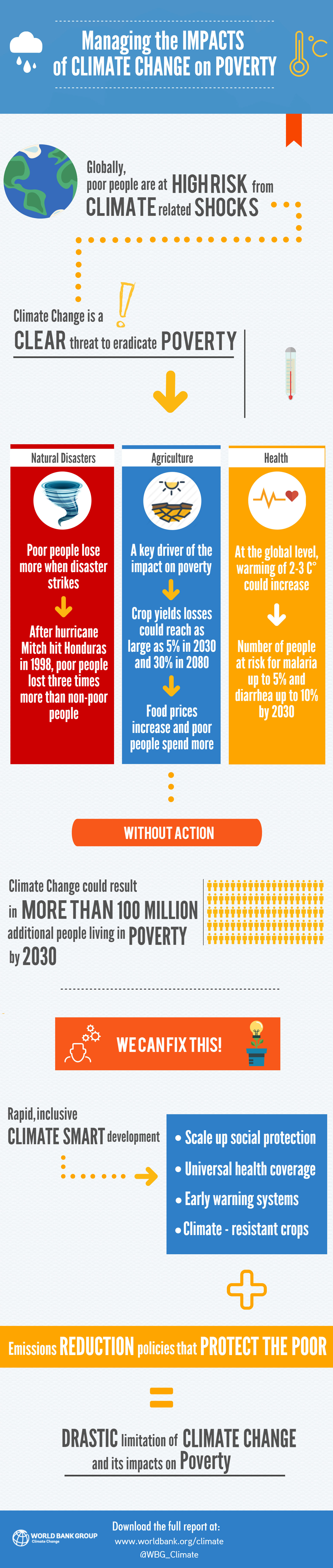
Climate impacts will affect agriculture the most, a key sector in the poorest countries and major source of income, food security, nutrition, jobs, livelihoods and export earnings. By 2030, crop yield losses could mean that food prices would be 12 percent higher on average in Sub-Saharan Africa. The strain on poor households, who spend as much as 60 percent of their income on food, could be acute. The resulting malnutrition could lead to an increase in severe stunting in Africa of 23 percent.
At the global level, warming of 2-3°C could increase the number of people at risk for malaria by up to 5 percent, or more than 150 million more people affected. Diarrhea would be more prevalent, and increased water scarcity would have an effect on water quality and hygiene.
The result would be an estimated 48,000 additional deaths among children under the age of 15 resulting from diarrheal illness by 2030.
To prevent this grim picture becoming reality, the report prescribes “good” development that is rapid, inclusive and climate-informed. This includes continuing and expanding programs that reduce poverty while increasing people’s capacity to prepare for and cope with shocks. For instance, in Kenya, the Hunger Safety Net Program prevented a five percent increase in poverty among beneficiaries following the 2011 drought.
These efforts will need to be coupled with targeted climate adaptation measures, such as protective infrastructure like dikes and drainage systems and mangrove restoration to deal with flooding, changing land-use regulations to account for sea level rise, disaster preparedness, and introduction of climate-resistant crops and livestock breeds.
In Uganda, the combination of new crop varieties and extension visits increased household agricultural income by 16 percent.
The report looks at different scenarios to 2030 and finds without good development more than 100 million additional people would be living in poverty. In India alone, an additional 45 million people could be pushed back over the poverty line by 2030, primarily due to agricultural shocks and increased incidence of disease.
“The report demonstrates that ending poverty and fighting climate change cannot be done in isolation – the two will be much more easily achieved if they are addressed together,” said Stephane Hallegatte, a senior economist at the World Bank who led the team that prepared the report. “And between now and 2030, good, climate-informed development gives us the best chance we have of warding off increases in poverty due to climate change.”
In the longer term, only immediate and continued efforts to reduce global emissions will save poor people from climate impacts, according to the report. To be successful, governments should design mitigation policies so that they protect, and even benefit, poor people. And action can be taken to reduce the burden of policies that would impose new costs – such as by strengthening social protection and assistance, or using cash transfers.
One analysis of 20 developing countries showed that collecting and redistributing energy taxes would benefit poor people despite higher energy prices, with the bottom 20 percent of the population experiencing a net $13 gain for each $100 of additional tax. Well-designed emissions-reductions programs that strengthen the productivity of agriculture and protect ecosystems could benefit 20-50 million low-income households by 2030 through payments for ecosystem services.
The report argues that in the poorest countries, domestic resources may be insufficient to put in place such measures, and international support will be essential. This is particularly true for investments that involve high immediate costs but are urgently needed to prevent lock-ins into carbon-intensive patterns, such as for urban transport, energy infrastructure, or deforestation.
Shock Waves: Managing the Impacts of Climate Change on Poverty differs from previous efforts by looking at the poverty impacts of climate change at the household level, rather than at the level of national economies. The report combines the findings from household surveys in 92 countries that describe demographic structures and income sources with the most recent modeling results on the impacts of climate change on agriculture productivity and food prices, natural hazards such as heat waves, flood and drought, and climate-sensitive diseases and other health consequences.
Funding for the report came from the Global Facility for Disaster Reduction and Recovery (GFDRR) and the UK’s Department for International Development (DFID).
Apple Launches New Clean Energy Programs in China To Promote Low-Carbon Manufacturing and Green Growth
BEIJING — Apple® today announced two new programs aimed at reducing the carbon footprint of its manufacturing partners in China. The programs will avoid over 20 million metric tons of greenhouse gas pollution in the country between now and 2020, equivalent to taking nearly 4 million passenger vehicles off the road for one year.
Apple also announced that construction on 40 megawatts of solar projects in the Sichuan Province is now complete. These solar installations produce more than the total amount of electricity used by Apple’s offices and retail stores in China, making Apple’s operations carbon neutral in China.
“Climate change is one of the great challenges of our time, and the time for action is now,” said Tim Cook, Apple’s CEO. “The transition to a new green economy requires innovation, ambition and purpose. We believe passionately in leaving the world better than we found it and hope that many other suppliers, partners and other companies join us in this important effort.”
First, Apple is significantly expanding its clean-energy investments in China. Apple plans to build more than 200 megawatts of solar projects in the northern, eastern and southern grid regions of China, which will produce the equivalent of the energy used by more by than 265,000 Chinese homes in a year and will begin to offset the energy used in Apple’s supply chain.
Second, Apple is launching a new initiative to drive its manufacturing partners to become more energy efficient and to use clean energy for their manufacturing operations. Apple will partner with suppliers in China to install more than 2 gigawatts of new clean energy in the coming years.
Apple also will share best practices in procuring clean energy and building high-quality renewable energy projects, and provide hands-on assistance to some suppliers in areas like energy efficiency audits, regulatory guidance and building strong partnerships to bring new clean energy projects to China.
As part of Apple’s industry-leading program, Foxconn will construct 400 megawatts of solar, starting in the Henan Province, by 2018. Foxconn has committed to generate as much clean energy as its Zhengzhou factory consumes in final production of iPhone.
“We are excited to embark on this initiative with Apple. Our companies share a vision for driving sustainability and I hope that this renewable energy project will serve as a catalyst for continued efforts to promote a greener ecosystem in our industry and beyond,” said Terry Gou, founder and CEO of Foxconn Technology Group. “Sustainability is a core pillar in Foxconn’s strategy and we are committed to investing in green manufacturing.”
“Being responsible, protecting air and water, and driving clean energy are at the heart of Apple’s commitment to China,” said Lisa Jackson, Apple’s vice president of Environment, Policy and Social Initiatives. “These projects go beyond Apple’s operations in China to help our suppliers adopt clean renewable energy.”
Apple has taken significant steps to protect the environment by transitioning from fossil fuels to clean energy. Today the company is powering 100 percent of its operations in China and the US, and more than 87 percent of its worldwide operations, with renewable energy.
Learn more about Apple’s environmental efforts at www.apple.com/environment.
Apple in China
Apple operates 19 corporate offices and 24 retail stores in Greater China, directly employing 10,000 people. In total, Apple has helped create and support over 4.4 million jobs in China, including at least 1.4 million iOS app developer jobs and other positions related to the iOS ecosystem.
Developers in China have earned more than $4 billion through the worldwide sale of apps on the App Store®, with over half of that amount paid in the last 12 months alone.
Apple revolutionized personal technology with the introduction of the Macintosh in 1984. Today, Apple leads the world in innovation with iPhone, iPad, the Mac and Apple Watch. Apple’s three software platforms — iOS, OS X and watchOS — provide seamless experiences across all Apple devices and empower people with breakthrough services including the App Store, Apple Music, Apple Pay and iCloud. Apple’s 100,000 employees are dedicated to making the best products on earth, and to leaving the world better than we found it.
NASA Mission Reveals Speed of Solar Wind Stripping Martian Atmosphere
NASA’s Mars Atmosphere and Volatile Evolution (MAVEN) mission has identified the process that appears to have played a key role in the transition of the Martian climate from an early, warm and wet environment that might have supported surface life to the cold, arid planet Mars is today.
MAVEN data have enabled researchers to determine the rate at which the Martian atmosphere currently is losing gas to space via stripping by the solar wind. The findings reveal that the erosion of Mars’ atmosphere increases significantly during solar storms. The scientific results from the mission appear in the Nov. 5 issues of the journals Science and Geophysical Research Letters.
“Mars appears to have had a thick atmosphere warm enough to support liquid water which is a key ingredient and medium for life as we currently know it,” said John Grunsfeld, astronaut and associate administrator for the NASA Science Mission Directorate in Washington. “Understanding what happened to the Mars atmosphere will inform our knowledge of the dynamics and evolution of any planetary atmosphere. Learning what can cause changes to a planet’s environment from one that could host microbes at the surface to one that doesn’t is important to know, and is a key question that is being addressed in NASA’s journey to Mars.”
MAVEN measurements indicate that the solar wind strips away gas at a rate of about 100 grams (equivalent to roughly 1/4 pound) every second. "Like the theft of a few coins from a cash register every day, the loss becomes significant over time," said Bruce Jakosky, MAVEN principal investigator at the University of Colorado, Boulder. "We've seen that the atmospheric erosion increases significantly during solar storms, so we think the loss rate was much higher billions of years ago when the sun was young and more active.”
In addition, a series of dramatic solar storms hit Mars’ atmosphere in March 2015, and MAVEN found that the loss was accelerated. The combination of greater loss rates and increased solar storms in the past suggests that loss of atmosphere to space was likely a major process in changing the Martian climate.
The solar wind is a stream of particles, mainly protons and electrons, flowing from the sun's atmosphere at a speed of about one million miles per hour. The magnetic field carried by the solar wind as it flows past Mars can generate an electric field, much as a turbine on Earth can be used to generate electricity. This electric field accelerates electrically charged gas atoms, called ions, in Mars’ upper atmosphere and shoots them into space.
MAVEN has been examining how solar wind and ultraviolet light strip gas from of the top of the planet's atmosphere. New results indicate that the loss is experienced in three different regions of the Red Planet: down the "tail," where the solar wind flows behind Mars, above the Martian poles in a "polar plume," and from an extended cloud of gas surrounding Mars. The science team determined that almost 75 percent of the escaping ions come from the tail region, and nearly 25 percent are from the plume region, with just a minor contribution from the extended cloud.
Ancient regions on Mars bear signs of abundant water – such as features resembling valleys carved by rivers and mineral deposits that only form in the presence of liquid water. These features have led scientists to think that billions of years ago, the atmosphere of Mars was much denser and warm enough to form rivers, lakes and perhaps even oceans of liquid water.
Recently, researchers using NASA's Mars Reconnaissance Orbiter observed the seasonal appearance of hydrated salts indicating briny liquid water on Mars. However, the current Martian atmosphere is far too cold and thin to support long-lived or extensive amounts of liquid water on the planet's surface.
"Solar-wind erosion is an important mechanism for atmospheric loss, and was important enough to account for significant change in the Martian climate,” said Joe Grebowsky, MAVEN project scientist from NASA’s Goddard Space Flight Center in Greenbelt, Maryland. “MAVEN also is studying other loss processes -- such as loss due to impact of ions or escape of hydrogen atoms -- and these will only increase the importance of atmospheric escape.”
The goal of NASA's MAVEN mission, launched to Mars in November 2013, is to determine how much of the planet's atmosphere and water have been lost to space. It is the first such mission devoted to understanding how the sun might have influenced atmospheric changes on the Red Planet. MAVEN has been operating at Mars for just over a year and will complete its primary science mission on Nov. 16.
DuPont and Caribou Biosciences Announce Strategic Alliance
WILMINGTON, Del, – Today, DuPont and Caribou Biosciences, a leading developer of CRISPR-Cas technologies for genome editing, jointly announced a strategic alliance. As part of the agreement, DuPont and Caribou have cross-licensed their respective patent portfolios, with DuPont receiving exclusive intellectual property rights for CRISPR-Cas technology applications in major row crops, and non-exclusive rights in other agricultural and industrial bioscience applications.
In addition, the alliance between DuPont and Caribou involves a multi-year research collaboration with scientists from the two organizations focused on enhancing the breadth, versatility and efficiency of the core CRISPR-Cas toolkit. DuPont also has made a minority equity investment in Caribou to further strengthen the working relationship.
“DuPont intends to lead in the application of CRISPR-Cas technology to improve agricultural productivity and enhance food security. Our alliance with Caribou is now at the forefront of this emerging science and will speed our development of this important platform to create long-term value for our company and our customers,” said James C. Borel, executive vice president, DuPont. “Specifically, we believe CRISPR-Cas has significant potential to advance plant breeding and expand the range of agricultural solutions available to farmers. We look forward to bringing related products to market in the next five to 10 years.”
CRISPR-Cas technology is capable of making exact changes to the DNA of most organisms. In plants, this editing capability can be applied to promote drought tolerance and disease resistance to protect plant health and increase crop yields. It also can provide direct consumer benefits like the removal of food allergens and the improvement of the nutrient composition of plant-derived oils.
“We are delighted to work with DuPont on what we believe will be a truly groundbreaking collaboration,” said Rachel Haurwitz, Ph.D., president and chief executive officer and co-founder of Caribou Biosciences. “DuPont has been responsible for numerous breakthroughs in CRISPR biology and we are excited to gain access to their impressive knowledge and expertise in developing and applying Cas-mediated genome editing technologies in promising commercial areas. This initiative will serve as a vital accelerator to our advancement of new applications for CRISPR-Cas gene editing that will help bring the tremendous promise this technology holds for patients and consumers to reality.”
Financial details of the agreement were not disclosed.
This most recent license and collaboration agreement completed by DuPont represents a cornerstone of its strategy as an early adopter and leader in the CRISPR-Cas field. It complements DuPont’s own estate of related patent applications, and adds to the previously announced licensing and collaboration agreements with Vilnius University.
CRISPR (Clustered Regularly Interspaced Short Palindromic Repeats) is a feature naturally existing in bacteria providing protection against viruses. DuPont scientists were among the first to understand how the CRISPR system works in bacteria. CRISPR-Cas (CRISPR associated proteins) is one of several CRISPR-derived tools and differs from the natural CRISPR process used to identify and immunize bacteria. The DuPont patent portfolio comprises more than 60 patents and patent applications related to the use of CRISPR for bacteria identification and immunization. It also comprises multiple patent applications related to the CRISPR-Cas genome editing technology.
DuPont (NYSE: DD) has been bringing world-class science and engineering to the global marketplace in the form of innovative products, materials, and services since 1802. The company believes that by collaborating with customers, governments, NGOs, and thought leaders, we can help find solutions to such global challenges as providing enough healthy food for people everywhere, decreasing dependence on fossil fuels, and protecting life and the environment. For additional information about DuPont and its commitment to inclusive innovation, please visit www.dupont.com.